
As I scroll through my social media feed, I find myself ignoring the very advice I regularly give others: never read the comments! Beneath posts about recent antisemitic attacks in the UK and Belgium, I see hundreds of users claiming that they’re “false flags” or that Jews are “playing the victim again.” These reactions reveal a deep confusion about how antisemitism works and who it serves.
Last year, I spent months delving into how antisemitism is talked about and perceived across Europe, and found a critical gap in our collective analysis. There is often a lack of understanding that antisemitism is undeniably real and affects Jewish people in material ways. And it is simultaneously used by political leaders like Keir Starmer and others as a tool to consolidate power that harms all racialised communities. Both of these truths can coexist, but we often struggle to hold them together.
Antisemitism throughout Europe, and in Belgium where I live these days after spending over a decade in the UK, often appears through conspiracies of Jewish power. I have been told that “Jews control the media” or that Jews are just too clever, manipulative, well-connected, or wealthy. In some cases, physical violence, threats or harassment, whether in person or online, are also involved.
While keeping this reality in mind, we still need a much stronger analysis of how antisemitism serves certain political interests. It is used to shift attention away from the ruling class and onto a fabricated Jewish “cabal” supposedly operating secretly behind the scenes, when in fact, it’s all out in the open for us to see. Jews are an easy scapegoat to hide those actually responsible.
This is where neoliberal capitalism has led us: small groups of people amassing extreme amounts of wealth and buying democracies, while our social security systems are decimated by politicians who are no longer accountable to people but to corporations.
I experienced how this dynamic operates firsthand when I recently sat down with a plumber in my flat for an hour over a strong coffee, listening to his very real anger about the exploitation he faced. He told me that a small group of Jews controlled the “global financial system,” and that they were the cause of all of this.
I told him his anger was legitimate, but his target was wrong: this story was about capitalism, about elected politicians making intentional decisions that led us here, not about “those” Jews manipulating the global financial system. I tried to explain to him that we live in a system that allows a few people amass wealth while the majority are left to struggle, and that there are specific elected people that we can name that are propping it up. I’m still not sure how it landed with him, but after our coffee he refused to let me pay for his labour.
The myth of the “imported” threat
Throughout my research, I found that antisemitism was often described as an ancient, permanent hatred. Sometimes portrayed as a ghost, a demon, or even a virus, right-wing and Zionist politicians and groups depict it as almost having a life of its own: a personified evil, rather than a tool or a set of conspiracies that has evolved over time.
This framing is politically convenient, because if antisemitism is a natural disaster or a supernatural phenomenon, then it is disconnected from human action and dismantling it feels like an impossible task.
I also found that ruling parties on the centre and far right commonly frame antisemitism as an external threat which is imported to Europe. Never mind that antisemitism is in fact a very homegrown product, with deep roots in Christianity and Europe going centuries back. If we look at European history we can find accusations of blood libel, ritual murder, pogroms, and of course the Holocaust: antisemitism has always been a crucial part of the fabric of European nation-building.
It’s always been the preferred tool of the day used by kings and dictators. To frame it as “imported” erases centuries of European complicity and guilt. As Aimé Cesaire insightfully points out, the Nazi genocide against Jews is but European colonialism turned inward.
Politicians today cynically use the so-called protection of Jews from migrants (the supposed external source of antisemitism) to justify specific policies that align with their racist and anti-migrant agendas. This is a calculated strategy to deflect, divide and build support for further securitization. By framing antisemitism as an ‘imported’ virus brought in by migrants, they can bypass the fact that antisemitism is deeply rooted in European history.
A concrete example is visible in the UK, where the ‘Prevent‘ strategy and public order bills have been consolidated under the guise of protecting Jews from ‘foreign’ extremism, with the state increasing surveillance on Muslim communities and criminalising protest. In these cases, ‘protecting’ Jews is not the end goal, but instead a useful narrative to legitimise stricter borders, militarised policing, and the suppression of dissent. The ultimate agenda is not to protect Jews, but to secure power. These policies don’t actually keep Jews safe at all. In fact, they make us all less safe, with increased surveillance, militarised policing, and more fear to justify it all.
Antisemitism as a smokescreen: quashing dissent on Gaza
This framing also includes portraying antisemitism as primarily originating from Palestine solidarity movements and allows ruling parties in Europe to deflect from their own role in using tax payers’ money to sustain the genocide in Gaza.
Again, antisemitism is a useful tool in crushing dissent: criminalising movements and people that are inconvenient to particular established interests. When politicians face criticism for sustaining genocide in Gaza, they can simply pivot to “combating antisemitism” to distract and divide. By claiming that protesters are in fact hiding behind anti-Zionism in order to attack Jews, they try to de-legitimise the entire movement that threatens their imperialist agenda.
We see this tactic used in the UK where Palestine solidarity groups are criminalised, activists are incarcerated and protesters attacked under the guise of public order and national security, or in Germany where BDS is policed as an extremist (external) threat to the state. All of this unfortunately results in a perceived hierarchy of racism where Jews are presented by ruling parties as a “model minority” and Muslims as an external other.
This further justifies programmes such as Prevent that target Muslims, while claiming to protect Jews. We end up divided and separated from our natural allies. Our potential resistance and solidarity is weakened as we’re pitted against each other.
Conditional protection and the “wrong kind” of Jew
The right acts as if they are the defenders of Jews, swiftly protecting us from other racialised groups, while simultaneously undermining any Jew who doesn’t fit their Zionist imperialist agenda. We see this conditional protection everywhere: from false accusations of antisemitism and blatantly antisemitic cartoons of Zack Polanski published in The Times recently, to the EU where Katharina von Schnurbein, the Coordinator on combatting Antisemitism, refuses to include non-Zionist Jews and lobbies directly in support of Israel.
In these cases, if a Jewish person fails to align with this political agenda, they are excluded, ignored or even taken down by accusations of antisemitism. The IHRA declaration is wielded not to protect us, but to shut down dissent and protests against a genocidal regime funded and sustained by European governments.
Antisemitism as a tool of the far right
Understanding this dynamic properly requires locating where antisemitism is actually rooted. Antisemitism does not emerge evenly across the political spectrum. Historically and empirically, it is deeply rooted on the extreme right, where it acts as a smokescreen and a machinery of division and fear used for specific material or political gain.

Join our mailing list
Sign up for shado's picks of the week! Dropping in your inbox every Friday, we share news from inside shado + out, plus job listings, event recommendations and actions ✊
Sign up for shado's picks of the week! Dropping in your inbox every Friday, we share news from inside shado + out, plus job listings, event recommendations and actions ✊

By redirecting anger away from systems of exploitation and toward Jews, antisemitism serves as a tool for scapegoating and power consolidation, especially during periods of socio-economic crisis like the present. Acknowledging this does not excuse antisemitism when it appears elsewhere, but failing to locate antisemitism accurately risks misunderstanding both its causes and its function.
Leftist and anti-capitalist frameworks, by contrast, can offer us clear analytical tools to understand power, exploitation, and inequality rather than relying on ethnic or religious scapegoating. Leftist frameworks offer the possibility of collective struggle rather than division, while identifying those who hoard resources, exploit workers, pit us against each other, and control the tools of state violence as the correct targets of our anger.
People on the left, just like anyone else, are of course not immune to antisemitism; but when it appears, it is more often the result of political blind spots, insufficient historical understanding, or weak analytical tools than a deliberate strategy of divide and rule.
Unfortunately, even those committed to anti-capitalist or anti-imperialist struggles can sometimes fall into the trap of substituting rigorous analysis with lazy, antisemitic conspiracies. This is also a dynamic I’ve seen play out in the social media comments I mentioned above: authors positioning themselves as anti-imperialist, yet repeating the same antisemitic conspiracies that distract us from the real culprits.
Fear of feeding into right-wing narratives regarding antisemitism also often creates immobilisation on the left, leading to silence. This is itself a result of divisive tactics that frame Jewish safety as in tension with the safety of other communities. No such tension should exist: Jewish liberation is an intricate part of the antiracist struggle. The only way forward to effectively challenge antisemitism is through an antiracist, solidarity-based approach that strengthens safety and freedom for everyone.
Reclaiming the narrative: moving away from vertical to horizontal alliances
Although there is constant and unceasing noise about antisemitism and Jews coming from the far right, we cannot let the right claim this topic. When we do, we allow it to dominate how antisemitism is defined, dividing us and shaping public perception in support of securitisation, border enforcement, and policing of social movements. To reclaim the struggle against antisemitism, we must reclaim it as part of our broader antiracist struggle; as one form of racism among others, intertwined with all forms of racism and domination.
As Jews, we must urgently move away from vertical alliances: relying on the state and its machinery of violence to keep us safe. Instead, we should build horizontal and intentional broad based alliances between Jews, Palestinians, Muslims, migrants, working-class people, and other racialised and oppressed groups, resisting the politics of division and scapegoating. Safety comes from collective liberation, not conditional state protection.
Dismantling antisemitism is not only about Jews; it is about regaining our power to build a mass movement against fascism that cannot be easily divided. We must understand and combat antisemitism because Jewish people, like all others, deserve to be safe and free. By pairing this understanding with a clear analysis of capitalism and power that doesn’t rely on conspiracies, we can effectively defang the right’s disinformation campaigns, claw back the narrative, and inoculate the public against authoritarian strategies. The sooner we see the smokescreen for what it is, the sooner we can make change and build the liberatory future we all deserve.
What can you do?
- Read To Defeat Antisemitism, We Must Defeat Capitalism
- Read this explainer on The European far right and ‘imported antisemitism’
- Check out this zine: Demand NO IHRA
- Read The Past Didn’t Go Anywhere by Antidote Zine
- Watch Colors of Jews: Racial Politics and Radical Diasporism – Remembering Melanie Kaye/Kantrowitz
- Listen to Talking About Antisemitism
- Read: What is Settler Colonialism?
- Read: What is Zionism?
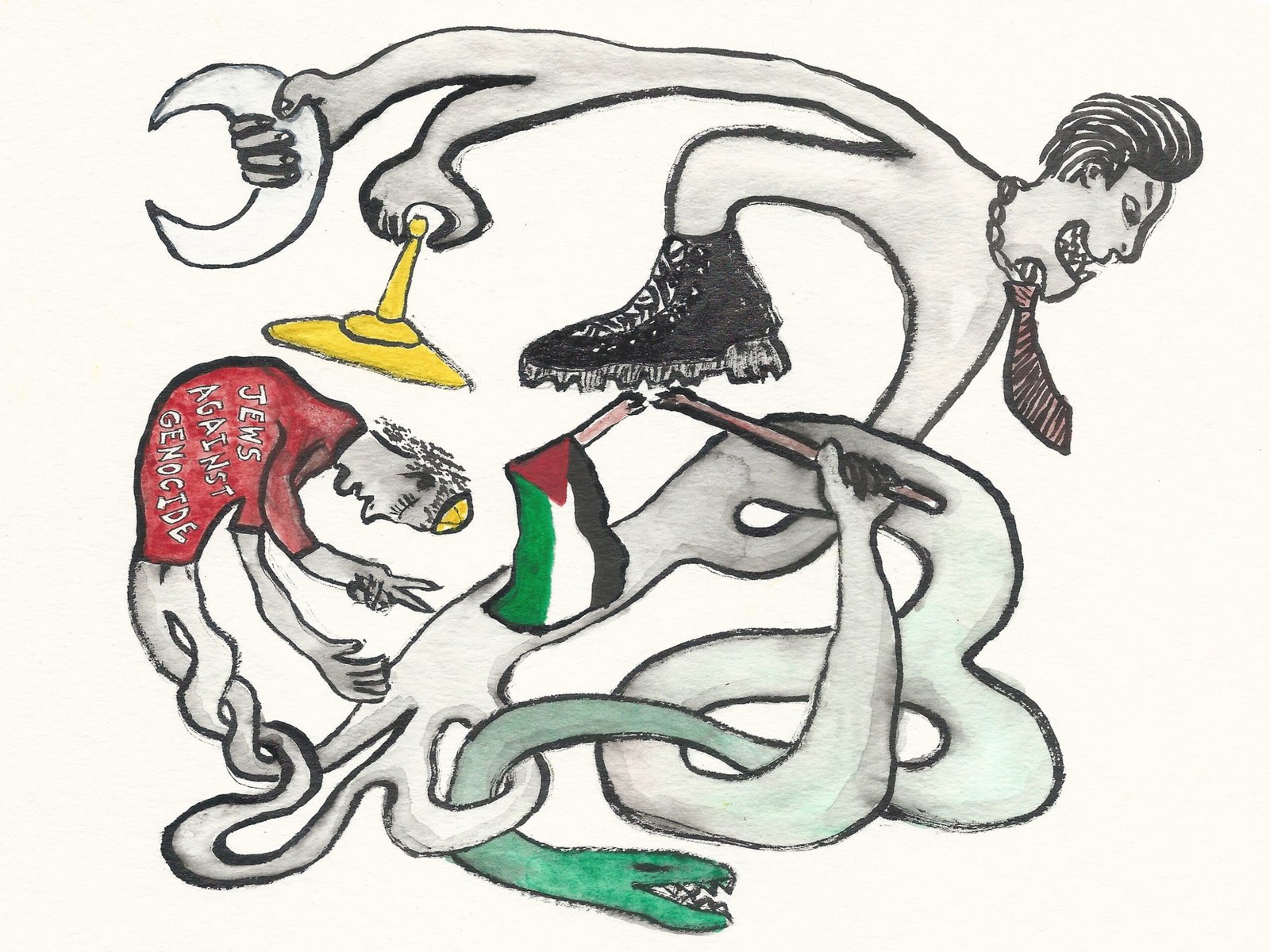
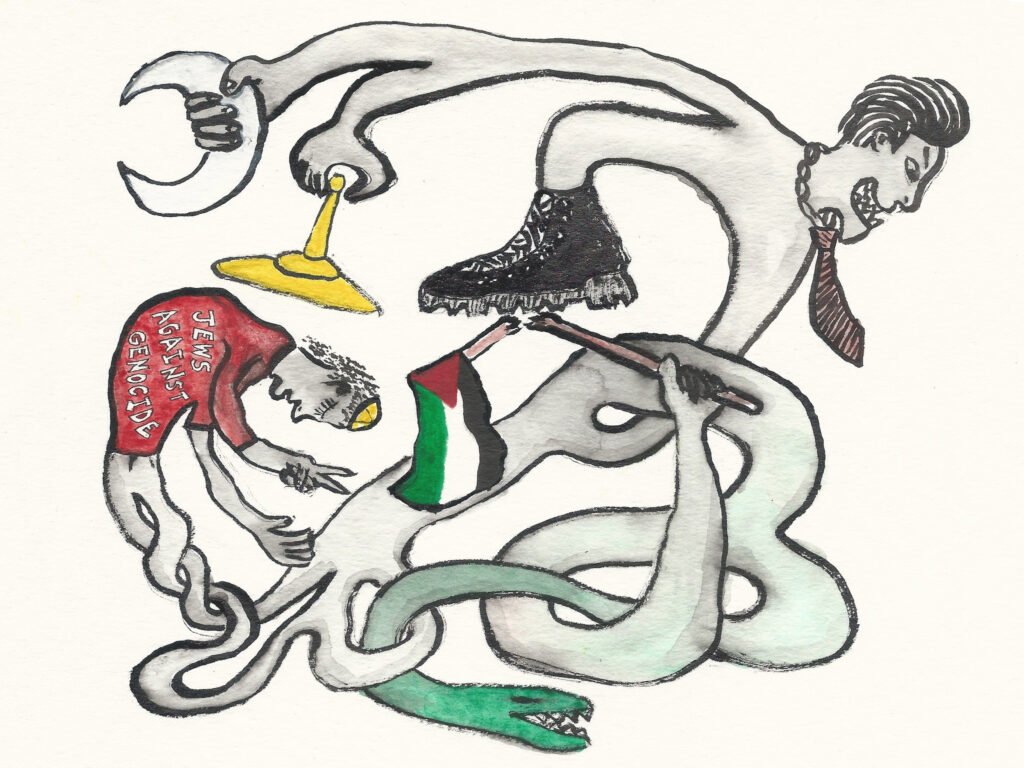 Illustration by @yesyesbernstein who says: “This drawing depicts an entangled mess of oppression. The character on the right is a brutal fascist wearing a necktie chain, hiding behind a veneer of respectability. He is crushing the solidarity movement for Palestine; gripping the moon, a symbol for Islam, and pressing a judenhut into an Anti-Zionist Jew. Judenhuts were hats that Jews were required to wear in medieval Europe by Christian dominant societies.”