
One evening in late 2024, the team behind Refuge Worldwide published a message they had hoped never to write. After years of building one of Berlin’s most beloved community radio platforms, the station was facing a financial crisis. Funding had fallen through, costs were rising, and the future of the space was suddenly uncertain. Within hours, their crowdfunding campaign was circulating across the city’s music networks, shared by DJs, listeners and artists in group chats and Instagram stories. Donations began pouring in from across Berlin and beyond.
But the speed and scale of the response to Refuge’s fundraiser also pointed to something more fragile: how quickly even well-established grassroots institutions can tip into crisis. What appeared, briefly, like collective relief was also a glimpse into how precarious these spaces have become under conditions of shrinking cultural support and rising costs.
Beyond Refuge, other stations such as Cashmere Radio and THF Radio remain vital platforms for artists, DJs and organisers across the city. Combining broadcasting with workshops, programming and educational initiatives, these hybrid spaces operate as more than online radio; they function as part of Berlin’s cultural infrastructure. But that infrastructure is increasingly under threat.
The ugly reality of austerity is an oozing wound at the heart of Berlin’s creative scene. Having worked in community radio for over three years, I’ve seen first-hand the care, labour and emotional investment that keep these spaces alive. In an industry overwhelmed by the soulless churn of algorithmic noise, community radio remains authentic, honest and vital.
To understand what is at stake, I travelled across Berlin to visit some of the city’s stations and speak with the people behind the DIY airwaves, the organisers, hosts and cultural workers fighting to keep them alive.
The making of the airwaves
Community radio in Germany emerged from the “Freies Radio” movement of the 1980s, shaped by pirate broadcasting and grassroots media activism across Europe. These stations challenged the dominance of public and commercial broadcasters by giving airtime to marginalised voices, political groups and independent cultural scenes.
After German reunification in 1990, Berlin’s media landscape opened up further. Projects like Radio Multikulti and Alex Berlin experimented with multilingual programming and open-access broadcasting. Many, however, relied heavily on public funding and struggled under political and financial pressure. When Radio Multikulti closed in 2008, it was widely seen as a warning sign of shrinking space for community media.
In the 2010s, a new generation of internet-based stations emerged across Berlin, broadcasting from record shops, cultural centres and club-adjacent venues. Closely tied to the city’s nightlife and music scenes, they created new forms of cultural infrastructure that operated outside traditional broadcasting hierarchies, platforming voices and sounds that might otherwise go unheard. But the conditions sustaining these spaces remained fragile.
A scene under pressure
In late 2024, Berlin’s government approved sweeping cuts to the city’s cultural budget, removing roughly €130 million from arts funding as part of a wider austerity drive to address a multi-billion-euro deficit. While major institutions were partially shielded, the independent sector, including artist-run spaces, small venues and grassroots initiatives, absorbed the impact. For community radio stations, which rely on grants, volunteer labour and affordable space, the effects were immediate.
There’s a crude irony in the fact that the platforms fostering the most creativity, the ones that encourage artistic freedom and originality, are among the first to be pushed out. Community radio stations are the kinds of spaces that make Berlin feel like Berlin: multicultural, vibrant, and alive, are being forced to pack their bags, while towering corporate office blocks continue to thrive unchecked.
For a city quite literally built on its underground scene, on repurposed bunkers and raw, alternative spaces that still hold up its cultural identity, it feels laughably cruel. The very foundations that gave Berlin its character are being erased in favour of sterile expansion. So we keep building upwards, while denying the roots that made the city worth building in the first place.
Refuge Worldwide responded to the cuts by launching a GoFundMe campaign. Announcing the fundraiser, the team wrote: “While considering our options and the current climate in Germany, we have decided that we have little choice but to launch a crowdfunder in order to support the station’s projects and stay on air. From Neukölln to the world, we aren’t going quietly just yet.”
I met with Adam Cooke, the station’s Venue Assistant Manager, to talk about the campaign. Adam describes the move as something that was both pressing and strategic: “The campaign was the fastest way to bring in funds after losing support,” he tells me. “But it also mobilised the community and increased transparency about the costs of running the station.”
The fundraiser hit its target, but it wasn’t enough to maintain the status quo. The station was forced to consolidate into a single space; running two venues had become unsustainable. “Losing funding removed a key safety net that previously allowed the organisation to support marginalised communities without asking for financial return,” Adam says. “Now we’re operating in survival mode, trying to keep the space open while continuing to serve the community.”
That survival comes at a cost. The station’s current model, he explains, is both mentally and operationally demanding, locking the team into a cycle of constant project-building and collaboration. They are required to plug funding gaps while relying on partners with equally limited resources. While Refuge Worldwide has never been driven by profit, sustaining its programming, studio access and educational work still depends on a baseline of financial stability.
The heart of community
Yet despite these structural pressures, the overwhelming response to Refuge Worldwide’s fundraiser showed just how deeply embedded these stations are in their communities. For many hosts and residents, community radio is far more than a studio.
“Community is a shared space where people contribute what they bring, rather than being asked for something in return,” Adam says. “Refuge has never been about profit: we are about people, stories, creating space, providing opportunities and amplifying voices.”
Talking to Adam reminded me not only of what drew me to community radio in the first place, but what kept me there for so many years, and why I still remain invested in its future and security today. Operating outside the logic of the robotic capitalist machine, community radio felt like something increasingly rare and sacred.
That ethos shapes the programming itself at Refuge. Shows are driven by the interests and perspectives of contributors, letting conversations, music and storytelling unfold in organic ways. For Refuge Worldwide host Ned Dillon, the station has become a space where different worlds intersect. “I’m careful about the ‘things were better before’ rhetoric,” he says. “But even in my three years in Berlin, I’ve seen how much harder it’s becoming for independent creative spaces to exist.”
Walking through Berlin now, that tension feels increasingly visible. Independent venues and community-led projects exist alongside cranes, luxury developments, and rapidly changing neighbourhoods, creating a city caught between preservation and commercialisation. The contradiction is difficult to ignore. Berlin continues to market itself through the image of its underground culture, while many of the spaces sustaining that identity struggle to survive.
Join our mailing list
Sign up for shado's picks of the week! Dropping in your inbox every Friday, we share news from inside shado + out, plus job listings, event recommendations and actions ✊
Sign up for shado's picks of the week! Dropping in your inbox every Friday, we share news from inside shado + out, plus job listings, event recommendations and actions ✊
The politics of culture
When Oona Bar – Refuge’s beloved first home, an in-studio bar and community space – closed its doors, something tangible was lost. Amid the bustling creative energy of Berlin’s iconic Weserstraße strip, Oona was a place where people gathered and spilled out onto the streets, while the buzz of live radio drifted through the space. It embodied everything community radio is meant to represent. More than just a physical studio, it was somewhere people came to share in-person experiences and conversations with one another.
Oona Bar was somewhere I often found myself, whether sitting with a coffee during friends’ live shows or sharing bottles of wine at Refuge summer parties. It felt worlds apart from the stereotypical dark, smoke-filled Berlin bar; instead, it was open, bright, and communal; a space that, for many, came to feel like a second home within the city.
The public response to Refuge’s call for help revealed just how invested the communities built around these stations are in their survival.
Berlin’s community radio exposes a simple but telling truth about the politics of culture. The city’s celebrated cultural identity rests on fragile, community-run infrastructures that receive little institutional protection. While major institutions are often shielded from cuts, grassroots platforms are left to endure, running largely on the goodwill of the communities they serve. Culture, in this sense, is not only about what gets funded, but about what is expected to survive without support.
Berlin’s reputation as a cultural capital has long depended on the energy of its underground scenes. As these come under strain, a stark reality emerges: culture is only as strong as the economic structures that sustain it. Yet, viewed through a broader lens, culture tells a different story, one shaped by care and kinship, a communal voice from those who make it.
I don’t know what the future holds for Berlin’s cultural scene, but one thing feels certain: we aren’t going down without a fight. Since the closure of Oona Bar, Refuge has moved to its Niemetzstraße headquarters, and the community continues to thrive. There is still a precarious undercurrent running beneath the surface, but the harder we fight for the spaces and communities we believe in, the quieter that fear becomes.
I won’t stop talking about community radio, and as long as we continue to carry it in our conversations, our spaces, and our hearts, it will continue to live on.
What can you do?
Listen
- Refuge’s ‘Goodbye Oona Bar’ Mix on Soundcloud
- Support and tune into Berlin’s independent radio ecosystem:
- Beyond Berlin, there are many other community-led stations which you can discover on Radio Garden – Berlin
Read
- Further reading on Berlin’s cultural funding crisis, austerity and independent media:
Books and essays:
Follow
Support
If you value community-led cultural infrastructure:
- Donate directly to independent stations when possible
- Attend fundraisers, workshops and local broadcasts
- Buy memberships or merch from grassroots platforms
- Share programming outside algorithmic feeds
- Advocate for long-term public funding for independent cultural spaces and media initiatives
- Sign up to Refuge’s newsletter
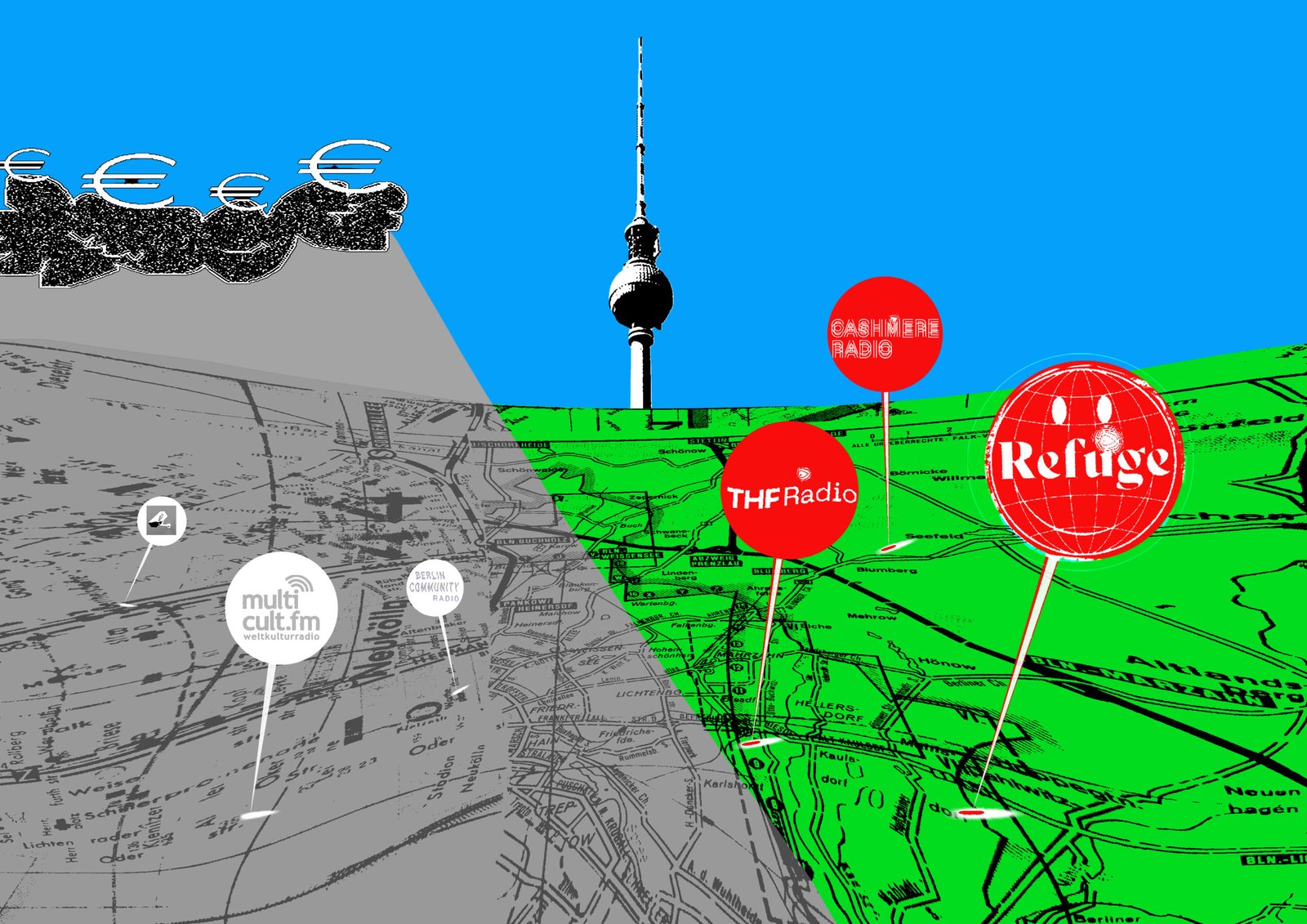
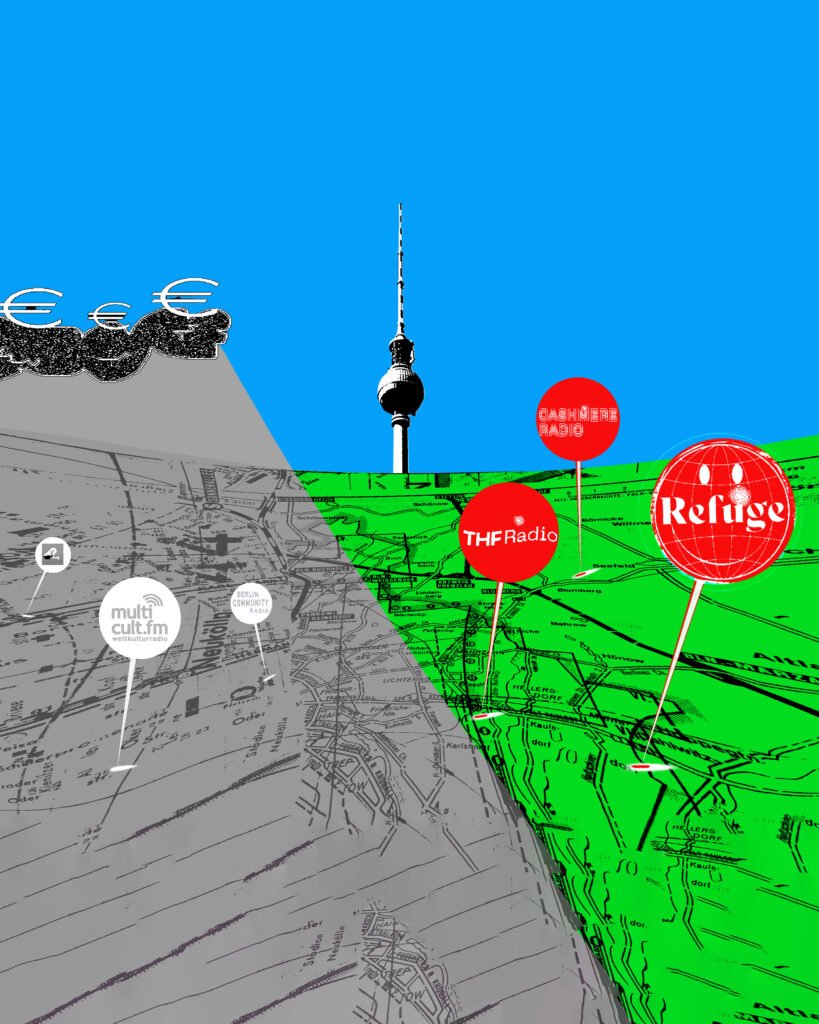 Illustration by @ahammyshutiris who says: “I wanted to show Berlin as a divided city. The threat of funding cuts looming in the form of ‘money clouds’, casting an austere grey shadow over an otherwise green and life-giving cultural landscape. The radio stations Alice speaks about are represented as pins across the map; those forced to close greyed out, those still alive and broadcasting in red.”