We’re in desperate need of an economics that liberates us from capitalism’s crises. The fact that for most people, economics as a discipline is synonymous with capitalism is evidence of this. As an economics lover, I view it as a tragedy that an entire discipline of knowledge and practice can be collapsed into a singular (and I’d argue worst) expression of itself.
This flattening is entirely an active choice by the stewards of economics. Economics as it is taught and practised prioritises methodological positivism, individualism, and market-driven solutions – grounded in desocialised, depoliticised, and dehistoricisised analyses.
Patricia Hill Collins writes that because elite white men control structures of knowledge, their interests pervade the themes, paradigms and epistemologies of traditional scholarship. This understanding of knowledge production points to how power relations shape what we understand as economics and how we practise economics. Simply put, economics as it is practised protects the interest of powerful white men. It is socially constructed.
As a community economist and educator, I believe that this reductive equation strips us of the agency to reclaim an economics that can protect the sacredness of life over markets. We need an economics which is shaped by us, an embodied economics which liberates; a joyful economics. Building this requires us to become skilful in new tools, because in a time of rampant capitalism, it is glaringly obvious that the master’s tools cannot dismantle the master’s house.
The Degrowth cabaret
Meeting Joaquín Pereira from The Chaga Collective feels like a divine gift on my ongoing quest to understand how we can liberate economics from capitalism’s grip and the plurality of tools we have available to us. They have spearheaded ‘The Degrowth Cabaret’, a space where artists and economists come together to design and perform a cabaret featuring performance, singing and comedy around the themes of Degrowth economics. The Degrowth Cabaret creates a vital space for connecting disciplines and creating new tools to express economic ideas through expressive and immersive ways.
Joaquín exudes a warmth and playfulness that is starkly different from what comes to mind when I think about economists, because, let’s face it, economists can be kind of dry. As both an economist and a dancer, Joaquín spent a lot of time keeping the seemingly opposing disciplines separate, but now finally through the DeGrowth Cabaret can say, “I’m now dancing my economics and not just economising my dance.”
Degrowth economics is a framework and social movement that is centred around infinite growth on a planet with finite resources. It rejects market economics’ insistence on perpetual growth and metrics like GDP, arguing that there is an urgent need to challenge this obsession in the face of the climate crisis. However, degrowth has been challenged for being a very global-north-centric economic framework in that it doesn’t speak to the root of colonial oppression that capitalism emerges from.
The Degrowth Cabaret was born out of a frustration with the lack of art and expression within the movement, something which was exemplified at the Degrowth Conference that Joaquín and his co-founder Anna Nordahl Carlsen attended in Spain in 2024.
Joaquín remembers the atmosphere, explaining the anger at having “to listen to white European academics talking about models and speaking from the whitewashed environmentalist perspective, forgetting the murders of climate activists taking place in the Global South.”
Feeling this atmosphere of hopelessness and rage, The Degrowth Cabaret became a space to transform these feelings into a creative mobilising force. “They were hungry for this! We had 300 people that came to the show,” exclaims Joaquín.
Cabaret as a translation device
For the Chaga Collective, degrowth is not just a framework; it is a political project and a personal practice that contests Europatriarchal knowledge systems and the hierarchies that dominate economics as a discipline. Degrowth looks like valuing knowledge from a plurality of sources and not just capitalist market economics. Looking at a plurality of ways to define and understand the economy as a set of relationships instead of quantitative metrics of value. For example, the Chaga Collective look to mushrooms as a source of inspiration, learning from the complex interdependent webs of mycelium relationships.
The Degrowth Cabaret reminds me of Audre Lorde’s The Uses of the Erotic, where she explores “how acutely and fully we can feel in the doing”. According to Lorde, the erotic is knowledge formed by creative energy that can be a tool to reclaim our languages, histories and lives from the clutches of neuropatriarchal intellectual rational knowledge by building bridges between the sensual, the emotional and the rational.
Similarly, the Degrowth Cabaret operates as a site of collective feeling and knowledge production. Through the process of making performances for the cabaret together, people from different disciplines, languages and lived experiences connect on economics in a way that isn’t discussing abstract models that feel removed from people but rehearses economic self-determination together. The Cabaret brings together artists, economists and activists to create songs, performances and immersive art to express degrowth principles.
Joaquín tells me, “We were bringing together diverse people in the hope of enabling them to understand each other.” The participants didn’t all speak the same language, but when creating the show together, Joaquín explains that degrowth economics was the unifier; “we are all speaking degrowth, and we find a way to do it and understand each other.” The Degrowth Cabaret becomes a translation device.
Repairing economic thought through multidisciplinary collaboration
The need for translation devices is evident in the inaccessibility of economic thought and practice, which are gatekept by institutions and separated from changemakers and communities.
One collective, Rethinking Economics, echoes this necessity of translation devices, arguing that the way that economics as a discipline is taught and practised doesn’t allow for an economics that is socially responsive to the complex crises confronting societies today. They argue that in order to effectively use economics to organise against capitalism, we need a pluralist approach that invites a multiplicity of voices, perspectives and ways of doing our economics.
The Chaga Collective invites us to think about the repair needed in multidisciplinary approaches to economics due to the prejudice that exists against artists. Economists have long looked down at artists, considering their knowledge production less than because it is not scientific. There is a need to value the work of feeling that art-making asks us to do, and as economists, in a discipline that reduces feeling into qualitative data, we can really struggle.
“The key word here is trust; we created trust because we were all brought together by a common joy”, muses Joaquín. The Degrowth Cabaret as a collective process encourages performers and audiences to unlearn these hierarchies in order to collaborate on a vision of an economy beyond the extractive economy.
For example, at the Degrowth Cabaret Tester Lab in London in January 2026, Anna noted that there were “recovering economists who were unlearning patterns” of efficiency and performance while having to learn about adaptability and patience through collaborating on the cabaret together. Through creating across disciplines and contesting hierarchies in knowledge production, economists were mobilised into experimenting with different tools to engage audiences with their research through speaking to artists, poets and activists.
Economics education
Black feminist author and thinker Minna Salami calls for knowledge that affects the “interior”, our relationship with our bodies, feelings, emotions, the senses, art, nature and poetry. This is especially prevalent given how existing within white supremacist capitalism is full of grief, rage and hopelessness.
Join our mailing list
Sign up for shado's picks of the week! Dropping in your inbox every Friday, we share news from inside shado + out, plus job listings, event recommendations and actions ✊
Sign up for shado's picks of the week! Dropping in your inbox every Friday, we share news from inside shado + out, plus job listings, event recommendations and actions ✊
Economic self-determination, I believe, begins with metabolising our lived experience together, affecting the interior and undoing the individualism, scarcity and competition mindsets that we are subjected to under capitalism in order to survive. In doing so, we build our capacity to imagine what nourishing economics can look like and feel like.
When designing political education workshops, for example, I ask myself, ‘How can I affect the interior?’ Instead of a million slides with graphs and numbers to highlight the impact of housing inequality on Black families, I’ll think about using creative tools to explore feelings of displacement, belonging and safety. I’ve found that people respond well to visual representations of economic ideas.
For example, Gargi Bhattacharyya invites us to imagine racial capitalism as a multi-storey house with lots of rooms, some full of comfort and some lacking in comfort, with people living in the house who rarely meet. This metaphor highlights how the movements are shaped by the place in which they find themselves, and who they see is defined by the geography of the house – and that’s how racial capitalism operates.
Inspired by this visual representation, I’ve led workshops where I ask participants to design the game Sims house to represent an interdependent economic system. I encourage them to think about how the rooms can be designed to foster solidarity, cooperation and joy. People often design spaces to be together, big kitchens to cook together, rooms to be creative, and huge comfy rooms for resting.
The joy of economics
Learning of The Degrowth Cabaret has had an undeniable transformative effect on my thinking about my own economic practice. As someone who’s inner artist is in eternal conflict with my conception of myself as an economist, Joaquín’s words move me towards bravery in breaking apart from these false dichotomies about my practice and trying out different translation devices.
The Degrowth Cabaret illustrates the need to liberate economics out of economic institutions and into communities and has started to map the kinds of tools we need to do this in order to facilitate economic self-determination.
“In a capitalist world that tries to take away our hope of a different world or a different future, Degrowth Cabaret gives me hope that I’m not stuck in a system but that other futures are possible,” says Joaquín. Through these words he reminds me of the plurality of anti-capitalist futures and the range of methods with which we have to realise them. Reminding us that “we can talk about economics if we can also dance our economics.”
What can you do?
Read:
-
- Read The Chaga Collective’s Guide to fermenting your own degrowth cabaret
- Attend a workshop by The Alternative School of Economics and create art
- Read “Manufacturing ‘Economics’ Minds: Ideology, Authority, and Economics Education” by Mohsen Javdani and Ha-Joon Chang
- Explore Take Back The Economy resources on pluralist economies
- Read Sensuous Knowledge: Minna Salami
- Read more articles by Noni
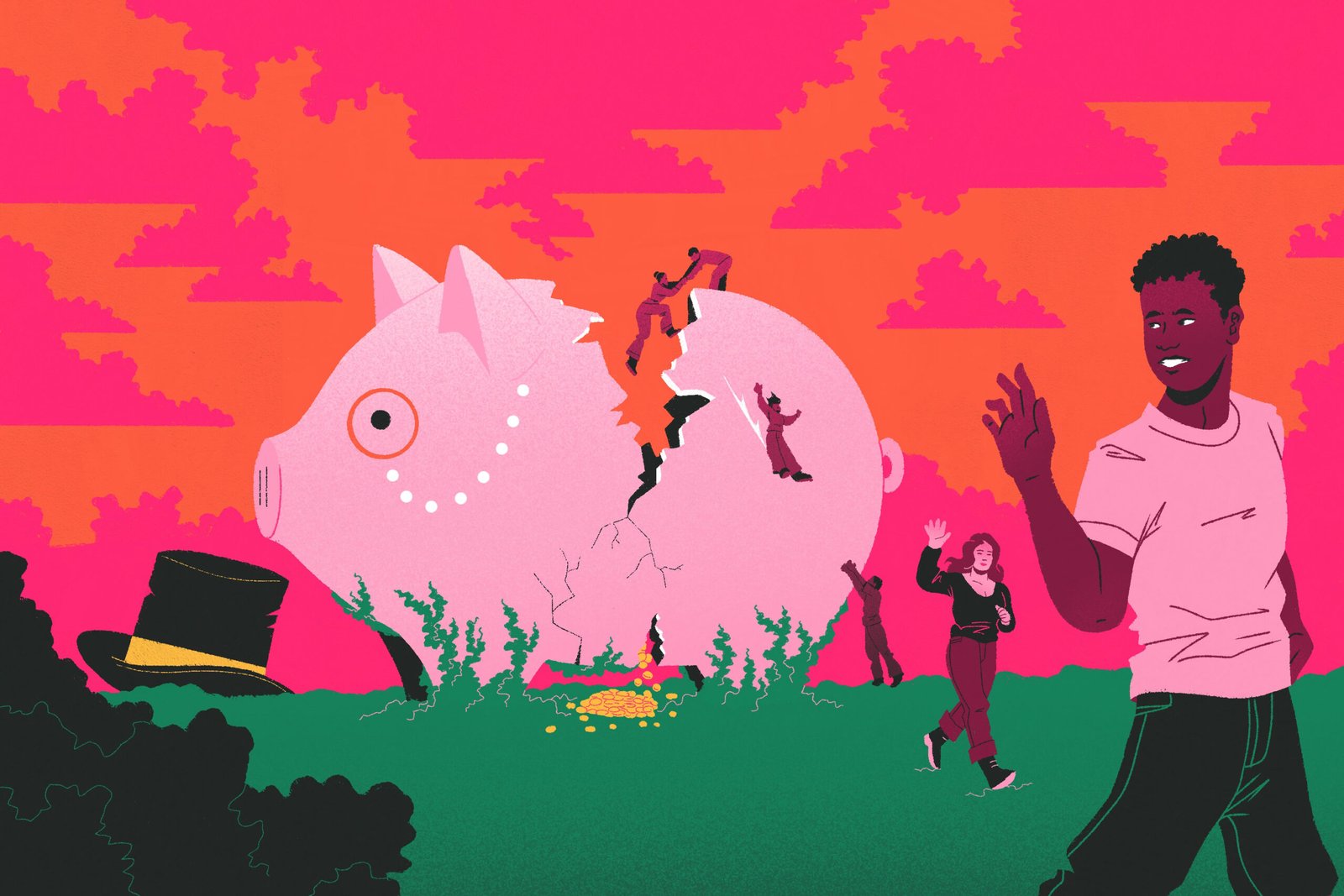
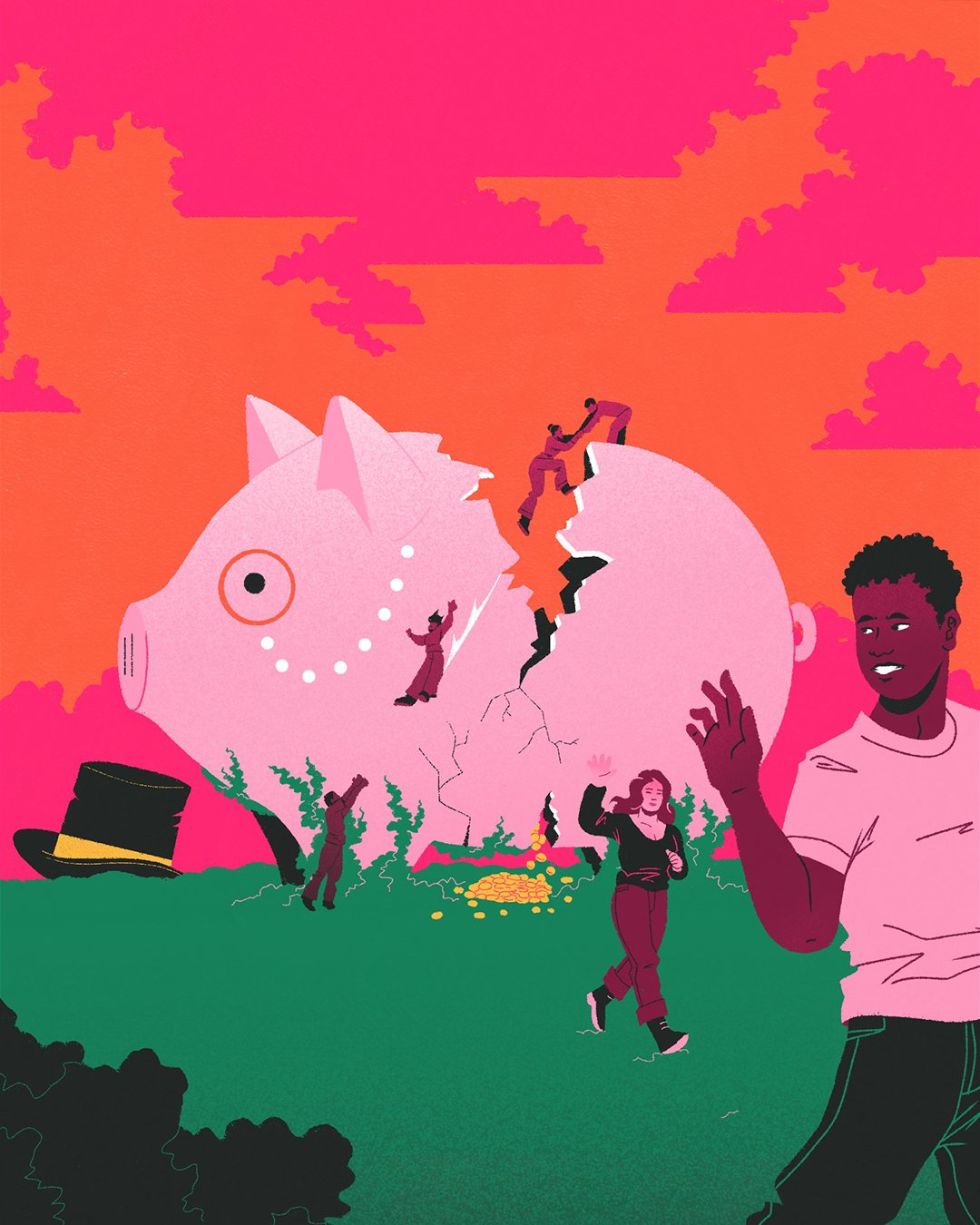 Illustration by Driss Chaoui @kalakal_klk who says, “A broken piggy bank stands, covered in moss and wearing stereotypical capitalist accessories. A pile of coins is pouring out of its belly, while people are helping each other crawl out of it, as a metaphor of escaping an outdated and broken economic system.”