It’s summer, which means everything is in a state of becoming. Limbs sprawling out of pubs. Tiny tops unearthed from drawers after the long winter. It’s a high growth season and even the friendships I thought were fixed and permanent start feeling newly alive this time of year.
As a queer writer and a prolific consumer of queer culture, I have been thinking a lot lately about the fag hag. Wikipedia describes the fag hag as a historically derogatory slang term first coined in the 1970s used to describe heterosexual women who seek the non-sexual company of gay men. It has historically been considered a double negative – that has somehow survived and become somewhat of a term of endearment. “[T]he fag hag exists on the fringes of an already marginalised life – that of her gay best friend,” writes author Shannon Luders-Manuel.
What if friendship is the great love story?
I can understand why fag hag is regarded as derogatory. It begins with a much-hated slur and then the latter part of the term arrives already sharpened. Hag. It’s mean. It’s blatant misogyny disparaging women. The phrase has always carried an indictment inside it, as though the woman orbiting queer men must be compensating for some social failure elsewhere. That these women are too loud, too old, too ugly, too desperate, and too much.
But I have also always been fascinated by the strange honesty and emotional intensity inside the stereotype. The hag implies a certain type of woman who is daring to disrupt gender roles and to me, refusing to sit pretty has always been an act of defiance. My preferred nomenclature has always been fruit fly (who orbits the fruit? Their flies? Get it?). It has always sounded more loving and affectionate to me, even though I tend to use the terms interchangeably.
I first heard about the fag hag dynamic through the enduring relationship between RuPaul and Michelle Visage, that almost supernatural intimacy they have built over decades. The rhythm of old friends who know each other’s lore by heart. Then there was Will & Grace, which I watched old enough to fully understand Will was gay and still somehow believed he and Grace were romantic soulmates and, maybe they are! Maybe soulmate is too small a word for the kind of universe certain friendships become.
I’ve noticed this relationship in media everywhere: Sex in the City, Fire Island, and Hacks to name just a small and wide ranging sample. In most cases, the relationship between the straight woman and her gay best friend exists as comic relief, emotional scaffolding, or cultural seasoning for her life, while the actual intimacy between them remains strangely underexplored.
Julia Roberts’ and Rupert Everett’s characters also embody this relationship in the 1997 film My Best Friend’s Wedding. While this relationship runs throughout the film, it is most memorable in its last lines, as Everett’s character states: “Maybe there won’t be marriage, maybe there won’t be sex; but, by god, there will be dancing.” It feels like, to me, one of the great fruit fly manifestos. A vision of intimacy between a man and a woman built not on possession or domesticity, but on joy and fun.
The friendship that survives the stereotype
I know using the term fag hag is somewhat unfashionable and unwoke now and like I said, understandably so, but still, they live amongst us; on our dancefloors and in our clubs. When I spoke to my dear Judy, Tom, once described by me as my “feral twink” while we sat on the roof of the now defunct but still infamous Fountayne Road afters, he admitted he finds the phrase slightly insulting.
“There’s a hint of disposability to it,” he told me. “Like the female equivalent of gay best friend.”
He is right, of course. The term often reduces women, even queer women, to accessories in queer male spaces, flattening them into wingwomen or spectators. But I also think language has a habit of bringing emotional truths to the surface that it cannot fully explain.
Because what exactly is this relationship? Why has it lasted so long culturally? Why do so many girls build emotional homes around queer boys?
I think part of the answer is that some of us grew up craving closeness to men while feeling profoundly unsafe inside traditional masculinity. Even in 2014, I already knew I was non-binary and had already had my heart broken by several girls at a girls grammar school in Kent, so being shipped off to a very white university meant queer boys began to offer an alternative route towards intimacy. A sort of homemade masculinity, I guess. Something softer and stranger. For me, it felt like access to a type of masculinity without the constant threat of conquest bubbling underneath it.
There is an old sexological concept called “the invert,” coined in the late nineteenth century by people like George Chauncey, Havelock Ellis and John Addington Symonds. The theory imagined homosexuals as people who possessed the soul or emotional qualities of the “opposite” sex. Obviously this framework is outdated and deeply flawed, and I am not interested in resurrecting the idea that sexuality determines gender but I am interested in the uncomfortable question it accidentally reveals: what happens when people do not fit neatly into the gender roles they have been assigned? The fruit fly relationship often feels less like opposites attracting and more like two people standing adjacent to gender together, both slightly exiled from what straight masculinity and femininity are supposed to look like.
Who gets to belong in queer spaces?
To be called a fag hag is to always be placed in relation to cis gay men before anything else. It can be so reductive. It suggests your place in predominantly cis gay male spaces is conditional, and it carries the accusation that a woman in that space is collecting or worse, consuming gay men rather than simply living their lives. Once you’re labelled a fag hag, the writing is almost on the wall. Every friendship, every night out, every relationship to the queer community starts to look like evidence that the label was right all along. It is its own self-fulfilling prophecy.
Sometimes I think fag hag is less an identity and more of a transition state. A gender you pass through. Beth from Dyke March tells me that when she first moved to London, her friendship group was predominantly cis gay men and she was always labelled as a fag hag in queer spaces despite also being queer.
“Usually it’s harmless joking, but I did also have some people essentially tell me I shouldn’t be in these spaces,” she explained. “At the time, it felt quite hateful.” It’s interesting to me that this is such a shared experience for queer women. I remember being freshly eighteen in the debatably iconic gay club Heaven, under the arches by Charing Cross, and being aggressively bumped on the dancefloor by a gaggle of gay men. I can only assume they thought I was a straight woman interloping in their space.
I think about so many queer women musicians who occupy this weird space: being queer themselves but their primary audience is a legion of adoring and sometimes, bafflingly, hateful gay men. Chappell Roan. Princess Julia. Lady Gaga. Whitney Houston. Madonna. CMAT. Cardi B. Even beyond the Western world this parasocial relationship persists with Cantonese Chinese singer Anita Mui who has a devoted gay fanbase. This isn’t surprising. The diva and the gay boy are often mirrors for each other. But more often than not the emotional infrastructure we provide goes unacknowledged. I wonder why that is?
London has a severe lack of spaces for queer women despite an estimated 938,000 women (3.4% of the female population) in the UK identifying as lesbian, gay, or bisexual. This figure includes roughly 440,000 bisexual women and 498,000 lesbians or gay women. I wrote about Lezzer Fest earlier this year, and the main feedback I was getting from lesbians was that they desperately want more spaces to commune, to simply be with one another.
For many of us, our first foray into LGBT+ society was through spaces ultimately built for gay men. And this was less a choice born out of want but out of desperate necessity to meet other people like us.
You chose the family that teaches you how to love
I have always occupied a strange place in queer nightlife. I’ve been going to gay nights, or more accurately “circuit parties”, for years now, and without fail I become that meme: the tiny girl surrounded by muscle gays built like Greek statues. Except in my version, the Greek statues are wearing Nikes and sniffing poppers, and I have a huge smile on my face.
Join our mailing list
Sign up for shado's picks of the week! Dropping in your inbox every Friday, we share news from inside shado + out, plus job listings, event recommendations and actions ✊
Sign up for shado's picks of the week! Dropping in your inbox every Friday, we share news from inside shado + out, plus job listings, event recommendations and actions ✊
My introduction to queer culture came through the gay men who raised me. My gay dads. The first people who taught me that camp performance could be an intellectual endeavour, and that getting dressed and looking oh-so-fucking-fabulous could itself become a kind of resistance. When they got Civvy Partnered, their wedding theme was opulence and my dress sparkled so hard people genuinely thought I was the bride (soz Tom and Danny!)
Because of course, there is real love here! Real tenderness! And there will always be.
Katharine Hepburn might genuinely be one of the most famous fruit flies of all time. Old Hollywood is full of women like this actually, orbiting gay male worlds because those relationships allowed for a kind of intimacy untouched by traditional heterosexual expectations. Hepburn surrounded herself with witty, cultured, devoted queer companions and built a persona so resistant to conventional femininity that modern historians still read her as an icon of fluid sexuality. She wore trousers, spoke sharply, loved fiercely, and seemed permanently uninterested in performing womanhood correctly. Which, to me, is spiritually very fag hag.
The ways in which we belong to each other
I hold their coats. Their poppers. Sometimes their drugs (I am the pharmacy and I am always open). They form protective circles around me on dancefloors and quietly tell me when my nipple has slipped out, again. We mother each other constantly. Sometimes I am mother and daddy simultaneously. Sometimes they are. Gender fuckery abounds here, as it should be. And yet there is loneliness inside it too.
I think that is the part people rarely talk about. These friendships are often built by people who feel slightly displaced from the worlds they were originally assigned. The boy alienated from traditional masculinity. The girl exhausted by heterosexual performance. The people who learned early that intimacy could feel safer sideways.
Who do we go looking for when we are lonely? Who do we choose as our witnesses?
I think about a lyric from George Michael’s Father Figure: put your tiny hand in mine.
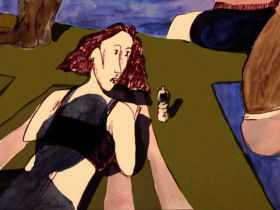
The song understands something essential about longing and protection. About wanting what we should maybe call the divine masculinity to shelter rather than dominate. The fruit fly friendship often exists inside that exact emotional register where it’s not romance exactly, though desire sometimes flickers confusingly around the edges of it. It’s not just a familial bond exactly either, though these friendships can become more binding than blood.
Maybe that is why the trope survives. Because it allows television to explore intimacy between men and women outside romance. A relationship where devotion is not automatically flattened into sex. Tom mentioned Bob and Rose to me, Russell T Davies’ heartbreaking series about a gay man who falls in love with a woman. Holly, the fag hag character, is devastated not because she loses a potential boyfriend but because she loses her central emotional role in someone else’s life. That kind of heartbreak has always felt difficult to name for me.
My sexuality is and always will be friendship
One of my favourite lines comes from a poem I wrote a year ago: My sexuality is and always will be friendship.
I worry sometimes that I do not know how to be a good friend. How do you learn that? Especially when so many of your formative relationships existed slightly outside conventional scripts. Maybe that is another reason these friendships matter so much. They are improvised and handmade. Cobbled together like the Tower of Babel, a form of communal sensemaking in the search for a shared language in this life and maybe, the next.
Summer heatwaves are slowly becoming our new normal and fruit fly season is blooming. All over London, queers, lesbians, transmascs, dolls and gays and yes, their straight girls, are spilling onto streets together, building tiny temporary worlds out of cigarettes, lip gloss, sweat, gossip, grief, and love. The old stereotype has never quite captured the actual emotional architecture underneath it all I think.
What people call “fag-haggery” is often just two outsiders seeing each other and simply trying to make the other feel less alone.
What can you do?
Watch:
- My Best Friend’s Wedding (1997)
If you haven’t already watched, please take one evening out of your week to watch one of cinema’s most enduring fruit fly friendships. One of Julia Roberts’ best roles and a reminder that some of the greatest love stories are not always romantic ones.
Read:
- Fruit Fly by Josh Silver (2025)
A dark satirical psychological thriller about Mallory Maddox, a struggling, once-famous author suffering from a seven-year writer’s block. Desperate for a comeback, she exploits the tragic real-life story of Leo, a young homeless gay man battling addiction, to revive her career. The novel explores questions of exploitation, queer identity and asks the question: who gets to tell whose stories?
Do:
-
- Make space for people who exist between the categories. Resist the cop in your head telling you to put people in boxes. Queer communities have always been built by people who don’t fit neatly into the labels they were given. I’m not saying let the straight girls run wild, but let’s question who we see as immediately belonging and who we decide is an outsider.
- Read more articles by Fopé HERE
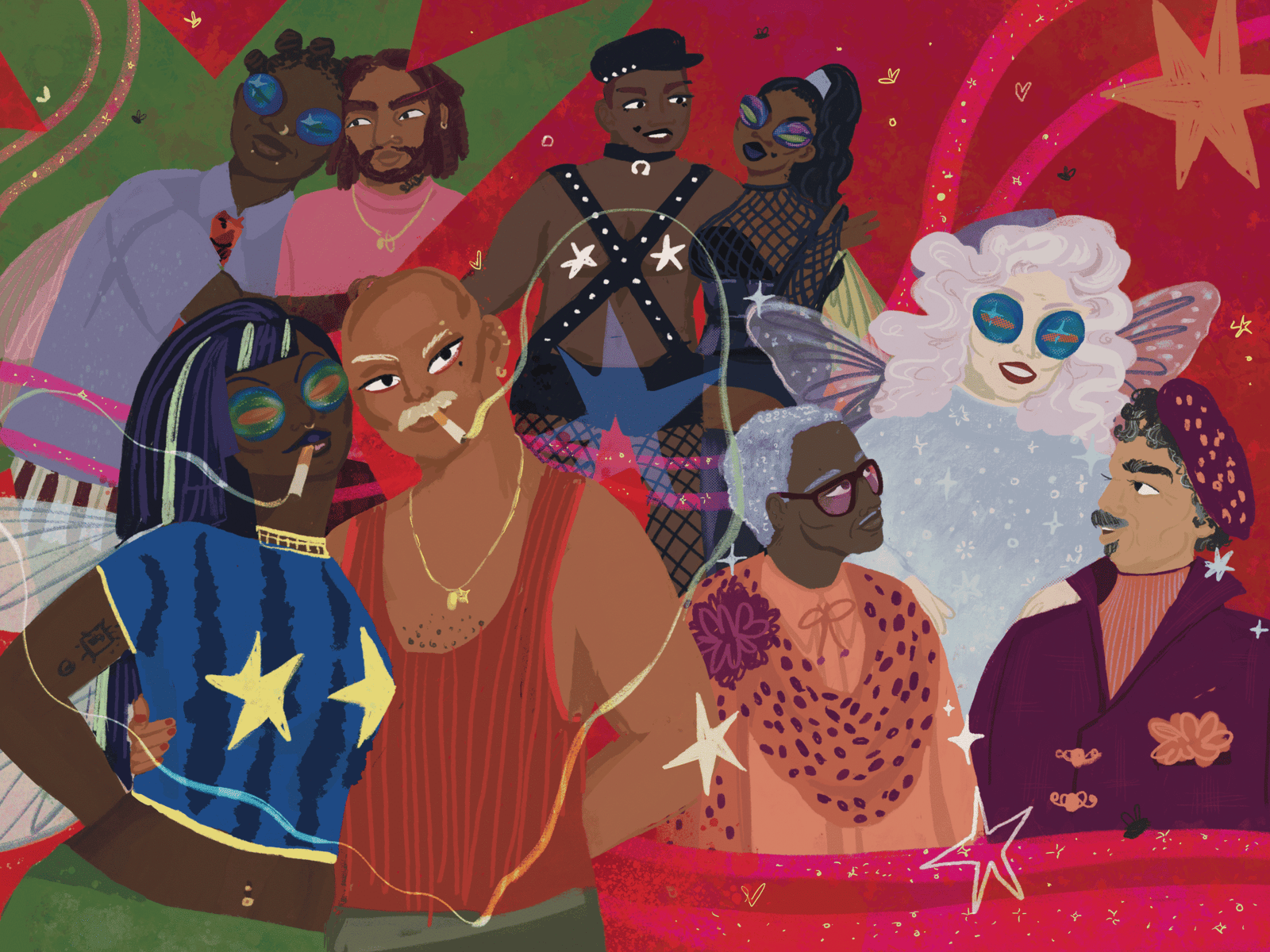
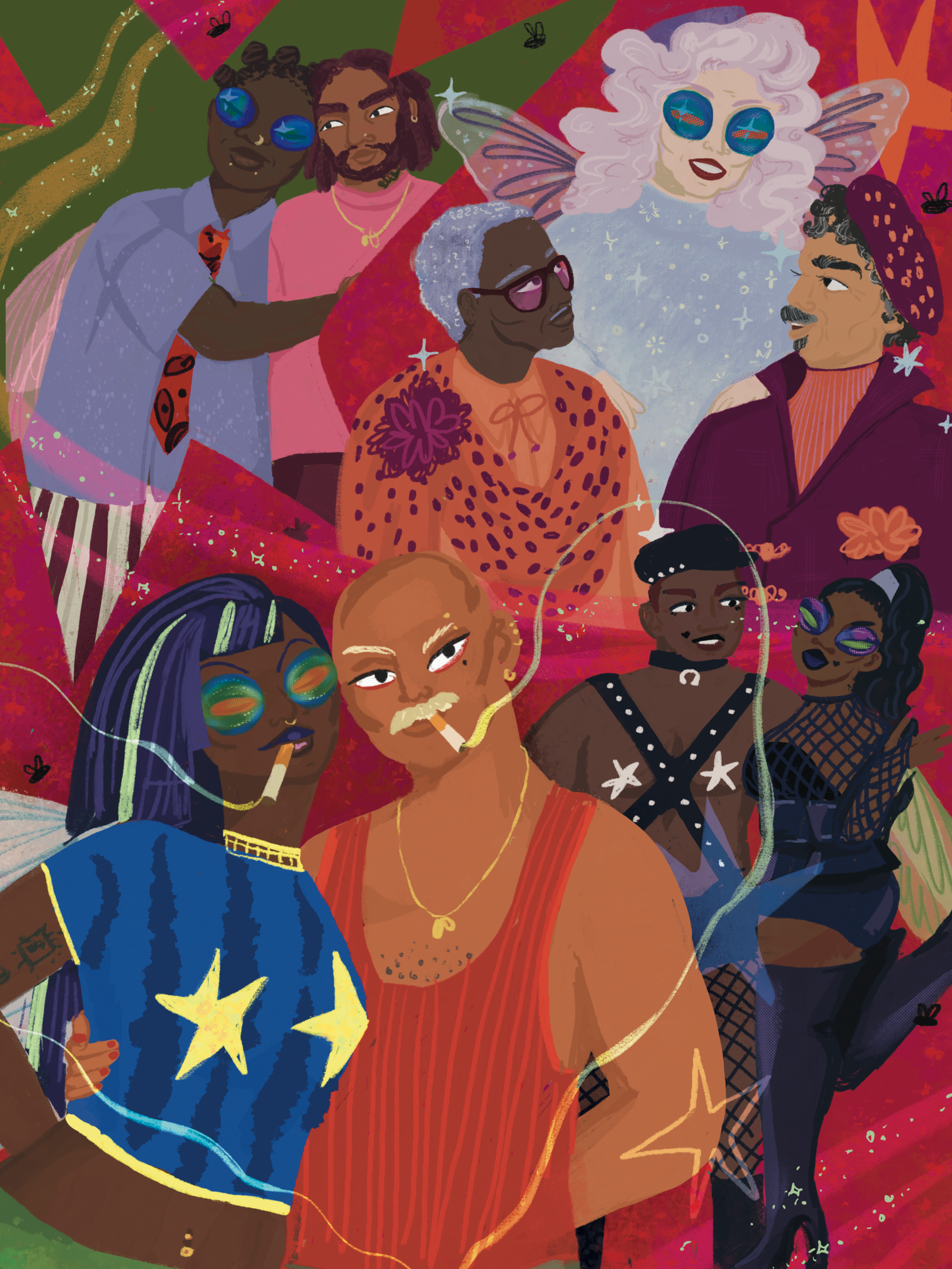 Illustration by Tinuke Fagborun @tinuke.Illustration