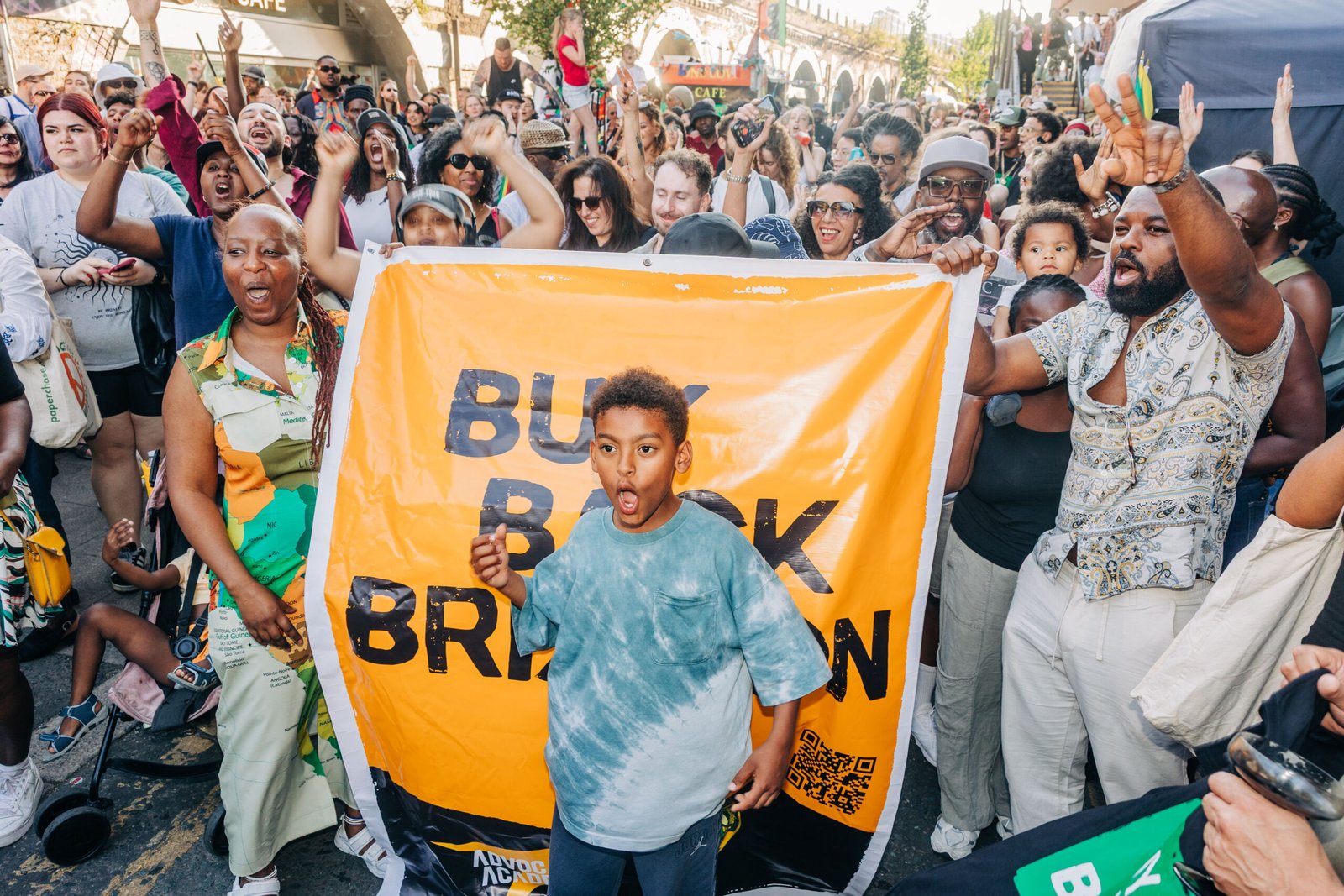

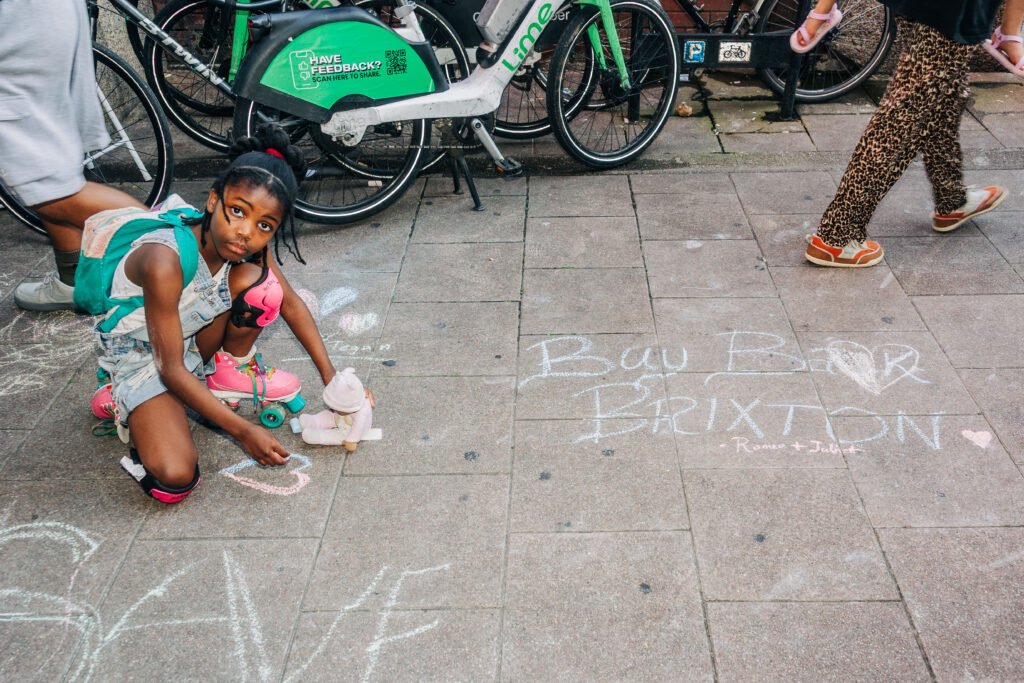
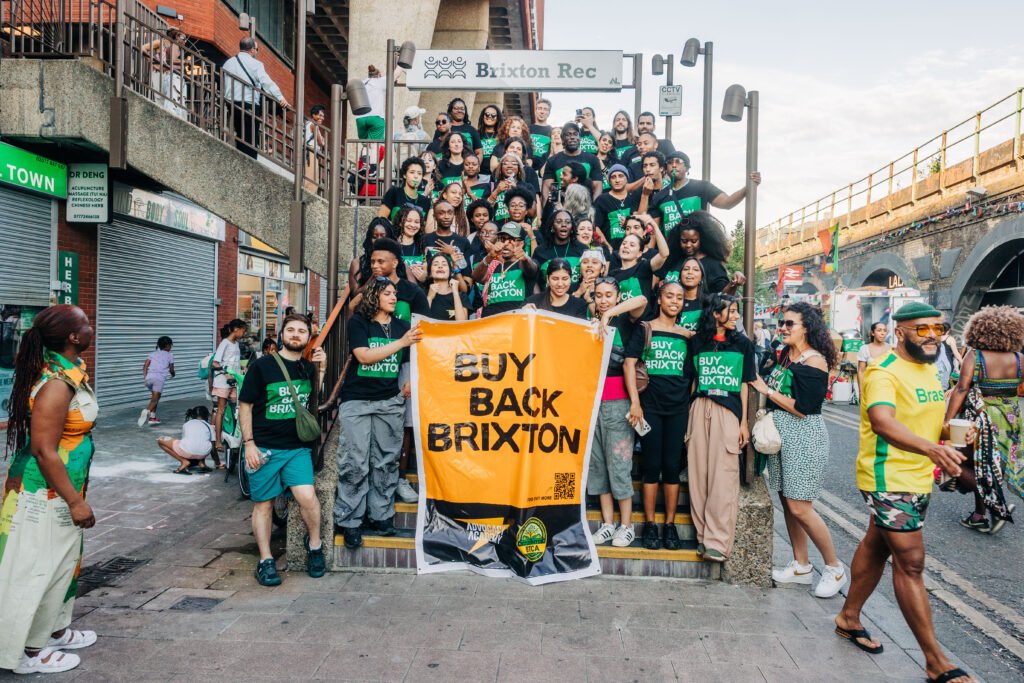
On Friday 19th June, I stepped onto Brixton Station road and was met with a crowd of people that stretched all the way beyond the bridge. It was buzzing. An incredible DJ set by Just Vibes poured through the street; there were elders leaning against railings and stalls catching the sun, children running around, games being played. People from all backgrounds were in attendance, and there was an abundance of food from the local traders serving the smells and tastes from home. The energy felt alive, and electric – exactly the vibe Brixton is known for.
We were all gathered in Brixton for a particular reason: to defend Brixton Market from being sold off to private equity developers. This #BuyBackBrixton Rally was an invitation to the public to join the movement to reclaim Brixton into community ownership.
I have always proclaimed my love for Brixton loudly and incessantly. As I walked into the crowd, the overwhelming feeling of solidarity washed over me. I could’ve cried, but instead, I let myself take in how brilliant the Brixton community is, and how willing we are to fight for what’s right, and to fight for what’s ours.
When I’m in doubt about what can be achieved through collective action, I never have to look further than SW9 to find that. If I was alive then, I imagine this turnout might have felt like the day Nelson Mandela visited Brixton in 1996. Resistance is woven into Brixton’s legacy, and today was no different as we all gathered for one purpose.
Commons not capital: Brixton’s future
Started by Brixton’s Brixton Traders Community Association and The Advocacy Academy, the #TheBuyBackBrixton campaign is working to bring Brixton Village and Brixton Market Row into community ownership. They started the campaign because news had spread that these iconic community landmarks were going to be sold to private equity developers.
When I first heard the news of the potential sale, I was devastated. Brixton has fought and won against many gentrification plans – from Save Nour in 2020, to the #FightHondoTower campaign – but this felt like the scale of the displacement had escalated dramatically.
With more than 100 independent traders in Brixton Village and 45 in Market Row, it is harrowing to know that if this asset falls into private ownership, the consequences are dire: rent hikes, mass displacement of traders and their livelihoods, and the erosion of a thriving community all for profit.
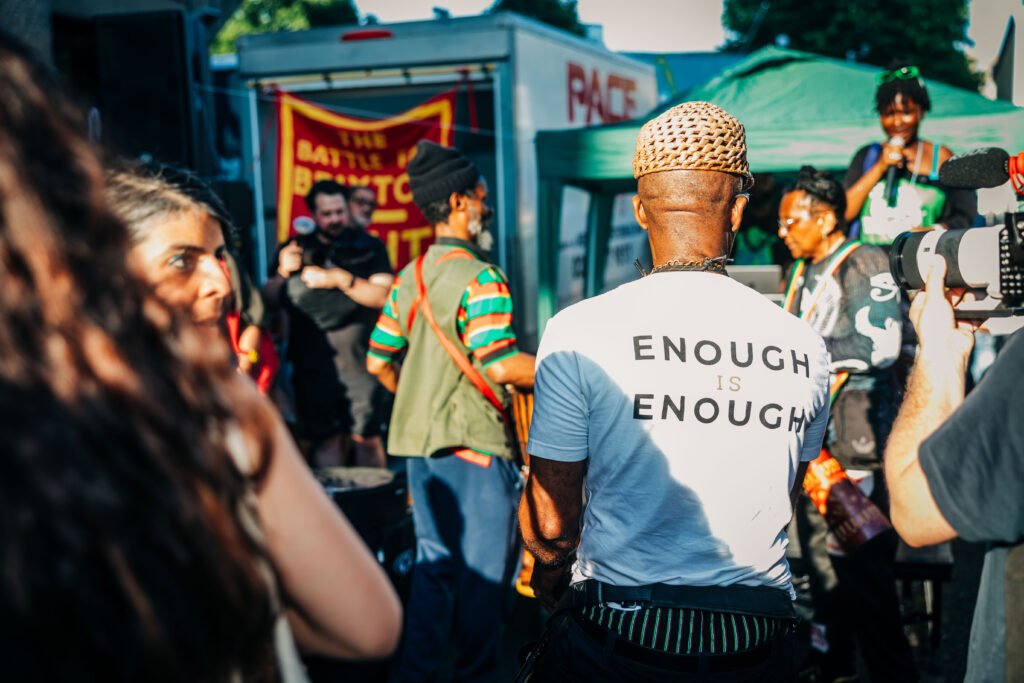 Photography by Mark Chilvers
Established in the late 1800s, Brixton Market is one of South London’s most significant cultural and economic assets. Losing it would mean losing a living archive of Black, migrant, working‑class life. And with campaigns like the Save Ridley Road campaign happening simultaneously, it is clear, there is an attack on the people, the communities and cultures that make London great.
The #BuyBackBrixton Rally was an establishment of the two truths we should hold dear in this moment: Brixton is not for sale – and neither is the imagination of what we can build next when ownership is in the hands of the people.
“We can change that together”
To start the rally, we were welcomed by speeches from members of the Brixton community, MC’d beautifully by Olamide, Member of The Advocacy Academy. The first speech came from MP Helen Hayes who spoke with fervour about what was at stake here.
“Brixton market is precious,” she said, “and worth mobilising for.” Her message was simple: “as a community we can stop private equity. We can buy back our assets ourselves.”
Cllr Martin Abrams was next, and his speech fired us all up. “Private investors see Brixton as a balance sheet,” he announced to the crowd. “For two decades, private equity has been circling like vultures.” He commented on how quickly ‘culture’ becomes a marketing strategy and ‘community’ becomes a brand, to which the people who make the community so incredible in the first place are told they’re no longer a part of it.
“But today,” he said in a rallying cry, “we can change that together.”
By the time they had both finished, the crowd was cheering loudly, in firm agreement with what was said. I understood because their speeches weren’t just describing what we were already aware of, they named the political, economic and social consequences of gentrification: Who gets to stay? Who gets pushed out? Who profits? Who gets to decide the future of Brixton?
The traders who built Brixton
The most emotional moment of the rally came from Kat Miles, the co-chair of the Brixton Market Trader Association. Her voice cracked as she spoke about the years spent fighting developers – the exhaustion of battling rent hikes, the fear of displacement, and the constant pressure of trying to protect their livelihoods.
For traders, this isn’t just about losing a stall; it’s about losing your livelihood, losing generational businesses and losing the place that has fed their families for decades. She said that even convincing people that community ownership was possible had been a struggle. But on this day, she was “proud of the organising happening.”
The co‑chair Meera Ghanshamdas joined, recalling how the idea of buying back Brixton Village sounded absurd at first. “When it was first proposed, I thought it was impossible,” she said. “But an hour later, I was in.” She spoke about the importance of staying grassroots and local – keeping the campaign rooted in the people who built the market, not in distant investors.
“We want to put more into the market, not strip away from it,” she said, emphasising that the future of Brixton must be shaped by traders, foundations, and community trusts, not private landlords. She also made the call out to foundations and trusts to put their money where their mouth is when it comes to funding community ownership.
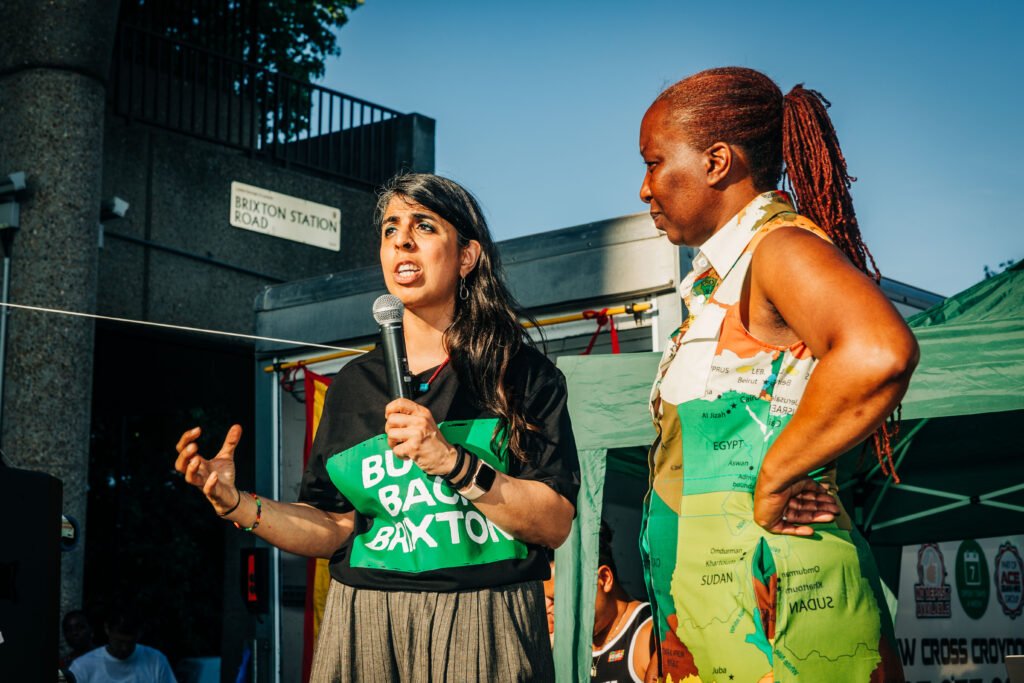 Photography by Mark Chilvers
Listening to them made me think of how time and time again we see communities having to prove their worth through every metric possible to secure very little funding – especially for things like community and cultural impact, which are often immeasurable and priceless.
Often the Foundations and Trusts are so far removed from the work happening on the ground they do not get to witness the sweetness and familiarity you build with your favourite vendor who always chucks in an extra mango for you, the fact that your Moroccan meat trader can speak Twi and Patois to connect with his customers, nor the fact that the relationships the traders build with people who frequent the market makes them are social anchors in their own right.
Join our mailing list
Sign up for shado's picks of the week! Dropping in your inbox every Friday, we share news from inside shado + out, plus job listings, event recommendations and actions ✊
Sign up for shado's picks of the week! Dropping in your inbox every Friday, we share news from inside shado + out, plus job listings, event recommendations and actions ✊
Hillary, originally from Roehampton, told me she’s been coming to Brixton since childhood – “to get my hair done, to buy plantain and fish after church, to hear Afua Hirsch and Stella Dadzie speak at the library, and to browse Pure Vinyl for the world’s greatest sounds.”
Brixton Market has been part of her life for decades. “The amount of money raised in four days is a testament to the organisers,” she said. “But it also shows that the community can show up – and we need more of that.”
Her words echoed what the traders had been saying all along: this market is a home to many. And the people who built it are refusing to let it be taken from them.
Brixton in a national movement
What’s happening in Brixton is part of a much bigger story about communities across the UK refusing to be priced out of their own neighbourhoods.
Community buyouts aren’t new. They’ve been quietly reshaping towns and cities for years. Stretford Public Hall in Manchester was bought back by local residents. Hastings Pier was reclaimed through community shares. In Scotland, entire villages have taken land into collective ownership through the community land movement, and closer to home, Seven Sisters Market, a thriving Latin American hub, has been fighting its own battle for years through the #SaveLatinVillageCamaign, now Wards Corner – and won. All these fights prove that people can own the places that shape their lives.
That’s why traders’ leadership matters so deeply. Markets are often the first places targeted by private equity because they hold things that can’t be easily quantified – cultural memory, intergenerational relationships and the kind of community infrastructure that doesn’t fit neatly into a balance sheet. When traders organise, they don’t just protect their businesses; they also protect the social fabric of their neighbourhoods.
Brixton is not for sale
We were coming to the end of the speeches, then came one of the most powerful moments of the day. Dan Taylor, Saba Shafi and Liv Francis-Cornibert from The Advocacy Academy stepped on stage and immediately shouted “Brixton is not for sale,” to which the crowd erupted in shouts, drummings and vuvuzela blowing.
Then they led the chant “Buy back!” to which the crowd replied “BRIXTON!”
As if we couldn’t be riled up enough, Dan, Saba and Liv got us to quieten just a little to read out the numbers: “£250,000 raised in four days. £2.2 million total.”
The crowd roared. People screamed, hugged, and cried. You could feel the awe ripple through the street. Awe at what community organising can do. Awe at what happens when people refuse to be passive. Awe at the fact that Brixton had already achieved what private equity never expected: a community raising millions to buy back its own future.
I and so many others there were bursting with pride. It wasn’t just a win because we raised the money, though that is a huge achievement in itself, but it also marks a mentality shift of what we can build and achieve together.
Some of the hardest aspects of community organising is not just bringing people together in the first place, but bringing them together around a shared vision of something that can be different. The horizon always comes – and this particular moment felt like Brixton had stepped closer to it.
Brixton’s resistance and memory
That brought an end to the speeches, and the crowd was on a high from the announcement before. What immediately followed was a drumming session by Dende Nation, and community organisers were busy through the streets handing out QR codes to people, linking directly to the campaign and how you could get involved.
The street turned into a block party. People vibed, greeted strangers, hugged friends and danced together. Revolution songs blasted through the speakers – Dennis Brown’s Revolution sending a message that felt perfectly timed.
I thought the drumming and Reggae and Dub music was incredibly important to this rally, particularly given how Caribbean, and especially Jamaican, culture has been influential in Brixton. Rhythm and soundsystems have always been used as sonic forms of resistance, but it also reflects the ways Caribbean and African communities have always used music to gather, to warn, to celebrate, and to survive.
I spoke with Olamide, one of the hosts of the rally, who grew up between Camberwell and Brixton. “The whole day felt exhilarating, motivating, empowering – proof that community still exists,” she said. We both agree that Brixton has always been a hub of culture and resilience: “Yes, gentrification is happening, but look at how much Brixton has retained. Brixton is home. Brixton is resilient.” While she was initially nervous about her role in the rally, speaking in front of hundreds of people, she also felt a surge of hope. “We’re shown how individualistic society can be, but this day was an example against that,” she smiles. “It shows we can come together, care for one another, fight for one another.”
To her and to many, the rally confirmed that Brixton is still here, still fighting, still holding itself together through culture, memory and each other.
Brixton to the world: a look into what’s possible
As the rally came to a close, leaving people dancing in the street, I found myself in a place of reflection as I realised that the day was just the start of something much bigger for Brixton.
Less than three weeks after the rally on 7th July, Brixton Market was officially registered as an Asset of Community Value. It’s a monumental progression for this campaign, which empowers local people to take control of buildings and spaces, ensuring they’re not lost to commercial developers. That alone is historic.
But what’s happening here goes far beyond a legal recognition. It’s a blueprint for what becomes possible when communities refuse to be priced out of their own neighbourhoods. What’s happening in Brixton shows that markets, estates, cultural spaces, and high streets all over the UK don’t have to be swallowed by private equity. They can be bought back. They can belong to the people who built them.
Erel Onojobi, Programme Director for Power to Prosper, captured this perfectly. She said “There will be a time coming soon when there is a Brixton Commons – when our land, our property, and our enterprises are held in common by the people, for the people.”
 Photography by Mark Chilvers
Beyond my own unwavering belief in what Brixton and the people in it can achieve, the most important thing I took from that day is that when people choose collective action over resignation, gentrification loses its inevitability.
When people choose each other, the future stops belonging to private equity and starts belonging to us. Brixton will never be for sale.
What can you do?
- Join the #BuyBackBrixton Mailing list to stay updated
- Donate to the #BuyBackBrixton Gofundme
- Sign the #BuyBackBrixton Petition
- Join the Whatsapp broadcast group
- Follow Brixton Traders & Community Association and The Advocacy Academy on Instagram and share the campaign content to your stories + to your friends & community
- Sign the petition and donate to the crowdfunder of the International House campaign. International House near Brixton row is the home of 141 charities serving the Brixton and Lambeth community. Luxury flats are set to replace this, help them stop the sell off!
Other resources to check out around Gentrification
- Gentrification in Brixton and Beyond – The Knowledge Chronicles Series by Sara Bafo and shado
- To all the blocks I’ve loved before by Simmone Ahiaku
- What is Gentrification by Simmone Ahiaku
- From Hackney, with Love by Richard Yeboah
- Revolutionary Acts: Black Gay Men in Britain by Jason Okundaye
- Privatise the Mandem and Free the Mandem by Nabil Al Kinani
- Belonging in Brixton: An ethnography of Migrant West Indian Elders in Brixton, London by Audrey Allwood