
In early August, the Home Office announced that immigration raids had more than doubled since the Labour government took power in July 2024. Immigration raids are now at a record high, with Home Secretary Shabana Mahmood – the daughter of immigrants – boasting that “illegal workers and rogue employers have nowhere to hide.” Footage of raids and arrests are used for entertainment on TikTok, posted by the Home Office to showcase their “secure borders” approach to immigration.
The British media’s reaction to immigration raids at home has been drastically different to the coverage of raids in the US, which were largely condemned as being brutal or in poor taste. This January, barely seven days after Immigration and Customs Enforcement (ICE) shot dead Renée Nicole Good – a legal observer in Minnesota, the Home Office invited Sky News to accompany them on an immigration raid. The fluff piece made no mention of the impact of raids on the people being targeted. As an activist in the Filipino migrant community, I have seen first hand just how devastating these consequences are.
The impact of raids on migrant communities
Immigration raids are violent, cruel, and destructive by design – sometimes not even targeting the right person. This is what happened to Layla, a Filipino domestic worker I interviewed as part of my oral history project on Filipino migration.
In 2011, she was visiting a friend in East London, when immigration enforcement turned up at her friend’s house. Being undocumented, immigration enforcement took her away and detained her, even though it was her friend they came for. “I wasn’t the person they were looking for, but because I was there, I just surrendered myself,” she tells me.
She was immediately brought to a holding facility near Heathrow Airport, where she spent one night before being transferred to Yarl’s Wood. “People inside the detention centre just ignore you and your feelings. The guards are just like, ‘get out of this country.’ I couldn’t sleep because we were crowded – up to 15 people in one room,” she explains. “They call Yarl’s Wood a removal centre, but it’s really like a prison.”
When I interviewed Layla in May 2025, she said: “I was totally ignorant of my basic rights.” She’d “surrendered” herself because she didn’t know they had no right to detain her without a warrant. She is now part of a domestic workers’ association led for-and-by migrant domestic workers, with which I organise and volunteer. Together, we have organised anti-raids training sessions for UDWA members to ensure that if the worst happens, like it did for Layla, they are prepared.
Many are getting involved getting beyond migrant communities – to learn how to protect their neighbours or intervene if they witness a raid occurring in the street or at a business. I spoke to anti-raids activists who are taking action in their communities about how they organise, their advice on how to get involved, and why resistance is so crucial at this time.
For members of Haringey Anti-Raids, “raids are one of the frontlines of state violence.” Resistance to raids is therefore “one of the key points through which the border can be collectively resisted through simple and practical things.”
Chris, a Southeast London-based anti-raids organiser who I spoke with, feels similarly: “raids are tearing people from their homes, from their families, from their communities. And then, they lead to further violence and harm in the form of detention and deportation. If you can resist immigration raids, then you’re resisting a key element of the Hostile Environment. They are a tactic of fear, they are intended to terrorise.”
The legacy of Kenmure Street
Throughout our conversations, both Chris and Haringey Anti-Raids mentioned the power of Kenmure Street, the highly publicised and successful mass resistance to a raid in Glasgow in May 2021, as a call to action.
“There was an immediate wave of people wanting to do the same in their communities to resist immigration raids in their communities because of what happened in Kenmure Street,” Chris says. “It was incredibly inspiring and beautiful to see this community coming together so visibly and successfully resisting this raid. It was such obvious footsteps to follow in.”
Immediately after Kenmure Street, Haringey Anti-Raids organised an online workshop for people who wanted to join the group: “It was attended by hundreds of people who had been inspired by what they saw in Glasgow, many of whom went on to form new local anti-raids groups around the country,” a member of Haringey Anti-Raids explains. “This showed the ripple effects that resistance of that kind can have, far beyond the immediate impacts.”
The joy of community victory
I remember witnessing Kenmure Street unfold from my phone, checking Twitter for live updates from those on the ground as people came down to block the Immigration Enforcement van: I felt hope bubble up inside me, at a time when things were feeling bleak both due to the pandemic and the significant rightward shift in immigration policy that Priti Patel had brought as Home Secretary. I reached out to Pinar Aksu, a human rights campaigner and theatre-maker who was at Kenmure Street, to hear directly from her about what it was like on the day.
“It was quite an unexpected thing because it was COVID time: we were not expecting a dawn raid to take place.” Pinar was alerted about the raid through local group chats. “Within hours hundreds of people started to arrive. I think because it was on a Friday, it was on the day of Eid.” It was different to the usual protests she had attended where there was a pre-agreed clear plan, but Kenmure Street was organic: “it just happened.” Lack of predictability is one of the key challenges to responding effectively to an immigration raid. You never know who might be part of the response: they may be total strangers or they may not know how best to respond at all – unlike a pre-planned demonstration or action. Although Pinar is keen to highlight Kenmure Street was also possible because of Glasgow’s history as a city of solidarity: “We come together whenever people seeking asylum and refuge are targeted with hostility.”
As the day progressed, people continued to arrive on Kenmure Street, not knowing how long the stand off would last. “The numbers kept growing,” Pinar says. She felt they would’ve kept going, even into the night, if the men weren’t let go. But, “eventually the two men inside the van were released. Everyone was screaming, ‘they’re being released!’ And then the rest was just amazing.” The two men finally stepped out into the street and the crowd gradually dispersed – overjoyed and surprised at the day’s positive outcome. “People of Glasgow made this possible, unity did, solidarity did,” Pinar summarises.
The collective joy Pinar describes as the two men were released reminded me of the elation I’ve seen amongst migrant domestic workers going through anti-raids training – pointing out immigration enforcement officers in photos or practising saying no to random immigration checks. Often punctuated with laughter, the training helps them build their confidence to resist an immigration system hell-bent on exploiting them.
Haringey Anti-Raids echoed this feeling: they want people to know that raids “can be resisted, both in spectacular ways – [like in] Kenmure Street – and quotidian ways, like having the knowledge that immigration enforcement officers cannot enter your home without a warrant. Both of these approaches contribute to a broader environment that can result in ICE being reluctant to come to an area or the growth of communities that will support one another and help to prevent people being taken away by the state.”
Anti-raids organising as community and solidarity building
Organising against immigration raids is not just about making the work of immigration enforcement more difficult, it is also about building stronger communities: knowing your neighbours, and building a sense of responsibility and care for each other. Community resistance to raids will be strongest where there is a strong sense of community. As Chris advises: “build it from what community relationships and networks already exist. Talk to people in your local area or local community groups about raids. Start to build a network of people who are aware of raids, can support each other, and resist them.”
This community-building requires work beyond the immediate response to a raid. For Pinar, a major priority for the current anti-raids movement is learning from previous generations and building a movement of solidarity. “We need to remember that people before us experienced fascism and they won, even if it took a long time,” she says. “That knowledge exchange and intergenerational knowledge is so important.”
She continues: “organising, working together, doing things in solidarity and allyship. That’s another important thing: it can’t just be migrant rights’ organisations. That’s what solidarity is about. We do things together.”
Join our mailing list
Sign up for shado's picks of the week! Dropping in your inbox every Friday, we share news from inside shado + out, plus job listings, event recommendations and actions ✊
Sign up for shado's picks of the week! Dropping in your inbox every Friday, we share news from inside shado + out, plus job listings, event recommendations and actions ✊
“It has to be done with care and joy,” Pinar concludes. “I find that so important when you go to protest: you need to have fun. I love bubbles at protests, colours, music! Music really annoys the far right, by the way,” she adds with a smile. Building joy and care into movements is a key way of sustaining movements despite political defeats. The fun and joy I have seen migrant domestic workers bring into their campaigning counterbalances the violence of the state. It is perhaps the biggest lesson in organising I have learnt from the community.
Thankfully, Layla’s story of arrest and detention had a happy ending. Community is ultimately what saved Layla after she was released. They supported her through her period of reporting to the Home Office, and stayed by her side as she rebuilt her life and was able to get married to her long-term partner: “in 2015, we made it, with all my community, FDWA [Filipino Domestic Workers Association] and Igorot UK: we had the wedding at a church in Walthamstow.”
Now, with her community, she feels more confident in her rights and wants others to be similarly empowered. This is also my call to action: I hope anyone reading this will do what they can to intervene and prevent what happened to Layla from happening to someone else.
What can you do?
See:
- “Everybody to Kenmure Street” (Director: Felipe Bustos Sierra, 2026): a documentary about the incredible community response to the May 2021 immigration raid in Glasgow
- Two short BBC documentaries about the Glasgow Girls, the 2005 campaign led by Glasgow school girls in response to their 15-year-old classmate being taken into immigration detention. Content warning: the first documentary opens with footage of corpses and graphic depictions of physical and sexual violence.
- Vice documentary about the Stansted 15, fifteen activists who broke into Stansted airport to stop a deportation flight in March 2017.
Read:
- “The activists who stopped Tui’s deportation flights”, Huck, March 2022
- “I was caught once my immigration enforcement”: for a full account of Layla’s experience from my newsletter, January 2026.
- Guide to getting involved in anti-raids organising
- ‘Everybody to Kenmure Street’ wants you to be a good neighbour
- Kenmure Street: a rally against the “good” / “bad” migrant narrative
Act:
- Organise an anti-raid workshop in your local area with an anti-raids group
- Join yourlocal anti-raids group orset one up in your area
- Download, print and distribute the How To Kenmure zine, made by activists who were at Kenmure Street
- Download, print and distribute the Anti-Raids Network flyer, which is available in a dozen languages
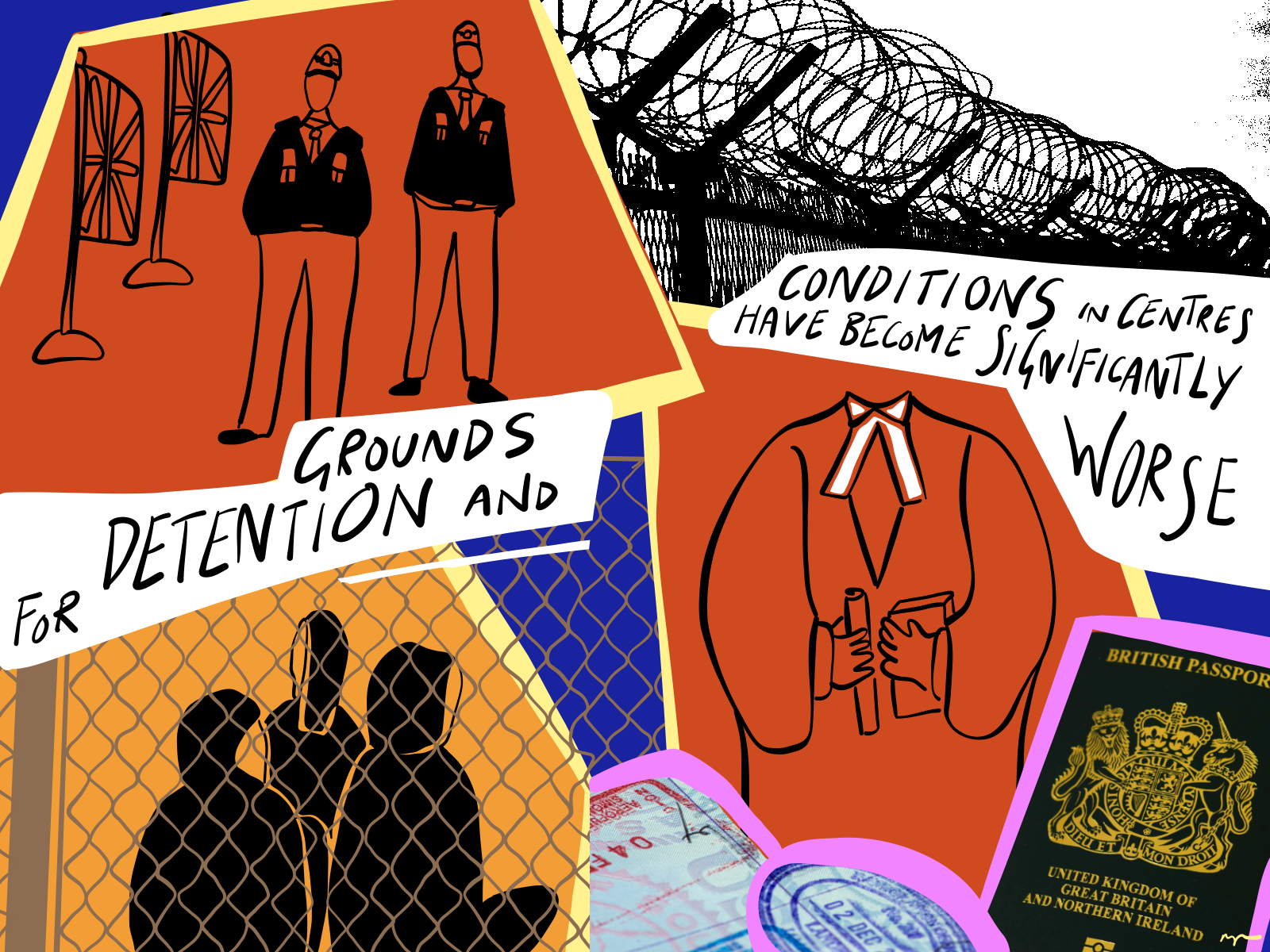
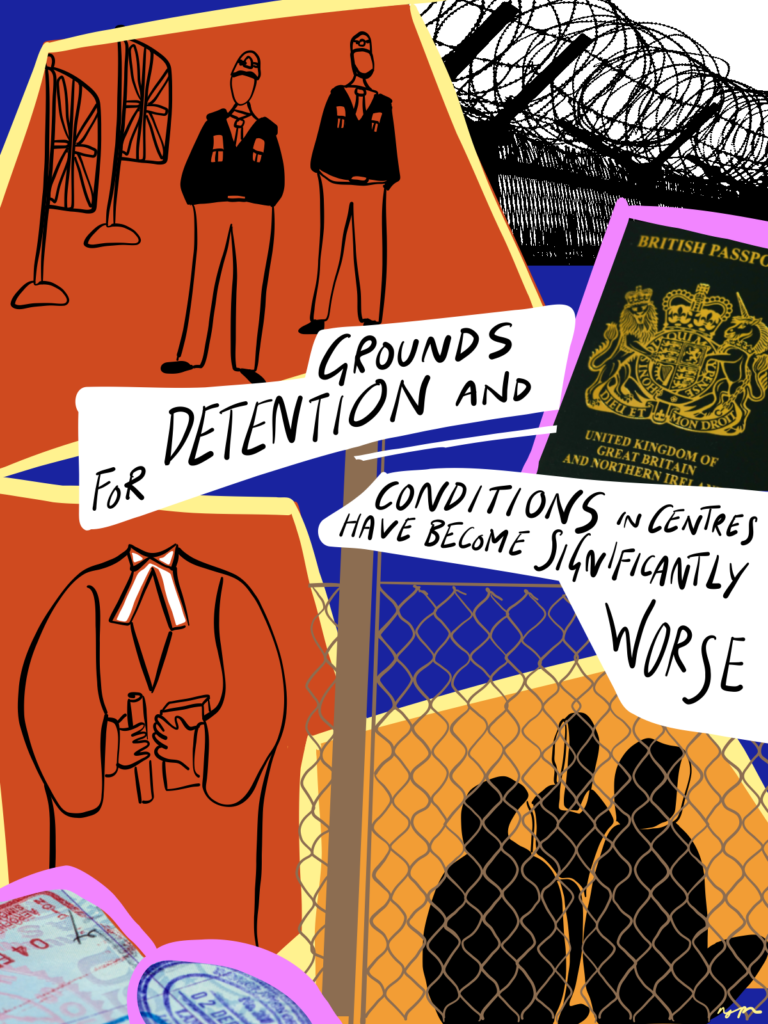 Illustration by @npl_illustration who says: “The illustration shows a collage of imagery – three figures are drawn enclosed behind wire fencing, a lawyer stands dressed in legal uniform holding documents, policemen and armed forces are depicted in black, with barbed wire fencing shown in black and white. Around these illustrations are cut outs of a British Passport, and passport stamps. The phrase, ‘grounds for detention and conditions in centres have become significantly worse’ sits in the centre of the image in black and white.”