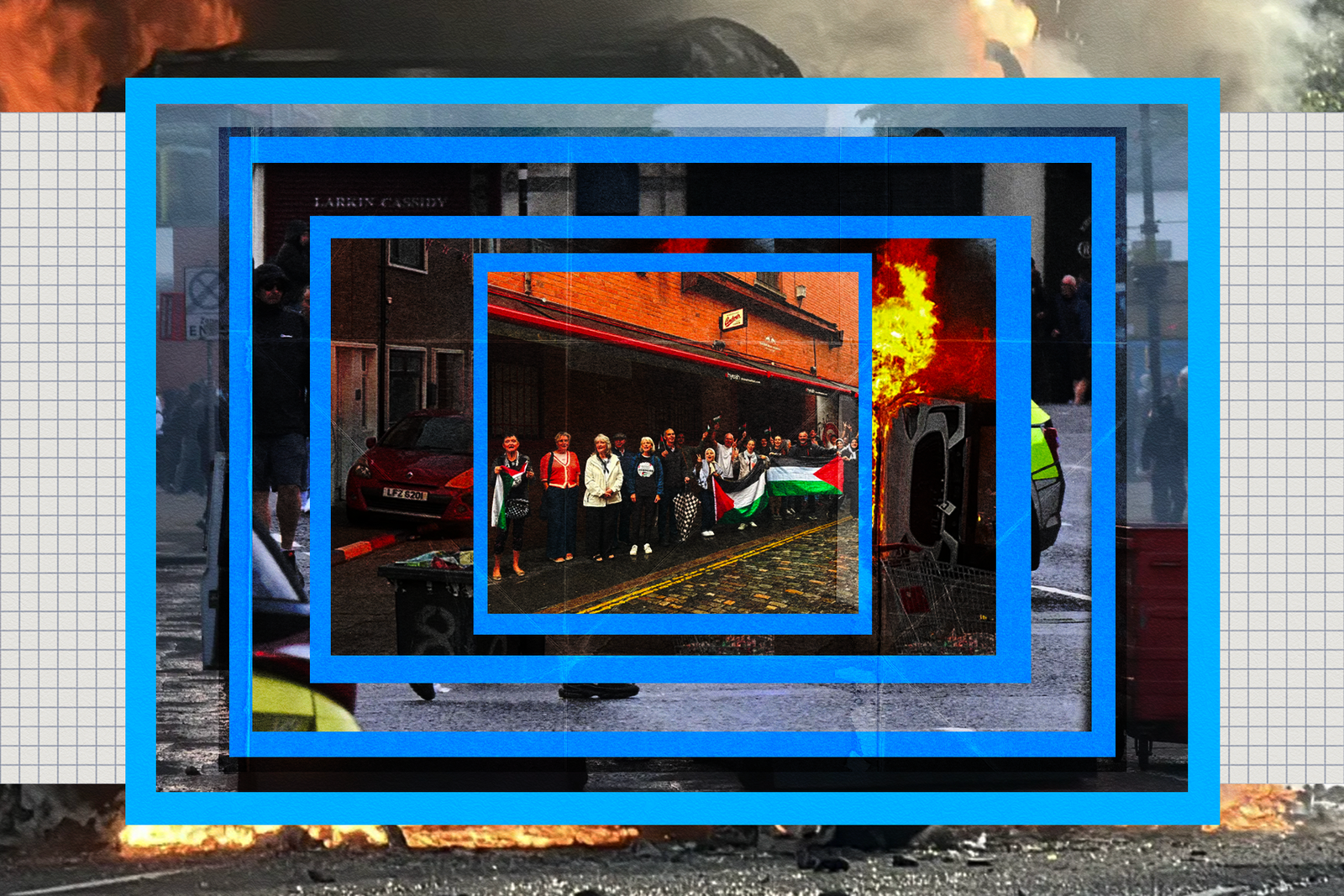

When the news reported that a person of colour had stabbed a white man in Belfast in June, Marissa McMahon knew that a racist pogrom was imminent. As a member of the Anaka Women’s Collective, she had been monitoring the groups responsible for acts of violence against people of colour.
This, I would soon learn, was not uncommon among the activists and organisers in Belfast that I interviewed, all of whom had also concluded long ago that relying on the Police Service of Northern Ireland (PSNI) would not protect communities from racist violence.
As a Lebanese researcher of authoritarianism and sectarianism, I went to Belfast during the week of July that includes the yearly bonfires on the eleventh as well as the Orangemen’s march on the twelfth. These are ostensibly to commemorate the 1690 battle of the Boyne, which saw the victory of the Protestant king William of Orange over the Catholic king James II. But given the sectarian associations with Ireland and Catholicism, the yearly commemorations have often featured symbols of both targeted – for example, by burning the Irish tricolour or the posters of pro-Irish reunification politicians during bonfires. In more recent years, these have also proved appealing to segments of the far right who descend on the city to spread their extremist politics.
While I remained an outsider, my intention in Belfast was and is to try and understand what, if anything, my home country has in common with Northern Ireland / the North of Ireland (NI). This piece is part of a series I’m working on for shado, as well as my own podcast and newsletter, called From Beirut to Belfast.
The pogroms come to Belfast, again
The pogroms that we all saw on 8th June 2026, when masked men set homes belonging to racialised minorities on fire, were not the first of their kind. This was in fact the third summer of violence in a row. The pogroms in Ballymena the previous year were so violent that some two-thirds of Romanian and Bulgarian Roma families left the town entirely. The 2024 pogroms were so violent that some migrant-owned shops were targeted twice in a row.
Given that this was not the first time, it would be reasonable to assume that the PSNI does know the identity of those behind these racist acts. In fact, the racist groups are often known. They even sometimes declare their targets beforehand publicly, including on social media, which is also why none of my interviewees believe that we’ve seen the last of such pogroms.
In the meantime, evidence is building up to point the finger at the PSNI for not acting on information that is made available to them. The June 2026 pogroms are a case in point: Eight months before they started, the Accountability Project Northern Ireland (APNI) warned the PSNI that racist groups were circulating a literal hit-list of addresses to target when the moment comes. (It’s worth noting that The Guardian euphemistically calls these racist groups ‘anti-immigration activists’ because everyone gets to be called ‘activists’ as long as it is minorities that are targeted. See also the term ‘anti-transgender activist’ to describe transphobe who openly want trans people to cease existing.)
If we take into account the fact that groups like APNI were warning about the coming pogroms, the reactions to the stabbing start looking less like an organic grassroots response and more like the enactment of a plan that was being prepared as early as August 2025. I personally know of around a dozen of such reports sent to the PSNI since that time, and The Guardian confirms seeing around 50 of them.
These “anti-immigration activists” often identify any person of colour and/or Muslim, regardless of citizenship or origin, as suspicious and foreign. For example, one common tactic, which was relayed to me by a member of APNI and which I’ve noticed during my own research as well, is to spread images of a “suspicious” non-white person on Facebook with the caption sometimes alleging outright criminal behaviour.
Some of these “alleged suspicious behaviour” are claimed to occur around schools, claims that often also reference educational changes, such as the inclusion of Islam in the “World Around Us” curriculum (alongside Judaism, Sikhism, Hinduism and so on) or celebration of Eid as part of multicultural events (again, alongside other religious celebrations). Although these groups don’t exclusively focus on Islam, they largely do.
Another increasingly common tactic is to spread AI-generated photos and videos of non-whites in situations that racists have to create due to an absence of real examples. For months and years, these are spread on various social media websites, often by people using their real names, which means that they are easily trackable by the PSNI should it choose to act on the information given to it by groups such as APNI.
The end result, meanwhile, is a years-long atmosphere of fear permeating many non-white communities. As Marissa reminded me, the yearly eleventh and twelfth commemorations are seen as particularly high-risk, with many communities, of colour but even of Catholic Nationalist Republican (CNR) backgrounds, choosing to stay indoors or even leave Belfast or NI entirely during that period – it’s also a bank holiday. She herself planned to stay indoors over that weekend out of safety concerns, unless vulnerable groups needed the Anaka Women’s Collective’s immediate help.
Normalised hatred
There is, evidently, a long way to go for the cause of anti-racism in NI as anti-racist groups are still catching up to the speed at which racist discourse spreads, particularly with the aid of social media corporations such as X and Meta. In December 2024, the Belfast Model School for Girls told Muslim students, all girls under the age of 16, that it was not safe for them to return to school. Online actors were spreading misinformation about these girls, accusing them of being in a “gang” with a “hit list” of “local” kids (local, here. meaning white – the implication of course being that Muslims can never be local to Belfast regardless of where they were born and how long they lived there).
The children were accused of terrorism and of having knives, all of which were entirely manufactured online. These girls were attacked, called monkeys, had their hijabs pulled, among other incidents. A brick was even thrown through “the window of a property close to where the three Muslim girls live.” Unsurprisingly, this has left them traumatised.
Such stories were common enough that I barely had to dig to find enough examples to fill a book.
The sectarian elephant in the room
Prior to going to Belfast, I was under the impression that the pogroms were more spontaneous. I was led to believe by much of the British press that the violence was instigated by ordinary locals reacting to a stabbing by a foreigner. This, I would quickly find out, was only a small part of the picture, one told by a British establishment which has long stopped caring – if it ever did – about the legacy of the troubles in NI, and little interest in assessing the everyday violence committed in particular by loyalist paramilitaries.
Racism in Northern Ireland is an extension of sectarianism, so much so that it’s been referred to as “the new sectarianism” with one group of scholars in 2017 finding “strong positive relationships between anti-immigrant negativity, sectarianism and perceived neighbourhood segregation.”
While racist violence is a cross-sectarian problem, and can be found in CNR areas of Belfast, it has been particularly prominent in Protestant Unionist Loyalist (PUL) areas due to both the legacy of sectarianism in NI post-Troubles as well as the more recent influence of international far right actors.
As violent sectarianism became less prevalent following the Good Friday Agreement (GFA) which nominally ended the Troubles (1998), we saw an observable increase in focus by loyalist groups and their far right allies against Muslims, Eastern European immigrants and other racialised groups – and although I don’t have the data to back this specific claim up (especially as the PSNI do not retain victim data by ethnicity or nationality), I suspect this has increased since the Brexit vote of 2016.
Here it should be noted that in September 2024, nearly two years before the worst pogrom thus far, the UN’s Committee on the Elimination of Racial Discrimination (UNCERD) urged the Northern Ireland Executive “systematically collect information on these acts of intimidation and ensure such crimes are “promptly and effectively investigated, prosecuted and punished with appropriate sanctions and that victims have access to effective protection and redress.” It should also be noted that, in response to the UNCERD report, PSNI’s Hate Crime lead, Ch Supt Sue Steen, said that the PSNI is aware of “the potential involvement of individuals associated with paramilitarism in the recent protests and associated disorder in a number of areas in Northern Ireland.” Again, this was nearly two years prior to the June 2026 pogroms.
Join our mailing list
Sign up for shado's picks of the week! Dropping in your inbox every Friday, we share news from inside shado + out, plus job listings, event recommendations and actions ✊
Sign up for shado's picks of the week! Dropping in your inbox every Friday, we share news from inside shado + out, plus job listings, event recommendations and actions ✊
The racist elephant in the room
Today, although anti-Catholic and anti-Irish symbolisms still appear on pyres, the discourse has shifted against Muslims, migrants and refugees. The pyres of Moygashel have made international news last year for displaying a ‘Stop the Boats’ effigy showing people of colour in a small dinghy boat, which they set on fire.
This year, also in Moygashel, an effigy of a Mosque with the sentence ‘Islamic Fascism’ (written in Arabic) was placed on top of a pyre that included “secure our borders” and “end the threat of radical islam.” The same pyres that used to symbolically burn Irish and Catholics now symbolically burn Muslims, often organised by the same loyalist paramilitaries and their offshoots (that are often known to the PSNI.) Other pyres are celebratory, and I saw a large one with an Israeli flag – it is common to see Loyalists supporting Israel in response to the long-standing support for Palestine among Republicans – or posters of the late American far right personality Charlie Kirk, mere moments after arriving in Belfast.
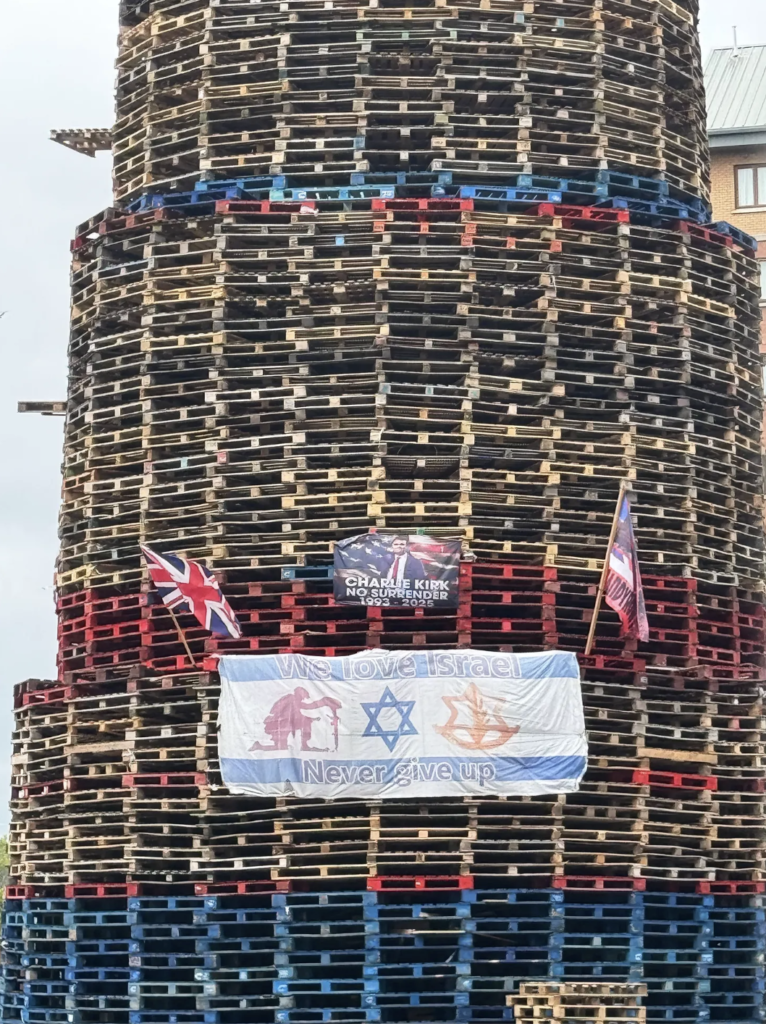 Image via Substack
Ostensibly, neither the eleventh nor the twelfth are ‘meant’ to be sectarian or racist affairs. This is, in any case, what their defenders claim. While I was in Belfast, I made sure to pick up on how unionist media covered these yearly events. What I found was denial of the facts and a sense that Protestants were the ones, somehow, who were threatened – although by who changed from article to article. Some blamed Irish republicans, others blamed online ‘woke,’ political correctness, and so on.
What I also found was an anxious group desperately clinging to relevance as political winds shift away from their dominance. Here it is important to note that in the most recent elections (2022), Sinn Féin, an Irish nationalist/republican party, won the most seats for the first time which means that, also for the first time, the First Minister of Northern Ireland supports Irish reunification. The leaders of the opposition, namely the Greens and the SDLP, are also pro-reunification.
What’s more, the 2021 population census in Northern Ireland revealed that Catholics (45.7%) have overtaken Protestants (43.5%). The numbers on the Catholic side did not change much from the 2011 census. Rather, it’s the Protestant side that saw a decline of around 5%. That’s in addition to roughly a third of the population now owning Irish passports, a huge increase (63%) since Brexit. This is important to keep in mind to understand why there is a fear of losing power within the PUL community, a fear that is exploitable.
Siege mentality
This is how I interpret articles such as that of Owen Polley’s on Newsletter.co.uk which claims that “the twelfth has never been more relevant to modern UK.” Incoherently written, it nonetheless claims that the twelfth is central to British democracy and has a direct connection in “developing the freedoms that eventually defined ‘the West.’”
Curiously, he calls pro-Irish reunification activists ‘Irish separatists’ when it is Unionists who wish to keep NI separate from the rest of Ireland. Of course, what is meant here is that Republicans want to separate NI from the UK which, yes, obviously. But I digress.
Polley’s article immediately starts in a tone of defiance, as if there were forces trying to stop the eleventh and twelfth from occurring each year. What is closer to the truth is that each year, a percentage of the population forces everyone else to deal with commemorations that are nowhere near subtle nor respectful of differences.
I can note, as previously mentioned, the sizeable percentage of the population leaving Belfast altogether each year, either because it’s a holiday or because they find the city to be intolerable this time of year (immortalised in a Derry Girls episode, I should note), or both. It is not the PUL population that is threatened. I can also note how each year, with virtually no exceptions, random people’s homes get burned down because of how reckless the bonfires are.
Meanwhile, NI cities like Belfast mobilise state resources to commemorate this period – I saw banners of ‘Orangefest’ throughout Belfast – which can actually last for several months a year. Indeed, the twelfth is merely the biggest one, but there are literally hundreds of marches throughout the year.
Whether or not the eleventh and twelfth would even beat the allegations of bigotry, though, is entirely up to them. I can tell you that I was told by multiple locals not to go to a number of eleventh bonfires because of my skin colour. I was also raised Catholic, which is such an absurd situation to be in in that context. Perfect for a writer though. Given how prevalent it was to see Israeli flags at these events, I wasn’t in the mood to go to them anyway.
Belfast responds
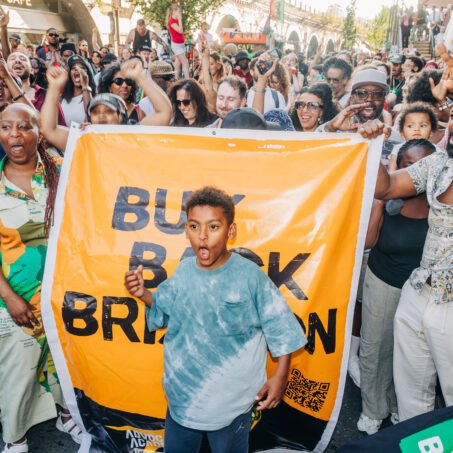
But far right and racist-sectarian actors are not the only organised groups operating in Belfast. One of the surprising things I heard from Marissa is that, despite the ongoing risks posed by the far right, she felt less anxious around the eleventh and twelfth this year thanks to the massive demonstration against racism that Belfast saw days after the pogroms.
The sense I got from her and the others I interviewed is that, because they don’t wait for the state to act – she told me that one of the racialised families being threatened had spent so long trying to reach the PSNI (four hours) that she actually reached them first – they find ways to help each other directly.
That’s what also happened in the immediate aftermath of the violence. It was Anaka, assisted by various groups such as quakers and travellers and otherwise ‘apolitical’ families, that stepped up to help the community. When loyalist groups threatened a young man out of his neighbourhood, Anaka found him accommodation for a week. The collective even had people in Scotland offer their homes for those who need shelter from loyalist groups.
Stories like these are part of what I want to explore further. One thing I’ve learned from Lebanon is that the process of sectarianisation – the process through which sectarianism is created and reproduced – is not some impermutable law of nature. It is a social construct that also contains within it the potential for its antithesis, de-sectarianisation. The same is true of racialisation, both of which are intimately linked in NI.
In other words, what Anaka, the Accountability Project Northern Ireland and all other activist groups in Belfast are doing is both immediate – opposing racism, calling for accountability, and so on – and long-term. Sectarianisation and racialisation require a sense of inevitability. In addition to being embedded in structures of power, they also require a buy-in from enough of the population who are told that these are merely normal parts of life in NI.
By rejecting this and demanding something better, the activists are embodying a vision that could, with time and effort, dislodge a decades-long status quo (with even older roots), with enormous repercussions for the global fight against the far right.
What can you do?
- Check out Elia’s project: From Beirut to Belfast
- Follow and support Anaka Women’s Collective
- Follow and support the Accountability Project
- Listen to Lee Hurley’s dispatch from Belfast
- Listen to How to Gael episode on “How to Unite Ireland” episode 6 with Tanistry
- Read Claire Mitchell’s book “The Ghost Limb: Alternative Protestants and the Spirit of 1798” and listen to the audio mini-series about it on RTE radio.
- Watch the docuseries “Once upon a time in Northern Ireland” on BBC iPlayer
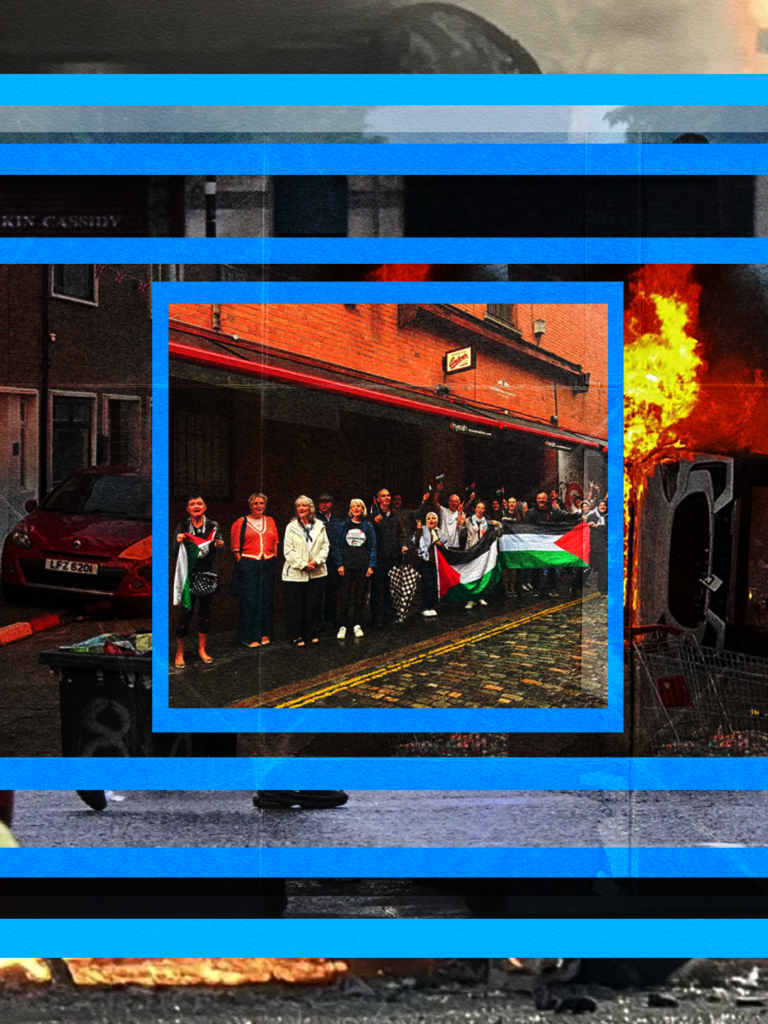 Illustration by @alexefrancis