Is art inherently bourgeois? Yes, says Arthur Moyse in his article ‘The Mirror of Illusion’, from a September 1968 edition of Anarchy magazine I found while undertaking a placement at the MayDay Rooms Archive last year. As he puts it:
“The artist is the most alienated and rejected of men, seeking by his art a substitute for living […] Year by year the demand is made as to what is the role of the intellectual elite sick of the thought of grubby hands, within the anarchist society, and the short and brutal answer is that in an anarchist society there is no place for a self-elect intellectual élite sponging as a self-proclaimed right, to the best that society can offer.”
Such assertions are representative of the plethora of polemical assertions I encountered during my placement. My project was simple: try and find any and all connections between anarchist thought and organising with creative practice.
Numerous anarchists, communists and radicals have opposed the very concepts of ‘art’ and the ‘artist’ as bourgeois, hierarchical distinctions of certain people from others (as Eric Gill states more plainly and compassionately in the same issue, “the artist is not a special kind of man: every man is a special kind of artist”).
What such observations obscure are the abundance of anarchic creative practices and creative anarchists which populate the same archive. Rather than reclaiming ‘art’, might it be possible to consider the various practices gathered under and exceeding this title, in relation to radical politics?
The active struggle for new consciousness
Over several months, I looked for anarchists discussing or using creative practice as a means of reflecting their politics, as well as creative practitioners (largely artists, musicians and poets) behaving anarchically in their work. I found overlaps between anarchism and creative practice in all manner of different and surprising places.
From psycho-geographic letters to self-built houses, ‘Schools Anarchy Propagation’ groups to concerts in aid of anarchist prisoners, to prison poems; exhibition, film, book and concert reviews (even anarchist magazines used to get press passes, it seems); cross-issue arguments about art and anarchy in Freedom magazine, anarchist punk interviews and music teaching in schools; transmissions on pirate radio; and non-hierarchical music groups. I found an article advocating putting the Tate gallery’s artworks in storage out on the streets (one of my favourites), self-destructive art practices, creative vandalism, art strikes and ballads against work.
I did this because, despite the hierarchical status of ‘art’, I believe there’s a very fruitful and under-discussed connection (or coalition) to be made here among practitioners and activists, anarchist or otherwise. Playing closer attention to the tools shared across these two sites might lead us, hopefully, to both create and organise in more capacious, destructive and generative ways.
As Marxist theorist Raymond Williams argues, creative practice “is already, and actively, our practical consciousness” as human beings attempting to navigate the world, and each other. “When it becomes struggle”, he adds, “the active struggle for new consciousness through new relationships […] it can take many forms.” Launching from my placement, I organised a series of events at the MayDay rooms, trying to explore what those forms might be, and how taking the relationships between anarchism and creative practice more seriously helps us find them.
What is anarchism?
Maybe an important question at this stage would be, what even is anarchism? We might say that anarchism is a form of revolutionary action which seeks to destroy all forms of hierarchy. The principle hierarchies anarchists tend to focus on destroying are capitalism and the state, along with their systematic forms of inequality, but hierarchies can be found everywhere, in relations of race, gender, and ability. Anarchists tend to hate the police because they are the protectors of capital and the enforcers of the state, and they also tend to be racist, misogynistic, ableist and queerphobic.
Here I take ‘anarchism’ to refer to the ‘class struggle’ anarchist tradition (anarcho-communists, anarcho-syndicalists, anarcha-feminists and Black anarchists) rather than certain individualist anarchist currents (this may seem like a cop-out to some, but, other than disagreeing with them, I also don’t find right-wing libertarians particularly interesting). There is an incredibly detailed and rich shado article exploring the definitions and tensions within anarchism by the Muntjac Collective.
The late anarchist anthropologist David Graeber notes that, contrary to Marxism which tends to be animated by great thinkers and their theories of revolutionary strategy, anarchism “is primarily concerned with forms of practice […] as much as possible, one must oneself, in one’s relations with one’s friends and allies, embody the society one wishes to create.” This focus on practice is why I think anarchism is so worth considering in relation to creative work.
Why anarchism?
Anarchism is almost synonymous with its specific forms of practice: direct action, mutual aid, and horizontal forms of organisation. Through these, anarchism is necessarily creative. It desires to create a new society “within the shell of the old” (the old anarchist maxim) through forms of prefigurative practice. To again quote Graeber, “it tends […] towards a kind of inspirational, creative play.” Often this involves tapping into forms of spontaneity, compassion, and solidarity which anarchists find already exist in everyday social life.
So, in anarchism, we have a form of political and social organising which emphasises practice, explicitly thinking about the ways we do things with each other in less hierarchical forms. The creative spaces that open up when making things together, in collaborative music and art-making, might offer generative sites for rehearsing these other social possibilities. Both of these sites, in their most engaged forms, ask: how can we be with each other in new and better ways, in order to make better the very worlds which we exist within.
Attempting to bring this all together somehow, my event series chose some examples to explore specific questions: What might it mean to consider creative practice a form of direct action, or vice-versa? How can artists incorporate the principles of mutual aid into their work? How can we make and organise under the immense historical weight of all that’s already been done? And how can we look at this not as an archive of failures but of experiments which continue to inspire new ways of making and being with each other?
Creative anarchy
My hope, with the series, was to tap into forms of creative play, in our discussions and interactions with archival material, which helped inspire such play to continue into the forms of creation and organising of those present.
The series was split into three events. In our first event, ‘Creativity and Direct Action’, I spoke with Stefan Szczelkun, artist and former member of the Scratch Orchestra, a British experimental performance group which existed from 1969 to 1974. We covered the group’s experiments with radical creative democracy, specifically a performance led by Szczelkun and other members of the Scratch Orchestra’s anarchic subgroup ‘the slippery merchants’, which involved building a cottage inside an art exhibition in Alexandra Palace.
The cottage was “conceived as a place to play – insulated from the context of high art,” and was built by the group’s members using found materials, in order to hold an alternative space within the exhibition space. In this experiment I see a clear articulation of the principles of direct action funnelled through a creative project: the ends being consonant with the means (getting everyone to collectively learn how to build the cottage and work together to achieve it) and the prefigurative quality of the action (creating the alternative world for creativity you want within the hierarchical world around it).
As a group, we spoke about the possibilities for social prefiguration in artistic work, as well as how radical projects can be incorporated into traditional hierarchical art spaces (materials pertaining to the cottage were featured in Documenta 14 in Athens). We even performed one of the Scratch Orchestra’s ‘improvisation rites’, a series of collectively authored text pieces, which involved speaking in gibberish to each other. For a brief moment all of us, regardless of training, experience or ability, came together to make something, existing in an alternative world while doing so.
Interrupting the normal
The second event, ‘Situationism Revisited’ explored the afterlives of the Situationist International. Formed in Europe in the 1950s, the group and their unique practices have been incredibly influential (most notably, perhaps, in the situationist slogans synonymous with the 1968 uprisings in Paris), inspiring numerous radicals who’ve since attempted to interrupt, and create revolutionary possibility from, everyday life.
Join our mailing list
Sign up for shado's picks of the week! Dropping in your inbox every Friday, we share news from inside shado + out, plus job listings, event recommendations and actions ✊
Sign up for shado's picks of the week! Dropping in your inbox every Friday, we share news from inside shado + out, plus job listings, event recommendations and actions ✊
I wanted to figure out why, despite many situationists not defining themselves as anarchists, many anarchists have drawn upon situationist forms of practice in their art and organising. These include ‘détournement’ (“turning expressions of the capitalist system against itself” by co-opting advertisements, for example), ‘psychogeography’ and ‘dérive’ (intentional wandering, ‘drifting’ throughout the city, or in conversation), and three-sided football (self-explanatory).
The room was filled to the brim with situationists, some veterans, some in the making, and some who found the event title controversial, as it implied there was such a thing as situationism proper. Our conversation was a whirlwind of historical arguments about specificities and interpretations, critiques of the gendered assumptions of some traditional situationist techniques, and critiques of those critiques.
What emerged was a consensus that the enduring legacy and utility of the techniques named above, particularly for anarchists (including groups like Up Against the Wall Motherfucker), lies precisely in their practical nature. They provide clear methods for subverting and undermining the world as it is, with creative and organisational uses. Sometimes the weight of history can transform into a toolbox, and, as one of the speakers, Mark Dyson, kept reminding us, “you’ve got to just do it”. Footage from that event, taken by Asim from the psychic workers’ union, can be found here.
Mutual aid
Our final event, ‘Creativity and Mutual Aid’, involved a discussion with artist Ruth Catlow and Jo from trans mutual aid group We Exist. It was a beautiful discussion traversing the ways that artistic labour itself can manifest mutual aid principles, the role of care in collaboration and political organising, the terrors of intellectual property and the necessity of asking for help as well as providing it.
The session finished with an impromptu ‘needs’ sharing circle, where we actively asked each other for help and set up ways to provide it. People found others to print things off for them, or to try and set up childcare webs with, and other forms of collaborative support.
We all agreed this should be a more regular part of events and organising spaces. An enduring sentiment across the sessions was, ironically, to stop thinking so much about how we might go about doing things and to just start doing them, working through the intricacies and best practices in the very act of doing.
Why direct action?
More than ever, I think it is worth thinking through how we might implement anarchist principles like mutual aid and direct action in our daily practices, including in creative work. Instead of delegating responsibility to other groups which often gain their power through hierarchical means – elected officials, for example – embracing direct action and mutual aid (which I view as one possible iteration of direct action) allows us to render them unnecessary.
Direct action does not seek permission from existing hierarchical structures; rather, it proceeds as if they do not exist. As is made clear by both the proscription of direct action group Palestine Action and persistent attempts by the UK government and courts to not provide actionists with a fair trial, direct action not only works, but it can invoke feelings far beyond its immediate participants, and governments are absolutely terrified of its consequences.
As I’ve written about elsewhere, the conditions for creative labour in the present are utterly inadequate, and more radical responses to these conditions are needed. Rather than appealing to fickle state and institutional reforms which might marginally improve conditions without completely upending them, what if we created alternative spaces and webs of support, which meant such appeals were no longer needed? What if we seized the means of creative production, so to speak?
When undertaking forms of direct action, the ends absolutely do not justify the means: the means are the very core of the action. How do we create a world, no matter how temporary, where the hierarchy doesn’t exist, where the factory doesn’t produce weapons, where housing is freely available, and where everyone can eat?
I think it’s a perfect time to talk a lot about direct action, not by giving away any plans but by reclaiming its discursive power from the authoritarian state and right-wing media, who are most people’s first interaction with it.
We need to make space to figure out what to do and how we think about it together, and I believe creative practice can play a key role in that process. As Emma Goldman noted over 100 years ago: “Direct action, having proven effective along economic lines, is equally potent in the environment of the individual. There a hundred forces encroach upon [their] being, and only persistent resistance to them will finally set [them] free.”
What can you do?
- Get involved with local mutual aid groups. I live in Cambridge, so would encourage anyone else who also does to get involved with Cambridge Community Kitchen (CCK). If there aren’t any where you live, try and set one up!
- Visit anarchist archival spaces like the MayDay Rooms or 56a infoshop.
- Read the aforementioned shado article on anarchism by the Muntjack Collective, which puts things better than I ever could.
- Listen to this Red Medicine episode on Catalan anarchist Francesc Tosquelles, who among other incredibly inspirational things promoted environments of creative freedom under extremely dire conditions.
- Read some Emma Goldman, specifically her musings on Direct Action on pages 76-77.
- Read some of David Graeber’s Direct Action: An Ethnography, which is both riveting and essential theorising.
- Read Saidiya Hartman’s Wayward Lives, Beautiful Experiments, which lovingly documents the everyday anarchy of marginal existence.
- Read Marquis Bey’s Anarcho-Blackness: Notes Toward a Black Anarchism, which is immensely powerful and galvanising.
- If you feel animated by the topics I’ve been thinking about, whether or not you attended the event series, please get in touch with me at ruarilpa@gmail.com. I am hoping to organise some collective writing sessions where we will write a sort of ‘creative anarchy’ manifesto. If you would like to be part of these, do let me know.
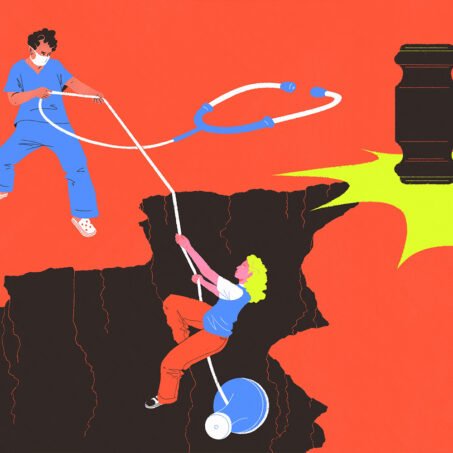
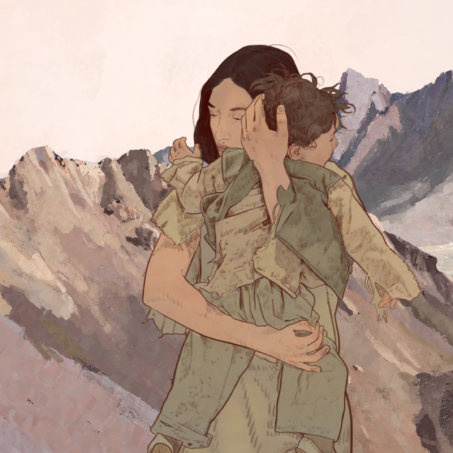
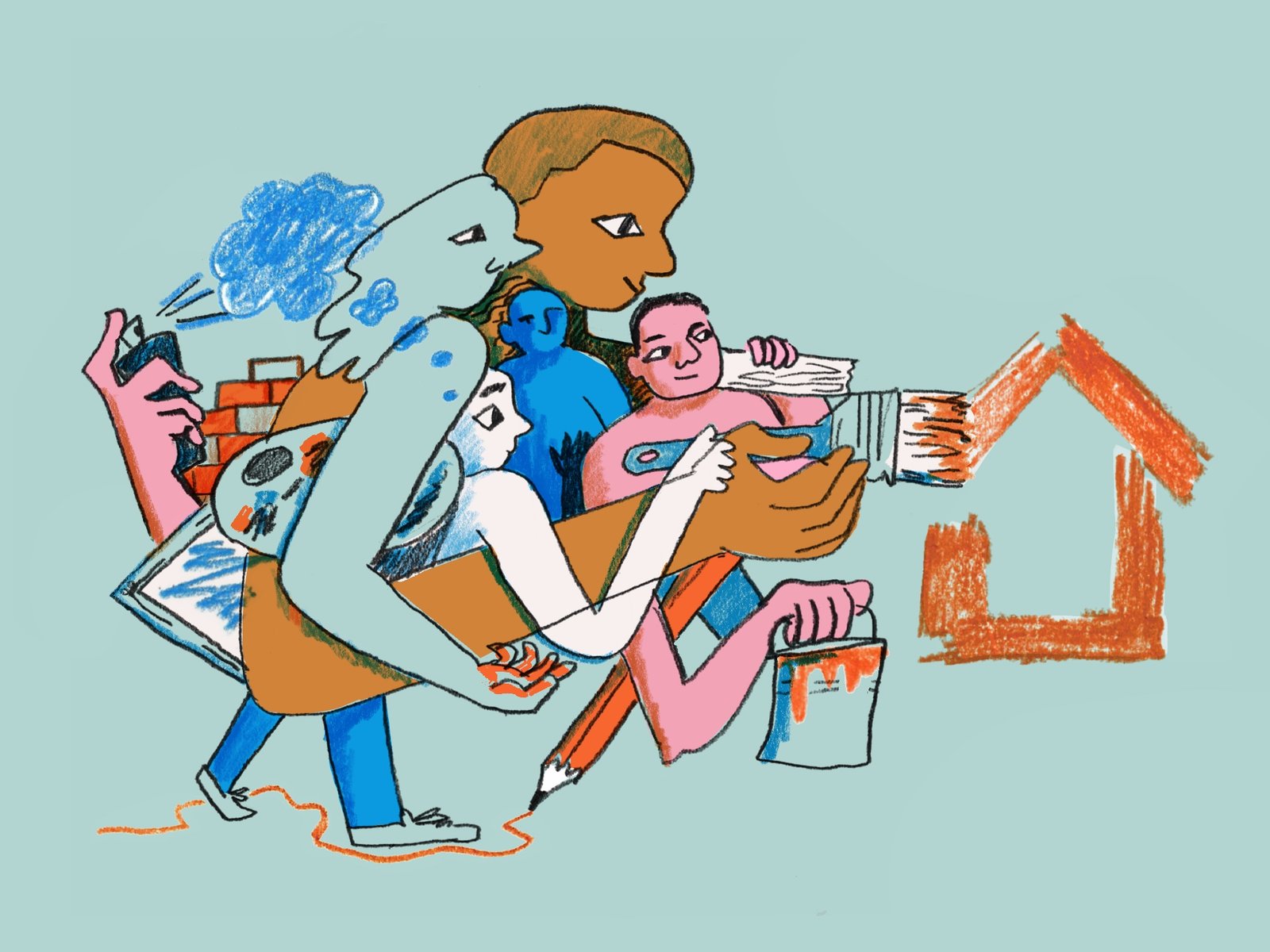
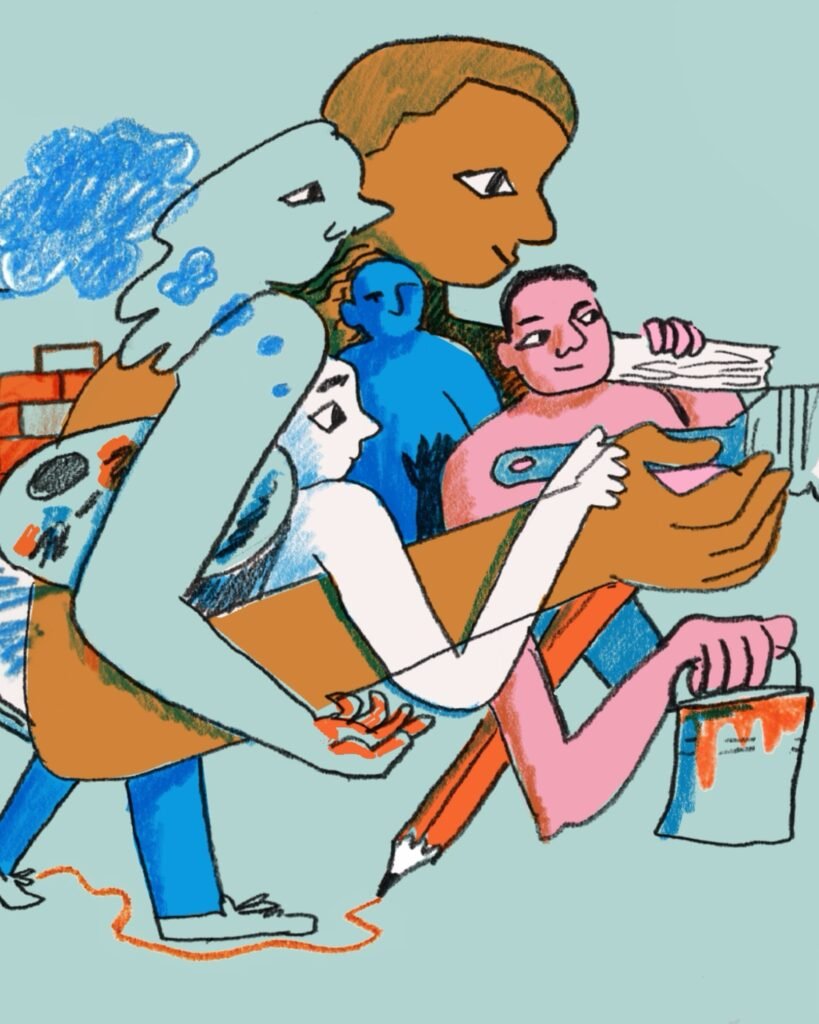 Illustration by @beck.oh who says: “I focused on collaboration and creativity as a practical tool. These people are using many forms of artmaking to move, using it to both envision and create the future they wish to live in.”