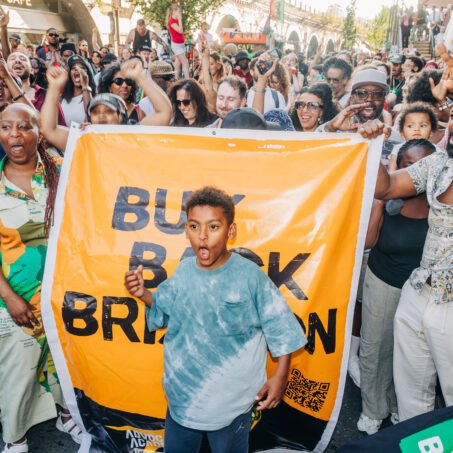

By 9am on 16th May, the anxiety through my phone was palpable. Is it safe to change at Victoria? I’ll bring spare water and masks. I’m staying indoors today, not risking it.
When the far right come to town, the choice for many of us – Black, brown, queer and progressive – is never abstract. Do we stay home, or do we fight against the people who want to dictate who gets to belong?
I kept thinking of my nephew, a young Sikh boy growing up into a much more hostile world than I imagined he’d inherit. So for me, the choice was simple: we show the younger generation the courage that we were brought up with, and we show up and fight.
On the shoulders of giants
My nephew has broad shoulders to stand on. His grandmother – my aunt – was a founding member of the Southall Black Sisters, and understood that fighting the far right required solidarity across communities and political traditions. She did not just speak about justice, she organised it. Standing up to racists in the street, distributing leaflets in the rain and joining meetings late into the evening. The Southall Black Sisters forged broad alliances of anti-racist feminists who won battles for women against racism and domestic violence, most famously in the landmark Ahluwalia case which changed the law for domestic violence victims charged with murder.
That same commitment to solidarity shaped my grandfather’s politics, who not only built movements across ethnic and political lines, but also wrote and sold revolutionary books, chaired meetings, raised money for Sri Lankan tea plantation workers facing exploitation and brought people together through community kitchens. He did this because he understood that division was a political strategy and that surviving the genocidal violence of the Sri Lankan state required collective resistance.
I grew up with these stories, long before I understood their politics and discovered that they were part of a much wider tradition of collective resistance.
I speak with Pritam Lal, a member of the Hounslow anti-fascist movement, who shares anecdotes about defeating fascists locally in the 80s. “On our estate, racists had attacked an elderly Asian woman in the lifts. They jammed her leg in the doors causing serious injury, they also beat up a young kid and smashed his bike,” Pritam remembers. “We were all connected, and knew who the people carrying out the racist attacks were, which made it easy to find them, so we would confront them on their doorstep. They weren’t so brave when they were facing the whole community.” Pritam’s tale shows us that strong community networks make racists a minority in public, which is where it matters.
The playbook already exists
We need to remember that we already have the playbook – fighting the far right is not new for our communities. We inherit long traditions of radical kinship and collective struggle: the Dalit Panthers in India learnt from and built alongside the Black Panther Party. Anti-racist movements have always learned from one another across borders, generations and political traditions. More recently, anti-raids groups in Glasgow, Croydon and across the country have physically resisted detention vans and deportations.
This year marks five years since the Battle of Kenmure Street, where Glaswegians took to the streets to stop the deportation of their neighbours Sumit and Lakhvir Singh. It also marks 50 years since the cross-community Southall Youth Movement rose up after the murder of Gurdip Singh Chaggar to fight police violence and a rising far-right.
Those movements succeeded not because they waited for institutions to save them, but because ordinary people organised where they lived. They built local defence campaigns, youth movements, legal support networks and political education projects. For them, anti-racism was not a moral performance but a condition of survival.
A movement built on fear
By the time I reached Embankment, I could see hundreds of St George’s Crosses. But I could see more Palestinian flags.
This second “Unite The Kingdom” march was billed as the largest mobilisation of the far right in modern British history. For weeks, organisers and commentators had warned that central London would become a stage for nationalist spectacle: chants about “taking our country back,” people drunk on nostalgia and grievance. But that weekend, we won. The largest demonstration in the capital that day was the pro-Palestine rally marking the Nakba, a reminder that the far right does not speak for the majority it claims to represent.
They only managed ten thousand people. By mid-afternoon, they went home tanked up after a boring day in London.
Let’s be realistic, though: while 10,000 might not sound like a mass movement in a country of millions, the danger of the far right has never simply been its numbers. It is its ability to drag public discourse further towards cruelty, to make once-unthinkable policies seem reasonable, to convince people that migrants, Muslims, trans people or refugees are responsible for crises created by decades of political failure and economic abandonment.
Figures like Tommy Robinson no longer need electoral success to shape politics. Their role is to create pressure and incite violence until harsher policies appear normal. The racist pogroms in Belfast and the disorder in Southampton are the latest manifestations of a far right movement whose repertoire of organised aggression continues to expand.
In the same vein, we must be realistic about how much the ballot box can save us. While we may take joy in the rise of a new insurgent progressive movement and the latest brand being Green, the electoral system is designed to trap us in a cycle of liberalism and fascism. I spoke with Zehrah Hasan, immigration lawyer, organiser and migrants rights campaigner, who explains: “We cannot vote our way out of fascism.” The only way to break this cycle and defeat fascism is through organisation, not representation alone.
“It is devastating to see how parts of our own communities are more fractured now than they have been in the past,” continues Zehrah. “But we must remake the bonds of true anti-racist solidarity; recognising that Muslim, migrant and Black communities are now at the sharpest end of racial and class violence in Britain, and imperial violence abroad.”
She’s right. Divide and rule has always been the Empire’s most effective tool: turning communities against one another, cultivating fear and suspicion, depoliticising us and fragmenting people along racial, religious and economic lines. They want us exhausted enough to retreat into private life while they occupy public space uncontested – but as our history shows, every victory against fascism, racism and state violence has come when people refused isolation and chose solidarity instead.

Planting something stronger
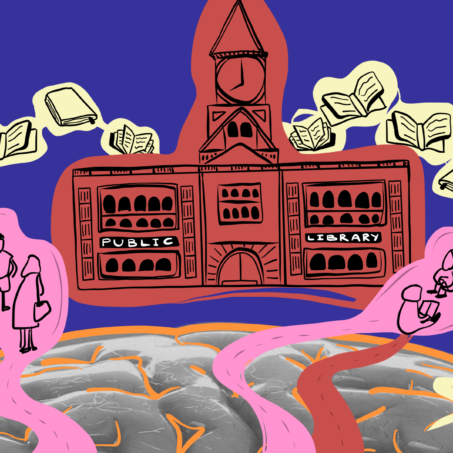
As far right politics gains institutional and cultural legitimacy, I come back to my nephew. His local library has been gutted, and recently the youth centre also shuttered its doors. This lack of vital public infrastructure fragments our communities, which in turn provides a chasm which the far right is quick to occupy. It’s clear that the need for popular solidarity has never been more urgent. The successful counterprotest in May was exhilarating, but it is not enough to resist the far right when it marches through our cities. We must build the kinds of communities where its politics cannot take root in the first place. Because when ordinary people organise together, the far right loses its greatest weapon: isolation.
The far right of 2026 is different from the National Front of the 1970s and the English Defence League of the 2010s. It has learned to speak the language of culture wars, “free speech” and patriotism while recycling the same old racism underneath. What once existed on the political fringe now bleeds into mainstream debate nightly through television panels and TikTok clips which reach a million views before lunchtime.
Join our mailing list
Sign up for shado's picks of the week! Dropping in your inbox every Friday, we share news from inside shado + out, plus job listings, event recommendations and actions ✊
Sign up for shado's picks of the week! Dropping in your inbox every Friday, we share news from inside shado + out, plus job listings, event recommendations and actions ✊
The digital terrain changes the tempo, with the growth of the paid advertising, meme culture and viral content – but the battle is the same. Our struggles are still tied together. It takes the form of community self defence, militant workers and renters unions, grassroots mobilisation and global solidarity.
The future is organised
The work is slower than a rally and less visible than a viral post. It happens in tenants unions, football fan groups, charity networks, youth clubs, social clubs, workplaces, places of worship, mutual aid groups and neighbourhood campaigns. It happens whenever people decide that someone else’s safety and dignity matters to them too.
Ultimately, it means building a cross-community, multiracial working class movement. White, Black and brown working class communities cannot fight this battle in isolation from one another. Trade unions must rediscover their radical purpose, not simply negotiating pay, but defending multiracial working class solidarity against division, scapegoating and organised hatred.
This is the organising that Zehrah, Pritam, our ancestors and others across the anti-racist movement are doing. It is work many of our communities, after generations of relative social stability and economic comfort in Britain, must urgently return to.
The far right is preparing for the future. Our task is to prepare too: building trust, bridges and infrastructure within and across our communities strong enough to withstand division. The future they desire is not inevitable. Like those before us, we can organise to prevent it.
What can you do?
- Read The Autobiography of Malcolm X
- Join your local anti-raids network
- Join a union or unionise your workplace
- Read The Black Jacobins, C.L.R. James
- Follow Anti-Racist Action Group @SunNeverSetsss
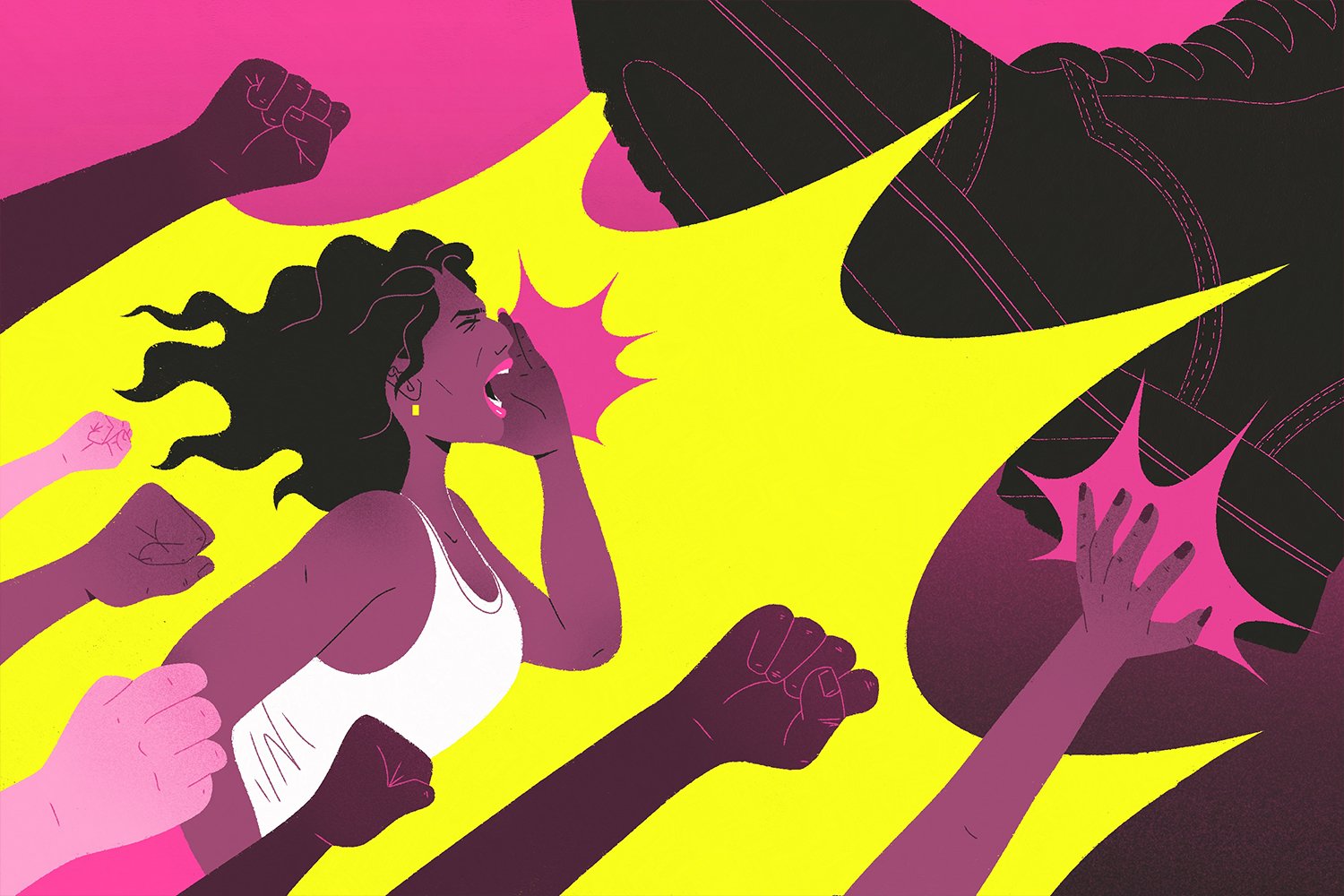
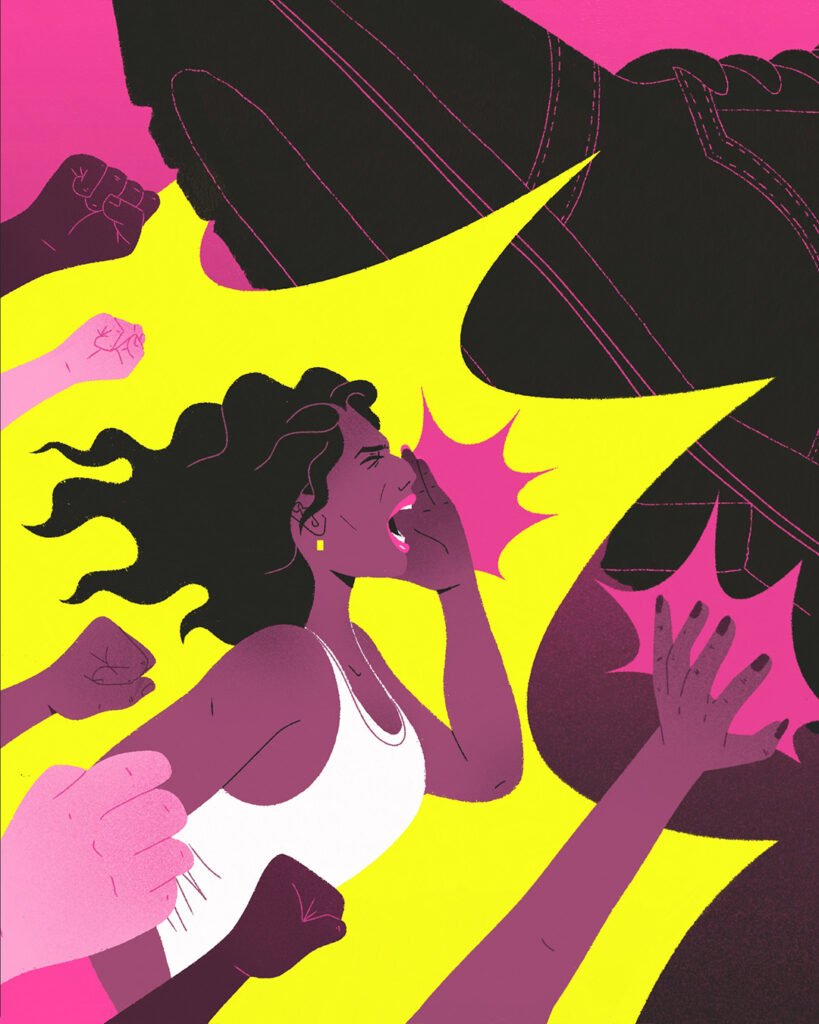 Illustration by @kalakal_klk who says: “A woman stands fiercely, surrounded by her community. The boot, which was about to step on them, is almost covered by the energy of the resisting crowd. A hand grabs it to stop its progression. None of them would be able to resist the march of fascism alone, but there’s strength in numbers.”