Tate Modern’s Nigerian Modernism explores the development of modern art in Nigeria between the 1940s and the late 20th century. The exhibition, curated by Osei Bonsu and Bilal Akkouche, brings together a large and ambitious group of works, with more than 250 objects, ranging from paintings, sculptures, textiles, and photography.
The exhibition shows us the multiple ways Nigerian artists responded to colonial rule, independence, and post-independent state formation. The exhibition includes the works of artists such as Aina Onabolu and others who adapted European academic techniques; Ladi Kwali’s intricate pottery that helped place West African ceramics on the international stage; the radical projects of groups such as the Zaria Art Society; adaptations of print and textile traditions, such as Adire and batik; and more experimental works that tackled politics, identity, and nationhood. What the exhibition did not prepare me for was the feeling of moral and symbolic dissonance it produced, that I found I could not resolve, and that I suspect is not incidental to the work on the show.
It brings together the works of pioneers of Nigerian modern art, and, in many ways, the contemporary art we know today. The exhibition reveals how these artists synthesised traditional Indigenous art forms, philosophies, and aesthetics with western mediums and techniques. It acknowledges the distinctive and stylised way Indigenous art was practised, while showing how these artists express these in the modern sense.
The dissonance awakens
Upon arriving at the exhibition, I was intrigued. The pieces looked beautiful, the exhibition seemed well curated, and as a Nigerian, I felt proud and glad to be in a space that centered the history of my country. However, as I made my way through the rooms, I couldn’t shake a strange feeling that I could not describe.
As I like to do when these feelings arise, I speak to people about them – especially people that have the context that arose the feeling. Luckily, I quickly ran into a friend. She was there with another friend, and had been taking in the exhibition as I had. I asked for their thoughts, and they helped me put language to my feelings towards the exhibition; it was dissonance that arose from experiencing the conflicting ways these artists negotiated the journey to and the journey after independence.
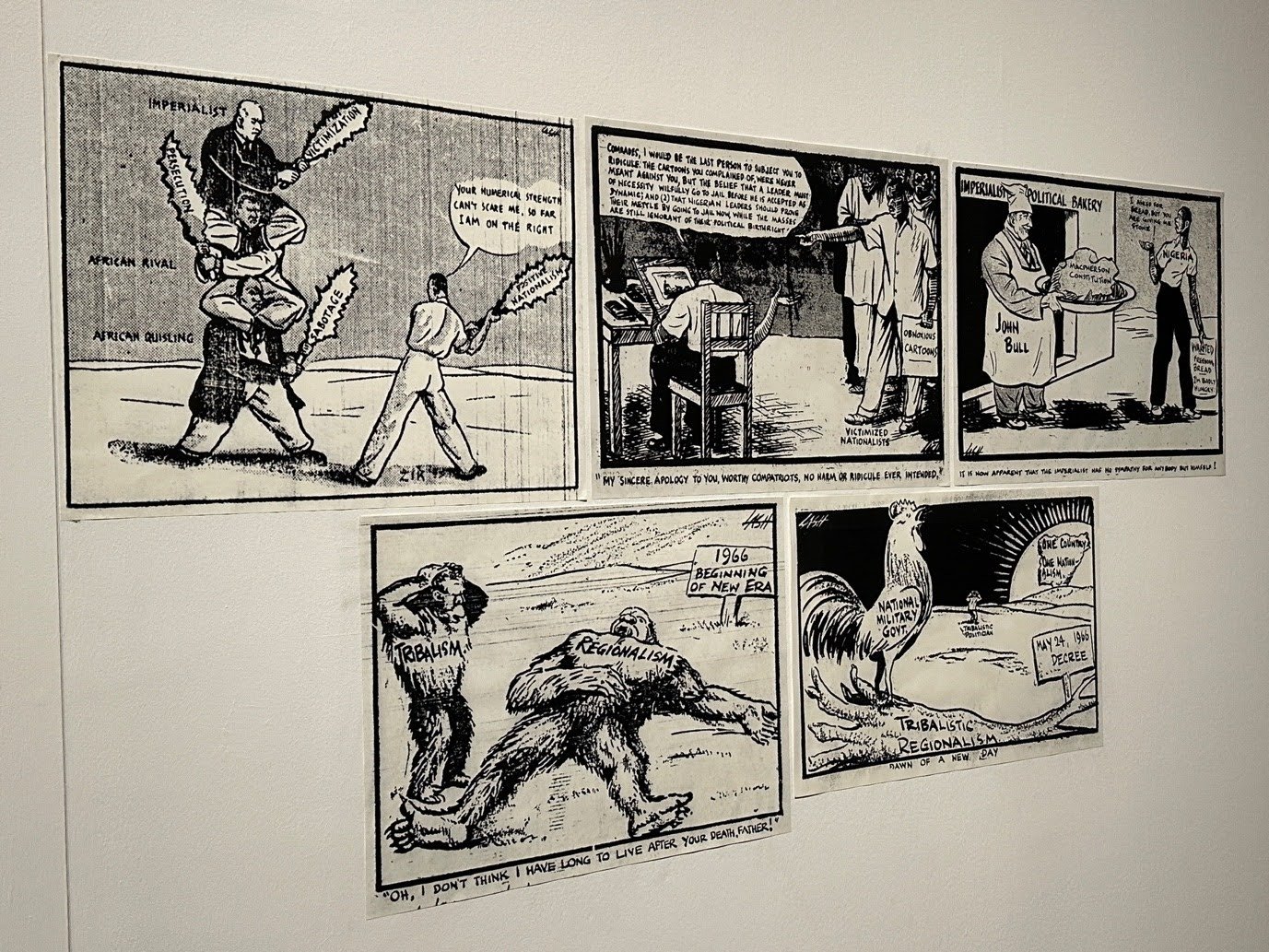
Akinola Lasekan, Cartoons in the Pilot, 1948-66. Facsimiles. Image courtesy of Adebayo Quadry-Adekanbi
We admitted that we could see some arts that express the tension between those who entered and ‘formed’ the country without understanding its people, and those who resisted their presence. This is seen right at the start with Akinola Lasekan’s Cartoons in the Pilot, where we see political sketches that translate these conditions into cartoons. However, we also see how artists had (and still have) to negotiate their way within the system in ways that show a sense of dissonance and even complicity.
Biafran War vs Queen Elizabeth II
No other space was this dissonance more exemplified to me than in Ben Enwonwu’s works. In Storm over Biafra, he depicts the horrors of the Biafran war (1967-1970).
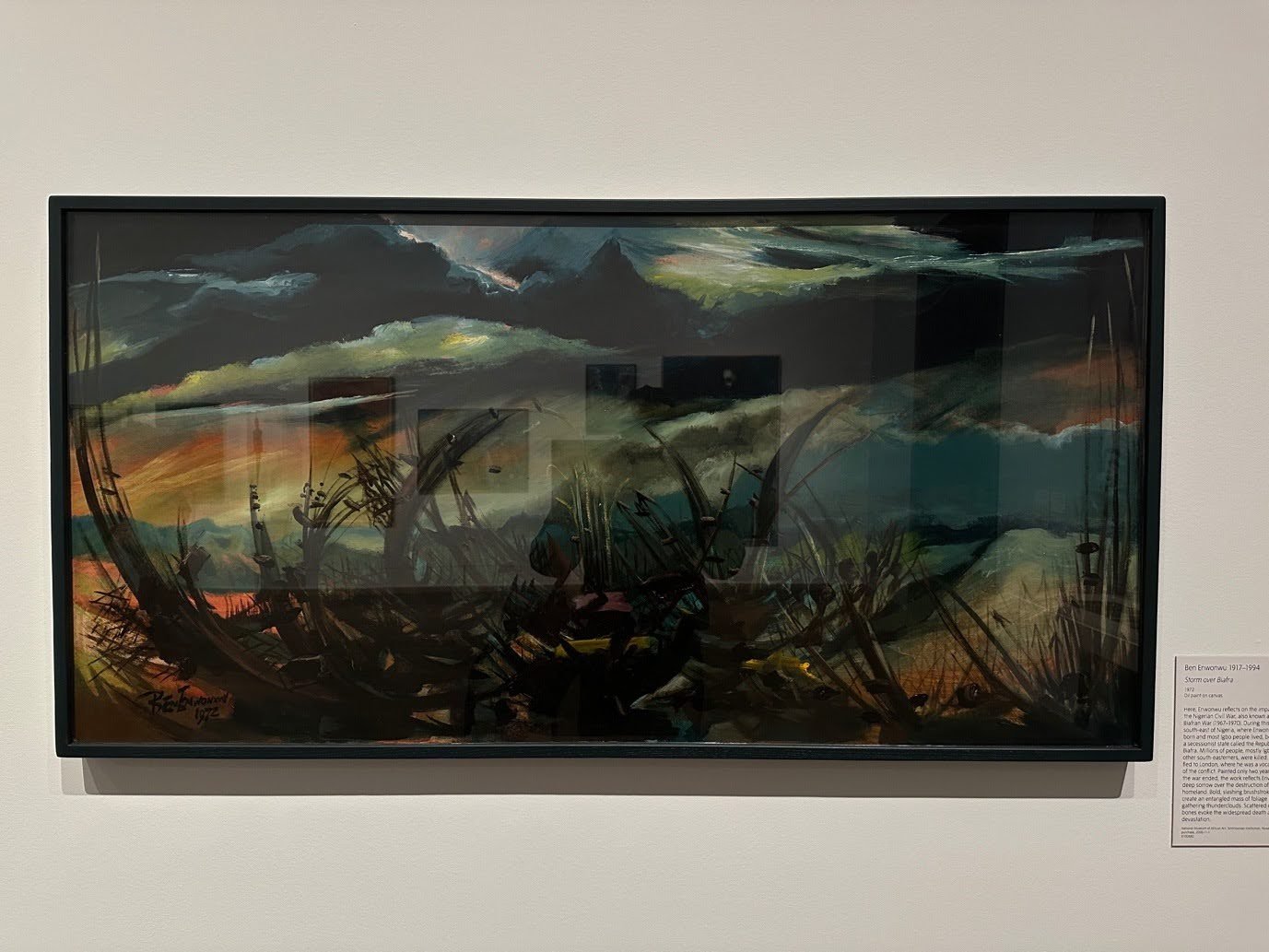
Ben Enwonwu, Storm over Biafra, 1972. Oil paint on canvas. Image courtesy of Adebayo Quadry-Adekanbi
The Biafran War was a civil war that emerged from the political instability and ethnic violence that followed Nigeria’s independence from Britain. After repeated massacres of Igbo people and the failure of the federal government to guarantee their safety, they declared independence as the Republic of Biafra. The Nigerian state responded with a military campaign that included a blockade of the region, deliberately restricting food and medical supplies. This led to a catastrophic famine in which over a million people, most of them civilians, died.
Britain, Nigeria’s ‘former’ colonial ruler, was not simply a neutral observer in the conflict. There were deep strategic and economic interests in Nigeria, particularly relating to oil, much of which was prevalent in the region of the Republic of Biafra. Therefore, the British government consistently supported the Nigerian federal government through arms sales and diplomatic backing. This support continued despite clear evidence that starvation was being used as a weapon of war. British officials justified their position in the name of national unity and ‘postcolonial’ stability, and prioritised state sovereignty over humanitarian concerns.
In fact, as discussed in the label of the work seen below, Enwonu fled to London during this war.
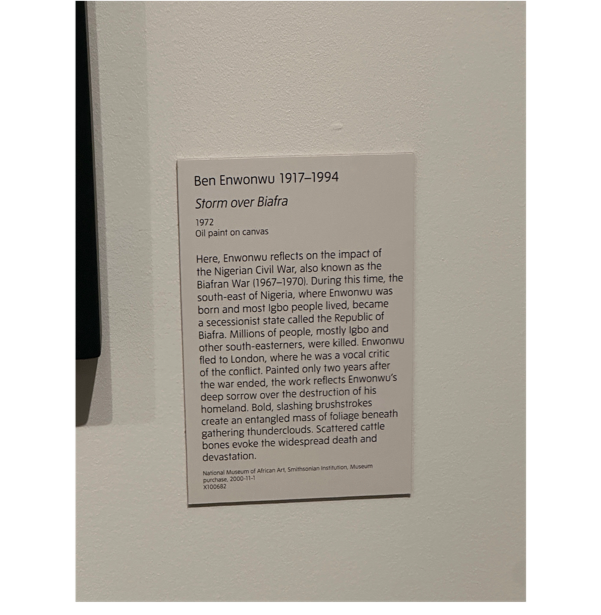
Image courtesy of Adebayo Quadry-Adekanbi
Right next to that piece, on the adjacent wall, was a huge picture of Enwonu with a bronze statue of Queen Elizabeth II. As discussed in the label:
Viewed as an act of diplomacy, the sculpture was created for the Nigerian House of Representatives in preparation for Nigeria’s independence in 1960. Enwonwu himself proposed this commission to commemorate the Queen’s visit to Nigeria in January 1956. A temporary studio was also set up for Enwonwu at Buckingham Palace.
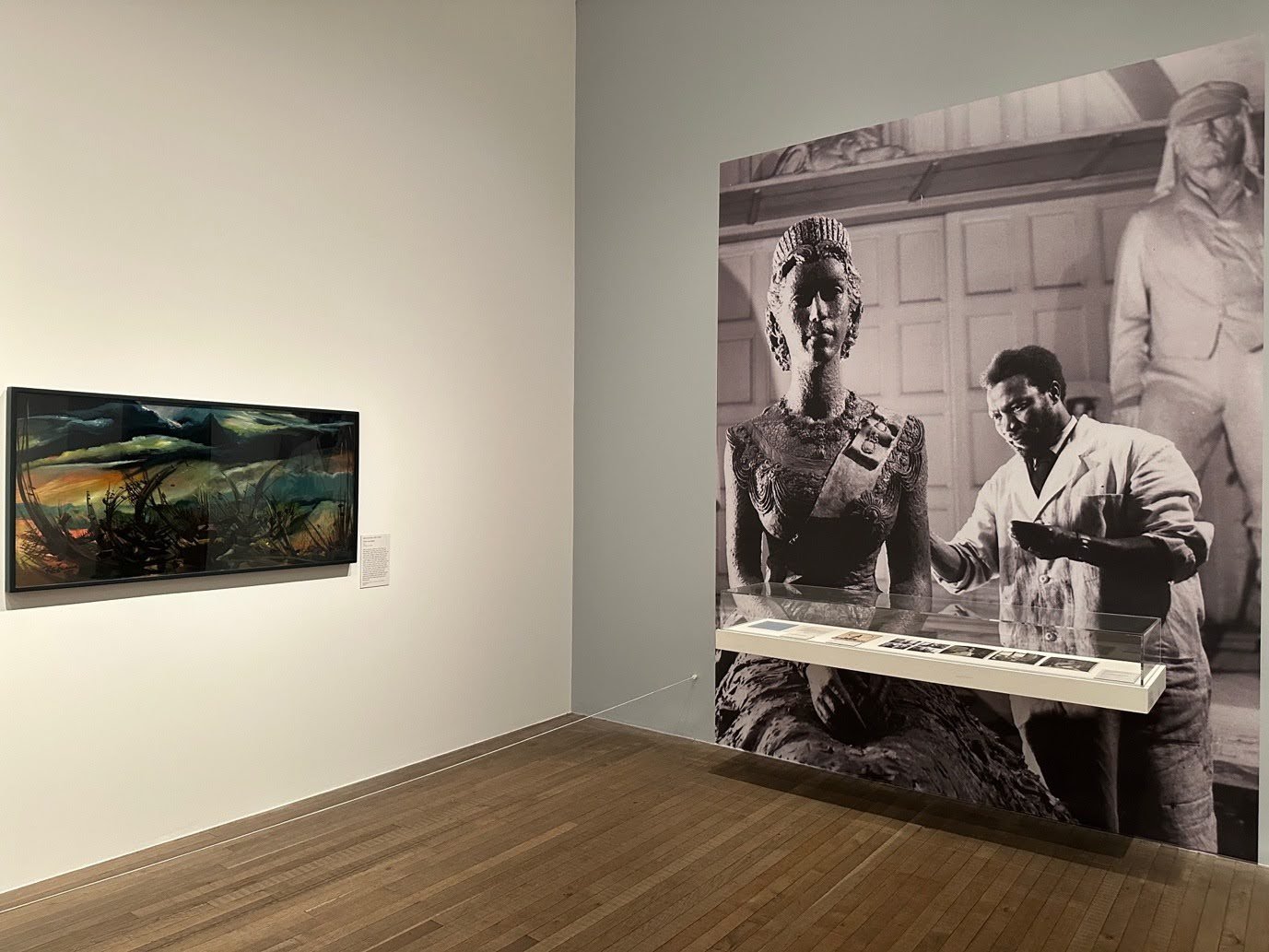
Image courtesy of Adebayo Quadry-Adekanbi
Join our mailing list
Sign up for shado's picks of the week! Dropping in your inbox every Friday, we share news from inside shado + out, plus job listings, event recommendations and actions ✊
Sign up for shado's picks of the week! Dropping in your inbox every Friday, we share news from inside shado + out, plus job listings, event recommendations and actions ✊
Facing these two works side by side was deeply jarring for me, because it suggested a proximity to establishment power that seems at odds with the politically charged moment these works were created. For many Nigerians, particularly those from the former Biafra, Britain is an implicated actor whose decisions materially shaped its outcome.
This history makes the artist’s relationship with British power especially charged. In the wake of the Biafran War, a conflict in which Britain actively supported the Nigerian federal government and remained complicit in mass civilian suffering, the artist’s proposal to commission a sculpture of the Queen, alongside the provision of a studio at Buckingham Palace, cannot be read as politically neutral. It situates the artist within the very structures of imperial authority that had recently underwritten violence against his people.
The proximity in time intensifies this tension. With only two years separating Storm over Biafra (1972) and the image of Enwonwu and the sculpture of the queen (1974), and his elevation by the British establishment, the move from depicting the aftermath of the war to producing celebratory representations for the former colonial power produces a striking moral and symbolic dissonance.
This can rightfully and fairly be seen as professional recognition and artistic success, but for me, it simultaneously raises questions about negotiation, compromise, and the costs of institutional validation.
Is the dissonance intentional or not?
For audiences, like myself, who are attuned to the history of British involvement in the war, this juxtaposition can feel deeply unsettling. It forces viewers to confront how postcolonial artists are often invited into imperial spaces not in spite of colonial violence, but alongside its unresolved legacies. The conditions here remind us of how power can absorb, reframe, and legitimise cultural production, even, and especially, in the aftermath of trauma.
Make no mistake, this is not supposed to be a critique I sit outside of. In fact, I place myself fully in the middle of this moral and symbolic dissonance, as someone who lives and works from the imperial core.
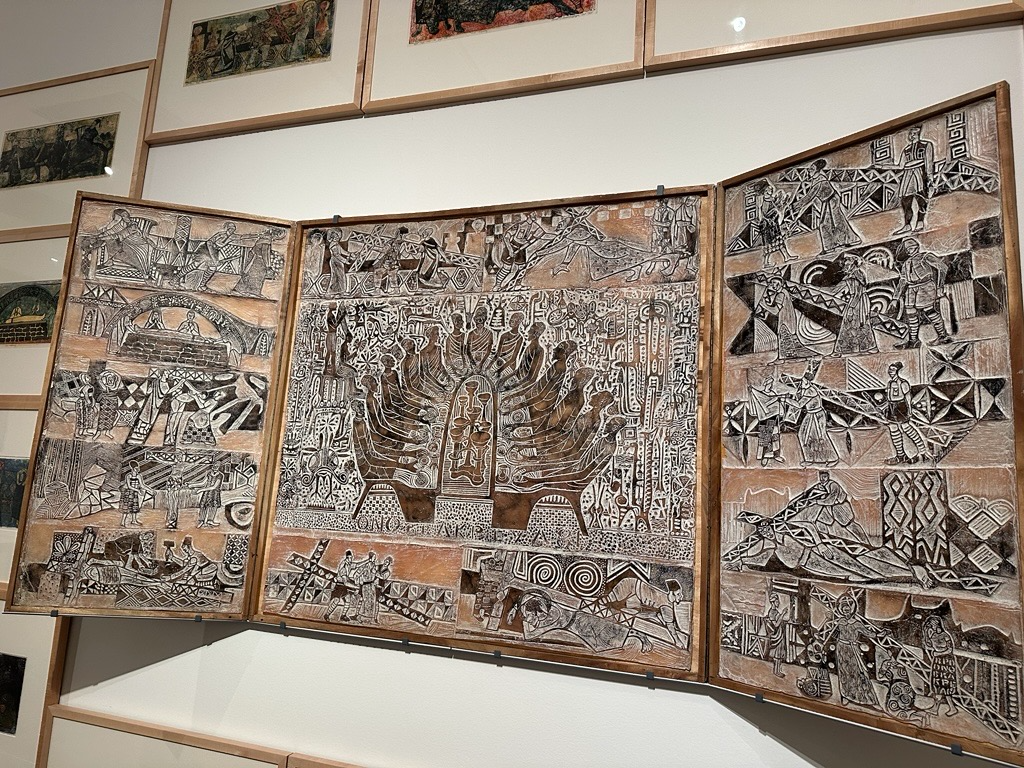
Bruce Onobrakpeya, The Last Supper, 1981. Resin, wood, metal and paint. Image courtesy of Adebayo Quadry-Adekanbi
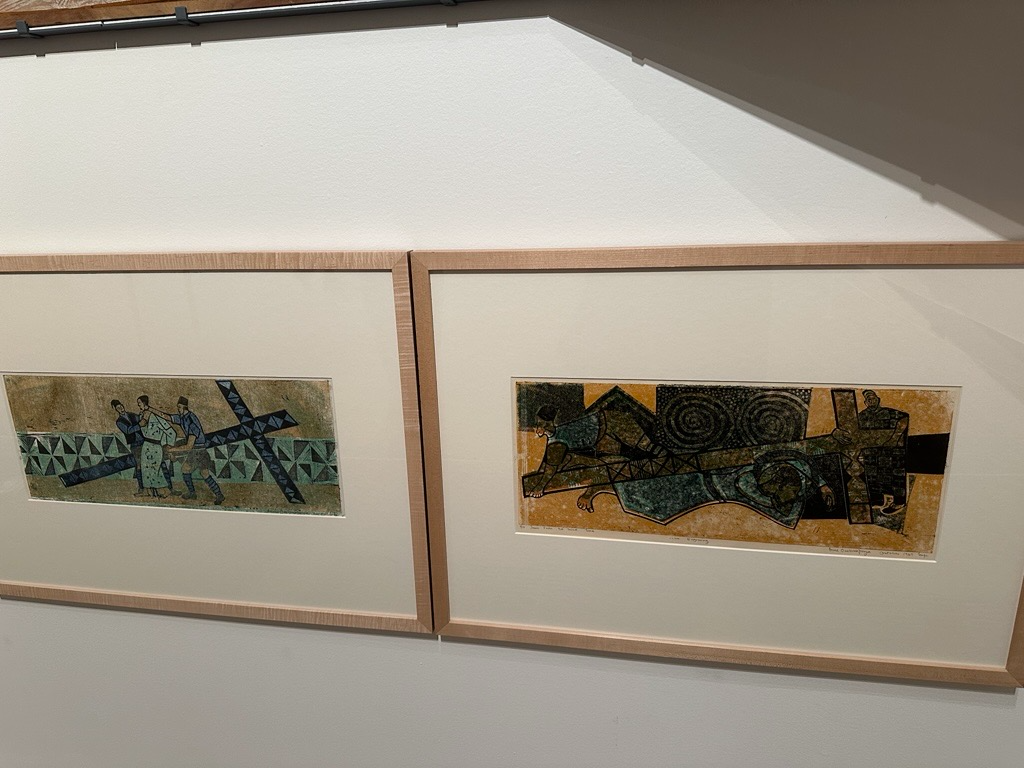
Bruce Onobrakpeya, The Fourteen Stations of the Cross, 1969. Linocut. Image courtesy of Adebayo Quadry-Adekanbi
Notably, this feeling was not confined to Enwonwu’s rooms. Bruce Onobrakpeya’s The Last Supper and The Fourteen Stations of the Cross produced a different but related sense of tension. In these pieces, the Àdìrẹ textile traditions that inspire these are distinctly Yoruba in their form and logic, and are made to carry the weight of Chrisitian iconography. The aesthetic in indigenous, but the symbolic content is colonial. The dissonance operates a little differently, but it’s the same friction.
This made me wonder: was the exhibition curated to intentionally evoke and stage this dissonance that asks viewers to sit with the moral and historical friction between anti-colonial struggle and institutional recognition, or is the dissonance an accidental by-product of a curatorial strategy that flattens complex histories into attractive objects? The answer to this question is important because it has consequences for how this exhibition is received, understood, and appreciated.
If the dissonance is deliberate and clearly signalled, it can be a productive feeling that opens space for critique of the systems that uphold such violence, while simultaneously evoking the pride and beauty of these arts. If it is incidental, unacknowledged, and unexplained, it risks appearing as complacency or, worse, as complicity.
It also begs the question: can an institution (person, e.g. Ben Enwonu or even me, or place, e.g. Tate Modern) that sits at the heart and core of the empire be trusted to represent the lives of the victims of violence enacted by the empire? When institutions at the centre of an imperial power presents work about a violent, contested past without explicitly grappling with that violence, the result is a sanitised narrative of independence.
Independent but not decolonised
Nigeria’s path to independence and the crises that has followed till this day are shaped by sustained resistance by women and men, local and transnational networks, and by the violent interventions of imperial powers. It is important not to see this history as tidy or decorative, as this erases the labour, refusal, and feminist and communal practices that makes the efforts towards decolonisation (which we are far from achieving despite being independent) more than a simple ceremony.
Likewise, the contemporary machinery of international development, cultural sponsorship, and restitution can perform a new kind of pacification: returning objects, funding galleries or sponsoring exhibitions in ways that reproduce old hierarchies.
Nowhere is this clearer than in the fraught launch of the Museum of West African Art (MOWAA) in Benin City, Nigeria. The museum was intended as a flagship home for returned Benin Bronzes, but the museum’s preview events in November 2025 were disrupted by angry protests. Supporters of the Oba of Benin objected that the new institution had been established and funded without proper royal consultation, and warned that the project risked usurping the Oba’s custodial claim over the bronzes. This exposed how international donors and government actors drive high-profile restitution projects, local elites and traditional authorities jockey for control, and ordinary communities are sidelined in the process.
How do we negotiate moving forward?
I headed home from this exhibition with a deep feeling of dissonance that I could not (and still cannot) resolve. I couldn’t help but consider how I (and many of us) have had to negotiate our existences within spaces of violence. We can see with the artists in this exhibition that it has been a while that we have been negotiating our existences with violent imperial systems.
I will be frank: I do not know what ‘negotiating’ should look like now. After decades of negotiating with institutions that profited from empire, it is reasonable to wonder whether negotiation has exhausted its moral currency. Do we keep seeking validation inside the very spaces that helped make the wound? Do we accept invitations to be celebrated by the same powers whose legacies we continue to carry, and do so at the cost of silencing other truths? Or is there value in refusing these, and building alternative forums of memory, practice, and stewardship outside the rooms where imperial histories are tightly policed?
I don’t have the answers to these questions. But perhaps we can think of them as we engage with this exhibition.
What can you do?
-
- Visit the exhibition Nigerian Modernism, open until 10th May 2026
- Watch Journey of an African Colony on Youtube
- Read Decolonization and Afro-feminism by Sylvia Tamale
- Listen to the podcast: Re-Queering and Reconceptualising the work of Rotimi Fani-Kayode
- Read The Invention of Women: Making an African Sense of Western Gender Discourses by Oyeronke Oyewumi
- Read more articles by Adebayo HERE