
In the right wing circle of hell that is X, a user posted an April 30th exchange between US Secretary of State Marco Rubio and Triumph the Insult Comic Dog, a comedic hand puppet character of early aughts MTV and late-night fame.
“This dog is a pain in the ass,” Rubio says, half-smiling.
“Just tell me what country you’re attacking next,” Triumph replies. “I’m trying to win some money on Polymarket.”
I came across this clip when I was doing my once-in-a-blue-moon muckraking, and it struck me as the kind of fucked-up nonsense that our politics have become these days. Trump’s circus clown Marco Rubio squaring off with a Letterman-era heckling dog, who seems to acknowledge the fundamental truth at the heart of our dysfunctional system – it’s all a tongue-in-cheek cash grab off of human suffering.
We know the Trump presidency is benefits a whole range of profiteers – Palantir, GEO Group, Paragon, Lockheed Martin, Boeing, Blackrock, Amazon, Walmart, oil and gas companies, Big Tech, AI self-cannibalisers… but, now, ordinary people can also profit from this presidency’s chaos. On prediction markets like Polymarket and Kalshi, anybody over 18 in the US can gamble on the collapse of our democracy.
Mo’ problems, Mo’ money
Polymarket, founded in 2020 (banned by the US Commodity Futures Trading Commission in 2022, un-banned at the end of 2025), allows people to bet cryptocurrency on real-world events. Kalshi, a competitor site founded in 2021 (in legal hot water with the CFTC in 2023, with business as usual resuming in 2024), offers a similar marketplace to trade on real-world events. They are officially classified as “prediction markets” – placing them in the same family as stocks and futures, rather than on the ponies.
Both claim they are more than a glorified gambling site – their platforms are a way to capture crowd sentiment on important issues in real time. Maybe the ebb and flow of mass approval and disapproval is most easily measured by daily market rhythms valued in the hundreds of millions. This promise of real-time, unvarnished crowdsourced wisdom has made it an attractive source of data for politicos, statisticians, and armchair forecasters in today’s uncertain age.
After Polymarket accurately predicted Trump’s reelection in 2024 – beating out traditional forecasting – its market value jumped. At the end of 2025, Kalshi signed lucrative partnerships with legacy media like CNN and CNBC, and Polymarket with Yahoo Finance.
“The long-term vision is to financialise everything and create a tradable asset out of any difference in opinion,” said Tarek Mansour, CEO of Kalshi. And they really mean any opinion.
Polymarket and Kalshi don’t just host markets on elections or sports, they also host markets betting on Russia capturing cities in Ukraine, on whether or not Palestinians would face famine in 2025, how many people Trump would deport by the end of the year, if the US will annex a 51st state, and when Israel might launch a ground invasion of Iran.
Dystopian much? These are the kinds of things that you imagine whisky-swilling, cigar-puffing robber barons discussing on their Martian colony – understanding very human impacts on millions of people in terms of dollars and cents, profits and loss.
The rise of these betting markets fuels a sense of total apathy and self-profiting nihilism about our world. There’s something disgusting to me about seeing the dollar values people are cashing in over events that, on principle, are sickening. 26 cents can buy you a “Yes” stake on Trump invoking the Insurrection Act before 2027 – cashing out means you’re in a world where a Trump-controlled state of emergency rules supreme. But none of that matters, right? Not when that 26 cents can exponentially grow into hundreds of thousands, even millions. Not when the bet is next to “Will the US reveal the existence of aliens?” on the Kalshi homepage. Not when people in the comments section of the market reply to each other with funny memes.
The platforms themselves cultivate this culture. A June 2025 AI-generated Kalshi ad declared, “The world’s gone mad, bet on it” – why would the average citizen bother to make the world better when you can individually profit off of having it burn?
The United States of Insider Trading
It’s no surprise that the current Trump administration has glommed onto betting platforms like Kalshi and Polymarket – both are an engine for this crassness and cruelty. Gamifying famine, bombing, regime change, and more is pretty much the M.O. of a presidency and administration that does deportation flight ASMR, unironically quotes Pulp Fiction bible verses, and tweets AI images of Trump as Jesus while beefing with the Pope. In a world where we can go to war in a tweet, everything is cheapened.
It’s no exaggeration to say the Trump administration was the biggest factor in the sudden explosion of these platforms in the United States – one of its first moves was to loosen regulatory restrictions around prediction markets. The Trumps are also benefitting from it directly: Donald Trump Jr. invested heavily in Polymarket, and now serves on its advisory board. This supportive policy environment has led to billion-dollar valuations of Polymarket ($9bil) and Kalshi ($22bil).
“Literally, outside of AI, you don’t see anything growing like that,” a Kalshi investor told the New York Times Dealbook.
The see-sawing, free-wheeling carnival of the Trump administration creates the chaos that makes a prediction market profitable and addictive for its users. The fact that there are open markets for pretty much every cabinet official’s or agency head’s resignation speaks for itself. It makes matters worse to know that people in our government – in our military, even – see this as an opportunity for insider trading. Three congressional candidates were blocked and fined by Kalshi for betting on their own races. A member of the US military is facing charges for allegedly placing bets on prediction markets using classified military information on the US’ coup in Venezuela, and several more military officers in Israel are being investigated for bets placed ahead of Israeli strikes on Iran.
Literally what is going on? It’s surreal to think that the killing and maiming machine of US domestic and foreign policy is being turned into one huge insider trading casino explicitly and in real time (that is, beyond the stock market).
No matter how much Kalshi and Polymarket try to crack down on it, prediction markets basically exist to facilitate insider trading, says Robin Hanson, the economist who has posed a vision of a society where policymaking is ruled by predictive markets. He doesn’t see is as a bad thing, actually, it could be a way to incentivise people to tell the truth (within reason) about things happening by making them filthy fucking rich – to the detriment of the people who have to live its bombed-out consequences.
Disaster = dopamine rush
Besides the ruling class, who else is attempting to benefit off of prediction markets? It’s not a coincidence that the prediction market/Trump administration/young American male triple Venn diagram is pretty much one circle. For one, they are the people who face lessened consequences (and can even benefit) from their destructiveness. For two, the young male market is exactly where they are focusing their efforts.

Join our mailing list
Sign up for shado's picks of the week! Dropping in your inbox every Friday, we share news from inside shado + out, plus job listings, event recommendations and actions ✊
Sign up for shado's picks of the week! Dropping in your inbox every Friday, we share news from inside shado + out, plus job listings, event recommendations and actions ✊
Let’s not sugarcoat it in CFTC language: prediction markets are basically betting apps – Kalshi is generating close to 90% of its revenue from sportsbetting. This is as gambling addiction in the US explodes in the years since a 2018 Supreme Court decision lifted a federal ban on sportsbetting, now legalised in 39 states and Washington, DC.
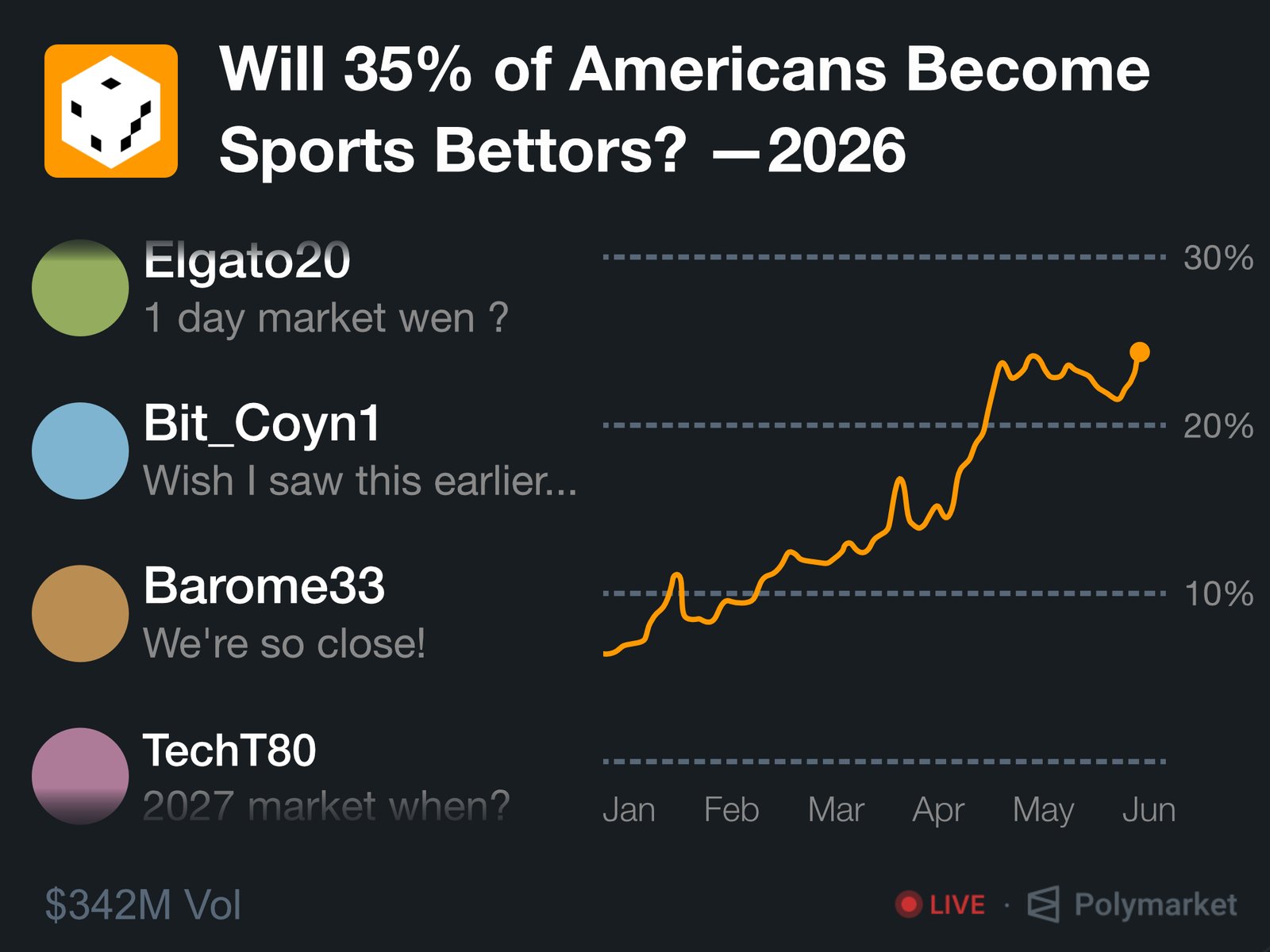
Gambling is being pushed down young men’s throats: an investigation by the University of Bristol found that gambling ads for companies like DraftKings, FanDuel or MGM are shown as often as every 13 seconds during US sports games. No wonder a 2026 Siena study found that 27% of Americans have an active online betting account, and more than half (52%) of men aged 18-49 are bettors. They also reported a significant increase in people “chasing” bets – betting more to recoup from previous losses – the kind of irrational thinking that speaks to addiction.
Prediction markets advertise in the same settings, to the same audience, but they sidestep state restrictions to be available to all 18+ users at a federal level. They open a door for backdoor betting in states that have banned sportsbetting.
They also have the same effects of rewiring user’s psyches: the constant opportunity to win big that sportsbetting apps offer on every minute of the game – on who has possession, on whether X player does Y action at Z time – keeps users hooked throughout. Prediction markets do the same for anything happening at all, a terrifying “normalisation” of this cycle of dopamine and financial ruin that has experts concerned. In a lowbrow way, it floods the zone in the same way that the MAGA-ified news cycle has inured us to – constant, steady information and outrage that numbs us to reality.
It’s worrying to think that a significant part of our population is getting addicted to thinking like the robber barons on Mars. This extractive way of thinking is leading young men to be completely derealised and desensitised to tragedy, and even taught to derive a sense of power from others’ suffering. Plus, they’re driving young men to go broke – a consequence that affects more than the individual. Scott Galloway, NYU Stern professor, writes: “The most dangerous person in the world is a broke and alone young male. The reduction of economic pathways for young people is no less serious for women, but it appears to be less dangerous: When young women feel shame and rage, they don’t grab AR-15s.”
Prediction markets are one powerful, profitable, and addictive part of the system fueling radicalisation among young men, a system that benefits the current ruling class. They are also hurting a core foundation of our society – the value of the truth.

Rewiring our relationship to reality
This is not in the way that Hanson intended it in his insider-trading-is-transparency spiel, which ended up being weirdly optimistic considering some of the more extreme effects of the prediction market. Bettors, instead of trying to accurately guess what will happen in reality, are trying to reshape the truth about reality to cater to their own cynical whims.
This is already happening. A few bettors on Polymarket made thousands off of a fluke bet on the Paris weather forecast that was actually the result of tampering with the government’s meteorological equipment (the hairdryer picture that went viral was AI, by the way).
To be fair, this kind of psychosis is enabled by reality actually winking back at bettors. Traders on Polymarket saw their bets multiply by up to 50x after Karoline Leavitt abruptly ended a press briefing 30 seconds shy of an arbitrary threshold on Polymarket. Elon Musk, whose weekly tweets are tracked on Polymarket (this week’s market is valued at over $6 million), is also a user of the platform — and he’s been known to use his influence to make millions by moving cryptocurrency markets. If you were an avid bettor, it’s within reason to think that reality could be persuadable.
What happens when people are so derealised that the lines between truth and lie and reality become indistinct? When people in the throes of gambling addictions are seizing on any lifeline to change what is real? It can become dangerous, as in the case of an Israeli journalist who faced death threats from users attempting to have him change his reporting to validate their fringe bet.
An anonymous message the journalist received read: “You have 90 minutes left to update the lie. If you do this, you will solve the most serious problem you have caused yourself in life … If you decide not to correct it, and leave the lie intact, you will discover enemies who will be willing to pay anything to make your life miserable.”
Reading this, it’s not wild to consider that a common understanding of truth – and what is and isn’t real – is needed in order for us to be able to coexist. Prediction markets damage that.
Changing the rules of the game
Prediction markets need to be reined in, as a matter of public health, a matter of moral urgency, and a matter of standard anti-corruption. Polymarket and Kalshi have faced blanket bans in France and other countries, but enforcement shouldn’t just lie with local governments or with the companies themselves – the US government needs to step in to effectively regulate these two massive companies and their imitators at the source.
An ongoing legal battle is playing out in the courts as state and local jurisdictions attempt to classify prediction markets as gambling. The Trump administration and their appointed CFTC chair have thrown their weight behind prediction markets, calling the change “overzealous.” States have fought back.
If prediction markets were to be gambling, it would put regulation in the hands of states. This isn’t necessarily optimistic. Again, 39 states have legalised sportsbetting and gambling, and this move is partly encouraged by the influx in gambling revenue that would then be taxed locally. But it’s a start. It would make a difference in states where gambling is more strictly regulated, or even in states where the gambling age is bumped up to 21. It also makes organising movements easier – the targets become commissions in the state executive, which could be more friendly and accessible to regulation than the opaque, high-level CFTC.
Minnesota, the state which has been on the front lines of regulating our wild, wild web, might be the first state to introduce a ban on prediction markets.
In the meantime, we have to fight desensitisation in our circles. If more than half of American men 18-49 are online sportsbettors, chances are that you might know a person who gambles in prediction markets. We can knock prediction markets off their pedestal and remind them: You are not going to be the one benefitting from corruption. Your minor payout isn’t going to offset the real impact of the economic instability resulting from the conflict you are betting on. It’s worth it to look at the world and decide to build, rather than extract.
In fact, it’s a good thing to remind us all that prediction markets are just an online casino with the same old rules: The house always wins – the only way to win is to change the rules, or stop playing.
What can you do?
- Need help quitting gambling? Americans can call 1-800-MY-RESET, and Brits can call 0808 8020 133.
- Read Yalda Keshavarzi’s piece War in the age of performance, which dovetails with the extractive and gamified vision of conflict playing out on prediction markets.
- Read more of Ning’s pieces
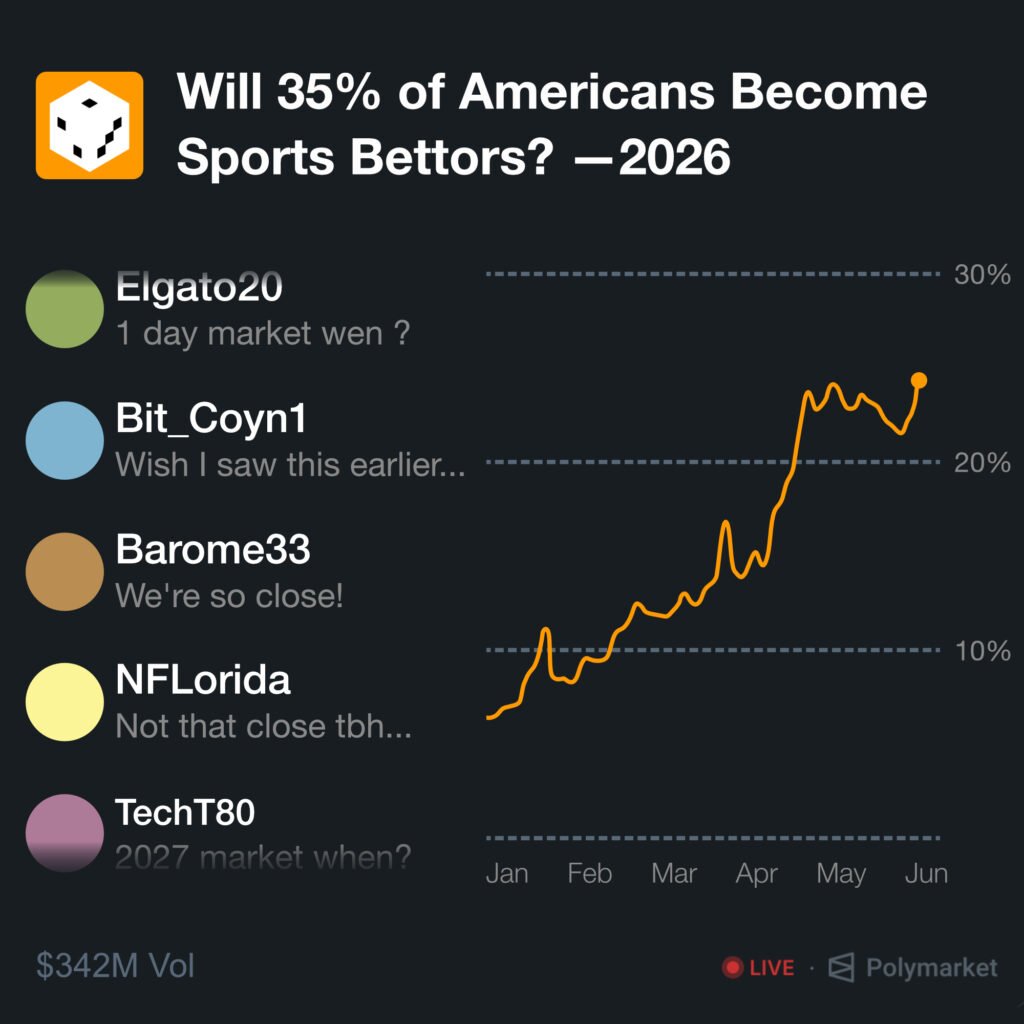 Illustration by Walker Gawande who says: “When I went on Polymarket to get a better idea of what the author was talking about, I was appalled by how it seemed that the entire world of news and politics had been trivialised through game-ification, and by the sheer amount of money being poured into these markets. It reminded me of the 2008 financial crisis, when the entire financial industry was hedging on people’s collective debts, and how those debts were then repackaged into collections (and collections of collections) of debts to be further bet on by massive firms. This is why I chose to imagine a Polymarket market in which even the rise of betting itself had become a betting market.”