At a WritersMosaic event in London on Iranian women’s writing this Spring, the question of truth weighed heavy. The co-editors of the publication Iranian Women’s Voices spoke about the space truth occupies between poetry and politics, and the care required to move within it.
Art, in that sense, carried responsibility and could not afford innocence. There was an insistence on writing with honesty, and on resisting the pull of easy sentiment, the kind that pushes past reality rather than sitting with it. A sense too that poetry endures where power does not – that long after regimes shift, we return to poets like Hafez and Rumi, and to the voices that can hold contradiction without flattening it.
But truth, they suggested, is never untouched by performance. After all, public life depends on it: the politician at the podium, the carefully chosen words, the practiced outrage. Sitting there, I felt the recognition ripple through the room. I noticed the murmurs as people shifted in their seats. Everyone, it seemed, is performing all the time.
The idea of truth
Stepping back online after the event, I found myself holding onto that idea of truth as something shaped but still tied to what is lived. But if the last year of the news cycle has taught me anything, it’s that performance is no longer limited to people; it can be built, repeated and circulated without them. It starts to shape how everything is told – including war.
This distance between representation and reality is not new. War has always been mediated through images, narratives and persuasion. In Britain during the First World War, propaganda circulated widely, whilst it was often the poetry of those who had returned that brought something closer to the reality of it into view.
Scrolling through my social media, I find that distance harder to locate. I’m shown a blue-eyed ‘American army girl’ smiling beside fighter jets she has never flown, AI videos of ‘Iranian women’ in military uniforms drift across feeds in perfect English, a nationalist skinhead lamenting a broken Britain, his anger shaped and financed with precision.
Elsewhere, men livestream their anger, turning control and hierarchy into community. Across it all, I keep returning to what was said in that room: the need to resist flattening. Yet the same logic repeats: desire, outrage, identity – each simplified enough to travel. War is recast, through figures that are easier to believe and even easier to circulate, whilst the people living through it fall out of view.
If the writers at the WritersMosaic event were asking what it means to hold truth without flattening it, then the question now feels more urgent: what happens to truth when war is carried through performances that feel complete on their own terms?
MAGA’s dream girl
One of the clearest ways this plays out is through the female body. War has long been told through it – nations imagined as women to be protected, violated or reclaimed; conflict framed through the logic of defending what is precious. And technology is now pushing forwards a new stage for that trend.
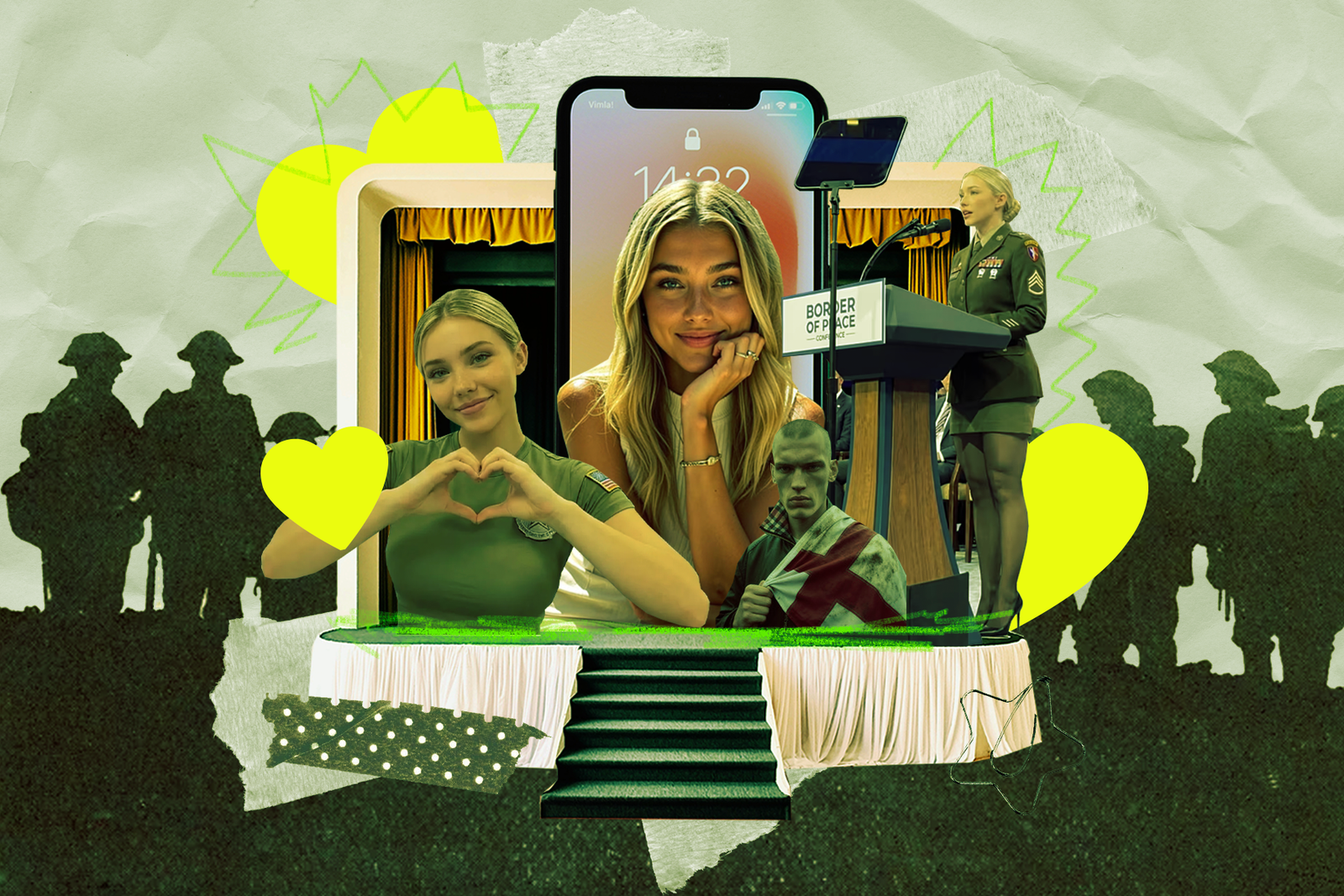
Across platforms, I have seen how war is increasingly being mediated through AI-generated ‘women’ positioned close enough to power to feel real, but polished enough to remain untouchable. ‘Jessica Foster’, otherwise known as the MAGA ‘dream girl,’ appears online again and again, living a life that hovers somewhere between a noughties sorority film and front-line military fantasy. ‘She’ is pictured walking with Donald Trump on the first day of the strikes on Iran and more recently cruising aboard a military vessel through the Strait of Hormuz. On her days off from smiling beside weapons she’s never seen, she slips easily into something softer: pillow fights, feet pics and the occasional appearance beside football star Lionel Messi.
‘Jessica’ moves seamlessly between battlefield and staged intimacy, engineered to satisfy a very particular gaze. She is the pinnacle of MAGA fantasies: a conventionally attractive young white woman with the politics of an older conservative man. What makes her unsettling is not simply that she is AI, but the way her image folds military force into something more familiar and desirable. War becomes something that can be looked at without discomfort – “best job in the world” read a caption posted to her million-plus followers (on the now deleted Instagram).
A similar logic emerges elsewhere. Videos of AI-generated Iranian women in uniform are being circulated widely, as soldiers and pilots, all striking and all cheering on the nation’s military. They speak in fluent English, addressing an audience beyond the country they appear to represent.
They project strength, visibility, and ironically, a kind of inclusion that does not exist in reality, given that women in Iran cannot serve in these frontline roles. In both cases, the figure of the woman has been made to carry something larger than herself. She is a surface onto which power can be rewritten – cleaner, more progressive and crucially, easier to defend. Watching them, I find myself caught between recognition and disbelief, unsure where that version of power is meant to come from.
Faces of truth
The construction of symbols as a tool of war propaganda is not new, nor is the use of idealised figures to carry them. World War Two figures like Rosie the Riveter or Ruby Loftus were never meant to reflect the full reality of women’s lives in wartime so much as shape it – projecting resilience, sacrifice and purpose.
What strikes me now is less that these images exist and more how they move. What AI produces is a different kind of presence, one that feels continuous, untethered and able to circulate without pause or origin.
These ‘women’ do not witness war, nor do they come close to it. They circulate within it untouched. Moving easily between intimacy and violence, between soft fantasy and hard power. Watching them, I find it difficult to locate where experience sits and I’m concerned by the impact they are having They draw in viewers across a distracted internet, where attention is converted into influence, and the reality of war slips further out of sight.
In the WritersMosaic room, which was shaped by Iranian women speaking of writing, poetry was held up as a way of staying close to truth – even when it resists clarity. Watching these images circulate, I find myself returning to that idea.
Not all forms of storytelling about war operate in the same way. As a poet, I am drawn to forms that remain accountable to where they come from – ways of telling that may not resolve easily, but still answer to reality. What moves across these platforms asks for no such accountability. It does not need to struggle with reality, only to pass as it.
AI in the hands of the far-right
If the female figure softens war, the male counterpart hardens it. Across the same platforms, a different kind of performance is taking shape: one built on control. The ‘musician’ Danny Bones appears as a white skinhead with the sculpted ease of a Burberry model, delivering songs about a country in decline. He speaks of loss and betrayal, and of something taken needing to be reclaimed – three guesses who from.
His videos, which target immigrants and Muslims, have been viewed millions of times on social media, filled with English flags, Halal shopfronts and men in armour set against bloodied landscapes. War is constantly invoked, a backdrop through which anger is sharpened and redirected. The lyrics gesture towards expulsion and violent deportation framed as necessity and a form of defence.
Join our mailing list
Sign up for shado's picks of the week! Dropping in your inbox every Friday, we share news from inside shado + out, plus job listings, event recommendations and actions ✊
Sign up for shado's picks of the week! Dropping in your inbox every Friday, we share news from inside shado + out, plus job listings, event recommendations and actions ✊
Danny Bones, however, is not real. ‘He’ is an AI-generated nationalist figure, paid for by far-right party Advance UK, his voice and image engineered for reach in the lead up to a by-election campaign. Experts say this is the first time a UK political party has publicly deployed an AI-generated influencer to amplify its messaging and it’s easy to see why they’ve chosen now to do so.
Part of the appeal lies in how easily Danny Bones inhabits a role that traditional politicians cannot. Far from the Nigel Farages and Jacob Rees Moggs of the world, this figure feels closer to the ground, less mediated, able to speak through experience rather than authority. He performs a proximity to conflict, loss, and a country ‘under threat’ – and in doing so, makes that threat feel both immediate and personal. All whilst carrying an aesthetic polish that makes it compelling.
The collapse of truth
What’s being tapped into does not exist in isolation. It sits within a wider ecosystem of male dominated online spaces, where identity is shaped through repetition, performance and reward.
Watching Louis Theroux’s Inside The Manosphere documentary, I was struck less by the extremity of the views and more by the structure they rely on. Young men are drawn in by the promise of ‘self-improvement’, then held there by a worldview that reframes dissatisfaction as something taken. Failure here is reworded as theft. The only solution offered is control – through women, performance and status.
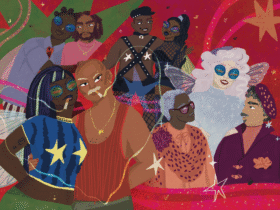
This is why the framing of these spaces so often feels militarised even when no war is being discussed. There are “War Rooms”, “Red Pills” and women referred to as ‘targets.’ Masculinity is sold as a position to defend. What begins as personal grievance is gradually expanded outward and reshaped into something that demands confrontation.
What this produces is a way of understanding the world that no longer depends on truth being verifiable, only on it feeling coherent. In the documentary, streamers speak with certainty about money, women and the world, their claims sometimes plainly false. However, it becomes clear their words do not need to be true, only convincing enough to hold.
As Chloe Laws notes in her review of the Theroux documentary, these spaces are built on contradiction: figures who broadcast contempt while carefully managing how they are seen. Even when the performance falters – awkward clips, contradictions surfacing – it does not disrupt the system, rather they are absorbed into it.
Within that framework, the world begins to organise itself around conflict. War is already there, embedded in how reality is interpreted. This is what makes everything else legible. The AI figures, the images, the narratives of war, all draw on the same logic. These are not separate phenomena but expressions of the same environment. A sense of loss is simplified and redirected – and war appears as a way of restoring order.
The people
Once war begins to make sense in these terms, the voices of people living through it become harder to hold onto, buried beneath the speed and certainty of everything else. Markets respond, oil dips, statements are issued, but meaning thins out in the process.
In Iran, the longest blackout in the nation’s history cuts entire populations from view. Information that comes out is fragmentary: reports of bodies and of the strange stillness settling around destruction. Elsewhere, displaced families in Beirut sleep on the streets and children in Gaza continue to lie awake under the sound of drones. They resist the kind of ease and repetition that the digital world rewards.
What gets lost are the things that cannot be performed: the sound of a foreign language paused mid-sentence; the ache of a place reduced to coordinates, the rare smell of clear skies. Even when these stories surface, they appear translated for clarity, edited for length and shaped to fit the limits of attention, made legible but never whole.
I think back to that room of writers, where truth was treated as something that could not be forced into clarity without losing something essential. It was shaped by language and performance, but remained tied to the lives it came from. What this landscape reveals is a shift in what truth is expected to do. It is not being contested so much as it is being bypassed.
The most dangerous thing about ‘Jessica Foster’ isn’t that she’s fake, it’s how badly people want her to be real. Her followers do not engage with the conditions of military life, or the contradictions in her image. She does not need to be real in order to function as such. What matters is that she reflects back a version of war, and of power, that feels desirable. In that sense, belief is no longer tethered to evidence, but to the comfort of seeing what is easiest to accept.
Across these spaces, the pattern holds: war is softened into something desirable, hardened into something necessary, and repeated until it feels inevitable. The people living through it diminish, replaced by figures who can move faster, say less, and mean more than they should. As that threshold lowers, war becomes easier to justify, easier to aestheticise and easier to ignore. What disappears is the friction that allows truth to be held at all.
What they were speaking about at that event was the kind of truth that moves slowly, resists simplification and does not ‘perform’ well in these conditions. Yet, it is the only thing that remains when everything else falls away. As Hafez writes: “light will someday split you open; even if your life is now a cage”. The question is whether we are still willing to sit with that light, or whether we have chosen to look away.
What can you do?
- Read Doppelganger by Naomi Klein – an exploration of the ideas and allegiances that give the online right its power
- Keep up to date with WritersMosaic events
- Read more shado pieces on Iran here and here
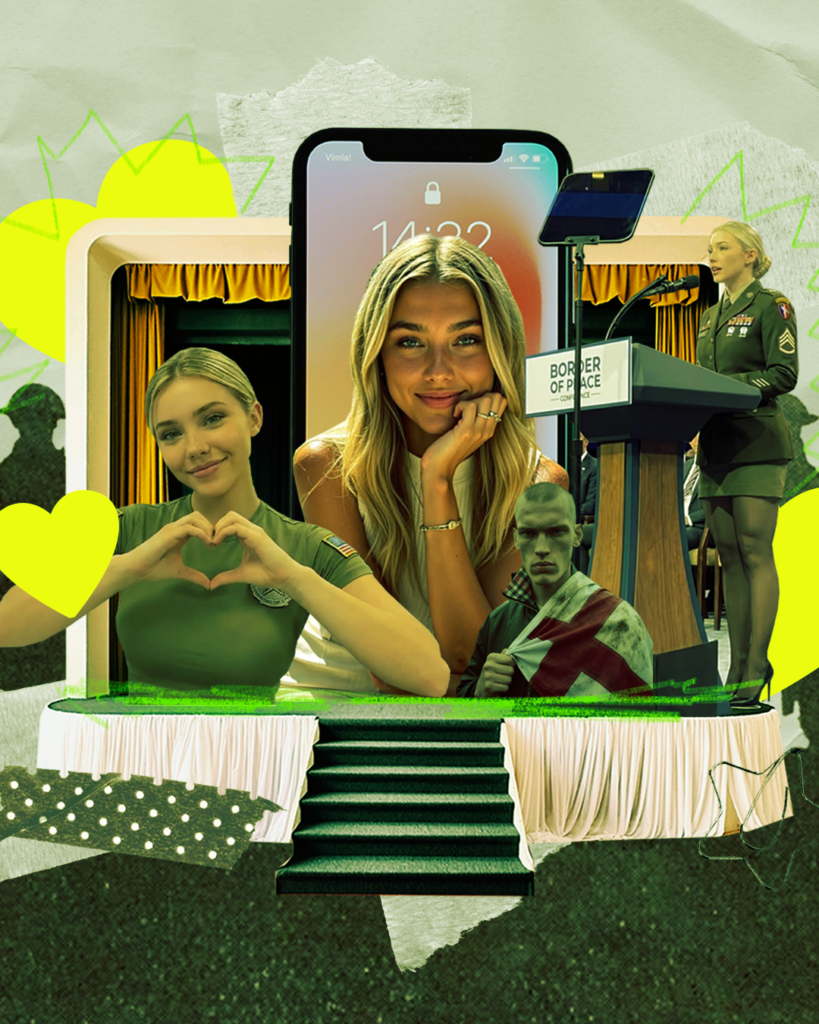 Image by @alexefrancis who says: “I used a lot of images of the AI influencers mentioned in the piece and situated the collage on a stage to give the idea of a dystopic performance.”