
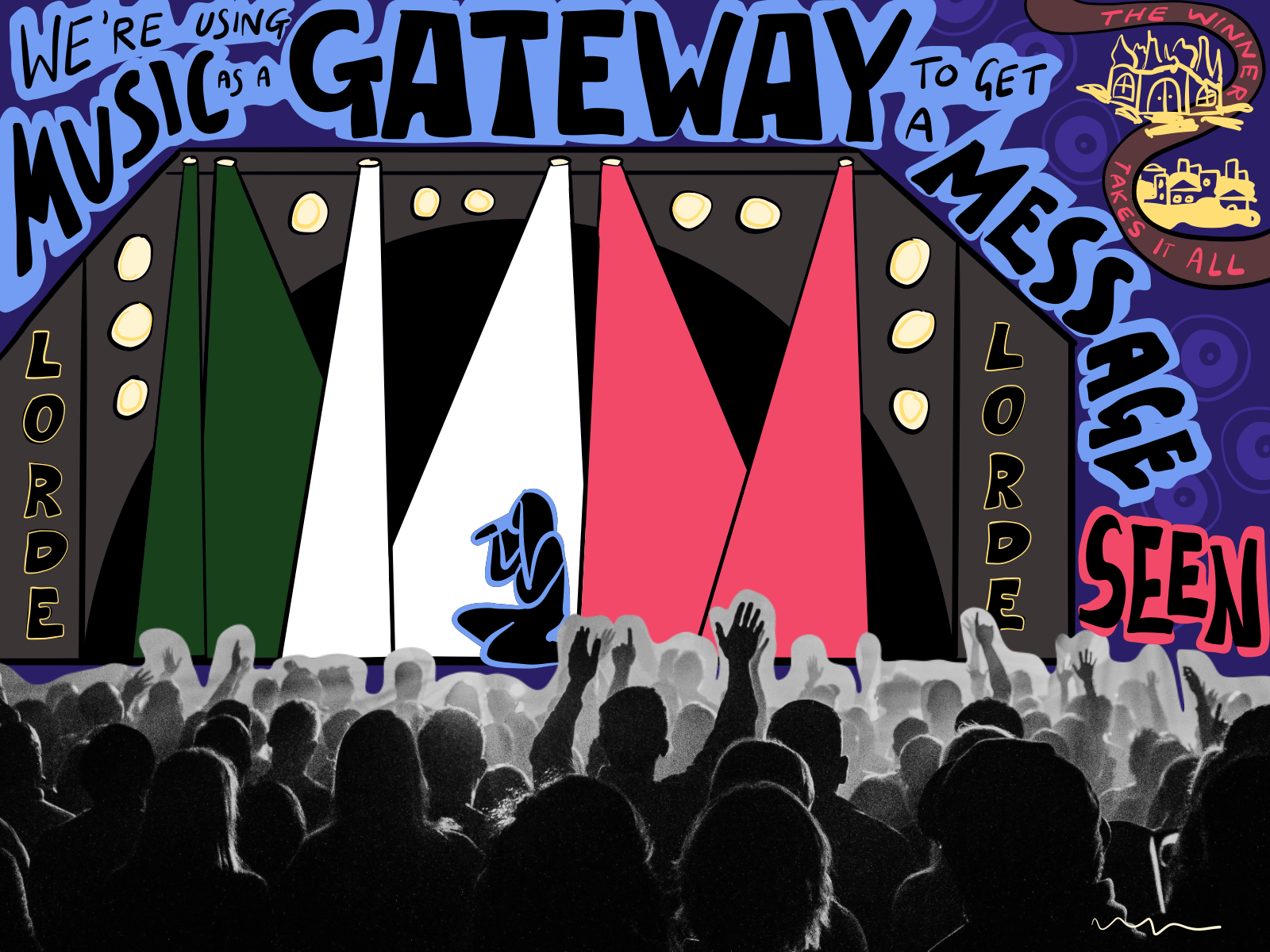

“We live in cities, you’ll never see on screen,” sings New Zealand pop star Ella Yellich O’Connor, better known as Lorde, in her song ‘Team.’ “Not very pretty, but we sure know how to run things.”
The song appears as the sixth track on the artist’s debut album, Pure Heroine – an angsty, jaded introspection of someone on the cusp of adulthood – an album that could only ever come from the mind and heart of a 16-year-old girl.
I was perhaps just shy of the targeted audience of this album, being only 12 years old when it came out. Lorde was like the cool, pot-smoking older sister I never had, filled with wisdom and stories from her teenage years that she would later pass on to me.
“No one comes to New Zealand; no one knows anything about New Zealand,” Lorde told Billboard about ‘Team’ in a 2013 interview. With its lyrics speaking to those from the towns untouched by fame or worldwide recognition, ‘Team’ quickly became an underdog anthem.
Modern times, modern narratives
10 years later, in October 2023, Palestinian-Canadian artist Nemhah Hasan (who goes by Nemahsis), shared a stripped-down cover of ‘Team’ on Apple Music. It was also the same month Israel began its brutal descent into Gaza. Nemahsis told Apple Music: “Lorde’s Pure Heroine was on repeat during my first trip back to Palestine as an adult. I remember feeling like the song ‘Team’ was written for us, the Palestinian people.”
In the weeks and months that followed, Palestinians began taking to social media platforms like TikTok, using ‘Team’ as a prompt for describing Gaza before and after October 7th.
I remember being in my college apartment when I first saw a TikTok of Gaza paired with ‘Team.’
It was like reading your favourite novel told from the perspective of another character. A new narrative had emerged, but it wasn’t far off from its original meaning. Other TikTok users also seemed to resonate. “Lorde’s song fits like a glove,” said one user. “Seeing this video is like hearing the lyrics for the first time and understanding them,” said another.
During Lorde’s stop in New York in September 2025 on tour for her newest album, Virgin, the venue went dark as the singer performed ‘Team.’ Suddenly, the stage lights of Madison Square Garden descended onto the crowd, covering them and the stage in the colours of the Palestinian flag.
“Free fucking Palestine!” Lorde cried, in one of the most famous venues in the world. As she continued her worldwide tour, she made this a regular part of her shows. While she could’ve chosen to look away or disavow the use of her song completely, she instead doubled down on what ‘Team’ had become: an anthem for Palestine.
Lorde followed up that moment by removing her music from all streaming platforms in Israel as part of the larger “No Music For Genocide” movement, where over 1,000 musicians and record labels have followed suit as part of a cultural boycott of Israel.
‘Team’ having a second wind in 2025, however, is not an uncommon trend in the digital age. Young people on TikTok constantly resurrect songs and give them new momentum. ‘Dreams’ by Fleetwood Mac, a song that came out in 1977, had its biggest week on streaming platforms in October 2020, after a TikTok went viral of a man skateboarding while lip-syncing the lyrics.
And for rock band Pavement, arguably their now most recognisable song, ‘Harness Your Hopes’ gained popularity 30 years after its release due to the algorithmically generated recommendations feature on Spotify, which led to it going viral among younger listeners on social media platforms. Most recently, the song has been used in the “fit check” trends by TikTok users in Utah. The song has become so popular that the band even released a music video for it in April 2024.
In using these older songs for TikTok trends, we inevitably give them some new meaning or, at least, a meaning different from those past generations have associated them with. Though with ‘Team,’ something bigger seems to be at play. We see its digital relationship with Palestinian TikTok users permeate reality. Thus, a question still looms for me: how did a pop song about the New Zealand suburbs become the unofficial anthem for Palestinian liberation? And, more importantly, what does this reveal about music culture in the digital age?
The medium is the message
Songs and social movements have always gone hand-in-hand. Particularly since the 60s – which saw artists like Bob Dylan, Joan Baez, Sam Cooke, The Beatles and Marvin Gaye sing about racial segregation, class inequality, the Vietnam War and counterculture – songs have long been vehicles for young people to challenge the status quo.
But in today’s context, we’re not just focusing on music which has a social justice message. Instead, we’re using music as a gateway to get a message seen. Where companies like Meta deliberately manipulate algorithms to hide material relating to issues like the genocide in Palestine, young users have taken on new tactics to attempt to subvert shadowbanning and censorship.
There are a few ways of doing this – not using particular keywords or using viral ‘sounds’ and music to accompany your content – something that Adam Elesick, or the internet’s Etymology Nerd, describes as “algospeak.” The use of Lorde’s ‘Team’, therefore, may have been a strategic move; the well-known pop anthem might allow videos disseminating information on Palestine to slip under the algorithm’s radar.
We can’t know for sure – the conspicuousness of the algorithm always leaves us with these dangling “what-ifs” – but it’s safe to say that it certainly had an impact on our shared reality, given how Lorde has responded.
ABBA-fuelled movements against corruption
Due to streaming platforms’ digitisation of music archives, an old song can become ‘new’ again when suggested by the algorithm. This is particularly true on TikTok, as it allows users to easily reuse ‘sounds’, allowing snippets of older songs to go viral. In fact, 20 of the 50 globally trending songs on the platform in 2024 came from back catalogues that are more than five years old. Over time, this changes the meaning and collective memories associated with the music.
This is what happened to Lorde’s ‘Team’. A song for the suburban underdog became, in the hands of TikTok users, a way to turn the world’s attention to Gaza. And this is not the only song to do so. Anti-corruption protests in the Philippines and Nepal this year took to the Swedish pop group ABBA’s 1980 hit, ‘The Winner Takes It All.’
Join our mailing list
Sign up for shado's picks of the week! Dropping in your inbox every Friday, we share news from inside shado + out, plus job listings, event recommendations and actions ✊
Sign up for shado's picks of the week! Dropping in your inbox every Friday, we share news from inside shado + out, plus job listings, event recommendations and actions ✊
In September 2025, Nepalese Gen-Z protestors toppled its government after years of grievances against corruption. The outrage reached an all-time high after the Nepalese government banned social media platforms in the country days before the protests began. In response, teens built an underground social media network named “Gen Z Rebels” using private VPNs.
On 9th September, Rishav KC, an 18-year-old from Kathmandu, Nepal, shared a video to TikTok, of Nepalese congressman and billionaire Binod Chaudhary’s house swarmed in smoke. “Current situation of the house of Nepal’s only billionaire’, reads the video, to the backing track of ‘The Winner Takes it All.’
“The song reflects this feeling of loss, imbalance, and unfairness, which really connects to what’s happening in Nepal right now,” Rishav tells me. “The youth are standing up against years of corruption, inequality, and political negligence, yet it often feels like no matter how much people fight, those in power still take it all.”
Other videos paired with the song show Nepal’s Parliament building on fire, Gen-Z protestors on the street, and commentary on the country’s corrupt political “nepo babies” .
It’s a similar case in the Philippines. The lack of government action on flood control has prompted outrage against the country’s longstanding history of corruption, causing young people to also use the ABBA song to highlight the reality of the disparity between those at the top and everyday Filipinos.
In August 2025, Rie Fabro from Manila, the Filipino capital, posted a photo of a town underwater set to ‘The Winner Takes It All.’ The text on the photo reads: “Every peso stolen is a life put at risk. Corruption drowns the Phillipines, not the flood.” I spoke to Rie about the song choice. “The line ‘the winner takes it all, the loser has to fall’ hits harder to the Philippines situation,” she tells me.
Nepotism is a theme that rings true in the Filipino context, too. One video presents clips of “nepo babies” in the Philippines – namely, Claudine Co, the daughter of a prominent construction company owner that’s been probed in the flood control investigations, who has documented her lavish lifestyle on social media – juxtaposed with images of everyday Filipinos standing in murky, nearly head-deep water because of the failed projects.
Like with TikTokers’ use of ‘Team,’ these juxtaposed images make it impossible to look away and convey messages in a way that are more conducive to our attention spans on these social media platforms.
The dark mirror
Unfortunately, politicians have begun to catch on to the trend. In December, the Department of Homeland Security, which operates Immigration and Customs Enforcement (ICE), uploaded a since-deleted video to their social media accounts of federal agents tackling and handcuffing individuals, using a viral lyric from Sabrina Carpenter’s song ‘Juno’ – “have you ever tried this one?”
Carpenter swiftly denounced the use of her song to benefit an “inhumane agenda”. But this tactic has gained momentum. Artists from Olivia Rodrigo to Kenny Loggins have also denounced the use of their music in videos posted by the Trump administration that encouraged undocumented immigrants to voluntarily leave the United States and depicted Trump throwing faeces at protestors during the No Kings protests, respectively.
Trump used ‘Fortunate Son’ – a song critiquing the ways wealthy people were able to avoid getting drafted into the Vietnam War while working-class people had to pay the price – in a video of the US military in Venezuela the morning the US captured the country’s leader, Nicolás Maduro. Despite a cease-and-desist from Fogerty, Trump has ignored it and continued to use the song.
The same tools that have allowed young people to use pop songs as a way to convey political resistance have also enabled something more sinister. Naomi Klein, in her book Doppelganger, calls this “pipikism,” where the aesthetics of rebellion and oppression are adopted in a nearly total opposite, more sinister way, in which the powerful cosplay as the underdogs.
Whether it’s weaponised by the Trump administration’s social media teams or utilised by on-the-ground activists like Rie and Rishav, it’s undeniable that TikTok and wider algorithms have changed the way we associate music with meaning. This has unlocked a whole new way to tap into the collective of fans and listeners in the music world to affect change. It’s important that we take a leaf out of Lorde’s book, and continue to tap into that.
What can you do?
-
- Pressure your favourite musician to join the No Music For Genocide boycott
- Support independent Palestinian internet radio station Radio Alhara
- Check out Palestinian musicians Saint Levant, Nehmasis, Shabjeed, Elyanna and many more described in detail by University of Virginia’s WXTJ Student Radio station WXTJ Writes! By Isabel Xiao: 5 Palestinian Artists To Support
- Read more articles from shado’s HEAR section
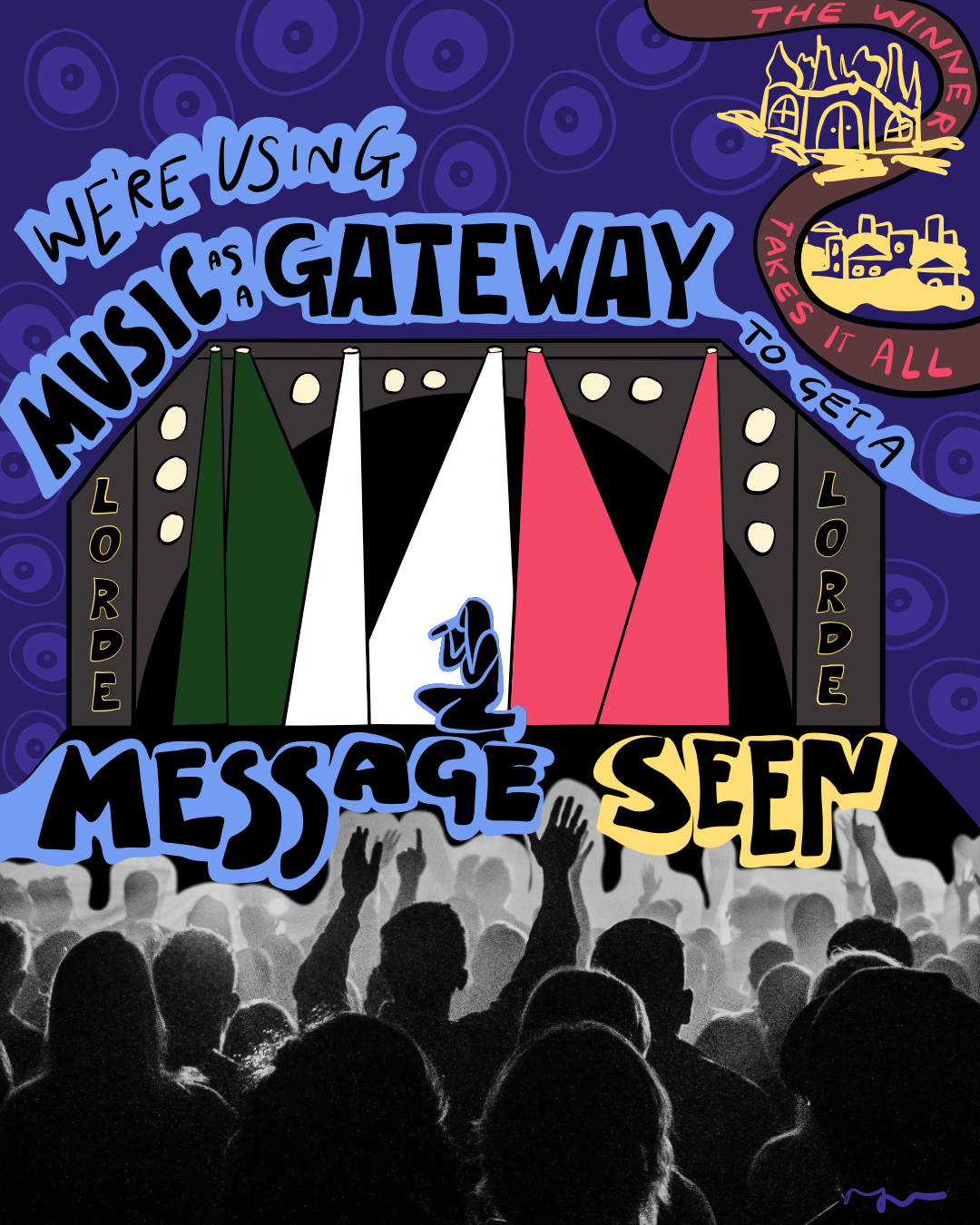 Illustration by @npl_illustration who says: “In the centre of the image is Lorde in concert with the foreground showing fans at one of her shows. Around the stage is wording saying: ‘we’re using music as a gateway to get a message seen’ all in black writing, highlighted in blue. The top right depicts a house on fire and city submerged in water with the text saying ‘The Winner Takes It All’ in a brown banner and red text.”