“These are not our people. This is not our culture!” I remember my grandmother telling me this as we watched videos of the Taliban in the early 2000s. We watched in devastation as they destroyed our books, burned musical instruments and blew up ancient monuments. It was only much later in my life that I learnt she was teaching me things that history books could never dare to.
This August marked five years since the fall of Kabul on 15th August, 2021. I am pretty sure the images of that day will never leave me: people dangling onto a military plane about to take flight; babies being passed over barbed wire to anybody who could take them. I remember watching the media’s shock and bewilderment at the sheer desperation of Afghan people.
The people of Afghanistan knew what was coming next. They knew exactly the kind of country that 20 years of war and occupation had left them, and despite the media theatrics so did the rest of the world.
As an Afghan living in the diaspora, I cannot help but feel like I am reliving the past. I am transported to a childhood marked by images and stories of the Taliban’s earth-shattering brutality. I remember sitting in our living room watching public stonings and floggings in football stadiums and trying to make sense of it all. Now, decades later, I feel like I am back there. The world has started talking about us again and I can’t help but notice the patterns being repeated.
The house that the empire built
For the past five years, the world has watched as women and girls in Afghanistan have been systematically and violently erased from public life by their de facto ‘government.’ In 2021, the Taliban banned secondary school education for girls. What has ensued is a violent avalanche of draconian edicts and laws which have not only reversed the gains Afghan women and girls have painstakingly fought for over decades, but plunged half of the country’s population into an unimaginable darkness.
Shortly after the ban on education, the Taliban ordered clerics to bring lists of unmarried women and girls aged 12 and over for their fighters to marry. Women and girls have been forcibly removed from universities; banned from public parks, gyms, from playing sports. They cannot enter healthcare centres, obtain driving licenses or take public transport without a male custodian. Women have been barred from medical training or working in healthcare. Women are imprisoned for “morality” or dress code violations. Parents are selling young girls into “child marriage.” Most recently, women have been prohibited from speaking, singing or reading aloud in public. This is what gender apartheid looks like.
There is nothing uniquely Afghan about gender apartheid
I have considered what it means to be an Afghan woman from as early as I can remember. I have patiently watched my grandmother, my mother, my aunties and cousins. I have read everything I have been able to get a hold of. I have cherished any representation of Afghan women, by Afghan women, that I can find in the media (unsurprisingly, I have found very little).
Afghanistan is a nation that holds many ways of relating to gender and a long history of women who have been celebrated for their courage and strength (Nur Jahan, Aisha Durrani, Mah Chuchak Begum, Rabia Balkhi as just some examples).
Afghan women gained suffrage in 1919, one year before the USA and 50 years before Switzerland. We have dreamt, written, sung, fought, learnt and loved in public for most of our history. Yet, somewhere along the line we became flattened into a character of fundamentalist gendered oppression.
There is nothing uniquely Afghan about gender apartheid, yet it is constantly being framed inside a political vacuum that starts and ends with the Taliban. We are told about the unique cruelty of the Taliban, but what is conveniently missing is that the Taliban, their interpretation of Islam, and the hellscape they have created, may be as American as apple pie.
The snake has been eating its own tail
The rise and spread of distortions of Islam has been a project of Western imperialism for over a century. Starting with the British Empire’s support of religious conservatives in the 1920s to undermine Afghan sovereignty, to the US-led anti-communist “jihad” and axis of colonial capitalism so called the Safari Club and Pakistani Inter-Services Intelligence. Nobody seems to have wanted the entrenchment of so-called “Islamic Fundamentalism” in Afghanistan more than the same people who spent decades livestreaming their fight against it.
What started as a clandestine operation has been painfully laid bare for all the world to see. Decades of funding, arming and training of Mujahedeen in Pakistani training camps; the distribution of Salafi/Wahhabi-glossed Qurans across Central Asia; the CIA-supervised evacuation and protection of hundreds of Taliban and Al-Queda to Pakistan prior to the invasion of 2001. A bear trap laid out for the USSR invasion of 1979. Suddenly, the US needs to invade to save Afghan women from behind their burqas. Our supposed liberation became the moral justification for the longest war in US history. Just like that, the US spent 20 years fighting its own creation, the snake eating its own tail.
War as identity
In 2016, I took my mum to see the West End adaptation of Khaled Hosseini’s The Kite Runner. There was a scene early in the play where two of the characters were catching up, one asked after about a person they both knew. The other responded “they died in the most Afghan way possible – they stepped on a landmine.” The audience broke out into a cacophony of laughter. I remember wanting the ceiling to fall through under the weight of the betrayal. This is the extent to which the imperial war machine has succeeded in robbing Afghans of our humanity.
I was raised on stories of the place I called home. A land full of history and culture, spanning some of the greatest art and science the world has seen. We grew up reading the poems of Ferdowsi, the Shahnameh (the Persian Book of Kings), celebrating Nowruz (the Spring Equinox and solar new year) and wondering at the pre-Islamic cultures that came before us. Yet, I have watched for years as the place I am from has morphed into something unrecognisable from the stories and archives my family have carried here with them.
For decades, we have been sold as nothing more than a playground for experiments in Western imperialism’s instrumentalisation of Islam, all the while the rich get richer off selling weapons and supercharging the global heroin market. We are turned into a nameless wasteland in video games and movies. The ancient craft of rug weaving moves to creating war rugs to satisfy a hungry foreign market.
There is no neutrality in the way the world has come to talk about Afghanistan. Not in the arts and definitely not in the media. We have been systematically denied any identity beyond this war. There has been a cultural genocide unfolding before our eyes, and within it the gender apartheid that we see before us today.
The heartbreak to abandonment pipeline
For as long as I can remember, there has been a systematic erasure of Afghan culture; a hollowing out so that we can be replaced by Taliban and their distorted interpretation of Islam. Even for me, it is now becoming difficult to see where one starts and the other ends. It is a project of legitimisation that has run so deep that, in August 2021, power was effectively handed back to the Taliban by the United States on the world stage.
Now, leaders across Europe are inviting the Taliban to “technical talks” on migration and granting them control of Afghan consulates. The narrative remains the same: what happened to Afghanistan was an inevitable tragedy; the West tried its best, but this is simply who these people are. The Taliban are falsely legitimised as a product of culture and religion. The world resigns itself to heartbreak, while the colonial project remains unchallenged and unquestioned. The Afghan people are systematically abandoned.
In August, I saw more calls to action than I could count. In and amongst these, gender apartheid is clumsily constructed in a political vacuum that starts and ends with the Taliban. Conveniently missing is the long history of how women have been endlessly manipulated as geopolitical pawns by imperial powers. Absent is the humanity of the young boys and men who have also been caught up in this nightmare. Western leaders are desperately called in to do something, to help Afghan women.
Unsurprisingly, the voices shouting the loudest are rarely Afghans themselves. I cannot help but worry that we risk falling into the same trap once again, when the world came to believe that we needed to drop bombs to save Afghans from themselves.
Join our mailing list
Sign up for shado's picks of the week! Dropping in your inbox every Friday, we share news from inside shado + out, plus job listings, event recommendations and actions ✊
Sign up for shado's picks of the week! Dropping in your inbox every Friday, we share news from inside shado + out, plus job listings, event recommendations and actions ✊
So, I say again, there is nothing uniquely Afghan about gender apartheid. The world owes Afghanistan a reckoning, the least we can do is finally have the courage to move through the heartbreak towards a deeper anti-imperial analysis.
نان، کار، آزادی
زن، زندگی، آزادی
Jin, Jîyan, Azadî
Our freedom has and always will be about dismantling the machinery of imperialism in its entirety.
The text above includes the three protest chants of women in Afghanistan, Iran and Kurdistan. I present them together and in this order to trace them back to their origins and roots to the revolutionary women of Rojava and the Kurdish women’s resistance.
What can you do?
Learning:
- Follow journalist Shabnam Nasimi who makes short and long-form content about Afghanistan
- The book, My Dear Kabul – a collective diary of 21 women, compiled using WhatsApp messages after the Taliban’s return to power in August 2021
- Blowback – a podcast unpacking US-led imperialism across countries like Iraq, Cuba, Afghanistan, Vietnam
- “We Came Home,” a documentary by Ariana Delawari
Action:
- Sign the petition to challenge the UK’s decision to suspend visas for Afghan students
- Call out and challenge narratives that systematically dehumanise Afghans and normalise war and occupation
Follow the work of:
- Afghanistan Activist Collective based in Berlin
- Women for Afghan Women https://www.instagram.com/womenforafghanwomen/
- Revolutionary Association of the Women of Afghanistan (RAWA)
- Support the numerous education projects in Afghanistan such as:
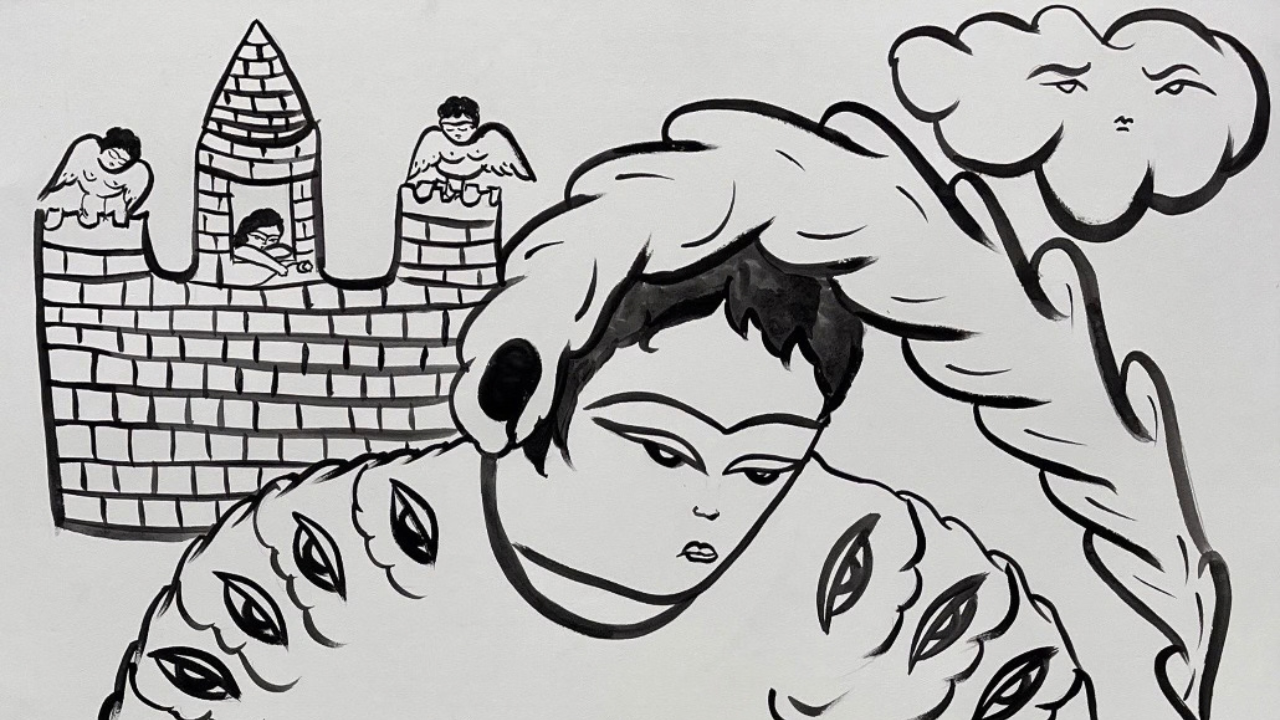
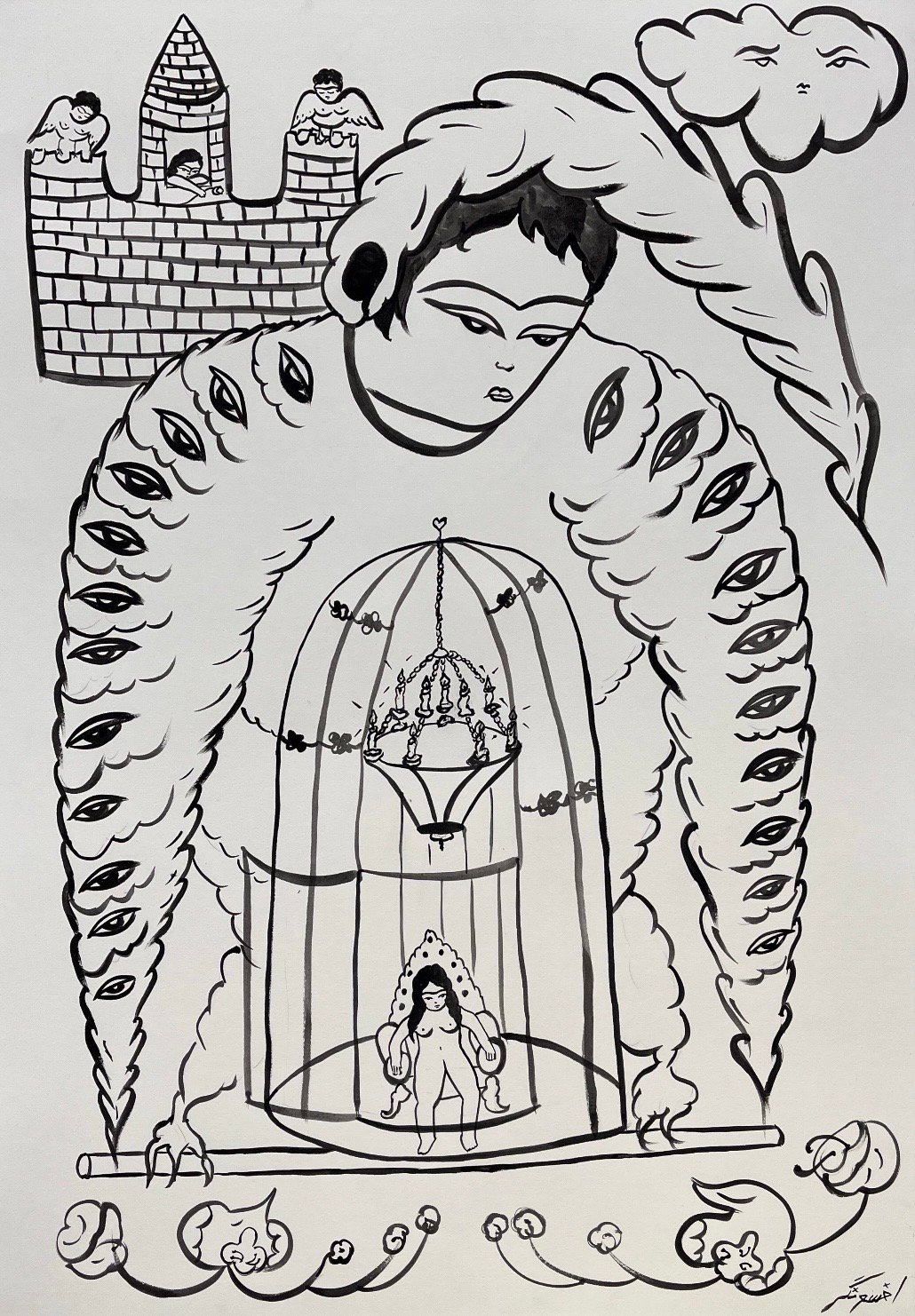 Illustration by Affsoongar who says: “The title of this painting is Cagefree. The painting explores the ways in which women are placed into boxes and confined by people who have no right to define the limits of their lives. When you have spent so much of your life being caged, it can become difficult to even imagine that you are capable of flying. Cagefree is about that struggle – the process of unlearning the limitations that have been imposed on us and finding the courage to trust our own freedom. Even when the cage is finally open, learning to fly can feel frightening and unfamiliar. Sometimes, the hardest part of freedom is convincing yourself that you are.”