
As doctors, we are alarmed at the rate that the attacks on the trans community in the UK are serving to widen health inequalities for all.
In a move that Amnesty called “disappointing” and the BMA Resident Doctors’ Committee described as “biologically illiterate”, on 16th April 2025, the UK Supreme Court ruled that references to “sex”, “man”, and “woman” in the 2010 Equality Act refer to sex assigned at birth. The ruling led to a swathe of proposed changes across sport, toilet and changing facilities, and other areas of public life, as well as a rise in anti-trans rhetoric within the media.
More recently, in August 2026, The Equality and Human Rights Commission’s (EHRC) updated its statutory Code of Practice for Services, Public Functions and Associations, with its definition of sex now in line with that of the Supreme Court ruling. The new code of practice advises organisations and service providers, including the NHS, that legally, access to single sex spaces should now be based on ‘biological sex’. This means that if a single sex space is inclusive of trans women or trans men, that it can no longer be legally classed as a single sex space, leaving it lawful to exclude trans people from spaces such as women’s sports, changing facilities and public services.
While the updated code of practice does not remove legal protections from trans people, it has created a ripple effect of fear, segregation and social exclusion for trans, queer and gender diverse communities in the UK.
As a Sexual and Reproductive Health consultant (Annabel) and a recently qualified resident doctor with experience in trans health and LGBTQ+ health inclusion training (George), we have both witnessed the far-reaching implications of the ruling every day on our patients. This has included trans patients voicing their distrust of health workers, self-discharging from hospital due to fears about which wards they may be placed on or even refusing necessary medical input altogether. Not only do we feel that this is affecting our patients, but our local communities, contributing to a general widening of health inequalities across the board.
Transphobia is a public health issue
Trans people already face substantial inequalities in healthcare. A recent study found that trans and non-binary people in England were more likely to have long-term health conditions and twice as likely to experience mental health difficulties. The factors contributing to this are a combination of minority stress, long waiting lists to be seen by NHS gender clinics and a lack of training for health workers and students on providing inclusive care for trans people.
Barriers to healthcare access are even more likely for trans people from Black and other global majority groups, and particularly Black trans women, who face the compounding effects of racism, sexism and transphobia. Globally, it’s also been estimated that 50% of trans people have had suicidal thoughts and 29% have attempted suicide during their lifetime, with discrimination a driving factor.
A UK government survey, which included responses from a total of 108,100 LGBT people, found that 40% of the 14,320 trans and non-binary respondents had negative experiences of using public services, including the NHS, because of their gender identity. Respondents also reported that this negatively affected the quality of care they received as well as their willingness to seek care in the future. This is more than likely to now worsen as a result of the updated EHRC code of practice.
In the UK, the current waiting time for an initial assessment at one of the seven adult gender clinics is up to seven years, with projected wait times for newly referred patients even longer. Health workers are also generally poorly educated about the needs of trans patients, exacerbating structural barriers to support. A recent report found that less than a third of health worker respondents felt they had sufficient training to support trans patients.
Many of us fear that this already poor access to services is likely to worsen as a consequence of the ruling and anecdotally, trans patients are already reporting that the changes to the EHRC code has increased their reluctance to seek medical care when they need it. 36 UK-based HIV organisations have warned that the ruling and subsequent EHRC code risks worsening health inequalities by increasing discrimination and making healthcare services less inclusive through creating additional barriers to accessing spaces and services in line with people’s gender.
As a trans person myself (George) I have seen these barriers both as a patient and as a doctor. I have first-hand experience of it becoming harder each day to advocate for my own health needs and the needs of my patients. Not only do these barriers exist while trying to access trans healthcare, they exist across all NHS services, services which most of us, regardless of our gender, will rely on access to in our lifetime.
Doctors have a responsibility to care holistically for trans patients
Following the changes, services still have obligations under the Equality Act to provide safe spaces for trans people. NHS staff and policymakers have a responsibility to ensure that the ruling does not create harmful or discriminatory healthcare environments for trans people, including for trans and gender diverse health workers.
In the current climate of rising hostility towards trans people, accessible and inclusive services are urgently needed and must be protected. On hospital wards, NHS guidance has previously stated that trans people should be accommodated in alignment with their gender identity, although following the ruling this is currently under review.
Previous Freedom of Information requests across 102 hospital trusts found no complaints from women who were inpatients about this previous policy. It is unclear how, in a time when the NHS is already struggling to meet the demands of the population and bed spaces are scarce, it will even be possible to uphold the demands of the ruling and, particularly, how it would be enforced in a way that is not inherently impractical, undignified and unethical.
Despite suggestions that the ruling will lead to changes in NHS policy, a number of NHS trusts, including North London NHS Foundation Trust, stated that no immediate changes would be made to their existing policy.
Some trusts have chosen a more supportive and inclusive route, including University Hospitals Sussex NHS Foundation Trust, who have acknowledged the negative consequences of the ruling on transgender, non-binary, and intersex staff and patients, reaffirming their commitment to inclusive care and to protecting all staff and patients from discrimination. It is vital that more trusts follow suit in order to promote an equitable model of care that can provide services that serve the needs of everyone.
Implications of the ruling on LGBTQ+ health workers
With fears that the ruling will exacerbate discrimination, health workers must also act to support their trans and LGBTQ+ colleagues. NHS staff who identify as LGBTQ+ already experience discrimination while at work.
A 2023 survey with 2490 responses, carried out by the British Medical Association and the Association of LGBTQ+ Doctors and Dentists found that 49% of trans staff had experienced transphobia, with 59% considering it abuse or harassment. 84% of trans respondents and 49% of cis respondents stated that they think transphobia is an issue in the medical profession as a whole.

No staff should have to fear abuse or harassment while doing their job or worry about where they will use the bathroom or get changed while working a 12-hour shift – which is now the norm for many trans health workers. This adds to the poor retention of staff and makes for a less inclusive and supportive environment for all staff and patients.
The inclusion of trans women is necessary for health equity
It is important that as health workers with an ability to make a difference in our trans patients’ lives, we intervene in the spread of harmful, ascientific misinformation about trans people. We can do this by highlighting the urgent need for trans awareness and inclusion training in our work places, voicing our concerns about the impact of the ruling and guidance on health outcomes and challenging transphobia in our professional and personal lives. Much of the national discourse around this ruling and single-sex spaces centres around the narrative that cis women need protection from trans women. This frames trans women as a threat by definition.

Join our mailing list
Sign up for shado's picks of the week! Dropping in your inbox every Friday, we share news from inside shado + out, plus job listings, event recommendations and actions ✊
Sign up for shado's picks of the week! Dropping in your inbox every Friday, we share news from inside shado + out, plus job listings, event recommendations and actions ✊
Trans women are likely to be victims of many of the same gender-based issues faced by cis women. In the UK, 16% of trans women have experienced domestic abuse in the last year, and trans people as a group experience high rates of sexual assault.
Rather than excluding trans women from vital gender-based services, providing services that are inclusive to all is essential. The exclusion of trans women from women’s spaces threatens to worsen gender-based discrimination. There have already been a number of reports of women who do not conform to Eurocentric, heteronormative and patriarchal ideas of womanhood facing verbal abuse and harassment on suspicion of “not being a woman.” By subscribing to rigid, binary understandings of gender, we risk increasing hostility towards intersecting marginalised groups.
We must reject the dangerous politics of exclusion
The Supreme Court ruling, EHRC code of practice and the vigour with which the UK has embraced anti-trans fervour should be grounds for concern for all those who care about health equity. As two doctors, who have long been involved in health equity activism and advocacy work, we know from lived experience and supporting our patients just how vital it is that NHS policymakers and staff, as well as the general public reject the harmful politics of exclusion and division.
As allies to the trans community, we must all support trans-led organising, speak against casual everyday transphobia and reject the notion that exclusion of a minoritised community makes anyone safer in society. As health workers, we must challenge the political targeting of all marginalised groups, oppose any proposals of discriminatory policies within the NHS, and advocate for the rights of our patients to access the care they need without fear. By making healthcare services inclusive of trans people, we are making them safer for all.
What can you do?
- Listen: Trans Health in Primary Care – Podcast episode of While I’m Here, Doc, with Dr Max Kelen discussing what trans inclusive healthcare practice can look like
- Read: The NHS as a site of structural violence, by Dr Kavian Kulasabanathan
- Read: None of the Above: Reflections on Life Beyond the Binary, by Travis Alabanza
- Read: A Short History of Trans Misogyny, by Jules Gill-Peterson
- Read: Her Name is Alice, by Caroline Litman
- Read: Feminism, Interrupted Disrupting Power, By Lola Olufemi
- Read: Care Without Pathology: How Trans- Health Activists Are Changing Medicine, by Christoph Hanssmann
- Check out: Trans is Human Exhibition on at Queer Britain from August – November 2026 featuring portraits and stories of 13 trans people (shameless plug as my portrait is included – George)
Follow and support:
- Black Trans Alliance: A not for profit organisation supporting black transgender people.
- Not In Our Name: A collective of women in support of trans rights
- Loving Me: Support and safe housing for trans and non-binary people affected by domestic abuse
- GLADD:The Association of LGBTQ+ Doctors and Dentists
- Mind Out: Mental health charity for the LGBTQ+ community
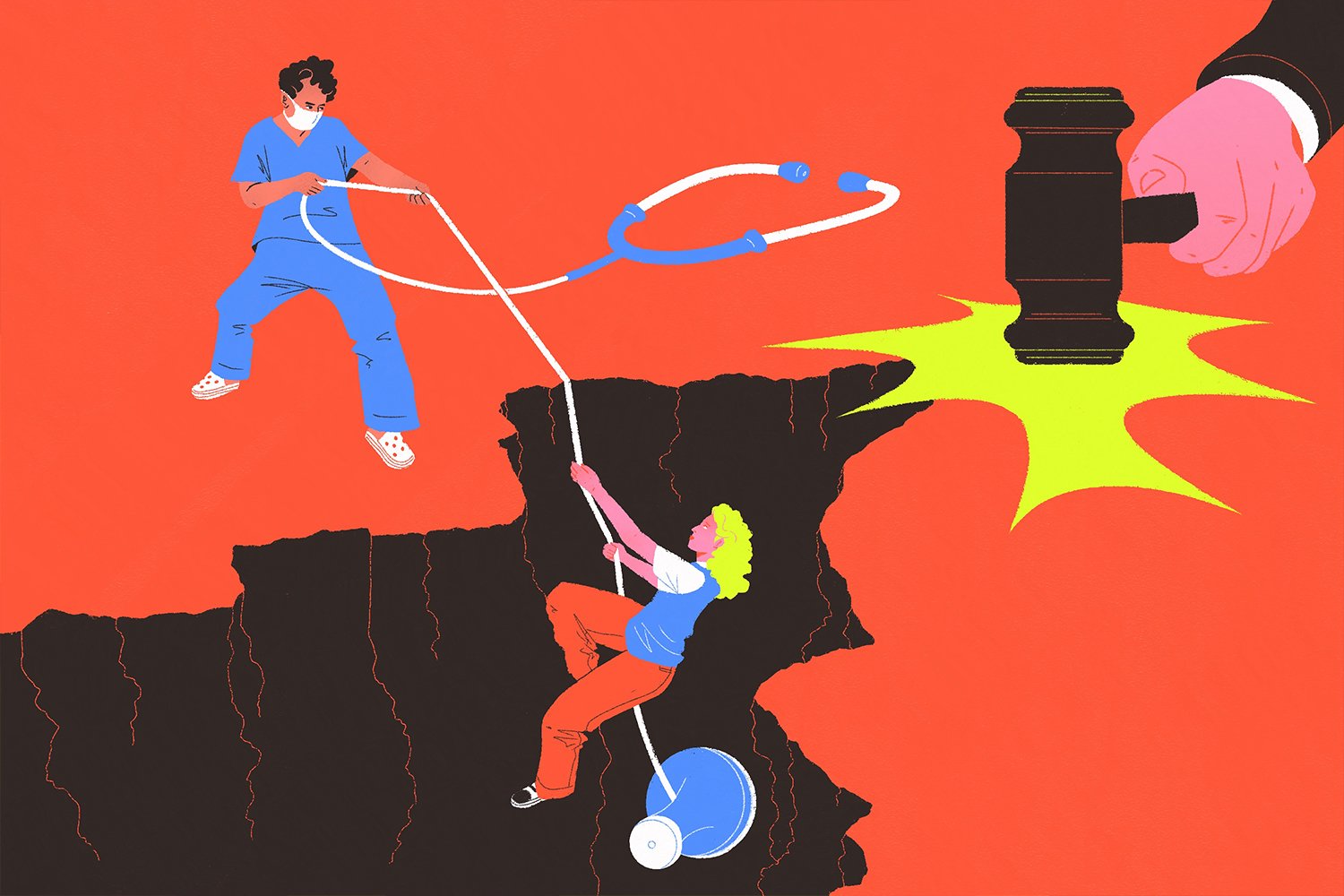
 Illustration by @kalakal.klk who says: “A gavel breaches the ground. A trans woman hangs on a stethoscope, carried by a medical worker, symbolising both allyship and how careless decision-makers are about marginalised lives.”