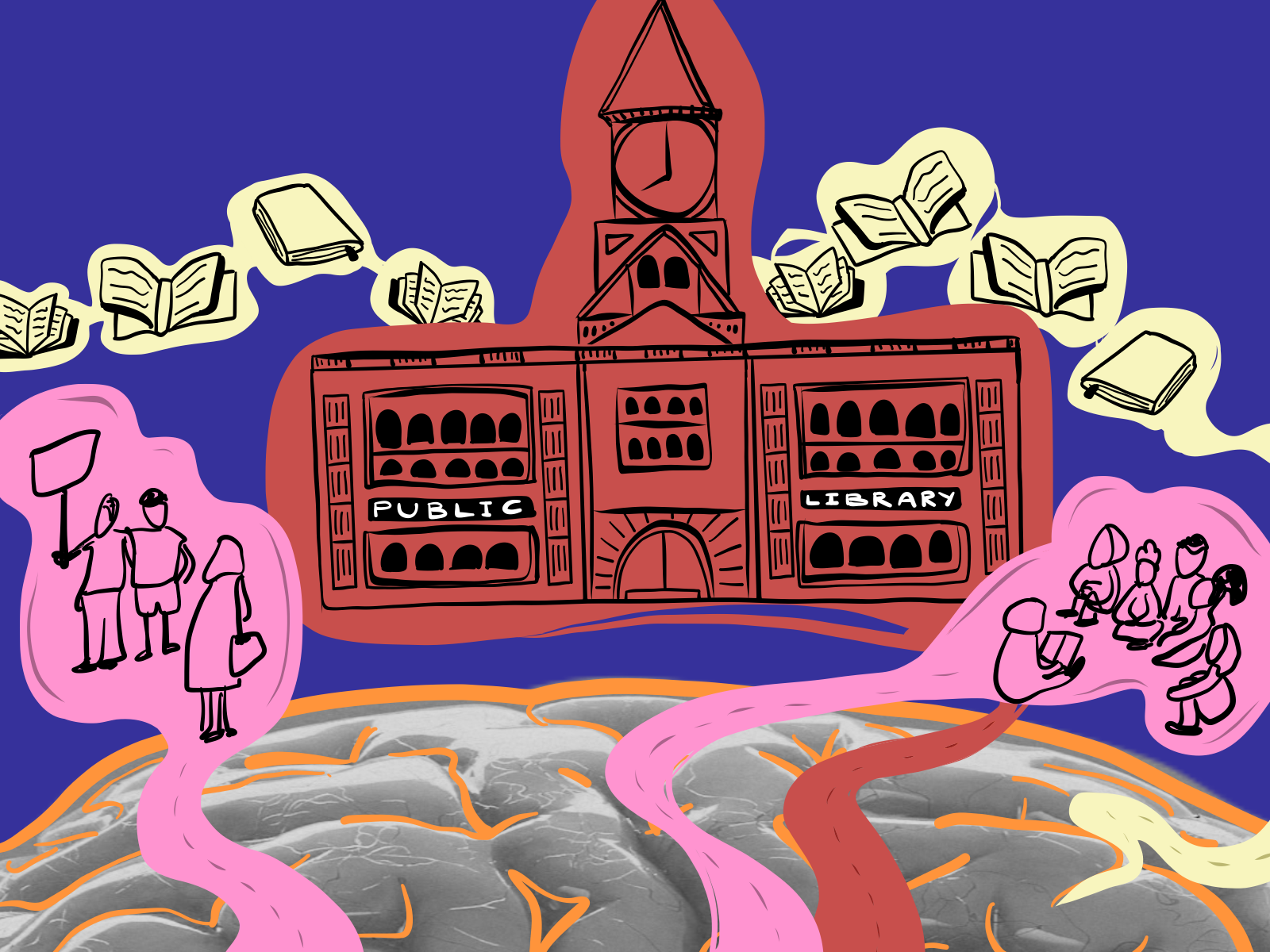
Closures? Cancelled. Reduced opening hours? Backtracked. £500,000 in job cuts? Blocked.
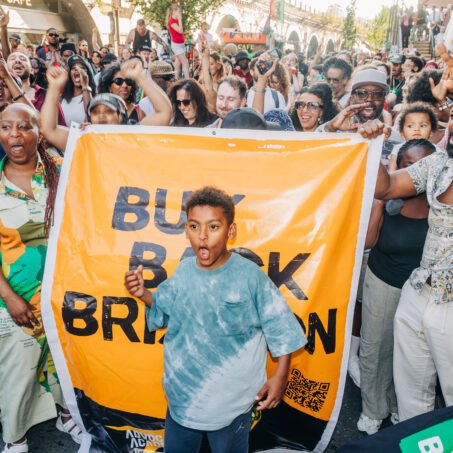
These are the concrete wins of the Save Newham Libraries campaign, but their wins far extend these. Bringing together workers, members and creatives across Newham, this campaign built an intergenerational coalition with the right mixture of tools and talents to win on a specific goal, and build foundations to strengthen local organising into the future.
Although specific, their goal was no small feat. To fully deep it, we need to visualise the field we’re playing on. More often than not, occupying space in British society comes at a cost – payment, membership, status, safety or otherwise. Catching up with friends in a coffee shop means you end up buying an overpriced latte. More worryingly, when teenagers hang out outdoors they run the risk of being accused of loitering, being subjected to a stop and search, or worse, particularly when they’re Black or brown.
Some of the only dwelling spaces with no product to buy, entry fee, hidden agenda or heightened risk of police profiling, are libraries. They remain spaces where people can just be. When such sacred space came under threat of closures and cuts, the community fought back. In Newham, library workers, active library members and other members of the community came together to do just that, and they won.
Yes, there were petitions, banner making workshops and town halls – hallmarks of countless campaigns. But, what I’m truly interested in lies beneath that. The Newham community met the perfect storm of cuts and elections with their own cocktail of classic campaign techniques and novel ways to tap into shared memory, creativity and duality.
“They are the library”: The people behind the magic
To learn what their win can teach us in a context where many of us are in the struggle without sight of that silver lining, I spoke to three organisers in the Save Newham Libraries campaign – two library workers, Nick*, Michael*, and a core library member, Sonia.
Nick is a 20-something library worker who clearly respects, perhaps even reveres Michael for his committed service to the community. Michael speaks with the deep knowing of someone who has seen firsthand why libraries are such essential pillars of our community for, I’d imagine, almost my entire lifetime. He has a warm appreciation for Nick’s energy, vision and mobilising skills. Regular library fixture, Sonia Quintero, is the founder of the Newham Poetry Group, a newly elected local councillor and hosts weekly meetings of the group in Newham’s libraries.
Introducing Sonia and the work of the poetry group, Nick explains “it’s not like the library is over there,” he gestures, “they are the library.” Over the next hour, each of them speaks about the library in this way – not as a building or a service but seeing each other and the community building taking place as the very essence of the library.
They all recognise that it is library workers and active community members, hand in hand, that make the library what it is. This ethos of shared ownership and, then, shared power was essential to their campaign.
Guerrilla intelligence, community stewardship and place-based practice
It was the mixture of library workers (union members at that) who are community members and community members who, in turn, are engaged in the stewardship of the library. The workers’ guerrilla efforts in exposing the information being withheld or obscured from the community and the mobilising power of community members gave the group its edge, and allowed the campaign to stay one step ahead. Sonia shared that it was only thanks to library workers that the community knew the extent of the proposed cuts, what consultations were running, and who to target. Without the community, the campaign would never have got off the ground.
This dual foothold is something I’ve often seen in campaigns for liberated education – coalitions of students and workers in schools, colleges and universities talking about what genuine co-ownership of these institutions would look like. But it’s only as I’m listening to Nick, Michael and Sonia that it dawns on me: I may not have fully conceptualised this beyond campuses.
What does it look like to build not only solidarity between workers who are locally rooted operating in a guerrilla capacity, and community members who have an active stake but to get to the next step. By that, I mean both groups wholeheartedly wearing both hats and showing up whole in each.
Creativity, play, memory and imagination as campaign tactics
When talking about how Nick, Michael and other library workers broke down the reality for the community, Sonia explains that on the website, the council “used very sophisticated language, they don’t say we’re going to make cuts, they say we are going to review the service.” With a hint of exasperation in her voice, she admits that, without the library workers sounding the alarm, “we would probably never know what is going on.”
Showing up whole also creates spaces for unique creativity to emerge. As well as the things I’ve seen in several organising spaces, like breaking bread together and bonding over these meals or banner making to engage people before an action, there were also some quintessentially library-y approaches to building community.
Sonia tells me that her poetry group hosted workshops as part of the campaign, and Michael spoke about regular town halls “giving people the opportunity to speak and shout and make some noise!” At them, library workers hosted library story times and nursery rhyme sessions for adults and children alike. For the adults there, I imagine this trip down memory lane brought back into focus the very reason that saving the libraries was – is – so important.
Nick reflected on how somatic those memories are. “People feel it in their bodies: their memories of being a kid and going to the library. People have such a fondness for them.” He carries on this train of thought: “it felt very unifying that all different types of people could be brought into this because there’s such a shared appreciation for these services.”
As I sit in the summer sunshine writing, I think back to summers as a library kid, the reading challenges that brought me back, day after day without fail; that had me zooming through pages, eyes wide, butt on the edge of my seat, with expectancy and intrigue. I cast my mind back even further to being read to. Being told a story – the expressive voices, and the pregnant pauses – holds the essence of possibility. As you listen intently, the story could go any which way. By recreating the imagination of a childhood past, library workers reminded the adults in their community that everything is possible. I bet the kids didn’t need reminding!
This is a key takeaway for me: the art of memory as a portal to imagination. Perhaps we could better activate sensory ways of tapping into memory. Learning from the power of the sounds – voice and silence – of storytelling, as a climate justice organiser I’m also thinking of the dampened birdsong with planetary destruction depleting 73 million wild birds in England, and the smells we risk erasing with rising temperatures causing jasmine blossoms to open before the scent can be captured as potentially unifying sites of memory.
Fighting back, winning and the future beyond the win
The Save Newham Libraries campaign delivered some incredible wins. But, more than that, the folks involved used play, joy and memory to build community and, in doing so, have offered a blueprint that other organisers – myself included – can learn from.
Don’t get me wrong: the picture that Sonia, Michael and Nick painted wasn’t all sunshine and roses. Like most campaigns, this one faced its fair share of challenges and institutional hostility. The reason Nick and Michael requested to remain anonymous is because they have personally witnessed underhanded actions from library senior management in opposition of the campaign. They testify that, as workers, they were warned not to promote the campaign’s petition and even (unlawfully) banned from attending public meetings of the campaign in their personal time.
Join our mailing list
Sign up for shado's picks of the week! Dropping in your inbox every Friday, we share news from inside shado + out, plus job listings, event recommendations and actions ✊
Sign up for shado's picks of the week! Dropping in your inbox every Friday, we share news from inside shado + out, plus job listings, event recommendations and actions ✊
Though Nick admits these threats did intimidate some members from returning, he reflects that any drop in numbers was counterbalanced by a radicalisation of other members. As Nick puts it, “there were a handful of people whose politics have really been shaped by the politics of our employer. The need to get involved and fight back has been made very clear to them.” The beauty of a clear and (at least nominally) simple ask: by having an accessible entry point, folks who may not have otherwise get involved, and through being part of a campaign sharpen their political lens.
The folks behind the Save Newham Libraries campaign are under no illusion that these challenges are over, nor that these wins will secure the fate of Newham’s libraries into the future. Just months after the win, they say they’ve already caught wind of the council hinting towards future restructure. These murmurs aren’t quelling their resolve. They’re determined that, off the back of this win, they can mount a bigger resistance to austerity measures in their local communities.
“More fights to be had, definitely,” Nick says with conviction. Seeing the twinkle in Sonia’s eye, the pride in Michael’s smile and the determination in Nick’s statement, three examples of countless more committed organisers in their group, I have no doubt that they will fight and they will win.
*Due to ongoing threats to their livelihoods, these library workers’ names have been changed to Nick and Michael.
What can you do?
- Follow the Save Newham Libraries campaign on Instagram and see where they take the campaign next
- Read about the Defend the Ten campaign and the 2016 occupation of the Carnegie Library
- Support the Free Books Campaign – donate, volunteer and/or share their social media posts
- Listen to Angela Davis and the late great Toni Morrison talking about libraries, literacy and liberation
- Find your local library here, get a library card, join a club that meets there regularly and get stuck in!
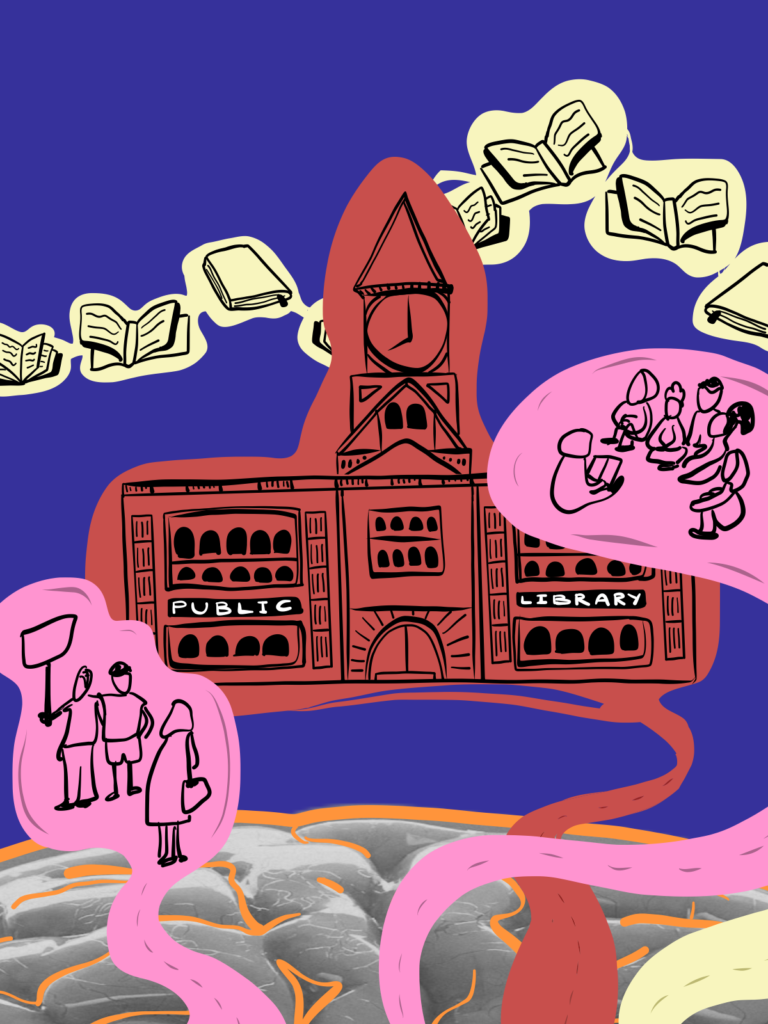 Illustration by @npl_illustration