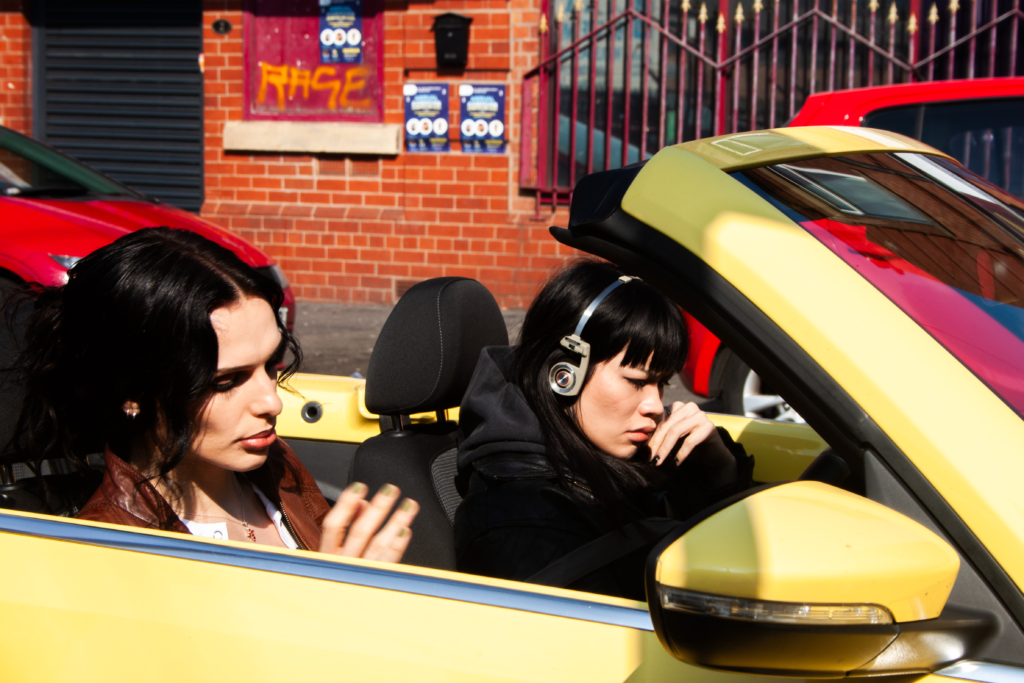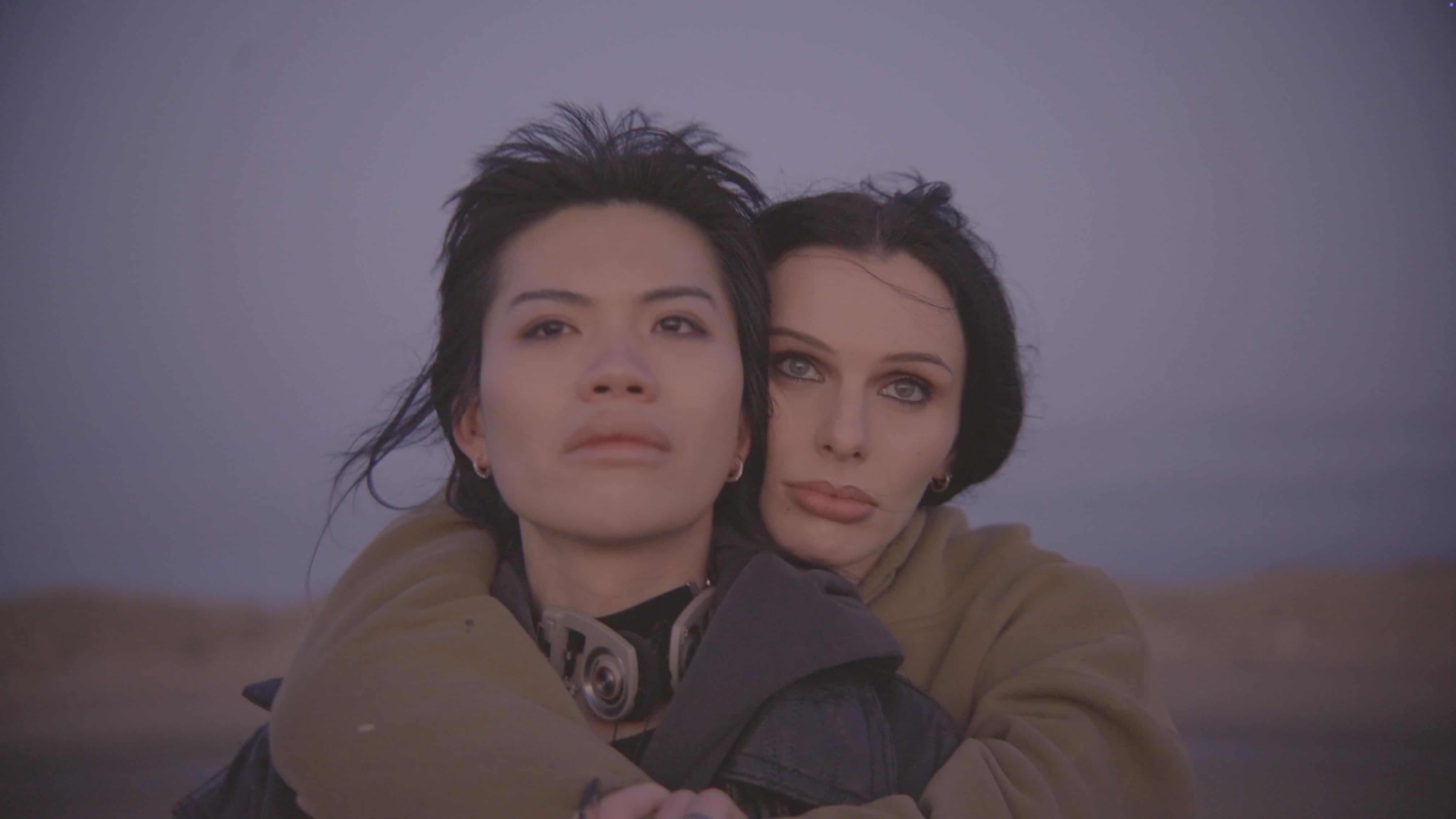
Shortly before the screening of Last Orders at The Mandrake Hotel in Soho – a trans-led short film directed by Adam Ali, starring actresses Jaylin Ye and Theo Papoui – a group of us (all trans women) gathered at the venue’s bar. It was March: nearly one year had passed since the UK Supreme Court ruled that our community should not receive the same legal protection as cisgender women.
Our catch-up mainly focused on things like work, dating, our plans for summer. We spoke about politics, too, and it struck me that many of the women in the room were thinking about moving away. They didn’t know where; they just knew that, at some point, it could become unbearable for them to continue living in the UK.
The inciting line of Last Orders is a confession: “I’m not proud to admit I spend my whole life running.” It is shared by Joy (Jaylin), one of the film’s protagonists, who is struggling with addiction and grief – although it speaks to impulses of many trans women right now, particularly in the UK, who feel that forming an escape plan is an appropriate response to the society they live in.
In Last Orders, art imitates life
Last Orders was shot shortly after the judgment was announced in April 2025; the fictional world it presents is almost indistinguishable from our own. It pictures a society in which transphobia has metastasised into chaos: a far-right protest has descended onto the streets with the intention to threaten trans people.
We learn about the escalating violence by its impact on two transgender women, Joy and Nora (played by Theo). Upon arrival at their place of work, an LGBT+ pub nicknamed The Doll House, the women are informed by their manager that the riots have forced the venue to close. She then urges the women to flee, insisting that they take her car to a caravan park near Liverpool so that they can take shelter.
What follows is a road trip adventure that drives the women to confront how their inner conflicts – such as drug addiction, grief and social isolation – are symptoms of internalised transphobia. Nora is the outspoken best friend and familiar mother figure who urges Joy to face her demons. At their first stop, next to a building site, she presses for the truth about her addiction; at their second pitstop, she grabs her diary and reads it – a betrayal which causes the truth to explode out of Joy. She opens up about the death of her grandfather; how he was her only family member who accepted her identity.
Ultimately, it is Nora’s overbearing nature that provokes Joy to experience emotional relief: in the film’s final scene, they are shown standing on a beach, holding each other and looking out to sea. It is at this moment that my eyes scan the room to gauge the audience’s reaction.
I notice viewers embracing each other; how their physicality mimics the actresses on screen. Many of us in the room know Jaylin and Theo as close friends, or rather, ‘sisters’; we were there for other each other during ruling, and now, as the Equality and Human Rights Commission (EHRC) asserts that we should be excluded from single-sex spaces (or be provided with a third space).
Seeing how these women staged this shared trauma on screen, and the emotional ripple it sent through the audience, prompted me to consider the role of film and television during moments of turmoil. I was also curious to hear from Jaylin and Theo about the industry’s treatment of trans people; how the ruling might have affected them personally and professionally.
Jaylin is a model, writer and multidisciplinary performer. She made her television debut as Karis in the UK series Dead Hot, a role that marked a historic milestone, establishing her as the First Chinese transgender woman to appear in a UK television drama. Theo is a London-based performer and model with West End credits including The Devil Wears Prada at the Savoy Theatre, and appearances in music videos for Sam Smith, Tov Lo, Jade Thirlwall, and FKA Twigs.
I invited the actresses to my home to hear their thoughts.
On typecasting and trans representation
It seems obvious how British politics makes trans women feel like the society they live in is untenable. But what role do our (pop) cultural institutions play in this ongoing exclusion?
My discussion with Jaylin and Theo challenged some of my preconceptions about how power moves through this mechanism: I have often argued, for instance, that visibility is a cynical tool excessively offered to trans people in lieu of material support. I don’t think that notion is entirely false: as author and activist Prishita Maheshwari-Aplin argues: “Without action – and true systemic change that supports the needs of the trans community – visibility can easily create further instability.”
But, in my attempt to argue beyond that framework, I have, perhaps, tread close to the idea that there is enough meaningful, or even progressive, representation out there, particularly in film and television.
“We are still either underrepresented or misrepresented by film and television,” explains Jaylin. “The industry is still lacking when it comes to telling our stories.”
Despite an uptick in television shows featuring trans characters over the past three years – What It Feels Like for a Girl, Heartstopper, The Umbrella Academy, Somebody Somewhere, to name a few – such representation remains scarce. According to a recent report by GLAAD (formerly the Gay & Lesbian Alliance Against Defamation), 7% of LGBTQ+ characters counted across broadcast, cable and streaming last year were trans.
As Jaylin describes, because of the way that trans people are typecast and “excluded from playing cis roles” – including in Hollywood – a lack of trans representation means “a lack of jobs”; underrepresentation on screen is simply another way to describe unemployment behind the scenes.
“Often, when a trans role does come around,” Jaylin says, “it is for a specific purpose. I have been told by cis directors after auditions, for instance, that I am too passing for the role.” This is a complicated issue about which Jaylin, Theo, and I have mixed feelings. As Theo notes, “a lot of the trans women around me are relatively happy; they go about their day like anyone else, although the government is trying to stop that. Where is that being represented?”
Their comments feel consistent with the stories I see on screen: rarely are trans characters afforded the privilege of “unspectacular lives”, to borrow a phrase from writer Colette Arrand’s essay on the importance of “trans mediocrity”. As Jaylin explains to me, the defining feature of trans characters on screen is often their transness, and not much else.
Of course, the subject of passing is fraught. Trans people are everywhere; we all form a part of the ordinary fabric of life, regardless of our appearance or bodies. Still, Jaylin’s experience reflects one of the multitude of ways that trans actors can experience exclusion. What Jaylin and Theo hope to see from popular television is a form of representation that deprioritises trans people’s appearances entirely and shifts them beyond the conditions of their oppression.
Join our mailing list
Sign up for shado's picks of the week! Dropping in your inbox every Friday, we share news from inside shado + out, plus job listings, event recommendations and actions ✊
Sign up for shado's picks of the week! Dropping in your inbox every Friday, we share news from inside shado + out, plus job listings, event recommendations and actions ✊
Being a trans actor since the ruling
The day of the ruling, Theo was backstage at a theatrical production when a dispute occurred. The colleague, unaware of the judgment’s meaning, asked ChatGPT for a description and read the answer aloud. They then brought up the subject of genitalia and openly discussed how it differs between trans and cis bodies.
“It made me feel so small,” Theo tells me. Perhaps the most shocking part of Theo’s story, though, is the reaction to her distress: “After I performed on stage, my manager confronted me and asked why I triggered another employee. I was in shock. The colleague who made me feel uncomfortable then insulted me; she called me names. I left, and I never came back.”
This was not the first time Theo felt uncomfortable at work: “I had been misgendered before in different environments,” the actress states. Yet, on the day of the ruling, the overwhelming feeling that Theo had was that no one was going to support her, both personally and professionally: “I felt targeted, and I just thought: ‘If no one was going to stick up for me before this day, they definitely weren’t now.”
Theo’s concerns about the lack of protection for trans people since the judgment are, unfortunately, not unfounded. This is something that affects all industries. Certain transphobic expressions – such as the assertion that trans women are not women – are legally protected viewpoints (this is something I wrote about for my first shado article, which detailed how NHS nurses throughout the past few years have exercised their beliefs to exclude trans women from female-only spaces).
The EHRC’s updated code of practice reinforced last April’s ruling, asserting that female-specific services that choose to include trans women are very likely to be at risk of legal challenge. It is still illegal to express transphobia if it is communicated through harassment (gender reassignment is a protected characteristic).
However, this stands in contradiction to the workplace environments that the Court is enforcing: trans women are, of course, much more likely to experience prejudice if the spaces they are in are designed to exclude them. Trans people are already struggling to prove they have been harassed, except in extreme circumstances; if the updated code is not rejected, this problem will intensify.
As I mentioned, this potential law would affect all industries. But there is also something unique about film and television that the guidance places at risk: its ability to uphold diverse representation and influence public perception on a mainstream scale. When the ruling was first announced, hundreds of actors and industry figures (Eddie Redmayne, Katie Leung and other notable names) signed an open letter calling on major cultural institutions – such as Bectu, BAFTA, BFI and Picturehouse – to denounce it. Most of these organisations have chosen either not to respond or to publish vague statements. That it could be illegal for these organisations to include trans people in their single-sex facilities is likely an explanation for their silence.
Theo tells me that she did not return to the production after she experienced harassment. If more trans actors are forced to work in untenable settings – unable to use the correct toilets or dressing rooms on set – we can expect to see less of them on our screens. Her experience indicates how the ruling could place trans representation in an even more precarious position.
You can still stop this
This is both a labour and a cultural issue. In this industry, working conditions decide whose stories are told and how. “So many people struggle to speak up for and defend trans people in this business,” says Theo. “Silence in the workplace is a big issue, and now more than ever, I want my fellow cast members and colleagues to use their voice in the ways they can.”
In mainstream commercial cinema, trans actors already find themselves navigating corporate HR environments, typecasting, and a lack of legal protection. One potential outcome of the ruling is that we might see an increase in trans actors starring in independent films: “a huge part of why we wanted to be a part of Last Orders is to reclaim the narrative. We wanted a story made by us, for us.”
It will be crucial during this period to show up and support the organisations that are sharing underrepresented stories (see list below); it means shifting how we think about our consumption, so it becomes less of a passive act and more of an ethical role. This coincides with recent shifts in power within the television industry, which will likely restrict trans storytelling. As Theo reminds us: “the recent merging of HBO Max and Paramount has given Trump more control. It’s not so dissimilar from the BBC here, in the UK, which, of course, is owned by the government. British and American states are controlling the political narratives.”
In the UK, the biggest threat that trans actors face – whether working in mainstream or independent film and television – the biggest threat right now is the ruling. MPs, including Nadia Whittome, have tabled a motion to disapprove of the EHRC’s updated code of practice. We are currently in a 40-day scrutiny window, during which the motion is the only mechanism that can challenge the potential law.
It is, right now, the most meaningful way you can change the script on trans rights, and to remind us that there are communities far and wide who love us, need us, want us to stay.
What can you do?
- You can write to your MP to help prevent the statutory guidance from becoming recognised legally within the Equality Act. Email them to reject the EHRC’s updated code of practice
- Fund trans charity Not a Phase
- Follow, support, and attend the screenings of the independent film organisation Fringe! Queer film and art festival
- Support and sign up to Bohemia Euphoria, a streaming site for underrepresented stories
- Stream Films for Action