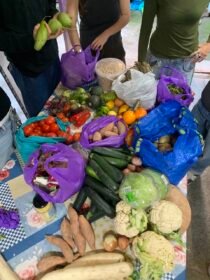
Around the world, Barcelona is held up as a model of progressive politics and world-leading urban design, attracting more tourists than Brazil and Australia combined. But for the people who actually live in El Raval – one of Barcelona and Europe’s most densely populated, majority immigrant neighbourhoods – the city’s reputation doesn’t hold up.
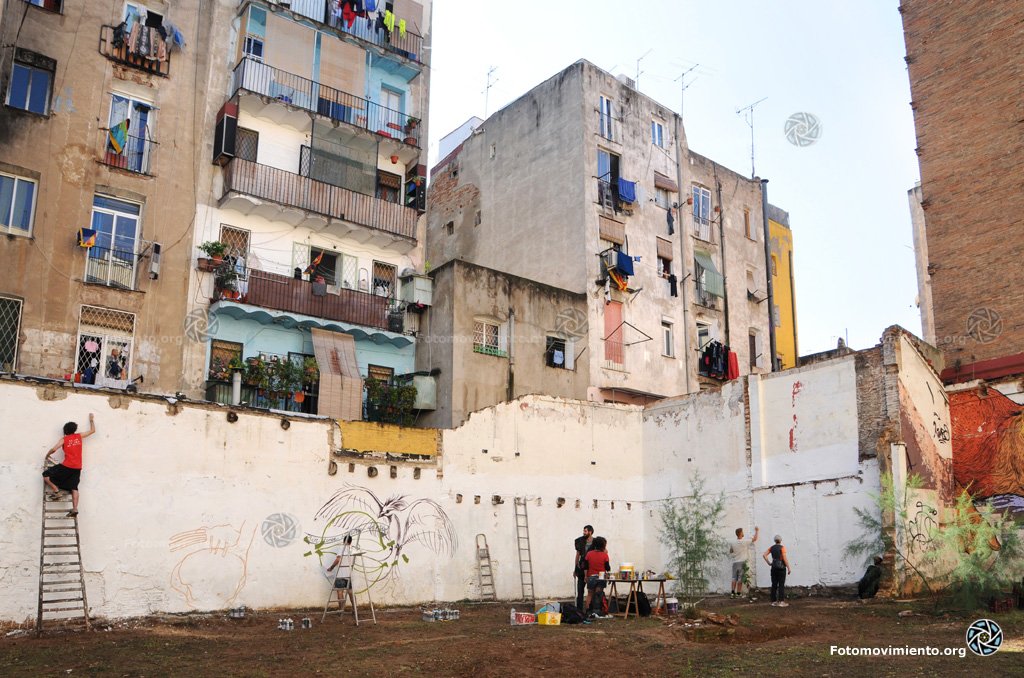
In nine days time, police are coming to evict L’Àgora Juan Andrés Benítez: a community garden, kitchen and organising space in the heart of El Raval. Built on the corner where neighbour Juan Andrés Benítez was murdered by the police in 2013, a coalition of collectives seized a vacant lot to build a garden in his memory and in resistance to police violence. Over the last 11 years, the garden has bloomed into the heart of the neighbourhood, and an organising space for over 400 collectives.
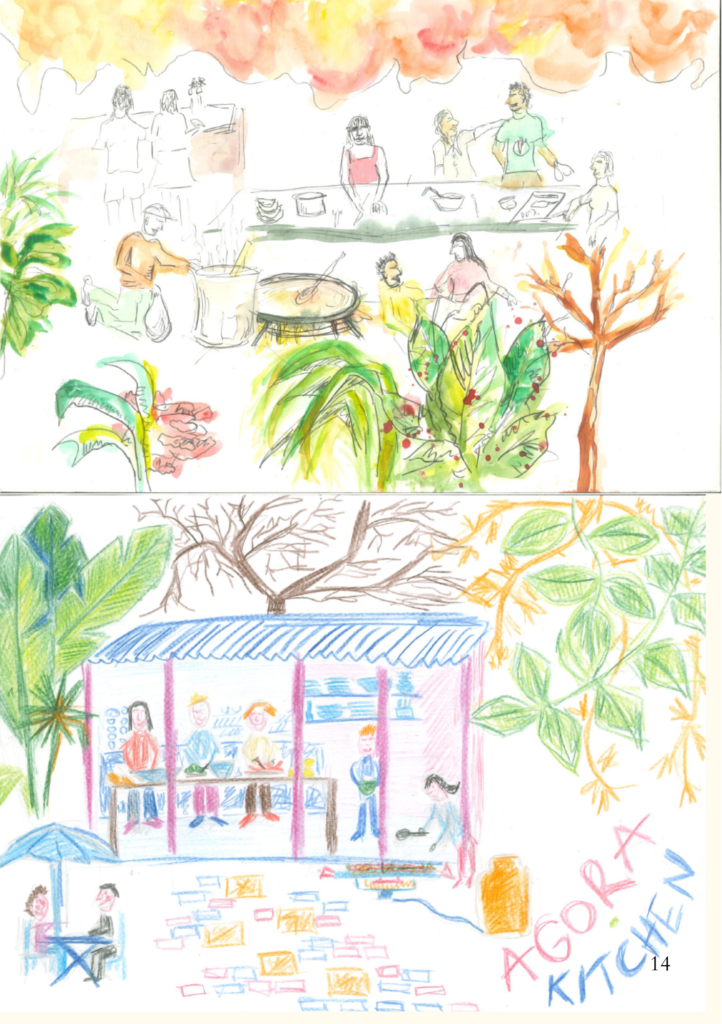
We, Comí collective, are one of those groups. Every Monday, we collect local food waste and turn it into hot meals for the community – serving 2,000 meals since September. L’Àgora is where we do this work, where many of us migrants to the city have found community, purpose, and connection. It’s where local kids have their birthday parties, where the sex workers union meets, and the cool green where people without air conditioning can find shade in the stifling summers.
L’Àgora has been all of these things for 11 years. And on the morning of 29th April 2026, representatives of Sareb arrived to serve it an eviction notice.
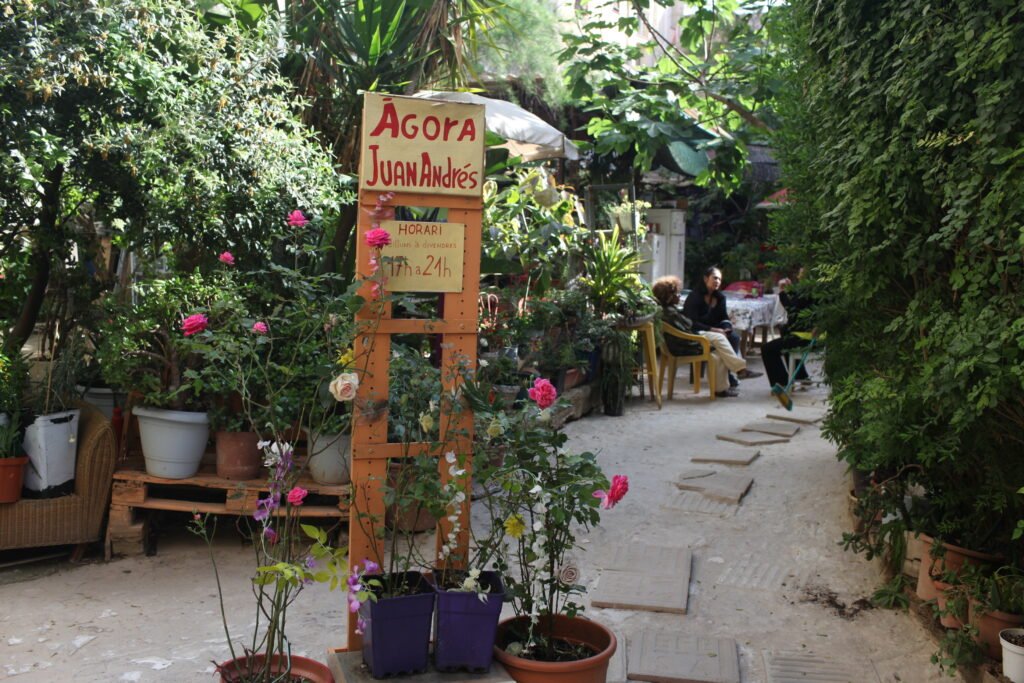 Àgora Juan Andrés Benítez in 2026. Photography by James Souder
The bad bank
Sareb is Spain’s national ‘bad bank’, an asset management company created in 2012 by the Spanish government, with the involvement of foreign firms including Blackrock, to bail out large Spanish banks following the 2008 financial crisis. The mechanism works by acquiring ‘toxic assets’: properties devalued by unpaid and unpayable debts, offloaded from the balance sheets of failing banks and handed to Sareb to sell off at maximum profit. These assets, seen by Sareb and the state as problems to be liquidated and balanced on their spreadsheets, are community gardens, grassroots spaces, and people’s homes.
Sareb doesn’t just evict your local community space, it is a cog in a much wider machine of state-owned enterprises and multinational companies that maintain the infrastructure of genocide and apartheid. The American investment funds who manage Sareb’s €25 billion portfolio, Blackstone and KKR, are deeply tied to the ongoing genocide and apartheid in Palestine, including funding and profiting from illegal real estate in the West Bank. Sareb is the mechanism – one node in a global system that turns public need into private profit, that funds dispossession in Palestine and delivers eviction notices in El Raval, that is always, everywhere, looking for new land to enclose.
Sareb is also scheduled for dissolution in 2027, and that deadline is now driving a frantic liquidation of its remaining holdings – including the lot on which L’Àgora stands – at breakneck speed, regardless of what public good has grown up through the concrete in the meantime. L’Àgora is one of the last community spaces still standing in El Raval, a neighbourhood with a long history of building self-governed spaces, sustained entirely by the people who use them. Because of Sareb and other financialised interests, most of the others are already gone.
Callous evictions are therefore nothing new for residents of El Raval. Properties throughout the barri (neighbourhood) that had been reclaimed and retrofitted to serve communities most impacted by austerity measures are now being subsumed once again into the gaping maw of urban ‘development’ and limitless profit seeking. Just 700m away, the MACBA – an art gallery whose visitors are 90% tourists – receives €5m annually from the municipality while vital community spaces are starved of funding and dismantled.
The MACBA’s consortium of private capital, municipal government and institutional prestige, has even been permitted to annex public space for its expansion, swallowing what was once one a world famous skating spot. The message from the institutions is unambiguous: culture that generates tourist revenue and flatters corporate donors deserves public subsidy and room to grow; culture that serves the people who actually live here deserves eviction.
“A place like L’Àgora is fundamental to the neighbourhood, a place for collectives without any interest in money or financial gain,” says a member of the Putas Libertad, the Sex Workers Union who collectively manage the space. “We’re tired of the neighbourhood being only for tourists and not for us.”
But there is hope that the very nature of L’Àgora – inclusion, solidarity, and care – has fostered the type of resistance network that can save its treasured space from the same fate. Along with support from the neighbourhood, collectives like us, tenant unions, and pro-Palestine activist groups, even the previous leftist government, Barcelona en Comú, has called on the municipal government to stop the eviction and recognise L’Àgora as ‘an essential space for the daily life of the neighbourhood and the city’.
A green space for the people
“The choice between gardens and public housing is a false choice,” says Professor Kate Brown, Distinguished Professor in the History of Science at MIT and author of Tiny Gardens Everywhere: The Past, Present, and Future of the Self-Provisioning City. “Citizens are rarely offered a choice between gardens or parking spaces, or empty lots, or speculative developments sitting vacant for years,” she continues. “There are all kinds of spaces that could be suitable for public housing. They choose to come for the garden.”
Last summer, 786 people died from extreme heat in Barcelona. The city that tourists flock to for sun, sangria and seafood now ranks third in Europe for climate change related deaths, many of them due to the deep inequity of how the city has been designed, and for whom. The science on urban heat and inequality is unambiguous: communities least responsible for climate change are the communities most exposed to its worst effects. Nature deprivation research shows us that working class communities live in neighbourhoods with less tree canopy, less green space, more concrete, and more air pollution, under flight paths and near waste facilities.
While the city government invests in strategically greening more affluent, tourist-facing areas, working class neighbourhoods remain overcrowded, poorly ventilated and lacking access to green space. El Raval, one of Europe’s most densely populated, majority immigrant neighbourhoods in Europe, has no parks to speak of, no air conditioning in most households, and a heavy, constant police presence that makes the necessity of being outside to escape the heat feel more hostile than relieving. With El Raval experiencing “almost double the number of ‘tropical nights’ compared to other neighbourhoods in the city”, it is a text book case of climate inequality.

The irony is that the city’s own greening investments tend to accelerate the displacement of the people most in need of them. When green infrastructure gets built in low-income urban areas, research consistently shows it drives up property values and pushes out residents. The community gardens and urban parks that appear in environmental justice rhetoric often function, in practice, as frontrunners for gentrification.
L’Àgora is an explicit counter-model: green space built and managed by the community, for the community, with active effort to keep it from being captured or commodified. Indeed, research shows grassroots cultural spaces across Europe are incubators for urban climate solutions and greening that actually combat the sharp impacts of gentrification, which city planners would do well to study rather than demolish. Tackling climate change from the ground up includes taking space earmarked for development and letting green space bloom – and we can all take inspiration.
L’Àgora shows what becomes possible when communities stop waiting for the city and start building it themselves. This is the spirit of Catalunya we can all learn from. L’Àgora proves nurturing mutual aid, greening the city and building community power are the same fight, done together, in one place, by enough people who refuse to wait for permission. We know this because we have been part of it. Since the eviction notice arrived, that same collective muscle – the one we cultivate each week feeding hundreds of people from food the city throws away – is now helping us fight alongside other collectives, unions, and neighbours to resist eviction and keep the space that made it possible.
Header image: Àgora Juan Andrés Benítez when it first opened, in 2014. Photography by Pedro Mata.
What can you do?
-
- PLEASE SIGN OUR PETITION. We need international support to show the municipality that this is a beloved space – please sign the petition to save Àgora here.
- Donate here to our campaign to save Àgora and protect vital community members here.
- Please follow our social media and share our campaign here.
- If you are in Barcelona, please come along to our events: we are hosting a party and protest next week.
- Support our neighbours and comrades fighting the MACBA expansion into public space.
- Read shado’s Knowledge Page: What is Gentrification?