I almost didn’t make it to Guinan Village.
At the start of January, I was fortunate enough to be a part of The Inclusive Ecology Collective’s Re-storying Futures Fellowship. For 12 days, I had the opportunity to live in Guinan Village, in Guangdong Province, as part of a multicultural and intergenerational cohort of from the United States and China to co-create, reflect, play, and rest – and explore with our “head, heart, and hands” our relationships with one another and with the living earth as the planet faces escalating ecological crises.
But I had to get there first. Having missed my flight from Hong Kong by a few minutes, I had to go back into the city to take a bullet train to Guangzhou instead. Soon, I realised: had I taken the flight, I might not have noticed the acute difference between the capital and the villages that surrounded it.
Guangzhou, historically known as Canton, is a fast-paced, 2,200-year-old trading city and also the capital city of Guangdong, one of China’s richest and most populous provinces. On the train, the well-designed roads, tall skyscrapers, and advanced cars vanished as I got closer to the village, the landscape replaced by smaller homes, people outside on the streets, and an abundance of green that I had forgotten about after spending the last few months in Beijing.
In pursuit of a different sense of life
Guinan Village has been continuously inhabited since the Qing Dynasty and has traditionally been home to Hakka-speaking farming families. Today, Guinan Village has about 2,000 registered residents. With its proximity to Guangzhou, Macau, Shenzhen, and Hong Kong, Guinan Village has also attracted a growing number of urban-to-rural migrants since 2014, gradually creating what is now called an “eco-community” (生态社区 shēngtài shèqū).
Many of them, burnt out and disillusioned with the intense 9-9-6 working culture of China (where individuals often work from 9am to 9pm six days of the week), were in the pursuit of a different sense of life, community, and sustainable living.
In a way, I was also in pursuit of a different sense of life. I often introduce myself as being born and raised in New York. This city has profoundly shaped who I am: it has given me a family from diverse organising spaces; its stoops have seen the cries of my friends and me; and its public parks have offered a green oasis. Perhaps because of the city’s high-stimulus environment, there is a sense of stillness and silence in nature that still startles me. I see nature as mystique, and it comes from my own ignorance: of not knowing how human beings co-exist with the world around them, of not knowing which way and how strong the winds will blow, and where the water comes from.
But describing myself this way, I simplify a more complex experience: while I was born in Flushing, New York, my dad had grown up in Pukou, a small village in Fuzhou, the capital city of Fujian Province in China. When I was around 8 months old, my parents flew me to China to grow up with their relatives for a few years before returning to New York City.
There were so many memories, perspectives, and understandings about China submerged deep into my consciousness – memories I’m not even sure were my own. Perhaps that’s why, despite being educated in New York for almost my entire life, I decided to pursue my graduate studies in China at Peking University as a Yenching Scholar.
In Beijing, I was lucky to improve my Mandarin skills, and learn from people who were communing and creating built spaces together, and were willing to let me peek into that world. But Beijing was not a representation of China: of all its diversity, differences, and multiplicity. In Guinan, I hoped to not only reach a better understanding of rural China, but also explore a part of my younger self I had forgotten about.
Rural revitalisation and eco-tourism
After we unpacked our bags, my friend and I walked through the town to meet some of our friends and facilitators at a local restaurant. In the last 3 hours, I had been in two of the busiest cities in the world, but at this moment, time was gone.
Keeping to a natural slow pace, uncharacteristic of Beijing and New York, we were charmed by the colourful pink homes. the various small shops, and fields of green. After passing a vast field, which we later learned was the Community Farm, we noticed more establishments closer to the town centre, including a “no-plastics” shop that had recently gone viral on Chinese social media, a gift shop, and a bookstore cafe that looked like it was built for photo-ops (daka, 打卡) and tourists willing to pay for overpriced matcha lattes.
I had expected my time in Guinan to be one of understanding local knowledge systems for deep ecology and sustainability. Instead, for a moment, it seemed like the village had been dramatically influenced by “eco-tourism.” By the end of the day, I thought I had a thesis going for how the “rural aesthetic” and eco-tourism rooted in the Chinese State’s grand narratives for rural revitalization had commercialized rural villages like Qixi.
Since 2017, the Chinese government has pursued a policy agenda aimed at transforming rural areas, most notably through the Rural Revitalization Strategy (乡村振兴战略): an initiative that sought to modernise agricultural practices, develop rural infrastructure, and attract younger generations back to their home villages. This policy sits within a wider ideological framework championed by Xi Jinping, captured in the phrase 绿水青山就是金山银山 (Xi Jinping Thought on Ecological Civilisation). It translates literally to “green waters and green mountains are gold mountains and silver mountains” – the idea that natural landscapes hold economic worth equal to material wealth.
These policies position the Chinese countryside as simultaneously a repository of cultural identity and a driver of future economic development. They can also be a main force transforming a place like Guinan into a commercialised, aestheticised version of rural China – one that may create economic development, but may also end up damaging the original, unique character of the village without the consideration of people who call it home.
Indeed, a beloved camphor tree next to the bookstore cafe recently died because of the development of the area. It is now purposely painted with a teal green lacquer – a statement on greenwashing by Zhou Laoshi, a resident and retired fine art professor.
But in the next few days, conversing over meals, tending to the land, reflecting on hikes through the mountains, and participating in dialogue brilliantly facilitated by our programming stewards, I found my first impression falling apart.
Learning from the people tending to the land
The Academy often praises “Critical Approaches to x Discipline,” but sometimes, ironically, these same frameworks translate into quick judgment without complete nuance. As someone who has been trained in the American Academy, I also immediately judged my new home. I had applied my personal understanding of contemporary policy changes, sustainability metrics, and visions of a rural village to this space.
When my group was invited to join one of the community farms in Guinan, owned by Yen Yen Jie 艳艳姐, my understanding of development and circular economics became more nuanced.
Over tea, Yen Yen Jie, who was an older member of the eco-village, explained that she had worked in Zhongshan her entire adult life before migrating to Guinan six years ago. She wanted Guinan to be our home too: inviting us to plant lemongrass at her farm, so that “if we were to return home, we could see the fruit of our seeds.” As we were planting, we met many of the town residents who stopped by the farm to tend to the vegetables and fruits they had planted or to gather their meals for the day. Yen Yen Jie suggested we do the same for our dinner.
Join our mailing list
Sign up for shado's picks of the week! Dropping in your inbox every Friday, we share news from inside shado + out, plus job listings, event recommendations and actions ✊
Sign up for shado's picks of the week! Dropping in your inbox every Friday, we share news from inside shado + out, plus job listings, event recommendations and actions ✊
The sun was setting, but the usual fear I get from vast spaces in the dark wasn’t there. Instead, the mood was joyous. The entire town could hear us cackling with laughter whenever Yen Yen Jie yelled over her speakers, which blared the same Chinese song over and over again, and teased us for acting like city kids who didn’t know which vegetable was which. As the sky turned from a warm orange to dark blue, I felt a new sense of warmth and abundance – from tending to the earth.
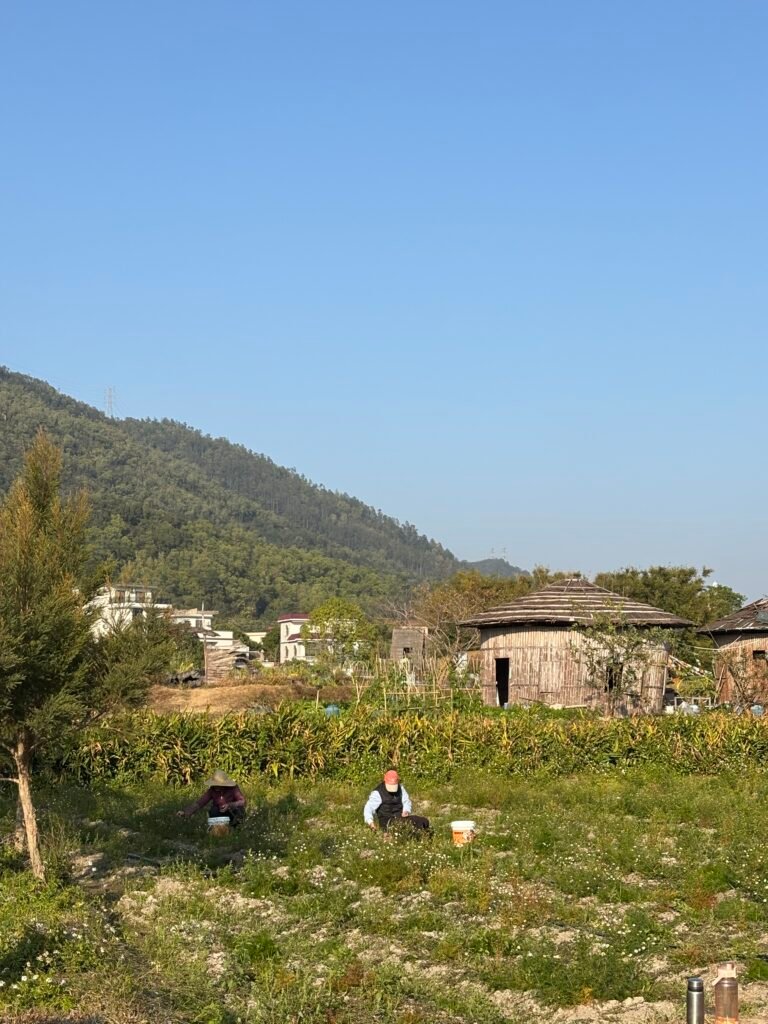 Farming at the community farm
Over dinner, we chatted about our families, our experiences in Guinan, and our changing perspectives on our relationship to the earth. We learned that Yen Yen Jie’s farm had a membership system where participating residents could pay a small monthly fee to enjoy the space, tend to the land, and harvest their seeds; the farm was born both from a desire to be more conscious of her consumption and to sustain her life. Yen Yen Jie talked about how, through intergenerational conversations and workshops with residents who had gone to Schumacher College, she began to see nature not as an economic asset, but life itself; soon, her farm became a local example of circular economies, and the room where we were having dinner became a space for open village meetings.
Yen Yen Jie jokingly told me to convince my mom to also move to Guinan, after I learned that she had convinced her daughter, nicknamed 小怪兽, “Little Monster”, to do the same. In fact, Little Monster was the one who had co-created the recently viral “no plastics” store to exemplify how everyday consumption can still be sustainable and intentional.

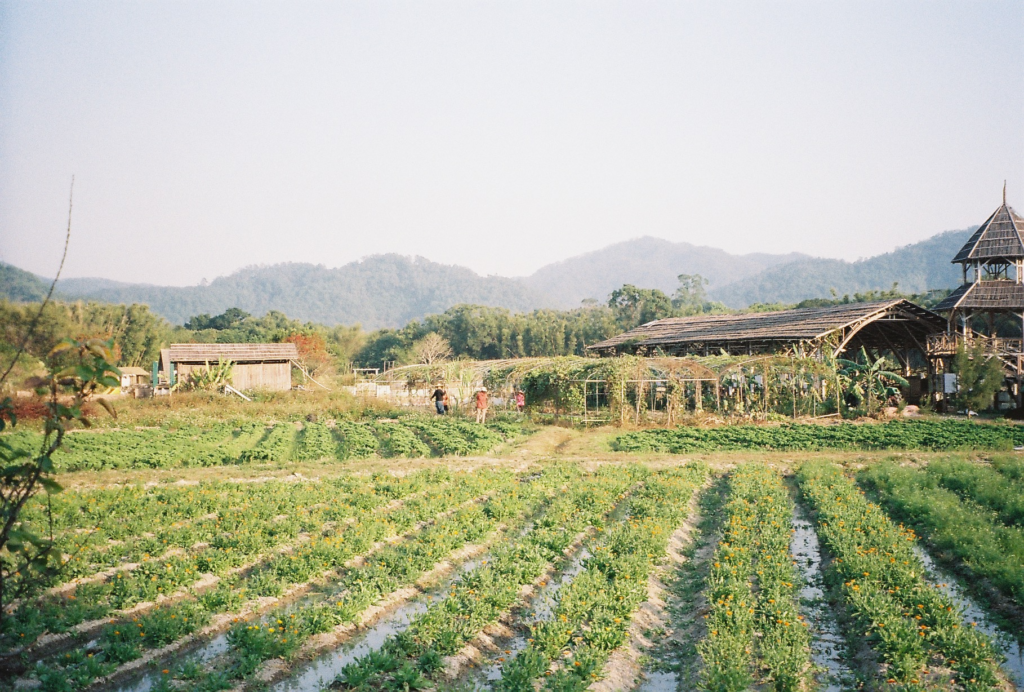 Now the office and canteen of the Community Farm, this site (九月楼), September Tower, used to host the Schumi Learning Garden, where community residents learned from workshops including Schumer College pedagogy, would occasionally host community potlucks, eco-markets, and more.
Ongoing moral discourses on economic revitalisation
Yen Yen Jie reminded me of my mom. They shared the same last name and the same sense of joy. I couldn’t help but think about how much my mom would benefit from (un)learning through co-creation. Both Yen Yen Jie and her daughter found opportunities to create their own spaces here in Guinan. They decided their own hours, aesthetics, regulations, and rules for work, and had specific reasons for opening their spaces – reasons separate from the grander narratives of revitalisation that don’t always translate neatly to official policy or economic discourse. Instead, it was co-created and regenerative.
Many of the local residents, with family roots in Guinan spanning generations, appreciate the government’s new attention to villages like Guinan. They enjoy government subsidies provided to renovate their homes, paint their walls pink, and install larger glass windows. Some urban migrant residents may have differing perspectives – some families with economic and technical means working to rent and renovate historical homes, integrating new facilities, but keeping many of their older facades.
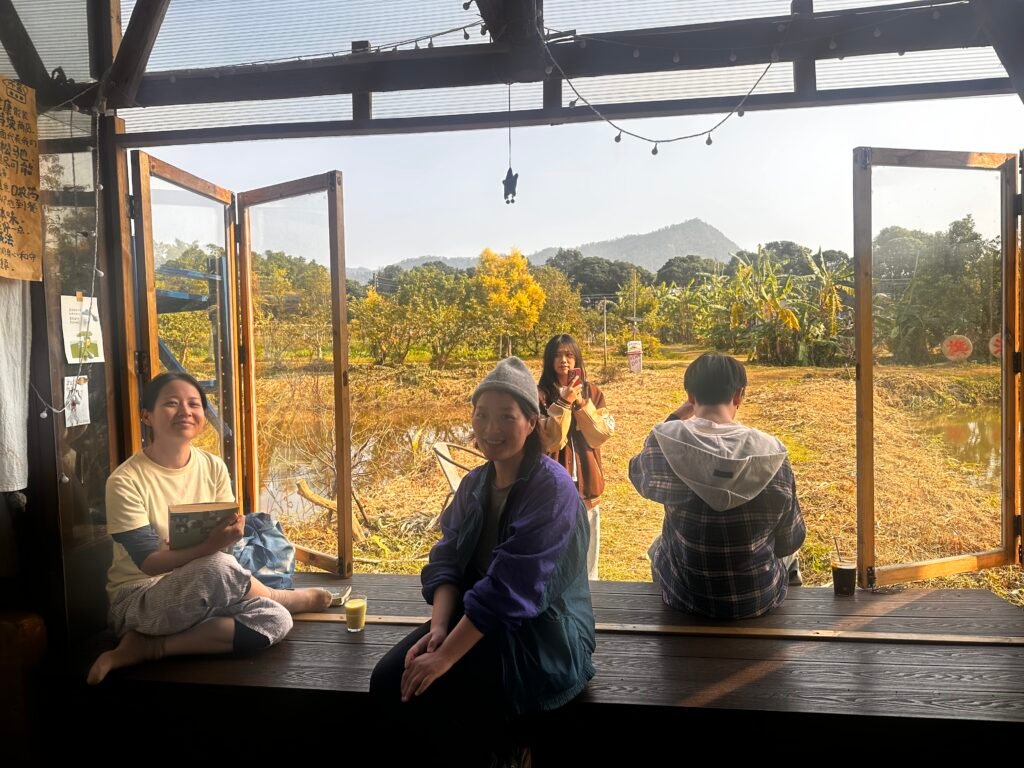 Resting in Little Monster’s no-plastics cafe
While it is true that some larger businesses have capitalised on a rural nature aesthetic, local residents, especially elders, have also negotiated with this new attention.
Some have started selling goods and street snacks near the town’s centre when tourists are in town, and younger residents have started providing workshops creating incense and soap. At the same time, they have also participated in workshops, community events, and started to learn new sustainable practices and have reconceptualised their relationship to the economy, work, and the Earth. In return, many of the younger residents have also started to imagine alternative ways of living and understanding work.
These multiple points of value amongst old residents, newer residents, or businesses participating in the revitalisation push can often be in contradiction with one another and may change or overlap over time. Yet, they are all reactions to the unique material conditions co-created by the community, and highlight that ecological and economic justice are inseparable.
I had always studied urban labour economics and industrial policy, but the Earth and the people who tend to it every day can give you many gentle reminders. Traditional ecological knowledge can converge to reimagine economies that regenerate rather than extract, from communities like Guinan Village to ethnic enclaves like Flushing, where I grew up. In lieu of the false binary between labour and climate, our economies are sustained by the labour of collective care and ecological stewardship.
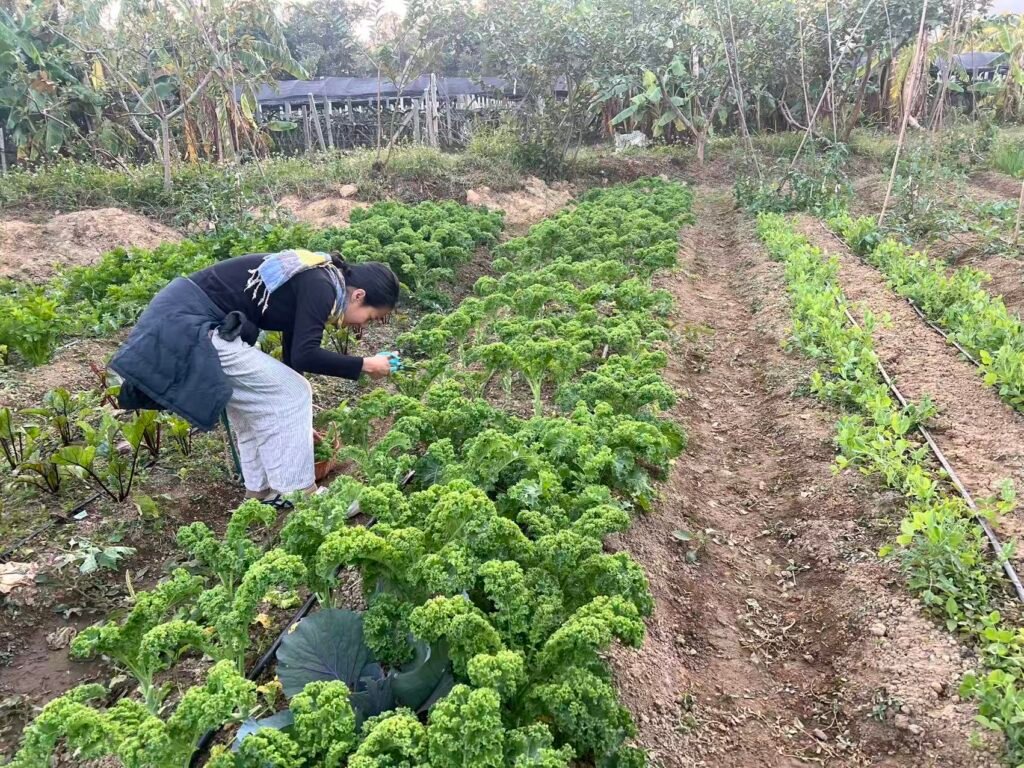 Jolie and I picking out our favourite vegetables from Yen Yen Jie’s farm. An abundance of kale
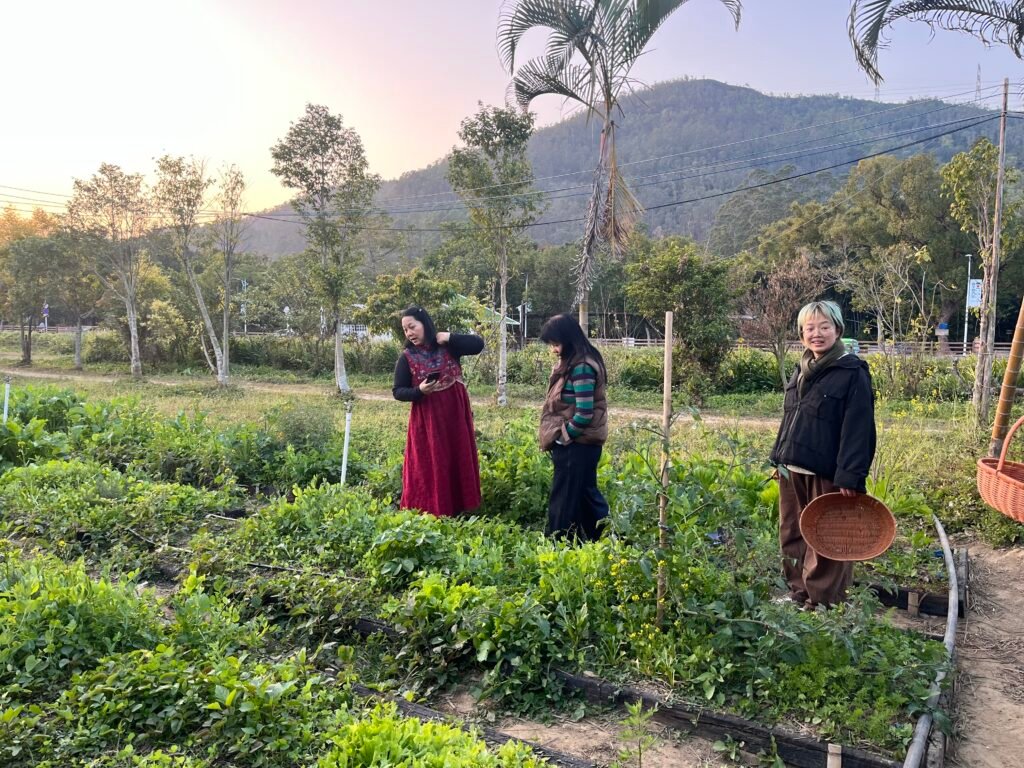 On Yen Yen Jie’s farm, picking our vegetables
Remembering where the water comes from
Spending two weeks in Guinan, where its winds whispered in my ears, and the trees waved hello to me on my walks, I found that the land can nourish you and teach you how to be in relation to other people and this world. It can also allow for many memories to reemerge.
When I lived in Pukou as a child in the early 2000s, it would often flood. Sitting on the edge of our stoop, my grandpa gently taught me how to fold paper boats and explained to me where the water had come from. Years later, playing with the earth in Guinan, this memory stirred to the surface.
As I moved further away from this village, grew up in the city, and immersed myself in academia, I’ve seen how policy briefs or economic models may never fully allow for enlightening memories like this to emerge. It reminds all of us of the ways we have always cared for the earth: either innate or taught through local knowledge systems. We have always played with the earth, and it is only recently that we have forgotten the many diverse ways to.
After my stay in Guinan, I returned home to Fuzhou. For the first time in 15 years, I celebrate the Lunar New Year in China, and have been spending some time in the city that was my first home. A Fuzhou Nighttime feeling warms me. As I reflect on my experience in the eco-village of Guinan, I allow the fragments of old and new memory to consolidate as the “feeling of beautiful, sunny, tropical Fuzhou, Fujian, fenced in by towering mountains and bounded by a boundless sea by which everyone leaves, where the palm trees sway, and the nights run so late.” I look out at sea, and I’m not scared. I remember where the water comes from.
What can you do?
- Read about land sovereignty, and how preserving local and Indigenous access to the land is a way forward for more just economies
- Read dispatches on tourism from Colombia, Asia, Jamaica, and Wales
- Read more about Labor of Change, a collective of young people fighting for economic justice amidst technological and climate change.
- Read more about the Inclusive Ecology Collective, a Think-and-Act Network that fosters regenerative education and catalyzes systemic transformations in response to the Planetary Ecological Crisis Think-and-Act Network, that leverages interdisciplinary research, intergenerational wisdom, and inter-cosmological expertise to address the planetary ecological crisis.
- Read about Satish Kumar, peace activist, ecological educator, Editor of the Resurgence and Ecologist magazine, teacher, and co-founder of Schumacher College.
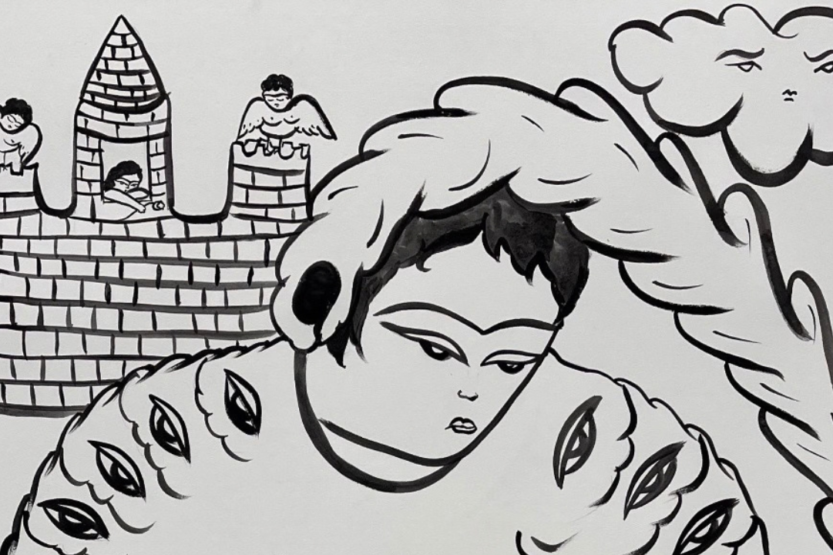
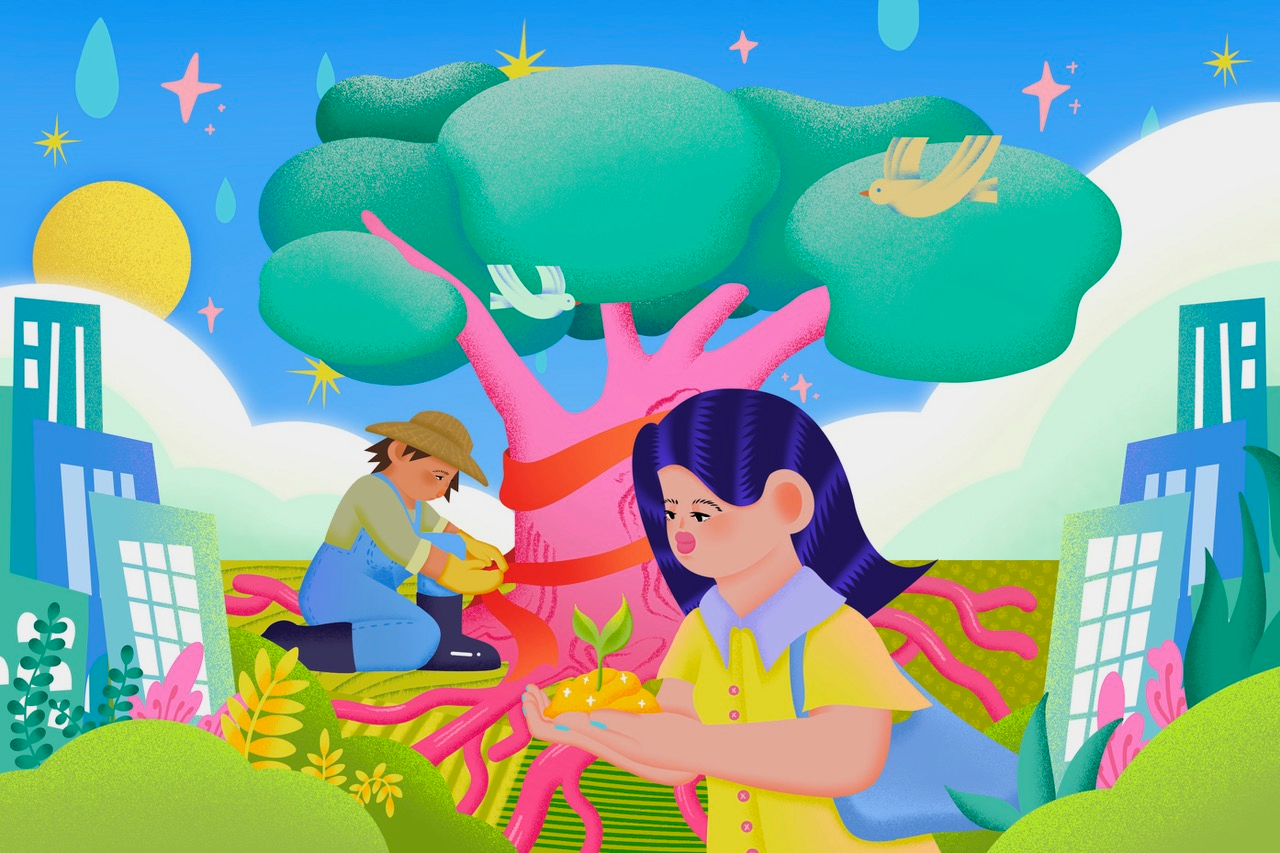
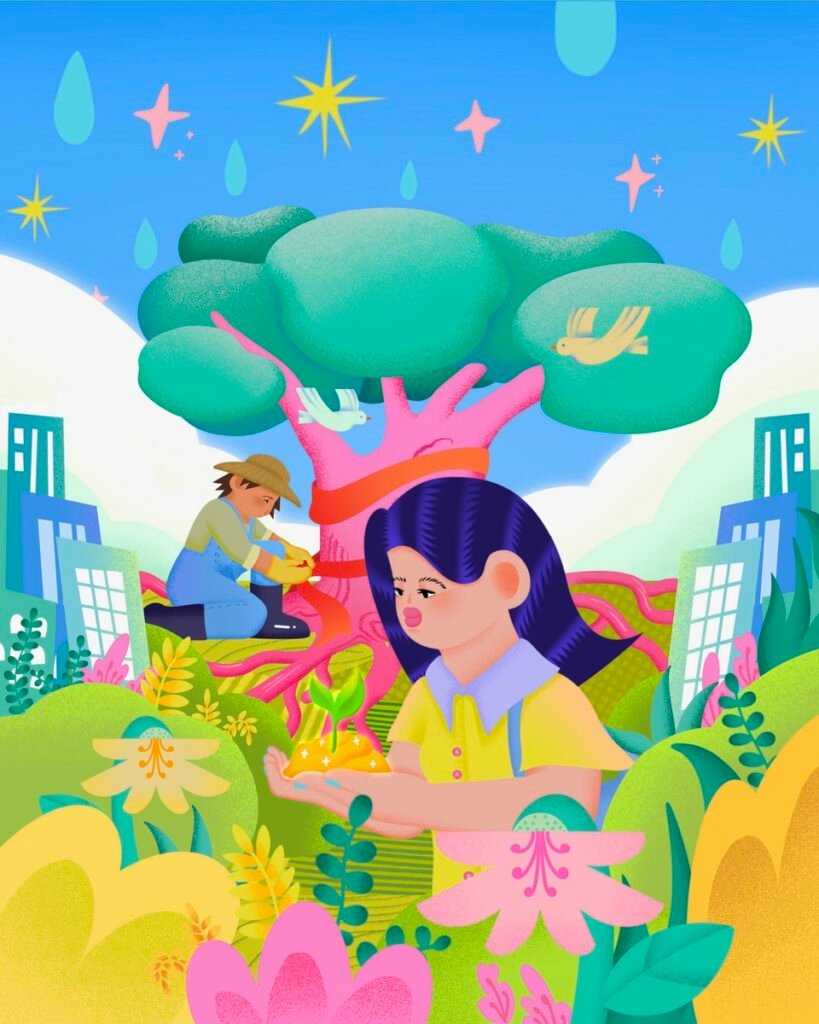 Illustration by @_wei.wu_ who says: “In this illustration, I depict the surreal experience of moving from the fast-paced rhythm of city life into the quiet stillness of the countryside, where it feels as though everything around you has shifted. The central figure represents not only the author, but also a broader group of individuals seeking to reconnect with their roots in different ways — whether through memory, place, or personal history. In the background, villagers are continuously building and shaping their own community. Through this piece, I hope to invite viewers to reconsider the relationship between people and the land, and to reflect on the interconnected dynamics between economy and ecology.”