


Those of us whose heritage is in the Middle East and North African regions have long emphasised the importance of food to our culture, and how central it is to crafting community. We have grown to become protective of our food and the ways we creatively use flavour to make soul-nourishing dishes.
Our food tells a story. One of oppression, resilience, resistance, power, unity and loyalty. Our food defines us, but also breaks the boundaries of how we are perceived. Our food is made to be shared, unreasonable portions displayed out before a table of loud families, all unable to get a word in – but loving the chaos all the same.
An important discussion missed within the discourse around the genocide in Gaza, is that of the colonisation of Palestinian food through the Israeli occupation – long before the siege – and the effect of this in gastronomy in the UK.
I personally came to this topic after analysing the language used in Western media surrounding the starvation of Palestinians in Gaza. I wanted to explore why the word ‘famine’ became increasingly used in mainstream news outlets rather than explicitly acknowledging starvation as a weapon of war, and how this linked to the colonisation of Arab cuisine.
Food-washing and culinary resistance
The colonisation of Palestinian flavours nods to the notions of gastrodiplomacy (the use of a country’s national cuisine to grow international relationships, improve its reputation and build on foreign policy goals), and culinary Zionism (the promotion of Israeli cuisine to subtly influence and create a cultural identity, most often seen through the appropriation of Palestinian cuisine).
In the UK, this easily goes unnoticed in everyday life, seen in supermarkets and menus displaying items such as ‘Israeli couscous’, the phrase ‘Tel Aviv street food’ and the adoption of falafel, za’atar and hummus as their own.
Fadi Kattan, co-founder of Palestinian restaurant Akub in Notting Hill, was more than willing to explore this with me. Nestled in a corner table of his restaurant, we delved into topics surrounding the significance of Palestinian flavours to Arab culture, and the intersection of food and politics.
The roots of Palestinian food are regularly disrespected and wilfully ignored by the UK culinary industry, which Fadi is accustomed to, and attributes to laziness of the general restaurant-goer. “People go to an Israeli restaurant in London, Paris or New York, eat our food and don’t think for three seconds where it’s actually from,” he says. The ubiquity and normalisation of culinary Zionism is such that many people see no issue with going to an Israeli restaurant, because they do not even know that there’s, actually, no such thing as Israeli cuisine.
Fadi is rightfully enraged by people shamelessly disregarding the effects of colonisation, especially since in the new age of social media and AI. It doesn’t take long to educate oneself and see that it’s a whole industry that has been stolen, pillaged and destroyed. But since Zionism is so omnipresent, we’re left to wonder if a Google search would even be enlightening after all.
The problem with ‘Middle Eastern inspired’ restaurants
Two years into the genocide, we’re no strangers to the BDS movement, and many try hard to avoid businesses with known links to the occupation. But it must be acknowledged that part of the reason for this widespread culinary Zionism is acceptance. Fadi further explains that people have normalised the presence of immoral brands and names in the industry, allowing them to be integrated into their daily lives. Such Israeli-owned brands include Sabra hummus, which directly funds the IDF and has long been on boycott lists. Another case is that of the Jaffa oranges, once a symbol of Palestinian agriculture, now rebranded as an Israeli export.
Even those that choose to publicly own their Israeli roots do not face much financial adversity, as when it comes to food, people often abandon their moral compass. This has further allowed an increase in ‘Middle Eastern-inspired’, (often) Israeli-owned restaurants in London, of which we’ve seen an influx of openings in culinary hotspots like Soho, Notting Hill and Hackney.
Addressing this new wave of deceptive Israeli restaurants is necessary, as they serve as further evidence of culinary Zionism and its normalised assimilation into Western society.
This is further explored in Salem Barahmeh’s video ‘The Food Israel Stole From Palestine’, which sees the host travel to Nablus in Palestine to trace the origins of its cuisine. The video shows Salem in a knafeh shop, speaking to the owner about the roots of knafeh, a traditional Palestinian dessert. He asks in Arabic, “Tell me about knafeh and its history”, to which the owner laughs: “I am its history!” Palestinians have an innate link to their food, and it is important to both recognise and honour this.
The normalisation of the colonisation of Palestinian food is evident in this video. One of the hosts explains that Palestinian food is about the way we consume and experience it, not solely about its ingredients. Ultimately this shows that the context of Palestinian dishes is vital. Inauthentically recreating them and stamping them is therefore characterless. What makes Palestinian food special is the history, heart and soul behind it – without these, it is not worth tasting.
Starvation as strategy
Maybe the most vital aspect of this discussion is that of how food is used as a weapon in war, and how it is utilised as a tool to carry out Israel’s intentions.
In Mira Mattar’s article for Vittles, she discusses the centrality of food restriction and starvation in the genocide in Gaza. Touching on Israel’s objectives, Mira talks of how the withholding of food in Gaza is wholly intentional and must be spoken about in this way – otherwise we aren’t addressing the genocide with the urgency it deserves.
As Mira writes: “To describe the famine in Gaza as a ‘humanitarian disaster’ is to position it as a crisis outside history. Discussing the current starvation in Gaza through this lens suggests it is an accident, a pitiful consequence of some natural calamity, or of some conflict”.
Mira taught me that the whole aim is to use starvation as a collective punishment with the goal to re-develop Gaza, in the way Israel sees fit. This year in particular we have seen a rise in murderous violence at aid checkpoints in Gaza where people are attempting to access life-saving food.
Through manipulating the language of humanitarian law, Israel disguises their militarised, manufactured famine as a natural disaster. As witnesses of this genocide, we must actively remind ourselves and those around us that these deaths in Palestine are not a coincidence, but a premeditated Zionist strategy.
The lie of the desert made to bloom
We cannot talk about Palestinian food without mentioning the deliberate, targeted destruction of Palestine’s farmland and agriculture by Israel. As reported by Al Jazeera in May this year, over 95% of Gaza’s agricultural land is now unusable, with the Guardian reporting in August this year that only 1.5% of Gaza’s farmland is left – down from 4% in April.
Join our mailing list
Sign up for shado's picks of the week! Dropping in your inbox every Friday, we share news from inside shado + out, plus job listings, event recommendations and actions ✊
Sign up for shado's picks of the week! Dropping in your inbox every Friday, we share news from inside shado + out, plus job listings, event recommendations and actions ✊
The intentional demolition of Palestinian land is influenced by the Zionist phrase ‘making the desert bloom’. The slogan originated back in 1969, first used by former Israeli Prime Minister Levi Eshkol, when he said “It was only after we made the desert bloom that they [Palestinians] became interested in taking it from us.” The phrase is based around the myth that Palestine was a barren desert, only coming into fruition once Zionists arrived. They believed themselves to be the only native people of the land, thus the only ones who truly knew it and could allow it to bloom. In this way they claim that Palestinians lacked the basic knowledge to make the land prosper, portraying them as ignorant, unintelligent and uncivilised people.
The occupation has since used the slogan to justify the creation of the state of Israel, belittle Palestinian suffering and brainwash the rest of the world into believing their existence is irrelevant and futile. Playing into Orientalist stereotypes of the East, Palestinian land was overall deemed uncultivated and neglected. But as Fadi pointed out, “I wish Westerners would know that we were a land fertile with wheat. I wish Westerners would understand that the idea that Israel ‘made the desert bloom’ is a fake narrative.”
When the occupation took over in 1948, they stole agricultural farmland that was already flourishing and lovingly preserved by the Indigenous community. Today, what we’re seeing is a systematic uprooting of Palestinian farmland, with the intention to disconnect their story from the land, and make those places impossible to inhabit. This agricultural produce has long been tied to Palestinian identity, and thus, something worth stealing and erasing. As the Israeli occupation continues to work to build a state without Palestinians, they will stop at nothing to achieve this.
Using food as a way to reclaim Palestinian heritage
The importance of representation in gastronomy for Palestinians must not be left out, and thus how Palestinian food further creates community. Sara, co-owner and founder of Bunhead Bakery, a Palestinian-British bakery in South London, has insight on this topic as a Palestinian, mixed race business owner herself.
We met in Brockwell Park to talk about why Arab flavours are so significant to our culture. Sara tells me that we’ve grown possessive because they’re consistently being stolen. “Across the Arab world, we’re at constant odds of feeling our culture is being stripped from us, or demonised.”
The ever-growing and shameless colonisation of Palestine’s food through the occupation has undoubtedly impacted our relationship to it – in both positive and negative ways. Particularly for the Arab diaspora in the West – whom more often than not, have a complex connection with our roots. Sara explains it means we hold it all closer to our hearts, revealing when she was younger she didn’t tell people she was Palestinian. “It wasn’t a conscious thing” she says, “It’s just someone I was in private.”
There’s a certain responsibility that comes with being Palestinian, which Sara acknowledges. She tells me she’s grateful for the attention and love, but it means nothing if she’s not doing a service to her community. “Recently some kids came in with their dad and he was telling us how they’re half-Palestinian, whilst they smiled and waved at us. I had to go to the back to keep from crying because that’s exactly who I’m doing this for.”
Sara’s honesty here allowed me to reflect on my own internalised shame attached to my identity. For years I rejected my roots for fear of standing out, but one thing I never rejected was our food. Our cuisine is the one thing that bonds us, standing the test of war and genocide, and remaining vital in this journey of reviving our heritage.
In a 180 degree turn from her childhood self, Sara has proudly taken ownership of her Palestinian roots – largely due to opening Bunhead. But she admits to having a complicated relationship with her homeland. “I haven’t always felt I can claim the culture, but Bunhead is fulfilling because it’s a representation of me. The Palestinian experience is vast, and I’ll have internal battles – but I am Palestinian.”
Witnessing Sara defeat her hardship was healing to see – something the Arab diaspora globally hope to experience. Arabs have been told who we’ve been, who we are and who we’ll continue to be – for centuries. We’ve watched the world rip our image apart and reconstruct it to fit what they want us to embody.
We can only have faith that in time, through raising awareness and increasing space for the conversation around culinary Zionism, we should start to see a shift in the way people interact with Palestinian flavours. Hopefully with a greater level of respect for its history, people and culture – in all the rich forms it takes.
Ultimately, we must never forget how the occupation has used something Palestinians are so passionate about, against them. Taking food as an unifying aspect of their culture, and using it as a weapon of war is an unfathomable and inhumane tactic, and we should relentlessly platform this discourse until Palestine is free.
What can you do?
Watch:
Listen:
- Sabah Al Yasmine – Ramblings of a Chef by Fadi Kattan
- Matbakh by afikra
Read:
- What is Food Sovereignty?
- Bethlehem by Fadi Kattan
- Palestine on a Plate by Joudie Kalla
- Stone and Seed by Mira Mattar for Vittles
- Zaitoun by Yasmin Khan
- The Palestinian Table by Reem Kassis
Follow:
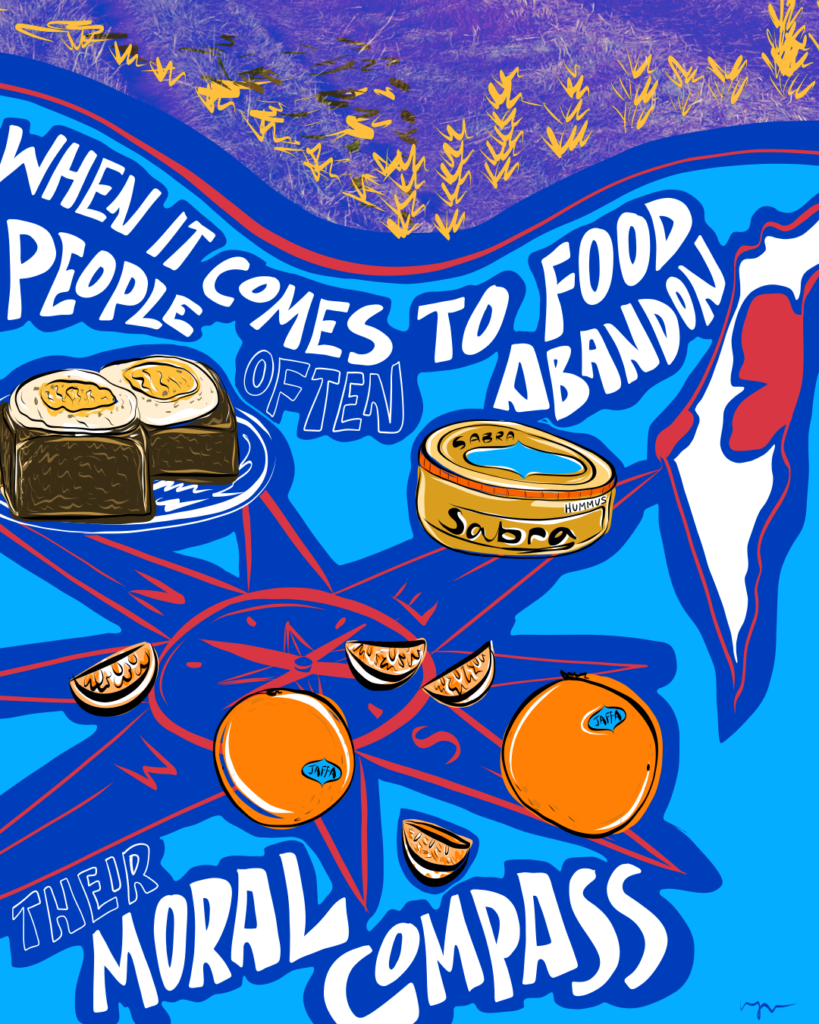 Illustration by @npl_illustration who says: “The main focus of the illustration is the compass which points to Sabra hummus, Jaffa Oranges and Bunhead buns. The top of the illustration is a burnt out field and to the right is the map of Palestine / Gaza / West Bank area. Surrounding all these elements is the phrase: when it comes to food, people often abandon their moral compass.”