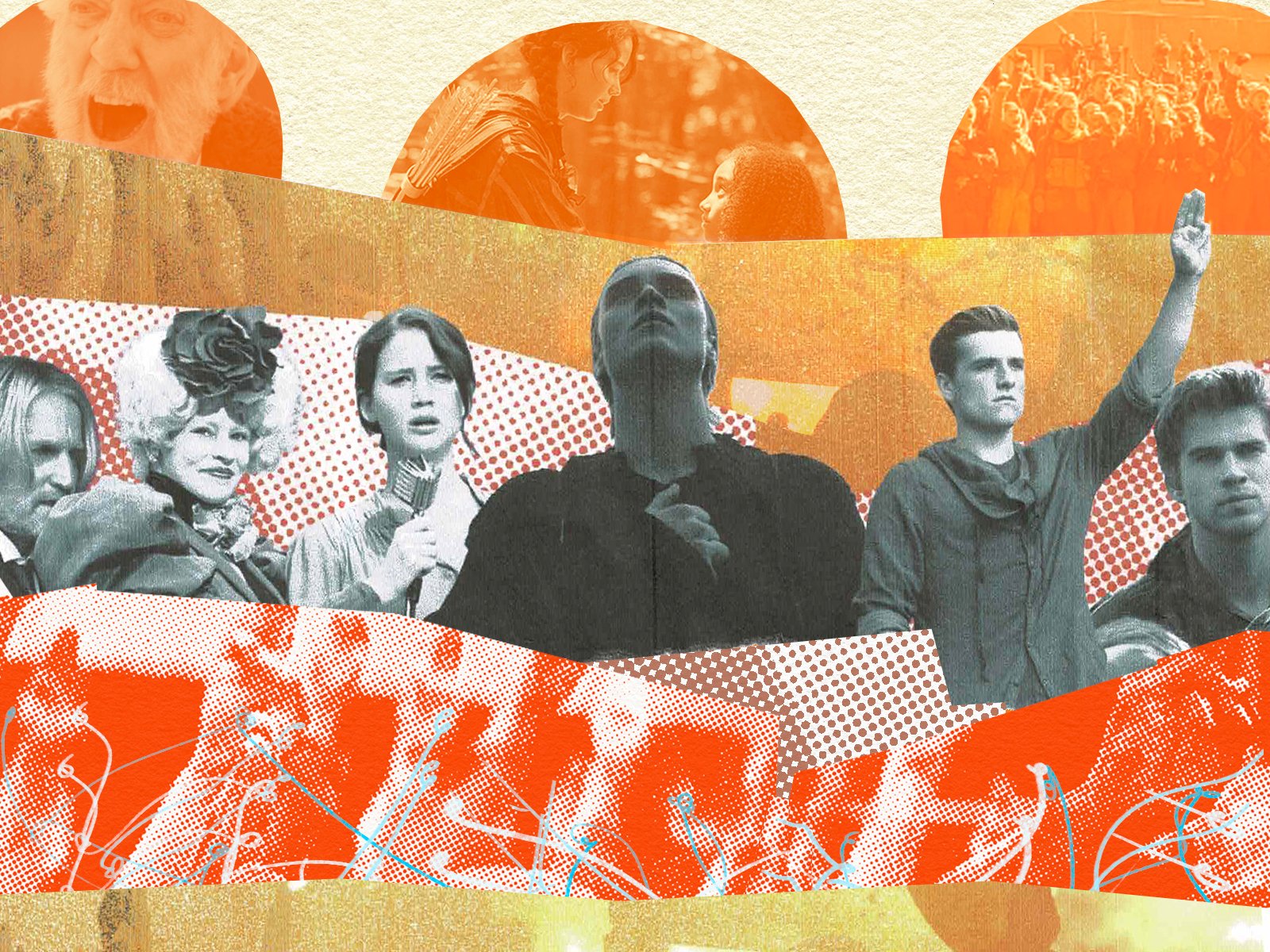

I first read The Hunger Games in my early teens, and, like many others I’ve spoken to, it had a huge influence on my politics. As I read about Katniss living in a society of deep and systemic inequality under a totalitarian regime established after environmental catastrophe and wars, I saw parallels between the fictional world of Panem and the world I was growing up in. Illegal wars over oil, austerity policies, the rising far right, increasingly extreme wealth inequality, a worsening climate emergency, genocides and eventually a global pandemic that in turn exacerbated all of these issues. People of my generation grew up with Panem as a touchstone for what can happen when the masses rise up in the name of justice.
As a die-hard Hunger Games fan, I was nervous about the new books. While excited, I was worried they may detract from the story I loved so much. But if anything, Sunrise on the Reaping has made the overall story even more meaningful to me. When the teenagers who were first politicised by this world are now exhausted 20 and 30-somethings, this new edition to the story – which follows Katniss and Peeta’s mentor Haymitch during his games and the acts of rebellion that ensue, 24 years before the main trilogy – is a reminder that revolutions don’t happen overnight. They show us the power of critical thinking in the face of propaganda and push back against the idea of the single revolutionary hero.
Regardless of the books’ core message – and in an uncanny echo of the oppressive Capitol class – merchandise is continually churned out to promote the film and stage adaptations, often made by exploited workers using materials harmful to our health and the planet (Eras Tour style-Hunger Games phone case, anyone?). The media’s focus on the ‘love triangle’ in the original series, at the expense of its central themes, reflects the same impulse: the dominant class will do anything to divert our attention from messages that challenge the status quo. Let’s bring the story back to its radical roots.
The mycelial network in action
Organising and social movements have frequently been compared to mycelium – the underground network of fungi that connects plants and trees and sustains life from the soil up.
The analogy of changemaking as a mycelial network completely altered the way I viewed organising and my own role within it. Instead of constantly chasing the fruiting mushrooms in a cycle that exhausted me, I looked at how I could support the development of the wider fungus – how I might be able to strengthen the underground work of a long-term movement.
The original Hunger Games trilogy focuses on a single revolutionary figure, Katniss, while she may not be the only one working towards the revolution, is seen as its catalyst and the driving force. The events of Mockingjay, the final book in the original trilogy, is the fruiting mushroom, while the work of the revolutionary movement before by other characters, as we see in Sunrise on the Reaping, is the mycelial network that creates the conditions for the mushroom to rise from the soil.
This happens frequently in our real-life activist movements, exacerbated by the dominance of social media platforms whose algorithms push individualistic outlooks. We end up with ‘celebrity activists’, many of whom do not want the spotlight they’ve found themselves thrust under.
As someone who has long campaigned in the climate movement, I have seen so many spokespeople who have found themselves with a large social media following and their existence become synonymous with a movement almost by accident. It has the potential for a huge impact, but I have only ever seen focus on a single powerful activist harm the actual person who is placed on that pedestal.
Your time and attention are in constant demand; people look to you for a kind of ‘perfection’ in your life or expect you to have all the solutions ready at hand, leading to inevitable burnout and illness for so many – not a sustainable path for any revolution. How can there be space for joy and laughter when there is constant work that you and only you must do?
Building an army at our backs
Throughout Mockingjay, we see Katniss struggle with the responsibility of being the ‘face of the revolution’. She is already struggling with PTSD and is unable to access the care she needs while the fight is ongoing. People she visits in the districts expect her to be all-knowing and resolute. The fact that she is a teenage girl in need of care frequently gets overlooked. And it is mostly teenage girls and young women who have become these figures in our activist culture today – the obvious being Greta Thunberg – and it doesn’t seem accidental to me that a lot of that work is feminised.
Sunrise on the Reaping, however, flips that narrative, showing how the revolution we witness in Mockingjay has been generations in the making. Set 24 years before Katniss and Peeta’s first games, Sunrise on the Reaping follows their mentor, Haymitch, for the games where he becomes the second-ever victor from District 12.
Haymitch may be the centre point of the story, but he is not the same type of revolutionary figure that Katniss becomes. The Capitol’s editing of the events of his games is partly responsible for that. In a conversation at the end of the novel, Plutarch and Haymitch discuss the future of the movement for a more just Panem:
“Oh, I see. He’s not going to overthrow the Capitol, is he?” [says Haymitch]
“Maybe one day. But we can’t any of us do it alone. […] You were capable of imagining a different future. And maybe it won’t be realized today, maybe not in our lifetime. Maybe it will take generations. We’re all part of a continuum. Does that make it pointless?” [says Plutarch]
“I just don’t know. But I do know, you need someone different from me.”
“No, Haymitch, we need someone exactly like you.”
“Just luckier?” […]
“Luckier, or with better timing. Having an army at their back wouldn’t hurt.”
“Sure, that would’ve helped. Where’re you going to get an army, Plutarch?’
“If we can’t find one, we’ll have to build one. But obviously, finding one’s easier.”
Join our mailing list
Sign up for shado's picks of the week! Dropping in your inbox every Friday, we share news from inside shado + out, plus job listings, event recommendations and actions ✊
Sign up for shado's picks of the week! Dropping in your inbox every Friday, we share news from inside shado + out, plus job listings, event recommendations and actions ✊
While Haymitch is at his lowest and cannot see a better world, Plutarch pushes the idea that the current system is not the only option, even if it might not feel it at that moment. This conversation may be obviously alluding to the events of the original trilogy, but it nevertheless shifts the perspective on the overthrow of the Capitol.
Katniss might not have become the catalyst she was if not for the ‘army at her back’ built over the years by Haymitch, Plutarch and their comrades. Together they build up the structure so that when an opportunity arises, it becomes a fruiting mushroom and successful system change follows.
Standing on the shoulders of giants
By following Haymitch through his games in Sunrise on the Reaping, we not only see well-loved characters as their younger selves (Effie, Beetee, Mags, etc.) but also the early stages of the revolutionary movement we encounter when Katniss comes to District 13. We see Plutarch’s schemes and the underground network as foundational building blocks to the overthrow of the regime that ends the franchise.
When we encounter District 13 in Mockingjay, it seems like it has almost sprung up out of nowhere. It is a shock to both the reader and Katniss that this movement exists. Haymitch’s story shows us the decades it takes to build a successful revolution.
Katniss’ destruction of the Quarter Quell arena in Catching Fire is the last in a long line of sabotage attempts. In Sunrise on the Reaping, we see multiple attempts to break the arena. As Plutarch describes, it is ‘part of a continuum’ – a collective effort not just from tributes, but also mentors and gamemakers.
They didn’t succeed, but each failed attempt strengthened relationships, provided more information about their target, and gave rebels something more to fight for. The characters suffer immensely, and there’s no world where fighting for justice is easy. As individuals, they are powerless, but when they come together with their different skills, expertise and social positions, they are able to overthrow a dominating system.
Although Katniss is positioned as such, this revolution does not have a single hero. Even outside of the named characters, there are thousands of people who keep the movement going on a grassroots level, including in District 13 with day-to-day tasks like washing clothes, cooking meals, and caring for the ill and wounded.
Without those roles, the movement for a new Panem would have failed. Even the most ardent revolutionaries need clean underwear and something to eat. Some of my favourite experiences in activist spaces have been when I wasn’t facilitating or part of the decision-making and action-planning groups; they’ve been when I was doing childcare or laughing with friends while we did the washing up after lunch. I knew my role was valuable to the collective while also allowing space for joy and care.
Reminders of hope
It is easy to fall into the trap of hopelessness. Things feel scary right now in so many ways, and the road to doomism is a slippery slope. Our battle is one of David versus Goliath – ordinary people versus the billionaire class – and that battle can feel impossible to win. But we cannot forget how much we have already won.
I have spent nearly all of my 20s campaigning against oil and gas fields, including Cambo, Jackdaw and Rosebank. At the time of writing, climate activists in the UK are responding to the UK Government’s approval of the Jackdaw and are waiting for an imminent decision on the licenses for Rosebank. The decision may not have gone in our favour, but as we wait to find out about Rosebank, I am reminding myself of all we have achieved so far.
In Not Too Late, a collection of essays of climate hope from across the world, editors Rebecca Solnit and Thelma Young Lutunatabua include a chapter entitled ‘An Extremely Incomplete List of Climate Victories’. The shift of the Stop Cambo campaign from focusing purely on the Cambo oil field to all fossil fuel projects in the North Sea (after public pressure from our campaign caused key stakeholders to pull out of the project) is included near the end of this list.
Seeing a win I had been a part of in a timeline of huge wins by millions of people across decades was quite emotional. It was also a reminder that we could not have indefinitely paused the Cambo oil field had we not been standing on the shoulders of the giants who came before us.
It also made me think of all the wins we have had since: my friends and I banning 250 oil companies from our students’ union, winning in court against Equinor, Ithaca Energy and Shell, declaring the Jackdaw and Rosebank licences illegal, and the Labour party including an end to new oil and gas in their winning election manifesto in 2024.
Each of these wins in turn would not have been possible but for the work done before us: the Fossil Free campaign launched in 2013 calling on universities to divest from fossil fuels, the successful Finch vs Surrey County Council Supreme Court case in 2024, and the decades of pressure and campaigning to make oil and gas a prominent issue for voters.
We may not have achieved our end goals yet, but we cannot forget how far we have come and how connected we are to the change-makers who came before us. As Plutarch says to Haymitch: “maybe it won’t be realised today, maybe not in our lifetime” – those of us fighting for climate justice today may not live to see the full fruits of our efforts, but those who come after us might, with the army we have built up behind them.
Panem today, Panem tomorrow…
In the face of rising fascism, climate destruction, genocide and economic depression, Sunrise on the Reaping reminds us that these are long-term fights.
The route to liberation is a marathon not a sprint, and that’s why we need communities and cultures of care to keep us going for long periods of time. These issues are urgent, but acting constantly with an urgency mindset just leads us to burnout.
By looking at movements over a longer period of time, we can see the scale of change we have collectively achieved. When we fail, we regroup, learn, and keep going. Until eventually, even if it takes generations, we will win.
What Can You Do?
-
- Read Sunrise on the Reaping by Suzanne Collins
- Watch this reel about Hunger Games-core at the Met Gala
- Read No Straight Road Takes You There: Essays for Uneven Terrain by Rebecca Solnit
- Read Not Too Late: Changing the Climate Story from Despair to Possibility edited by Rebecca Solnit and Thelma Young Lutunatabua
- Read Noisy Valley: The Art Of Protest by Myfanwy Tristram
- Read One Day, Everyone Will Have Always Been Against This by Omar El Akkad
- Read more articles by Jemima HERE
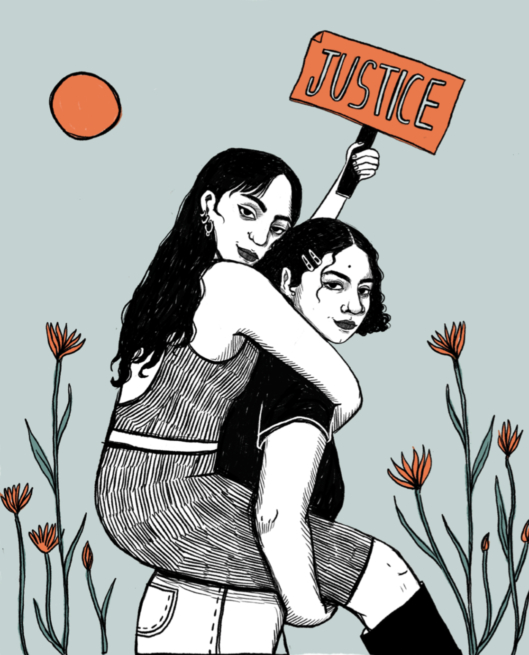
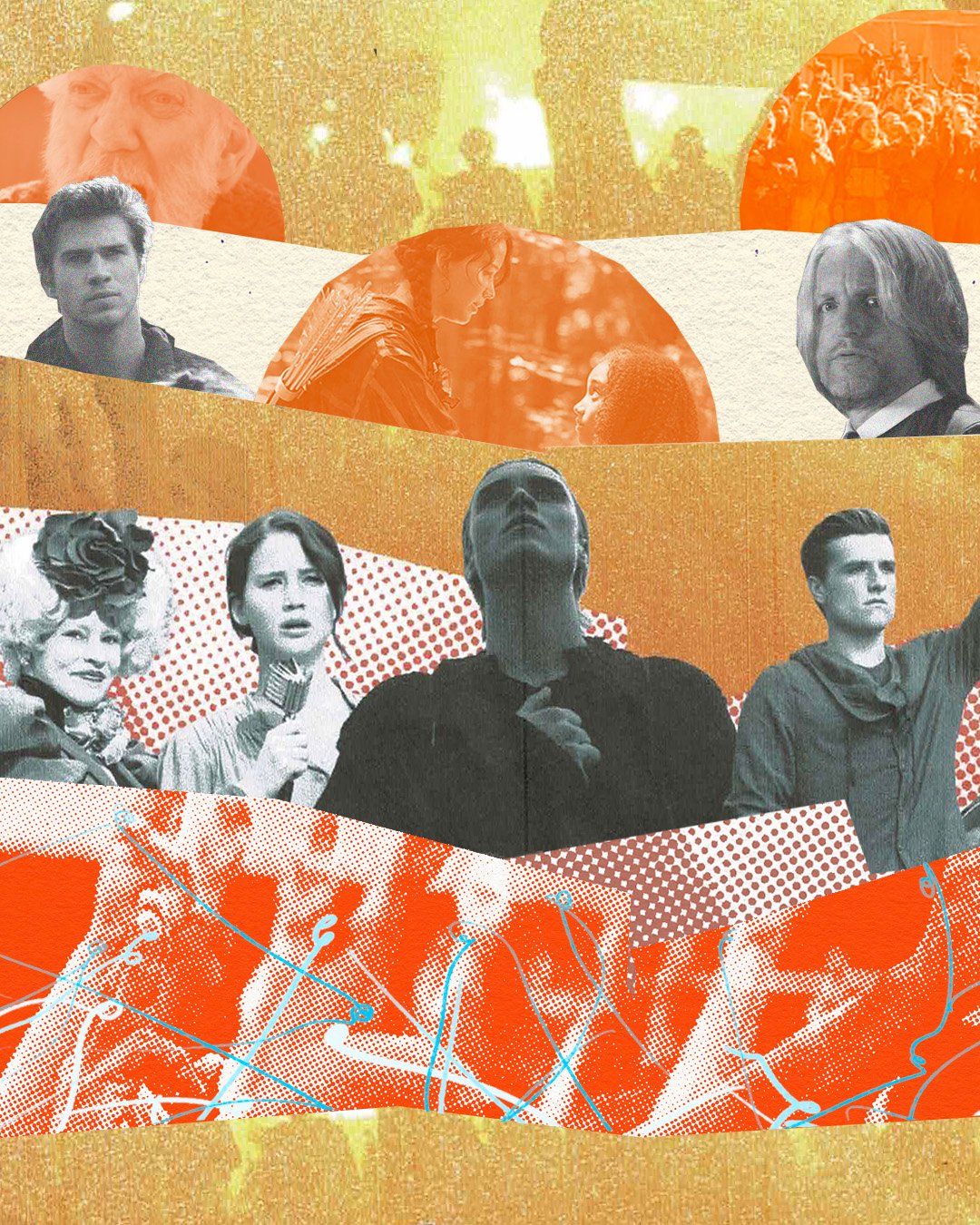 Illustration by Naomi Gennery @nn.aa.ii