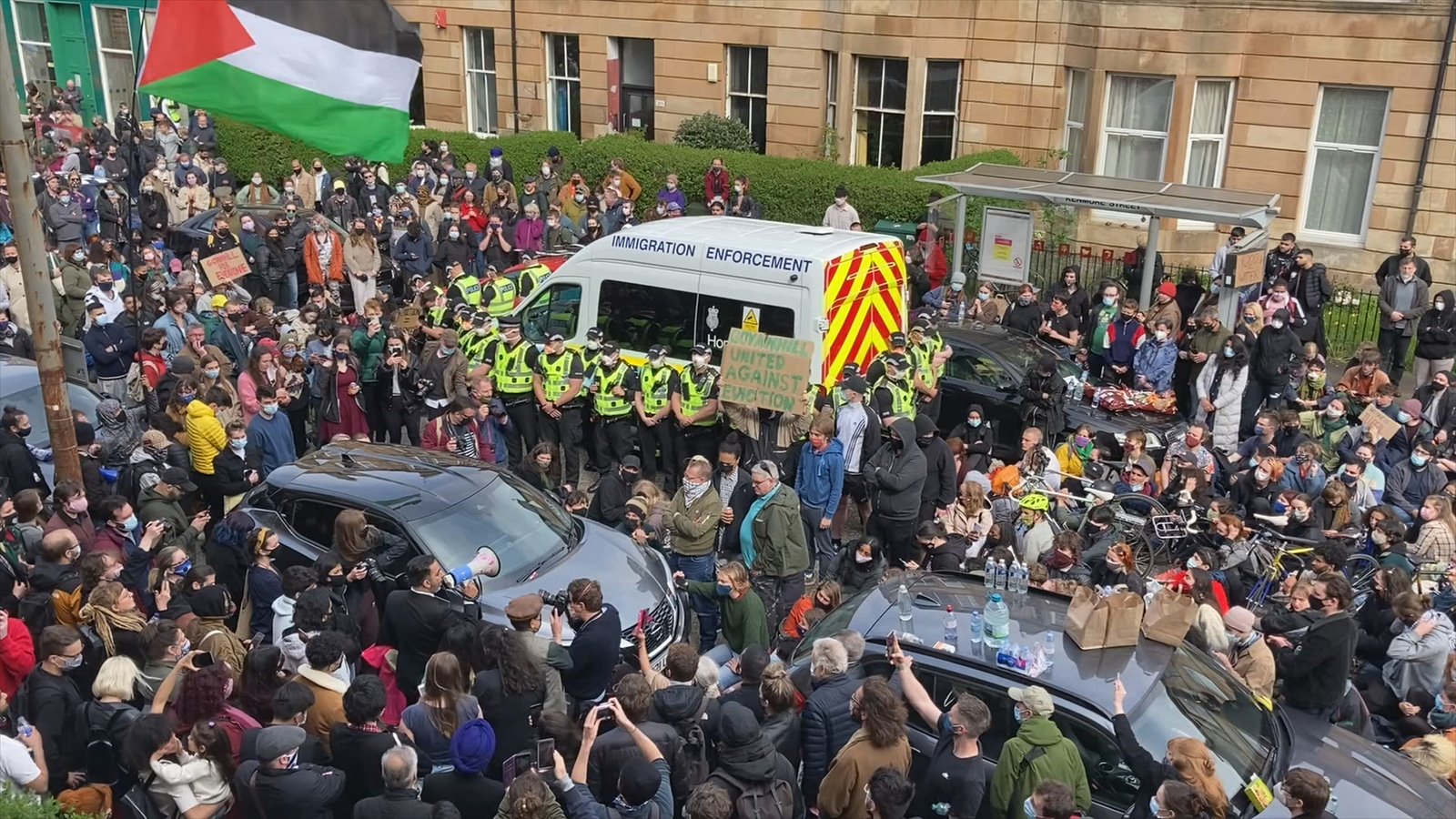

What happens when a community “doesn’t wait for permission to do the right thing?”
This is the question that Everybody to Kenmure Street, a new documentary from Felipe Bustos Sierra, attempts to answer.
Cobbled together from grainy cellphone clips, news and archival footage, and reenactments and interviews with residents, the film reconstructs the morning and aftermath of 13th May 2021, when a neighbourhood in Glasgow shut down to defend against a dawn raid deportation attempt of two Pollokshields residents. Improbably, after an hours-long standoff, the protestors succeeded in freeing the detainees in one of the most spontaneous and successful acts of civil resistance in recent memory.
Four years later, as the landscape for peaceful protest in the UK is changing, and ruling parties in the Western world are building a shared far-right, anti-immigrant playbook of abductions and state-sanctioned racist violence, the lessons of Kenmure Street ring louder than ever.
When I sat down to watch the film, the weight of the present moment was front and centre in my mind. I wasn’t familiar with the Kenmure Street protest before, and the film’s story felt improbable, the story almost fantastical. You’re telling me that, in the face of immigration enforcement, the sheer force of people power could win? As an organiser, I have to believe it does – but belief is one thing, and seeing the reality is another.
Ahead of the Glasgow Film Festival Opening Gala, where the film will be screened to a home audience, some of whom lived through the events of 13th May, I spoke to the director over Zoom to learn more about the film’s incredible subject, and the moment we find ourselves in.
“It felt like we couldn’t make this film fast enough,” Felipe tells me.
“The outcome wasn’t inevitable. But turning up is essential.”
On the day itself, Felipe, in neighbouring Govanhill, did not make it to Kenmure Street. He was working on the release of his previous documentary, Nae Pasaran, on Scottish solidarity with Chile. There was nothing to indicate that this protest would be different from any other protest in the past. But as the day wore on, and he followed the community mobilisation from a distance over social media, he realised something was different. He couldn’t quite pinpoint the moment that the playbook changed, but in the dazed aftermath of the day, he was struck with the need to tell this story.
As he began the four-year process to bring this film to fruition, he sat down with dozens of residents and activists at the Kenmure Street protest to hear about their experience of the day, and their spontaneous solidarity moved him. “What I loved was this idea – that clearly I had to relearn – that the outcome wasn’t inevitable. But turning up is essential.”
The film is a paean to showing up – a trickle of humanity becoming a roar. At the start of that quiet May morning, we hear and see a few perspectives from people looking out their windows, expressing curiosity and indignation. As the film unfolds, we watch outrage turn into action. I loved how, in the early hours of the day, Felipe and his editors relied on footage captured from protestors on their phones and social media livestreams — they painstakingly stitched together simultaneous footage of every angle of the day, creating a patchwork of perspectives to form a whole. We hear from a larger and larger swath of passionate Glaswegians, suspending their lunches, their biology exams, their Eid celebrations, to support the Pollokshields community. It was inspiring to see how many people didn’t think twice about jumping into action.
“I don’t think there was any expectation that they were going to change anything. I think the expectation there was that they were going to be witnesses to something,” an interview subject shares in the film, as the crowd begins to swell and brim with a desire to act, and to give what they can to meet this critical moment.
“Until 5:37 in the evening when the van door was opened, nobody really believed this was an actual possible outcome,” Felipe reiterates. “The film asks can you forget this has a happy ending and place yourself back in what it was like to turn up when you had absolutely zero hope? What was the thing you felt you could achieve? And it was really heartening to hear that in any circumstance, people were figuring out, what’s my superpower today?”
Showing up and taking action with no reward guaranteed is the central heroic push of Everybody to Kenmure Street, and what defines a successful movement. As neighbours organised spontaneously over the course of the day, it displays a long-standing organising principle that I shared in my conversation with Felipe: people in the present are organising for the best conditions we can, in order for the next generation of organisers to pick up the mantle and get us closer and closer to victory, whether it’s in the next year, the next decade, or the next century.
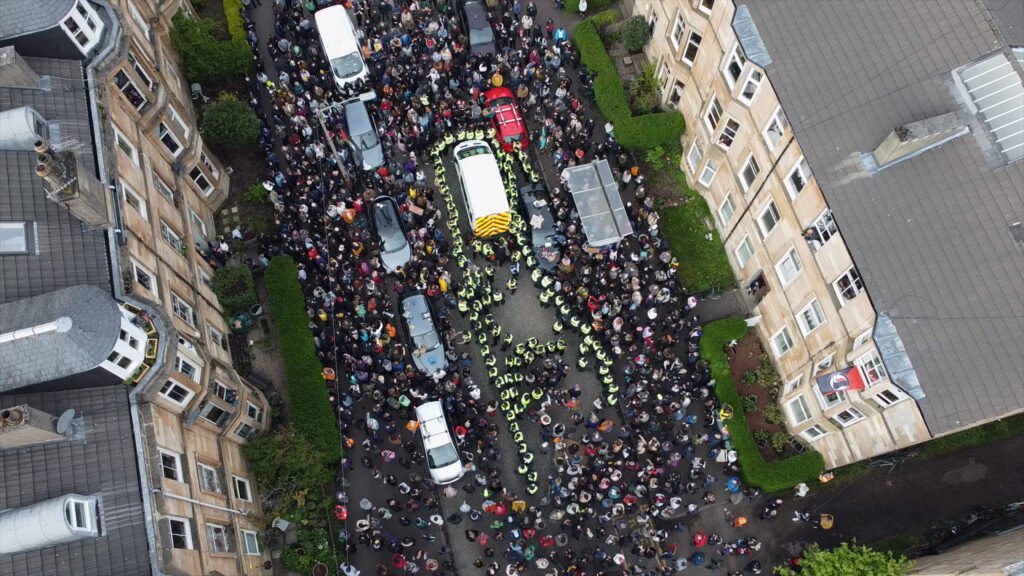 Aerial footage of the men being escorted out of the van, courtesy of Conic/PA
The people in the morning of 13th May laid the foundation to accommodate the protests of the afternoon, and the protests of the afternoon facilitated the ultimate release of the two men in the early evening. The movement is strongest when we lose the narrative of heroism, which puts the individual on a pedestal, and embrace being a part of a collective change.
“Saying that these guys are absolute heroes and nobody else could have done what they did really doesn’t help our kinds of movements, right? It doesn’t help to move forward if we think it’s about specific people doing all the work,” Felipe says.
It subverts the Hollywood narrative of heroism that I think exerts a high degree of control over people, neutering resistance in the mind before it even translates into action. There is no Superman to save the day, so to speak. Stepping up to the plate is not always dramatic, or a high-stakes calling. We have to accept that we are already made of heroic stuff, and do the right thing, with or without permission.
His interviews with some pivotal individuals of the protest – including with Van Man (his dialogue represented in re-creation by Emma Thompson), a protester who crawled under the van within the first 15 minutes of the deportation attempt and remained there for eight hours to prevent the van from moving – all display a conspicuous aversion to taking credit. Everybody knew the work they did was important, but none of them felt like it was solely critical to the protest’s success.
Radical histories converge in Glasgow’s southside
As a viewer, what struck me about the start of the day was how many people, recalling their mornings, spoke about recognising their neighbours in the crowd of people who slowed down to notice something was wrong. The call to stand shoulder-to-shoulder and shut down Kenmure Street was never so grand-sounding in the beginning – at its core, it was a case of neighbourly concern.
Felipe found my observation funny. “In a way, this mode of resistance was almost an ambush for the Home Office, because it was the most well-informed, best-prepared and peaceful people who knew how to deal with this type of situation and how to defuse it, sometimes in really creative ways.”
Pollokshields is an immigrant neighbourhood, from Gaelic-speaking Scots to Irish immigrants, European and Jewish refugees, and now South Asian families. Subjected to centuries of bigotry, racism, and classism, Glasgow’s southside has developed a long, proud history of organising and mobilisation in response.
Join our mailing list
Sign up for shado's picks of the week! Dropping in your inbox every Friday, we share news from inside shado + out, plus job listings, event recommendations and actions ✊
Sign up for shado's picks of the week! Dropping in your inbox every Friday, we share news from inside shado + out, plus job listings, event recommendations and actions ✊
In the second act of the film, Felipe unfolds an organiser’s history of the city, one that exposes the “quiet, invisible lines that connect one act of resistance to another, across time.” He does this not just by drawing from impressive archival footage, but also interviewing people who were present that day on Kenmure Street, who shared memories of Glasgow’s organised, activist past.
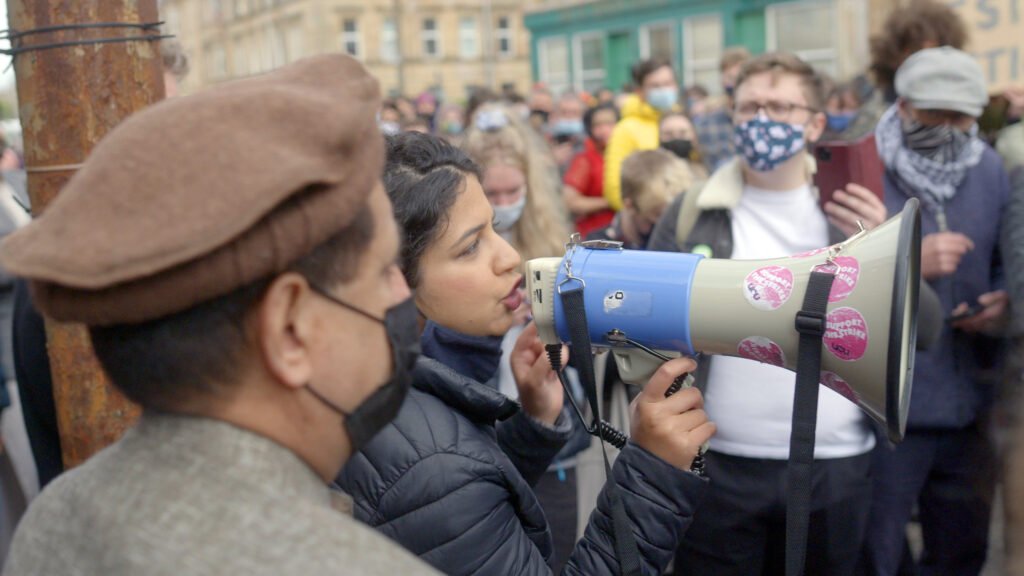 Roza Salih, an activist and original Glasgow Girl, addressing the crowd in a scene from the day. courtesy of Conic/PA
We hear from Roza Salih, a member of the Glasgow Girls who mobilised to protect a classmate from deportation, and community members who occupied the public baths complex a few decades ago to save it from a shutdown. Even the tactic of using bodies to stop vehicles is part of Scotland’s anti-nuclear movement. All this history has been passed down through deep-rooted activist networks. Solidarity that seems spontaneous has actually been nurtured for years.
In a striking moment in the film, human rights lawyer Aamer Anwar recalls making eye contact with a woman in a window overlooking Kenmure Street. “I recognised the woman – it was Eileen Reid, the daughter of the great [Glaswegian activist and trade unionist] Jimmy Reid,” he says. “I remember tears rolling down my eyes because I was thinking of Jimmy, I was thinking of Glasgow, and I was thinking of all the years, the three decades, because you could see all the faces I had seen from previous marches, previous campaigns that we had fought, who were young boys and now are parents themselves, or grandparents.”
In my work, and in my writing for shado, this is the crux of what has interested me. Pry a little bit under the surface, and you find that nothing is ever new under the sun. We all stand on the shoulders of people who came before us, who did the work then to enable us to do the work today. The better we know our history, especially at the local level, the more empowered our movements can be.

As one Kenmure Street protestor puts it, it’s amazing to see “that there are radical people around you that you didn’t realise were your neighbours this whole time.”
The fascist elephant in the room
In the UK, the Home Office has restarted dawn raids, some of which have been shut down by neighbourhood organising. But now, organisers face a protest landscape that fundamentally changed. In many ways, freedom of speech and the right to protest is under attack – see the protracted back-and-forth over the future of Palestine Action.
In Glasgow, Pollokshields residents are bracing as the Reform Party surges, with polling showing they could secure a majority in the Holyrood elections in May. Just last year, Nigel Farage claimed that the historically welcoming nature of the city amounted to a “cultural smashing.”
In the US, Everybody to Kenmure Street was first shown at the Sundance Film Festival in January, book-ended by two horrific acts of violence – the public murders of Renée Nicole Good and Alex Pretti in the streets of the Twin Cities of Minneapolis-St. Paul. Renée and Alex were bystanders and protesters in Kenmure Street-style neighborhood efforts resisting ICE’s abductions of immigrants. Here, rapid mobilisation has worked, but it has also become more charged as protestors stare down a militarised, violent force on our streets.
Felipe describes the reaction to the film as “heartbreaking,” recounting that, in his dozens of screenings and press conversations, everybody he has spoken to has expressed worry about the state of the world. Over the years of the filmmaking process, he found that the Kenmure Street protestors have a bleaker outlook on the event’s legacy.
Yet, he noticed that almost all of the people he spoke to have continued to take action, and stand up for each other – their shared experience at Kenmure Street has galvanised them to keep fighting. If anything, Felipe hopes that the joy, optimism, and happy ending of Everybody to Kenmure Street will serve as a morale boost for the moment.
“As the son of a refugee from Chile, I’ve been involved in solidarity my whole life,” Felipe tells me. “Solidarity has been so important to us, we’ve done our bit for Chile, campaigning against the arms trade, for refugees in general, and you realise we’re just going to have to keep doing this.”
He continues: “One of the things that somebody told me in my previous film was that the one thing we learn from history is that nobody learns from history.”
It rings especially true in the current moment, when it feels like the ground beneath our feet is constantly shifting. With our noses pressed up against the glass, so to speak, of the current of information and discourse, it’s hard to have the perspective to reflect rather than react. I’m guilty of this shortsightedness too. But it’s comforting in a way — even as we are supposedly condemned to face iterations of the same struggle, people are still picking up the mantle to keep fighting. Our instinct for justice echoes throughout time.
Felipe left me with a parting thought that resonates still. “There’s something really basic about the gestures of solidarity that are the latest iteration of similar gestures of solidarity that happened through centuries of Glasgow’s history. One of the key things might be: it’s not that the gestures don’t work, they do work. It’s just people forget about them. How do we find ways to retell those stories and reintroduce people every time? And the Kenmure Street protest reintroduced me, and I can only hope the film does the same (for others).”
What can you do?
- Watch the trailer for Everybody to Kenmure Street here, and catch it in theatres when it premieres in the UK on March 13th.
- Read about Reform’s plans for a far-right nationalist takeover, covered by Elia Ayoub
- Read about on-the-ground immigration resistance, from Minneapolis to New York City.