
When I went to the consultation event for Shepherd’s Bush Market in October 2022 with other community members, we expected to be able to make choices. We could choose a small blue, yellow or red sticker. We could choose to stick the sticker under Option A, B or C for the entrance sign in the market. We could choose the cosmetics. But the architectural model plan for the market lay pristine, in a clear container, protected.
Speaking to the people I went with and met there, we left with an overwhelming feeling of exclusion. Over time, these conversations formed a chorus amongst traders and community members, and not only in our local market as we see traditional street markets across London becoming both sites of gentrification and resistance.
I spoke with traders, community members and architects in Shepherd’s Bush Market, Queen’s Market and Ward’s Corner, to unpack the interconnected struggles being felt across the city. In the refusal to capitulate the demands of millionaire developers, sustained community organising has shown alternative, community-centred, worlds are possible.
Sites of gentrification and resistance
Traditional street markets are lifelines for low-income, working class, multicultural communities in London. They’re sources of affordable food and goods, but also profound community ties, which are vital for vulnerable members of society such as the elderly, single mothers, migrants, refugees and people with health problems.
But in recent years, communities and traders at traditional street markets across London are up against a violent beast: gentrification. Gentrification is the process of refurbishing areas that have been long neglected by state investment, home to working class communities, in order to attract wealthier new residents who will eventually displace them. Due to austerity and underfunding by the central government, local governments allow private companies to buy and develop land. Communities are then left to contend with the priorities of the ‘free’ market, the precedence of profit over people.
Gentrification is not a new process and it has been widely criticised by experts for exacerbating inequality. It has negative health impacts and exacerbates health disparities which benefits wealthier residents more, increases financial and housing insecurity, the wealth gap increases police stop and searches, leads to loss of services. It is experienced by communities as a form of community and individual trauma.
Given the backlash against gentrification, many developers have learnt the lessons of the past by agreeing to consult communities on their plans. But when a ‘consultation’ process focuses more on the aesthetics, rather than genuine input from the community, it feels like little more than a tick-box exercise – as I learned in 2022.
“The council have to listen to traders”
Nestled in between two significant roads in the area, my local, Shepherd’s Bush Market is a historic 111 year old market. In the past, it successfully fought off controversial gentrification plans for luxury flats through public pressure and a legal challenge led by the Shepherd’s Bush Market Tenants’ Association and the then-Chair James Horada.
But as the community were breathing a sigh of relief, the leadership of the Association changed and a multi-million private real estate investment firm bought a majority stake in the market in 2020, with the aim of developing an eight-storey building.
In response, community members and traders mobilised, later forming the group Friends of Shepherd’s Bush. They called on the council to ensure any development will guarantee affordable rents, for plans for open-market rents to be dropped, to commit to increase council housing, social rent on housing, ensure new traders are secure, address disrepairs and maintain the existing character of the local area.
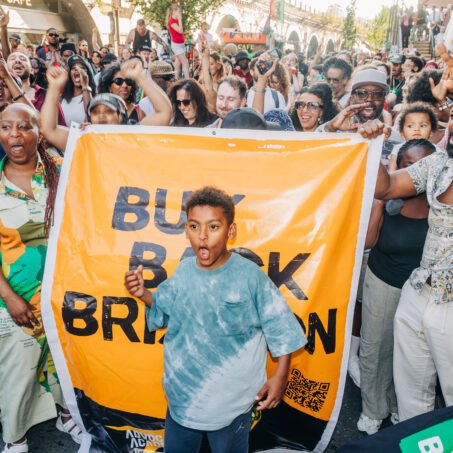
But a council meeting determining the future of the market resulted in a protest after market traders and community members were refused entry. The council later approved the plan. Very soon after, a beloved market trader of second-hand books and mother was evicted by developers for not signing a new lease with clauses which were significantly different from most traders.
The issue of the lack of meaningful communication kept coming up in discussions with traders. Amy* (name changed for anonymity), a long-standing trader tells me, “the council has to listen to the traders, we’ve been here for years. Information is not being given to the traders. The new head of the association doesn’t want you to know anything because he is happy with what he is getting.”
The division between traders and lack of meaningful engagement with all traders equally causes us to question: who is this development for? Who benefits? And who will suffer?
Amy adds: “everyone is struggling. They said the development will take two years, rent will be frozen for five years, but after then what? We need to think about the after. We’ll lose customers and the business.” Her words urge us to consider how short-sighted offerings are guises for long-term spatial exclusion, and for me, warn of how social existence can be bartered in terms and conditions of the free market.
Recently, the council rejected the Friends of Shepherd’s Bush Market application for the market to be an Asset of Community Value which would have provided additional protection.
Billy Mehra, a long standing trader of 47 years, tells me: “ The council has also been shy of communication. We are part of one big community, we may agree or disagree but the dialogue is important so it would be good if they spoke to Friends of Bush Market.”
Local communities and traders have invaluable knowledge on how the market can be thoughtfully developed, protecting the character of the market and creating transformative opportunities for the existing community. The people they elect should listen to them.
“There’s a colonial mindset in planning”
On the other side of London, traders and the community formed the Friends of Queen’s Market in 2003 and successfully fought off a controversial redevelopment plan for an Asda in 2009, through concerted community pressure. But, despite being a publicly owned market, Queen’s Market is still facing ‘managed neglect’ and ongoing threats.
I speak with Saif Osmani, an artist and member of Friends of Queen’s Market. We discussed the impact this has had on low-income, multicultural communities and the tokenist approach to engagement.
“There’s a colonial mindset in planning that somehow tick-boxes Black people, Asian people, working-class white people,” he says. “It’s a give them a few things here and there and that should shut them up, sort of attitude.”
Join our mailing list
Sign up for shado's picks of the week! Dropping in your inbox every Friday, we share news from inside shado + out, plus job listings, event recommendations and actions ✊
Sign up for shado's picks of the week! Dropping in your inbox every Friday, we share news from inside shado + out, plus job listings, event recommendations and actions ✊
Similar to Shepherd’s Bush Market, meaningful engagement with the community and traders has been lacking in Queen’s Market. Saif’s words echo that of Amy’s and Billy’s revealing the interconnected struggles but goes further, revealing the racialised underbelly of exclusionary urban development. In the act of racialised displacement, gentrification is an ancestor of settler-colonialism.
And in the same way histories of the present mimic the past, exclusionary practices are reinforced by technology. Saif tells me about Newham Council’s attempt to form a ‘co-creation’ process in the form of a digital platform. He confirmed, “most people in Newham don’t have access to this.” Friends of Queen’s Market notified the council of this digital exclusion and after discovering 11 live online consultations for the market but received no response.
While gentrification makes an area more affluent through the displacement of people with low-income, traditional street markets actually play a role in economically uplifting the people already there. “I remember a white working-class guy used to be at the station, selling drugs, asking for money,” Saif recounts. “Fast forward a few years he was selling bowls of fruit in the market, speaking Urdu to the aunties.”
“The market can give people a step up. It doesn’t have to be about criminalising people, but actually understanding their situation. Everyone has a right to the city.” Revealing the deep link between socio-economic inclusion and transformative justice, strong community relationships formed around traditional street markets can tackle the systemic conditions that produce harm at its core, and reveal positive alternative actualities.
The community plan “proved there was an alternative vision for what’s possible”
North of the river, Ward’s Corner, also known as Seven Sister’s Indoor Market/Latin Village/El Pueblito Paisa, represents a significant community win against market gentrification.
When the council signed an agreement with a property developer, the traders began mobilising immediately, submitting alternative community-led plans within two weeks. I speak with David McEwen from Unit 38, the architectural cooperative which worked on Ward’s Corner plan, who says: “it proved that there is an alternate vision for what’s possible, and it’s one that originates with the community.” This initial community plan that was submitted signalled what could be, expanding the imagination of what is possible.
But that wasn’t the end. Developers and the community continued to submit plans simultaneously and the community created a combined pressure of community organising including demonstrations, architectural planning, legal challenges and political lobbying.

The United Nations human rights experts warned that the developers’ gentrification project would have a “disproportionate impact on people belonging to minorities and their right to equal participation in economic, social and cultural rights” and that the cultural life would “simply disappear.” This intervention from the UN on human rights grounds only amplified what community members and traders had been saying – that these street markets are essential to the dignified life and livelihoods of local communities.
After a 20 year struggle, the council approved the Ward’s Corner community plan, the withdrawal of the developers and TfL to buy into the community-led plan. The Ward’s Corner community plan will save and restore the Ward’s Corner site, improve and expand the market space, provide community facilities, low-cost retail and space for local businesses.
David tells me “to the council, it was a catalyst for community wealth building. For the community, it’s a bottom-up project that resists displacement. To TfL, it’s an exciting opportunity to collaborate with a community organisation, to set an example of what this partnership could look like in London.” The community plan was a win for everyone, and evidence to other councils and decision makers that community centred plans are not just imaginations but actualities taking form in the city at this very moment.
A future that can’t be sold off
Growing up in London, Shepherd’s Bush Market was a lifeline for me and the people in the community. It was where we shopped for Eid clothes, bought affordable fruit, shared stories and laughed with people. But it wasn’t nostalgia that prompted me to join Friends of Shepherd’s Bush Market, it was the overwhelming evidence that traditional street markets are still vital lifelines for our communities.
By mapping the interconnected struggles to save traditional community markets in London, I was struck by the hope and determination. As Billy says: “I hope the market continues for many years to come, continues to be a place where people can make a living here, support their families, support the communities, and that rents and service charge remain a reasonable rate to allow that to happen.” The struggle against spatial and economic exclusion continues in Shepherd’s Bush Market, with community protection and affordability being the key.
Saif poses key questions for decision-makers. “What kind of future are we proposing together? Are we co-producing it? Is it really being co-created? And what is the role of ethnic minorities in this global city, and where do we acknowledge that?” he asks. “We’re always hopeful.”
All over London, communities and traders have devised key demands and alternative, community-centred, plans of development. This is a future that cannot be sold off.
What can you do?
Act:
- Contact Friends of Shepherd’s Bush Market to get involved
- Contact Friends of Queen’s Market to get involved
- Contact the Wards Corner Community Benefit Society to get involved
Read:
- Resisting gentrification in traditional public markets: Lessons from London by Sara González and Gloria Dawson
- Social Value Index: Building the Case for the Democratic Commons in Tottenham by Adam Almeida
- Gentrification Is Inevitable and Other Lies by Leslie Kern
- What is Gentrification? By Simmone Ahiaku
Watch:
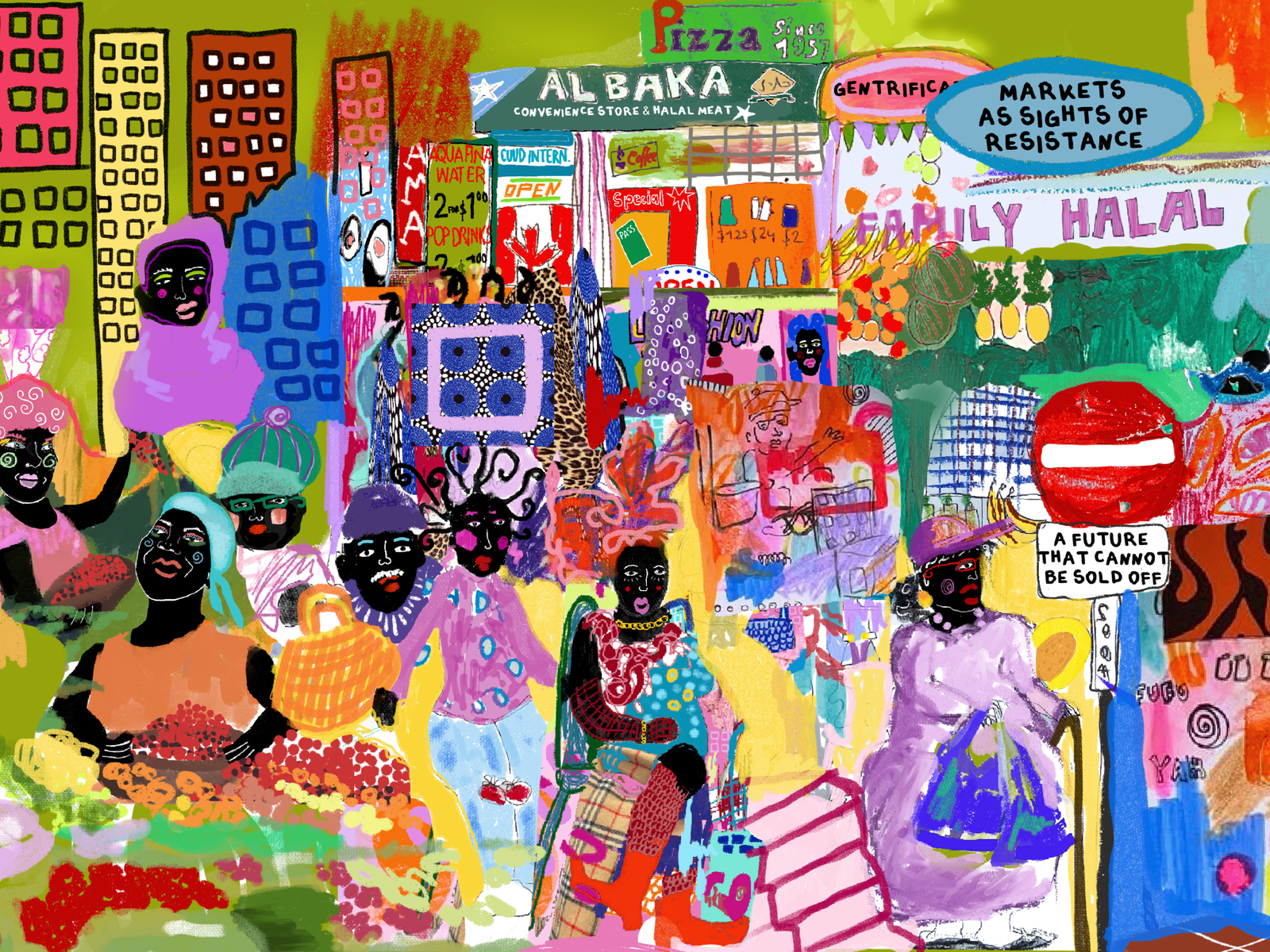
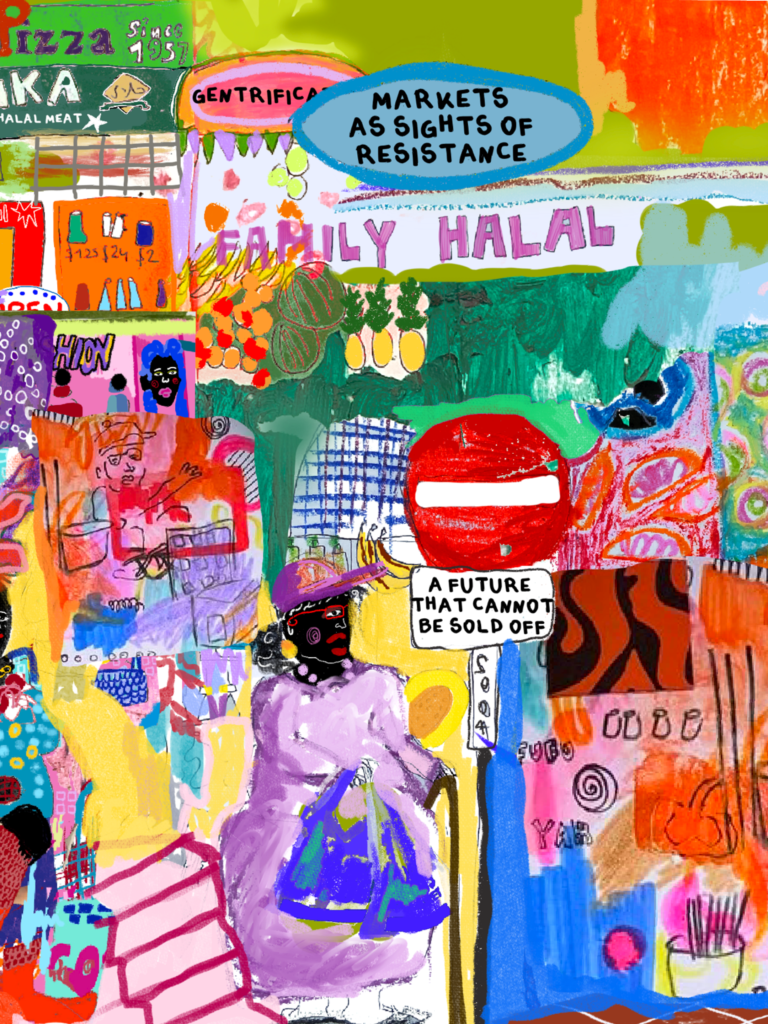 Illustration by @fioandfio who says: “The image depicts a dense, lively street market filled with people in colourful clothing. There is a sense of familiarity and shared community. Each stall is visually distinct, with hand-drawn signage and imperfect lettering that contrast with the polished, standardised aesthetics of high-street stores. In the background, large, uniform buildings loom over the market, their rigid forms encroaching on the textured, human energy below. Black skin appears prominently not as aliteral representation, but as a political racialisation, pointing to how gentrification disproportionately affects racialised and working-class communities. Signs reading “Markets as sites of resistance” and a “No Entry” symbol stating “A Future That Cannot Be Sold Off” frame the market as more than a place of trade, positioning it as a social infrastructure and a site of collective resistance.”