
The air in the law library is always heavy – a mixture of floor wax, old paper and the sharp, metallic scent of anxiety. I sit at a table scarred by decades of nervous fingernails. Before my client even sits down, I push a small candy dish toward her.
It’s a simple gesture, a small sweetness in a bitter place, but it serves a dual purpose. For her, it’s a moment to breathe. For me, those few seconds while she reaches for a piece of candy are a tactical silence. It buys me the time I need to look at her and calculate how to navigate the trap the state has set.
The law within the prison
I was a jailhouse lawyer for 20 years in the New York State female prison system. Many of my clients were far from innocent in the eyes of the prison disciplinary unit. However, the state is often sloppy, writing disciplinary tickets that are invariably tilted in its favour.
Disciplinary tickets are written against inmates who have allegedly “broken” the published prison rule code. Some clients find themselves following a direct order and then another officer writes them up for being “out of place.” Or an officer blatantly lies that they saw them in someone’s cell, but the camera footage shows them nowhere near that cell.
There are of course times when tickets are rightfully written. When, in the messhall, a woman stuck her finger in someone else’s cake – my client’s cake – my client got up and beat her with her food tray. For that, she received a disciplinary ticket. This client never saw a fight she would back down from. My job was to either reduce her disciplinary sanction or to have it completely thrown out and expunged from her prison disciplinary record. In fact, this client beat all five of her disciplinary tickets – I nicknamed her “my franchise player.”
When I review a case’s facts, I often nickname them. For example, I often referred to winning cases, with fellow law clerks, as a ‘Mickey Mouse’ case, because the state had made so many errors, the case has ‘cheese holes.’ I have seen the state lose critical evidence – video tapes, audio recordings, or even the contraband itself. I’ve seen hearing officers try to enter evidence written on the letterhead of a New York male prison – a glaring due process violation.
The function of the prison law library
My job isn’t to pretend my clients are saints; it is to ensure the system doesn’t consume them through its own procedural negligence. I operate with integrity. I don’t need to lie for them because the state’s own carelessness so often provides the path to justice.
In the isolated ecosystem of a prison, the law library is the town square of justice. Each day I have a list of clients who have dropped “tabs” or “notes” to see me, with a brief description of their unique problem. Problems can range from assistance with recalibrating jail time credits, accessing a court for a child custody modification, or assistance filing a grievance against the prison administration because “they” have broken a published rule or regulation. It is the only department that functions as a bridge to the outside world’s constitutional standards. The presence of a functioning law library is critical because it provides a non-violent outlet for grievances. It transforms a prison ticket into a legal issue.
When I find a mistake and have a ticket expunged, I am protecting a woman’s future. In New York State, many sentences are “indeterminate” – for instance, a sentence might range from 3 to 9 years – meaning the incarcerated person could be eligible at 3 years for release. However, a disciplinary ticket can delay someone from participating in mandatory programming, which procedurally blocks their chances at early release. Therefore, the work is vital.
The invisible advocate
The most unique aspect of my work is its invisibility. I am not a licensed attorney; although I did earn a paralegal degree while incarcerated. However, I am the exception as most jailhouse lawyers have no formal legal training. Thus, under New York law, we cannot technically represent another in the court of law, I can only ‘assist.’ As a consequence, whether I am drafting an administrative appeal or a complex court petition, my name never appears on the document. I am a ghostwriter. The client signs the work as pro se, Latin for “standing before the court alone.” My name is rarely identified unless someone is mentally impaired; then I must acknowledge this work is being done by a jailhouse legal clerk.
Most women in the system have been conditioned to believe they have no autonomy. When I hand a woman a finished motion that is professional and grounded in the law, and she signs her name to it, it is a revolutionary act of self-empowerment. She is no longer just “the accused”; she is a litigant. The act of her claiming that work helps build the self-esteem necessary for her spiritual reconstruction. She feels advocated for, protected, and for the first time, not so alone in her struggle.
The prison industrial complex is designed to isolate, keeping individuals siloed in their own struggle and disconnected from a sense of community. When I sit across from a woman, I am breaking that isolation; she realises she is no longer navigating prison alone because someone is finally in her corner. Because I am “similarly situated,” I am in a powerful position to translate the system.
Many women change when they feel someone truly cares about their situational outcome. Many of my clients do return from SHU (Special Housing Unit; or ‘solitary’) with a time cut that they know I facilitated, and they come back with a new perspective. They see that using careful, reasoned advocacy is the only way to truly win against the state.
The greatest compliment I receive is when a client asks for help with a college admission essay or a resume because “they want to do what I do.” By modelling professional excellence and integrity, I am showing them that they too can claim autonomy over their lives – something refined and powerful. Prison tries to narrow the future, and these acts widen it again. We aren’t just arguing for time served; we’re insisting that growth and dignity persist even inside institutions built to deny both.
A vision from the outside
On 2nd October 2025, I was released from the NYS prison system after serving 22 years. Now that I am home and looking back at those scarred tables from a position of freedom, the needs of women’s law libraries are clearer than ever.
Because women prison populations are often denied proper word processing computers – there are none at all, in the case of New York State – the incarcerated women often describe our legal efforts as “writing the law in the sand with a stick” which describes the arduous task of writing with a pen and paper versus computer technology. No NYS court, district attorney’s office, or attorney general’s office, is processing legal work with a pen and paper or typewriter as incarcerated women in New York State are mandated.
To ensure the women’s prison legal struggle to maintain constitutional compliance for fair and meaningful access to the courts, we must immediately address this systemic technological void. Currently, women in many facilities are denied access to the same word-processing computers that are standard in nearly all male prison law libraries.
This disparity exists because of a dismissive administrative paradigm. In my experience, incarcerated women’s complaints are often ignored because their grievances are labelled as “bitching,” whereas incarcerated men’s complaints are prioritised because administrators fear they will “riot” if their needs are not met.
This is not just an anecdotal observation; it is a documented administrative paradigm. In a 2023 study, Dr. Melinda Tasca found that women are nearly 40% more likely than men to be cited for ‘defiance’ – a discretionary category for verbal acts. By contrast, men are significantly more likely to be found guilty of weapons charges and physical fighting, often at twice the rate of women. The irony is stark: while administrators rely on selective enforcement and resource allocation to manage male populations they fear, women’s grievances are trivialised.
By casting men as physical threats and women as verbal nuisances, the state rationalises leaving women’s law libraries technologically barren, forcing jailhouse lawyers to become the sole, exhausted conduit for the court-mandated work prisons themselves refuse to support.

Join our mailing list
Sign up for shado's picks of the week! Dropping in your inbox every Friday, we share news from inside shado + out, plus job listings, event recommendations and actions ✊
Sign up for shado's picks of the week! Dropping in your inbox every Friday, we share news from inside shado + out, plus job listings, event recommendations and actions ✊
To bridge this gap, we must invest in:
- Digital Equity: Equitable and consistent access to word processing technology, matching the standards of male facilities, so women’s legal work has the permanence and professionalism the state and federal courts demand.
- Professional Mentorship: Direct pipelines between incarcerated jailhouse lawyers and outside law firms to ensure the “invisible” work inside has the firepower of the private bar behind it.
- Educational Autonomy: Recognising jailhouse lawyers as essential paraprofessionals who maintain the stability and constitutional integrity of the prison environment.
To empower the female jailhouse lawyer is to empower the most vulnerable voices in our society. It is critical to ensure that their growth is protected and their voices are valued and supported – even if their signatures and transformative work remains invisible.
What can you do?
To address the technological and systemic “starvation” that NYS female prisoners are experiencing in their law libraries, I have been drafting a comprehensive grant proposal and non-profit framework as a Strategic Revitalisation Plan. I am advocating for the following three-pronged initiative:
- Formation of Strategic Pro bono Legal Alliances: Establish formal partnerships between NYS female prisons and outside private law firms. This pipeline ensures that the “invisible” work happening behind the walls has the research firepower and professional polish required to succeed in the 21st-century court system.
- Establishment of Networked Computer Technology & Digital Equity: Secure grants for networked computer labs in female facilities. “Meaningful” access to the courts under Bounds v. Smith is impossible in 2026 without the evolving digital tools used by the federal and state court systems and the private bar.
- Comprehensive Proposal that I have drafted called The Healey Law Learning Initiative to formalise the training of female NYS jailhouse lawyers. This program treats the prison law library as a clinical environment, providing female jailhouse lawyers with advanced legal research certifications and mentorship programs needed to transform the library into a centre of professional legal excellence.
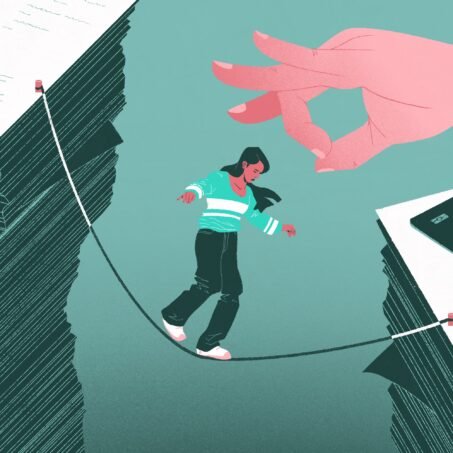
 Illustration by @happynappystudio who says: “This image centres the unseen labor of women who sustain justice from within prison walls. The figure’s body is present but her facial features have been obscured, while the hands remain vivid and actively writing. This is to emphasise how incarcerated lawyers are rendered invisible even as their work shapes real outcomes. Papers orbit the figure like unfinished thoughts, appeals, and lives in motion, reflecting the constant legal pressure surrounding them. The glowing pen and handwritten line represent the care, precision, and resilience in a system that denies her the proper tools and recognition for her labour. This piece honors authorship without credit and frames how writing can be a quiet, radical act of survival.”