

On 23rd September, 87-year-old Maricarmen Abascal was evicted from the Madrid apartment she had lived in for 70 years, after the developer who owned it more than quadrupled her rent. Maricarmen had been fighting this eviction for over seven years, organising with her local branch of the tenants union Syndicat de Inquilinas.
These same comrades, in attempting to defend her home, were violently restrained and beaten by the police, forced to watch as Maricarmen was carried out on a stretcher, suffering from severe exhaustion of which she later died.
Spain has erupted in response – streets on fire, hundreds of thousands marching, encampments in every major city centre, and politicians finally responding in the Spanish Congress. The mobilisations have led to the call for a general strike across Spain on 11th November. But Maricarmen’s eviction was tangled up in something far beyond the borders of Spain: the global machinery of international private equity that treats our homes as its frontier for capital expansion.
As migrants who have faced this crisis in Spain and back home, we’ve watched as the tenants unions rise to meet it. We think those living in cities ravaged by the corporate housing agenda should take note: the private equity behemoths are not infallible.
The eviction pipeline
The property developer that raised Maricarmen’s monthly rent from €500 to €2,650 – nearly double her pension payment – is called Urbagestión. This is their business model, where steep hikes from ‘flipped’ properties systemically replace long-term residents with wealthier tenants or higher profit short-term housing models.
In this case, Urbagestión bought Maricarmen’s apartment from Renta Corporation, a large property-holder in Spain who make their profit from ‘flipping’ properties – buying, minimally refurbishing, and reselling individual units or entire buildings. Renta manages Vivenio, a private rental sector platform that is funded by Dutch pension fund APG, and Australian pension fund Aware Super. In 2021, they reported a net profit of €74.3 million, mostly from rises in the value of its properties.
Centrist and right-wing politicians would argue that all of this is working as it should: capital investment will lead to more homes being built, growing their cities’ economies and enriching the tax bases as property values rise. But on the ground in Barcelona, where we live, you can feel it: the growing discontent, the rising homelessness, friends moving every couple of months as contracts are ended and precariousness increases.
These business models, where institutional actors see people’s homes as a lucrative vehicle for investment, are not novel, nor are their impacts only felt in Spain. But Madrid is experiencing a particularly sharp end of it due to a lack of local regulation.
Post-2008 recovery policies encouraged the entry of international finance into Southern European countries like Spain, with Spain’s central government supporting their expansion. The regional government of Madrid has actively courted global capital under a ‘build, build, build’ approach, fast-tracking permits, easing land-use rules, and resisting national rental price caps or strict market interventions.
US firm Blackstone is now the largest single private landlord in Spain, with over 20,000 units. Just earlier this year, Isabel Diaz Ayuso, the president of the community of Madrid, cheerfully proclaimed: “We will not intervene in housing, neither for rent nor for sale. Limiting and intervening in housing always proves to paralyse the market.”
For renters like us and our friends, the market is already paralysed. A one-person flat now swallows between 74% and 98.7% of a young worker’s net salary in Spain – that is untenable. We’ve felt hostilities increase on the ground, where locals and migrants end up fighting over the same scarce homes while the city fills with vacation rentals and investor-owned flats.
 Photo by Marilyn Yang
Scarcity by design
And Diaz Ayuso’s market logic doesn’t add up. Not only have rent increases put dignified housing out of reach for people employed locally, but investor owners have actively sealed the housing stock for the past decade to manufacture a housing crisis; driving prices upward from decreased housing stock while waiting eagerly to cash in and sell their properties on an enormous profit margin.
According to the National Statistics Institute, there are currently 3.8 million empty houses in Spain – 14% of the housing stock. In the state of Catalonia, Blackstone holds 4,036 of these vacant homes.
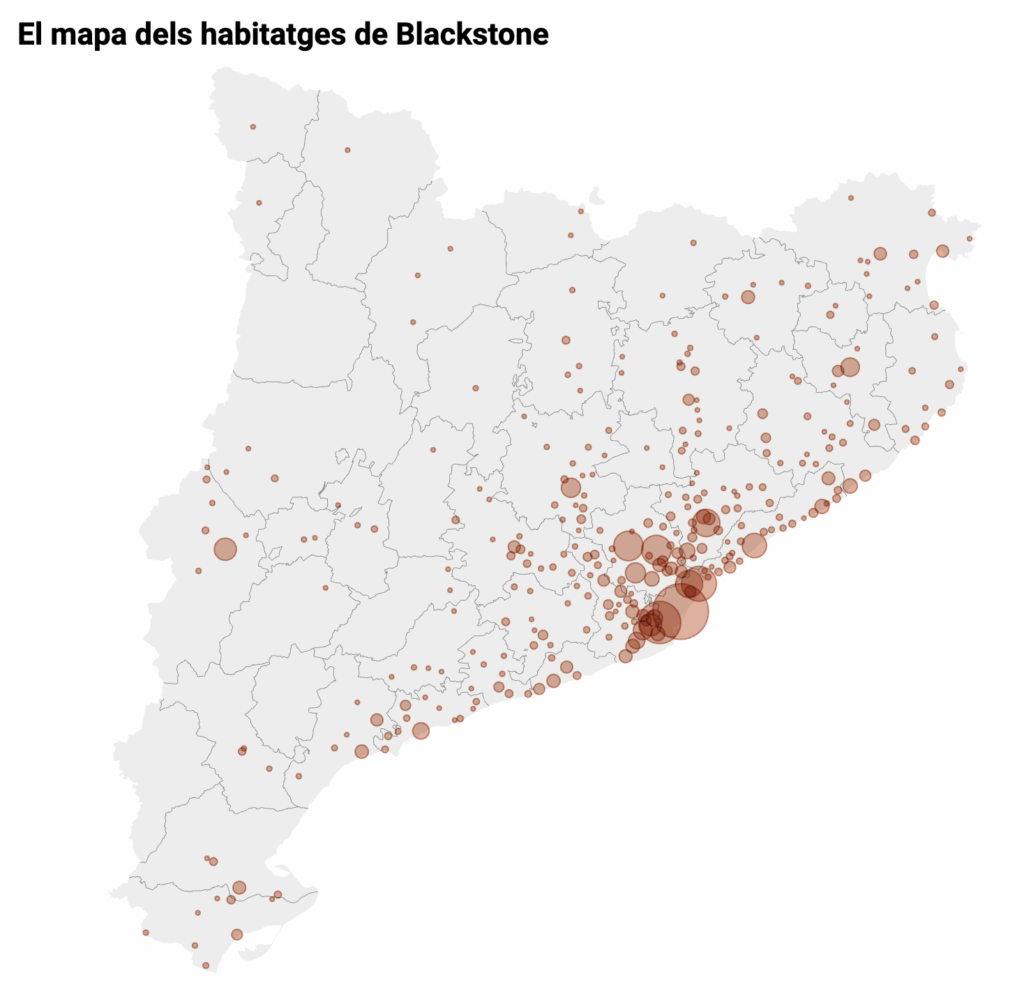 Empty homes owned by Blackstone in Catalonia. Source: La Directa
As for the Blackstone properties it does rent out, these serve mainly as a mechanism to funnel wealth from struggling Spanish families straight to Fifth Avenue in New York City, where they are transformed into dividends and distributed to investors across the world. This is the nature of institutional finance.
A housing system resting on a financial market fundamentally disregards housing as a basic need, as institutional buyers take whatever actions increase dividends.
The same playbook across the world
These dynamics are not confined to Spain. The most similar cases might be in other Southern European countries, including Portugal, Italy and Greece, where there is high tourism-driven demand. But even the more regulated economies of the Nordic countries haven’t stopped private equity: in 2016, Blackstone bought the controlling stake in Sweden’s largest real estate firm. The same year, the company renovated more than 1,000 apartments and raised their rent by 42%. By 2019, they owned over 20,000 residential homes in Stockholm.
While Blackstone’s spokespeople deny any responsibility for housing inequity, evidence in Stockholm says otherwise. An estate in the north of the city, half-owned by Blackstone’s Swedish company Hembla, and another half by the local authority, made clear the comparative degradation of the buildings owned by the corporation.
This is happening in the US too, where private equity firms now own 1 in 8 apartments. In some districts of Atlanta, as much as 99.6% of the market is owned by corporate investors, outbidding everyday homebuyers, and managing their properties using algorithmic rent-setting tools and enforcing aggressive fee structures and evictions.
When regulation works
But the actions of investors only tell one side of the story. In the US, it is the states with the least regulatory activity that are seeing this boom in private equity ownership.
In Denmark, after Blackstone’s Danish partner began renovating Copenhagen apartments in ways tenants said were meant to push them out and raise rents, tenants and the media rallied, politicians from left and right condemned the firm, and Blackstone stopped buying and later restructured its local business (though it denies it was responding to the criticism). In 2020, their parliament passed the “Blackstone Law,” which bars new owners from raising rents on renovated flats for five years and bans paying tenants to leave.

Join our mailing list
Sign up for shado's picks of the week! Dropping in your inbox every Friday, we share news from inside shado + out, plus job listings, event recommendations and actions ✊
Sign up for shado's picks of the week! Dropping in your inbox every Friday, we share news from inside shado + out, plus job listings, event recommendations and actions ✊
In Spain, after the 2024 housing protests organised by the Sindicat de Llogateres, Catalonia passed and began enforcing the housing regulations that tenants unions fought for, including caps on annual rent increases, limitations on seasonal and room rentals, and a 30% social housing quota on new developments.
In response, Blackstone has recently signalled that they want to “limit their exposure” in the Barcelona market due to the “regulatory climate,” shifting investments to Madrid and Malaga. All three of us had moved multiple times in the span of just a couple years, and we felt the shift, as advertised rental prices actually plummeted and the coveted 5 year contracts became easier to find.

Two of us come from the US and one from the UK, and we are familiar with corporate landlords. We know Spain’s housing crisis is severe, but what has surprised us was not the level of the crisis, but the organised response – a tenants union strong enough to make investors nervous and regulators listen.
And now we can feel the momentum building again for the general strike on the 11th November, called for by the housing syndicates in partnership with Spanish labour unions: the city papered with general strike posters and the central university functioning as the open house of the general strike, echoing the mobilisations leading up to the protest in 2024.
Make it unprofitable
This is where the national mobilisations come in. Some of the reforms the Spanish tenants movement are pushing for are ones that have already been passed in Catalonia, and clearly have made an impression on investors. In full, the “Maricarmen decree” includes automatic renewal of leases, a rent freeze, regulation of seasonal and tourist rentals, and an eviction moratorium for those who don’t have another housing option.
Initially, this decree was struck down by right wing parties claiming the solution was to build more housing rather than protect tenants. But with polling indicating widespread support for these policies, including amongst right-wing voters, the ground is shaking. The increasingly unpopular President of Spain Pedro Sanchez has dissolved parliament and called a snap election, hoping he can ride the momentum of the housing movement to win a congressional majority.
With congress dissolved, the caretaker lawmakers of the Spanish government already approved two emergency housing decrees following the widespread protests. Among the measures are protection against evictions for vulnerable Spaniards until 2030, the regulation of room rentals and a new tax on seasonal leases ranging from 32 days to 11 months.
The people united
Tenant organisers across Spain push that we not only can, but we must. Their clear messaging, “speculation kills” is spreading through marches, putting words to something we all know is deadly – leaving the management of basic needs in the hands of a company whose only goal is increased profit returns.
Valeria Racu of Madrid’s tenants union outlined in an interview: “we have seen that 8 days of people power has achieved much more than 8 years of a progressive government,” echoing the sentiment of many unions who remain skeptical of where a government’s interests lie. But by planting firm and unifying demands in a cultivated grassroots network, these tenants have forced the hand of an ambivalent government, or at least given them a wave of unified support to ride.
In a world where local organising can feel insignificant against the gargantuan forces of private equity, the case of Spain’s cities is a powerful reminder that we can all take up the fight by working to make their investments less profitable. We’ve witnessed the power of locally embedded tenants unions on the streets, in the news and in government, and now are waiting to see what the tenant-led general strike will accomplish.
What can you do?
- If you are living in Spain or visiting on November 11th, support the General Strike / Vaga General!
- Join your local tenants union:
- In Madrid: Sindicato de Inquilinas e Inquilinos de Madrid.
- In Catalonia: Sindicat de Llogateres and COSHAC.
- In the UK: London Renters Union and ACORN.
- Follow the encampments in Madrid and Barcelona.
- Read “We’re Staying Put: Neighbourhoods Fight Evictions in Barcelona” for info about how tenants unions organise in Barcelona.