
Andy Burnham: the prime minister to end the housing crisis? With promises of cheaper household bills, an end to rough sleeping, and investment in social housing, the former Manchester mayor certainly opened his premiership by saying the right things. Yet just two weeks into the new government, Angela Rayner, his Secretary of State for Housing, waved through a controversial data centre development on the site of the historic Truman’s Brewery on Brick Lane, an area with among the highest social housing need in the UK.
What does data have to do with housing?
Perhaps at first glance, the greenlighting of a data centre in Brick Lane doesn’t have a lot to do with housing. The environmental impacts have received more attention: the carbon emissions of data centres are thought to be 662% greater than the biggest tech companies claim. Water providers across the UK have raised the alarm about possible water shortages as a consequence of the high volumes of water consumed by the digital infrastructure. And, of 100 new data centres green-lit to be built in the UK in the next five years, an equivalent number intends to burn fossil gas to meet energy supply, a dangerous new use of these fuels in a moment when rapid decarbonisation is urgently needed.
In inner cities, data centres are often concealed within existing buildings, not obvious to the naked eye. Maybe this is why the connections between housing precarity and data-expansion often go unmade. Yet, electricity demand from data centres has been proven to delay delivery of social housing. For Tower Hamlets, a borough with a social housing waitlist of 30,000 and among the highest child poverty rates in the whole of Britain, this is critical.
Positioned in one of the most densely populated areas of the whole borough, the proposed data centre would use the equivalent energy of 18,000 homes, contributing to sky-rocketing energy and fuel costs, while occupying space that could otherwise be used to meet some of the borough’s urgent housing needs.
Brick Lane has already faced several waves of ‘regeneration’ – a santised term used by private property developers to gloss over the impacts of new developments, which homogenise the local area with disproportionately expensive flats and businesses, pricing out locals. This latest redevelopment plan holds all the same dangers. Only this time, those that benefit will be an even more elite demographic: the data centre is intended to service “high frequency trading” in London’s financial district.
Housing, climate and data justice: joining the dots
The resonances with other struggles are clear. Anyone who has put their body on the line to resist a housing eviction will know: our housing system in the UK is geared towards turning homes into profit-making assets, financially exploiting renters and abstracting our relationship to land and local culture.
Likewise, anyone who has organised for climate justice, will recognise that our profit-driven energy economy relies on the acquisition of land for exploitation, often with police or military forces helping fossil fuel companies to force projects onto communities that resist them.
When it comes to data centres, we can recognise a similar pattern: private landowners collaborating with corporations to yet again exploit land for profit, irrespective of the needs and voices of local communities. With this perspective, the Burnham government’s aim to combat housing poverty is totally incompatible with their plans to build nearly 100 new data centres in the next five years.
Banglatown: a long history of resistance
Brick Lane in London’s East End is the heart of the city’s Bangladeshi community, many of whom established themselves in East London during the 1970s and 80s following the Bangladeshi Liberation War and the Bhola cyclone. During this time, far-right violence targeting the East End’s Bengali community was ubiquitous, with the racially motivated murder of 25-year-old Altab Ali being its most extreme and tragic consequence. Nearly 50 years on, community groups working across Tower Hamlets still come together to resist racism and facism in their borough.
The community of Brick Lane’s ‘Banglatown’, the Bangladeshi cultural quarter, has also seen and resisted several decades of urban transformation by private property developers, including the most acute levels of gentrification in the whole of London between 2010 and 2016. From the mid-2000s to 2020, the number of South Asian-owned restaurants declined by 62%.
This decline was not a choice for local people but a consequence of expensive private residential and business developments in the area. These developments drove up rental costs, making working and living there unaffordable for many long-term residents and workers.
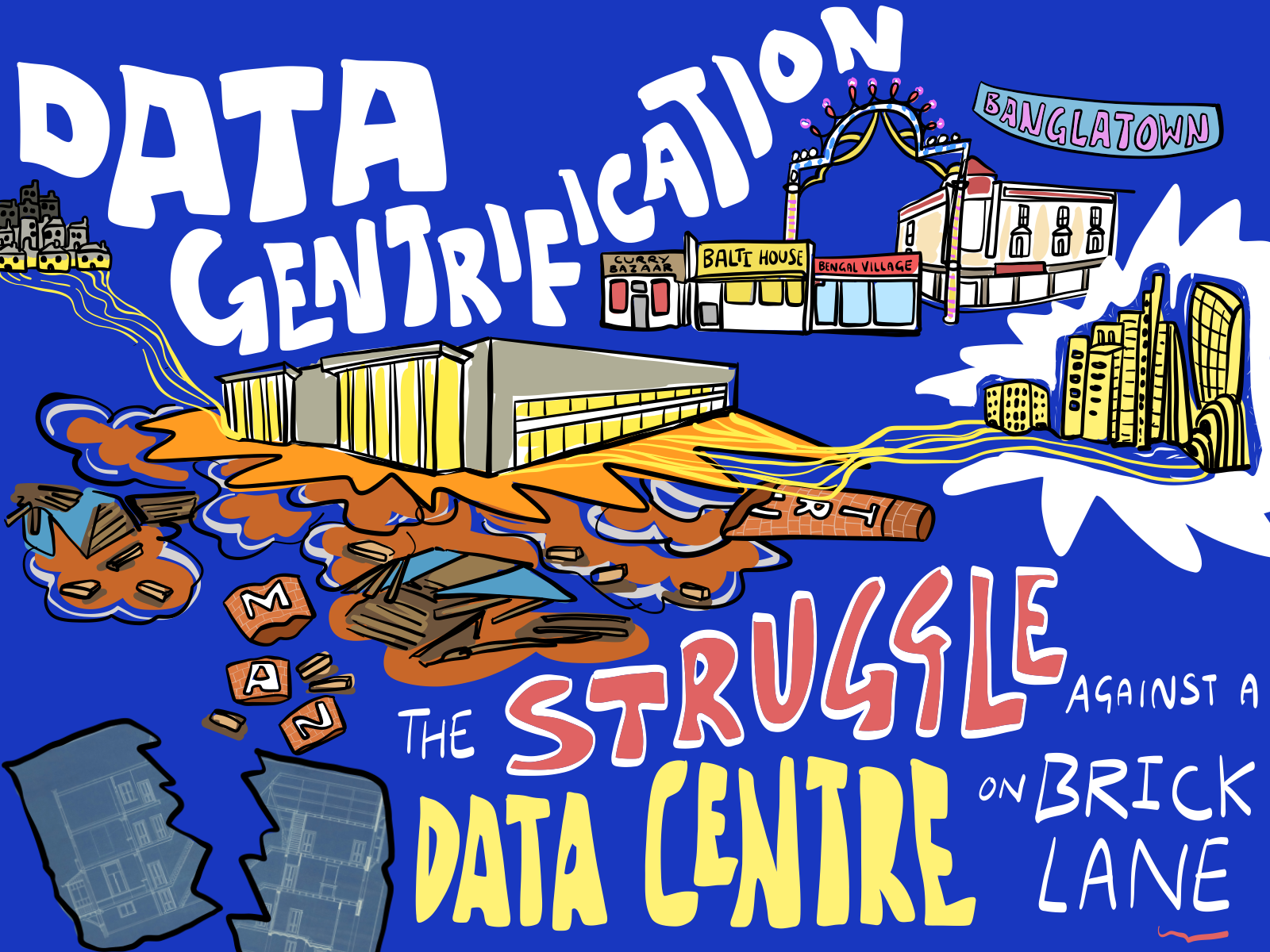
So, while Brick Lane locals are no strangers to gentrification, the latest £500m redevelopment plan for the historic Truman’s Brewery site introduces an alarming evolution of a longstanding trend.
Five years of the Save Brick Lane coalition
The schemes to develop the old brewery into a shopping mall, offices and luxury apartments have been on the table since 2020, with a data-centre added to the equation further down the line.
In the face of the proposals, a group of local residents, community groups and political organisations including Nijjor Manush, House of Annetta, Bangladeshi East End Heritage Society, East End Preservation Society, the East End Trades Guild, Spitalfields Life, the House of Annetta, and the Spitalfields Trust formed the Save Brick Lane coalition. The coalition have repeatedly argued that the Truman Estates plans are “alien to the history, culture and small-scale economy of Brick Lane”, making the case instead for “social housing, community provision and affordable workspace.”
Still, after several waves of community resistance to the plans, including a Supreme Court challenge to the shopping mall, Truman’s Estates and Zeloof LLP (the property owner) eventually appealed to the Planning Inspectorate, a central government planning appeals body. Following a public inquiry, the controversial project was given the thumbs up.
Data centres: a new form of gentrification
The tricky thing about gentrification is its framing as a ‘natural’ process of cause and effect, whereby urban changes are guided by “immutable laws we have no control over.” As academic Leslie Kern writes, “casting gentrification as an ecological process, with a little evolutionary flavour built in around competition for urban resources, works well to foster the idea that displacement of certain groups is to be expected and the normal trajectory of urban development is towards increasing concentrations of wealth.”
Such a framing has long been part of how colonial projects are naturalised, working to depoliticise and abstract the real causes of displacement from their roots. It makes sense. If ‘gentrification is inevitable’, then no one actor or political decision can be held to account. But gentrification is always a political choice.
Gentrification is first and foremost a process of urban change driven by private landowners and companies to accumulate profit. With the economies of urban centres such as London becoming increasingly reliant on big tech companies and financial services, demand for AI – and the data-centres to process it – is increasing at pace. This is only accelerated by AI’s normalisation in everyday digital life, from smartphone search engines to customer service helplines.
Again, this is a political choice. In October 2025, it was revealed that government ministers were meeting the leaders of tech companies at an average rate of once per working day. With such unprecedented levels of state lobbying for data-expansion, the designation of data centres as ‘critical infrastructures’ in 2024, which grants them priority status alongside water, energy and emergency services, has now made the UK a far more appealing prospect for big tech companies.
All this, in the context of decades of neoliberal property and planning reforms eroding tenants’ rights and establishing the asset-making powers of private landlords, the conditions for property developers to buy up land that could otherwise be used to meet local housing needs are ripe.

Join our mailing list
Sign up for shado's picks of the week! Dropping in your inbox every Friday, we share news from inside shado + out, plus job listings, event recommendations and actions ✊
Sign up for shado's picks of the week! Dropping in your inbox every Friday, we share news from inside shado + out, plus job listings, event recommendations and actions ✊

For less-wealthy inner-city communities, this threat is existential. Residential areas risk being bought up by private developers, who are now just as interested in investing in digital infrastructures as in the luxury apartments more typically associated with urban gentrification. For the government to prioritise the data processing demands of London’s financial district over the housing needs of the communities who live there demonstrates that the new government is just as interested in ‘profit over people’ as the cabinet that came before it.
Zooming out: the global struggle
Beyond London, the rapid and global proliferation of data centres is guzzling water in already ecologically precarious communities and keeping polluted cities hooked on fossil fuels. For instance in Querétaro, Mexico, towns and villages are experiencing droughts and blackouts as a consequence of the proliferation of data centres in the arid state.
Mumbai had plans to transition away from coal, but due to energy demands from the Amazon data centres, the city is burning more coal than ever, with widespread health impacts on residents. Whether unfolding in rural areas or in densely populated urban centres, the global push for datafication – driven by expansionist agendas of big tech companies – is grounded in the commodification of land. Resonant with the practices of English colonial land reformers, corporate data centre projects often rely on loose regulation to exploit local water and energy supply, making life more precarious and potentially unlivable for people nearby.
But the world over, people are fighting back. Across India, from Mumbai to Andhra Pradesh, this summer has seen mass demonstrations against the government’s push to “invite the whole world’s data to reside in India!”. In Aragon, Spain, the group ‘Tu Nube Seca Mi Río’ (‘Your Cloud Dries My River’) are campaigning against the Spanish government to achieve a moratorium on new data centres in the water scarce region. And in 2019 near Santiago, Chile, local community group MOSACAT (Socio-Environmental Community Movement for Land and Water), saw off a $200 million Google data centre project, which remains on hold to this day.
What these struggles teach us is that data centre expansion is about corporate control of land, water and ecology. To fight back is to demand determination over how our land is used.
A united front against big tech
Worldwide, anti-data centre struggles are growing in power. Against this backdrop, resistance to gentrification and wider struggles for autonomy over land are increasingly coming up against an expanding digital economy. There can be no doubt: the normalisation of AI and other other data-intensive technologies are reshaping how we fight for housing and climate justice.
Connecting these movements – from anti-eviction struggles to those on the frontlines of fossil fuel land grabs – is the fight for the global working classes to decide how our land is used and what it is used for. As long as neoliberal state agendas continue to facilitate the capitalist agendas of private landlords buying up our cities, the movements to resist big tech and the impacts of gentrification may just start to coalesce.
For Brick Lane, the fight continues, as the coalition seeks legal advice to challenge Rayner’s decision. In solidarity, it is critical we push back against the normalisation of AI in our day-to-day lives, while remembering that this is a broader ambition: for ordinary people to have influence over how AI is developed and implemented and to decide how our land and space is managed. The future of the communities that make our cities and the future of the planet depend on it.
What can you do?
- Join the Save Brick Lane Coalition, attend their demos and share social media.
- Follow Nijjor Manush on social media for updates.
- Write to your MP and Angela Rayner using the template made by SBL.
- Follow the work of Pull the Plug, a movement for people’s ownership over AI technologies.
- Join a tenants’ union, e.g., London Renters Union or Acorn.
- Support campaigns for community ownership.
- Support co-operative housing movements.
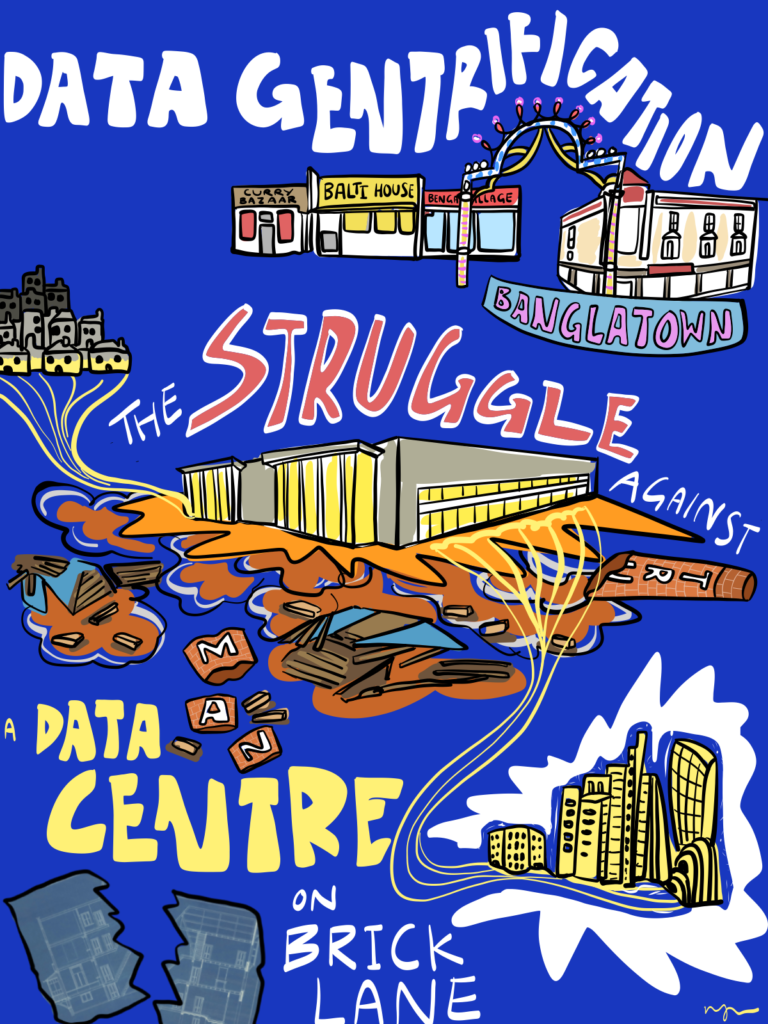 Illustration by @npl_illustration