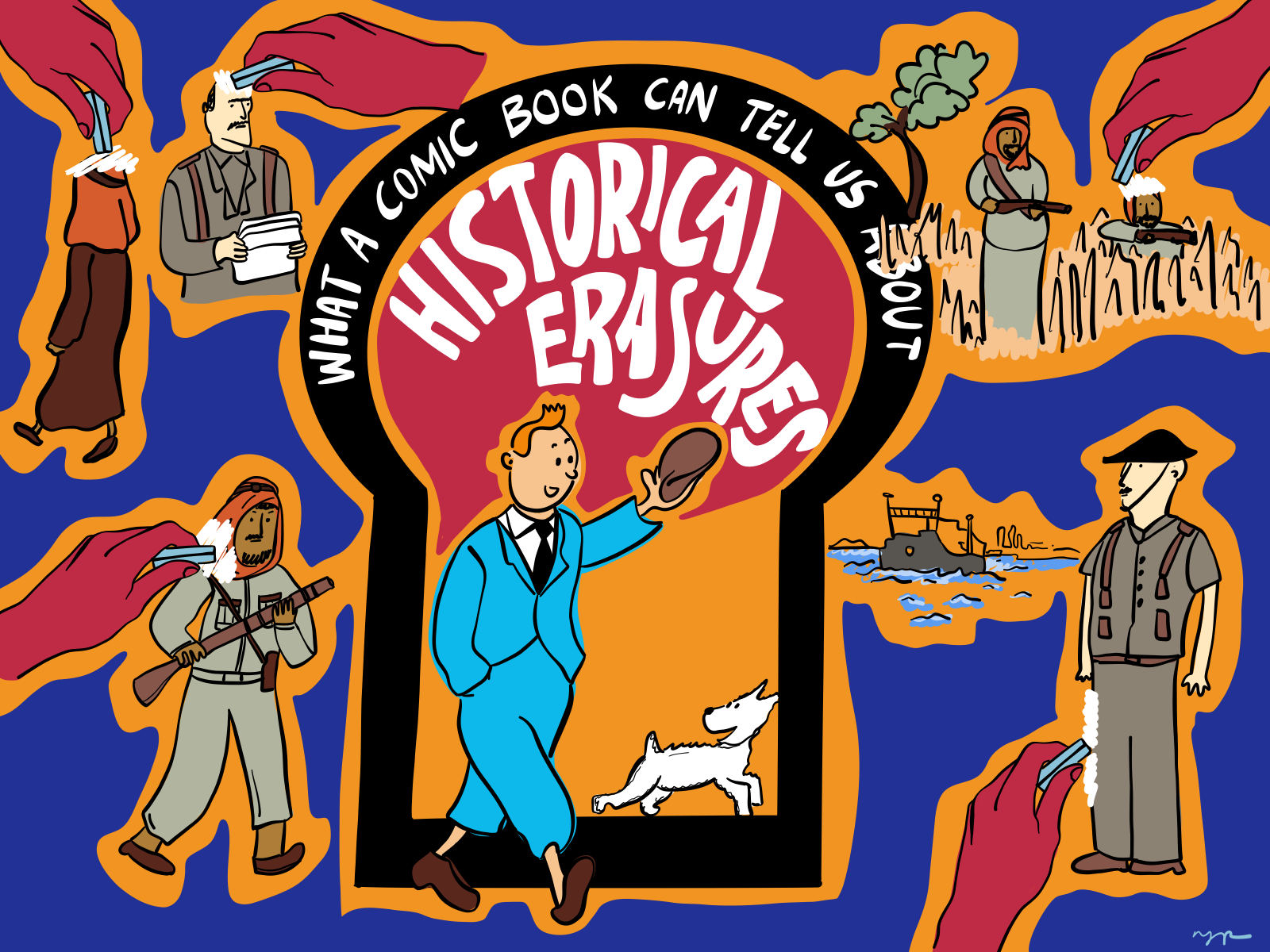

With some embarrassment, I admit that I grew up reading and thoroughly enjoying The Adventures of Tintin comic book series. I inherited most of my well-thumbed copies from my uncle, who had similarly pored over them in his childhood. The rest I begged my parents for, every Christmas and birthday for years, in the hopes that I’d complete the set.
Through them I travelled around the world; I keenly followed along as Tintin, with his ginger quiff and his loyal dog, embarked on wild adventures across desolate deserts and rough seas, up snowy mountains and into deep caves. I remember how excited I was to watch Spielberg’s 2011 film adaptation, where Captain Haddock’s angry tirades and Bianca Castafiore’s shrill soprano were magnificently rendered in 3D.
So imagine my surprise when I found out, only recently, that Tintin had once travelled to Palestine and gotten himself entangled in the Great Arab Revolt of 1936-1939. How had I never come across this episode of Tintin’s travels? As a Palestinian – and as a former Tintin enthusiast – this discovery was immense! I’d even go so far as to argue that the Palestine movement’s renewed interest in this particular period of Palestinian history makes this a politically pertinent find; consider Annemarie Jacir’s Palestine 36 and the recently translated edition of Ghassan Kanafani’s The Revolution of 1936–1939 in Palestine, which we will get back to in a bit.
So what had happened to Tintin in Palestine? Why was this trip scrubbed from Hergé’s oeuvre and rewritten as a story of Bedouin banditry and imperial struggles over petroleum in the fictional land of Khemed?
Hergé, orientalism and fascism
But first, I mention embarrassment because, in retrospect and with a far more critical (and adult) eye, I now read many of Tintin’s adventures as re-inscriptions of Orientalist conquest. Heavily laden with dehumanising tropes and racist caricatures of colonised peoples the world over, Hergé’s Belgian comic series has justifiably been subjected to much postcolonial critique.
As Tintin and his crew gallivant across entire continents with an ease afforded only to a very particular few, we view the world through their eyes. Distinct, complex geographies are flattened, and Indigenous populations racialised, perhaps most infamously in Tintin in Congo (1931).
These characters, stripped of any agency to narrate for themselves the world as they see and experience it, are mostly passive set pieces. When given more plot prominence, they are at best malevolent bandits or drug smugglers, and at worst, rhetorical devices to elicit pity and reify white saviourism. Elsewhere, they are primitivised objects picked out for demeaning ridicule. For Tintin the pioneer, the world is an open plain to explore and intervene in. Only he, the European colonialist, can thwart nefarious plots and defeat foreign despots.
Hergé himself was a man whose dubious political affiliations and fluctuations have garnered extensive scrutiny, both during his lifetime and posthumously.
Accused first of being a fascist himself, and later, a collaborationist during the Nazi occupation of Belgium, Hergé then “moved towards ‘what can be defined as a form of liberal humanism’”, whatever that means. But it is true that Hergé’s work cannot (and should not) be reduced to simply right-wing propaganda or Orientalist text; there is definitely something more interesting at play here.
Tintin as historical “record”
I am not interested in passing final judgement on Hergé’s moral code (or lack thereof). What is more intriguing to me is how the Tintin series, when taken together, reflects the malleability of Hergé’s political subjectivities according to shifting geopolitical tides.
The many editions of different Tintin volumes do not only reveal changing standards of political correctness (or censorship, depending on how you see it), but also (re)writings of history for different audiences, at different historical conjunctures, and that reflect different hegemonic interests.
This is illustrated well in Tintin in the Land of Black Gold. The 1971 edition, which is what I read when I was a child, is set in Khemed, a fictional Emirate that is a cross between Yemen, Saudi Arabia, Iraq and *insert miscellaneous Arab country*.
But originally, Hergé had based his story in British Mandate Palestine. The first edition (1939) was published right at the tail end of the Great Arab Revolt, a Palestinian peasant-led revolution aimed at British facilitation of Zionist settlement. It depicted British colonial forces and their occupation of Palestine as well as the increasing violence of Zionist terrorist militia groups like the Irgun and Stern, who, in the comic, let off a gas grenade and kidnap Tintin in a case of mistaken identity. It portrayed the racist xenophobia of these Zionist groups towards Palestinians (referred to as “satanic Arabs”) as well as Palestinian resistance to British occupation and increasing Zionist settlement.
The 1950 version stayed loyal to this original historic setting; in fact, the story was made more “timely” and relevant to the European reader in light of the 1948 Nakba. But in 1971, Herge completely revised the story at the request of his British publisher, Methuen – ostensibly to meet postcolonial standards of “political correctness” and neutrality which were no longer compatible with the comic’s original characterisation of Zionist militias or its matter-of-fact portrayal of Zionist-British collusion at the expense of the Palestinians.
And so, the original historical setting was erased and replaced with ‘Khemed.’ Kilted British Mandate soldiers were swapped out for Arab policemen. Caiffa (code for the Palestinian coastal city of Haifa) became ‘Khemikhal.’ Hebrew signs for Jewish stores were replaced with Arabic, and explicitly Jewish characters were renamed and redrawn, partially in response to accusations of anti-Semitism.
Indeed, instead of the Irgun/Stern militias, it is generic Bedouin bandits who kidnap Tintin and take him to their leader, Bab El Ehr. In the 1939 original, the character Bab El Ehr could be seen as an Arab nationalist confronting British colonialism and its agents and accomplices among the local feudal elite. In the 1971 version, however, Bab El Ehr and his opposition to the emir are revised and recycled into simple Bedouin rivalries for power and local wealth.
Ultimately, in this version, both sides of the rivalry are proxies for one European power or the other, and either way, Khemed’s sovereignty over its natural resources has long been violated. All the political tensions of the original plot between Zionist-Palestinian-British forces are deleted. Instead, the new story reflects the political tensions of a new world order: here, imperial interests have turned towards petroleum, and Palestine has long disappeared from the picture.
What was the Great Arab Revolt?
It’s true: the Great Arab Revolt had been a contemporary news item for the 1939 reader of the comic’s first edition. It represented a real threat to British-facilitated Zionist settlement of Palestinian land and saw wide swathes of Palestinian society – workers, “intellectuals” and peasants alike – engage in general strikes, cultural resistance and armed struggle. It was far less “relevant” for the 1971 reader, so Hergé updated his text to appeal to this new generation of young Europeans, for whom the existence of Israel was an unquestioned fact. Michel-Rolph Trouillot, the Haitian anthropologist, would describe this disappearance as a “formula of erasure”, a trope that “erases directly the fact of a revolution.”
But this revolution is a fact. Much of our contemporary knowledge of the Revolt comes from Ghassan Kanafani, who originally published The Revolution of 1936-1939 in Palestine in 1972. Here, Kanafani set out to demystify the Revolt, analysing its strengths and weaknesses, and diagnosing the reasons for its eventual failure.
Kanafani identified reactionary Palestinian leaders, Arab regimes surrounding Palestine and the alliance between Zionism and imperialism as major forces that undermined the Revolt, setting the stage for what was to come. Kanfani’s study encourages us to trace the historical trajectory of the Palestinian struggle; by studying the Revolt, we can explain how the British ensured the “domestication” of the Palestinian national movement and why the Zionist movement in Palestine “entered the 1940s with barely an obstacle on the battlefield.” Indeed, Kanafani characterises the Nakba as merely a brief “epilogue” to the “long and bloody chapter” before it.
Join our mailing list
Sign up for shado's picks of the week! Dropping in your inbox every Friday, we share news from inside shado + out, plus job listings, event recommendations and actions ✊
Sign up for shado's picks of the week! Dropping in your inbox every Friday, we share news from inside shado + out, plus job listings, event recommendations and actions ✊
The production of silences
In light of all this, the Tintin series – and its several iterations – should be understood as part and parcel of a broader “production of history”, as Trouillot puts it. Trouillot goes on to describe the production of silences, which “enter the process of historical production at four crucial moments: the moment of fact creation (the making of sources); the moment of fact assembly (the making of archives); the moment of fact retrieval (the making of narratives); and the moment of retrospective significance (the making of history in the final instance).”
What silences entered the Tintin series and at which points? At the moment of fact creation, when Hergé first wrote Tintin in the Land of Black Gold in 1939, Palestinians were merely marginal characters, their resistance to the British and the Zionists implied but ultimately overwritten by the plot, for which Palestine itself is just the backdrop for.
At the moment of fact assembly, when the completed story was finally fully serialised, the dominant narrative around Palestinians as victims had already been shaped and coloured by the recent Nakba. As such, the Great Arab Revolt had been relegated to a distant past which had no bearing on the present.
At the moment of fact retrieval, when the story was rewritten to completely erase Palestine, a new narrative was produced: here emerges an orientalised Arab world, one completely subservient to imperial interests and where tribal in-fighting reigns. And at the moment of retrospective significance, this historical episode and its erasure are merely a curious factoid. At best, the text is critiqued not for its ahistoricity but for its diminished literary value.
The repercussions of historical erasures
The widespread erasure of the Great Arab Revolt from the Tintin series is reflective of a wider historical erasure, one with extensive repercussions for the Palestine movement itself. This means that Palestinian history is often narrativised from the Nakba, a point of defeat decontextualised from the revolutionary period that preceded it. As a result, the “Palestinian” as a political subject is borne out of the Nakba’s rupture, our national consciousness and collective identity marked by our passive victimhood. I can speak on this personally: growing up, I never even heard of the Revolt but was all too conscious of the Nakba’s weight.
As a result, this erasure effaces the fierce resistance waged by Palestinian fedayees (guerrilla fighters) against the looting of their lands. It means that Britain’s crucial role in facilitating Zionist settlement and undermining Palestinian sovereignty is concealed, at the behest of a British publisher. It also fails to capture the internal dynamics of the Palestinian national movement and the complex nature of its enemies (Zionist and Arab reactionary alike).
These details are crucial for us to study and understand so that we, as inheritors of this legacy, may learn from our ancestors’ mistakes. What victories can the Palestine movement achieve if it remains unmoored from its past, ignorant to its own history? How do we begin to retrieve these forgotten episodes? How do we look past the rewrites and redactions — layers upon layers of imperialist propaganda — to locate these erasures? What sort of methodology must we develop?
As Hazel Carby states in Trouillot’s foreword: “what appears to be consensus actually masks a history of conflicts” and that “silences appear in the interstices of these conflicts between narrators, past and present.” Hergé is one such narrator, Kanafani another. But we must also become our own narrators, searching the archives to detect reminders of counter-histories that we must unearth and narrate ourselves. Sometimes, even Tintin can provide a starting point for this investigation.
What can you do?
Read:
- Hergé’s Adventures in Politics, by Martin Tyrrell
- What Tintin Tells Us About Imperialism, by Andrew Ancheta
- If you read French, Les devoirs de vacances de la librairie Tropiques 1 : Tintin en Palestine.
- The Adventures of Tintin in Fascism, by Ricardo Cunha Lima
- The Revolution of 1936-1939 in Palestine, by Ghassan Kanafani
- Silencing the Past: Power and the Production of History, by Michel-Rolph Trouillot
- Other pieces on Palestine
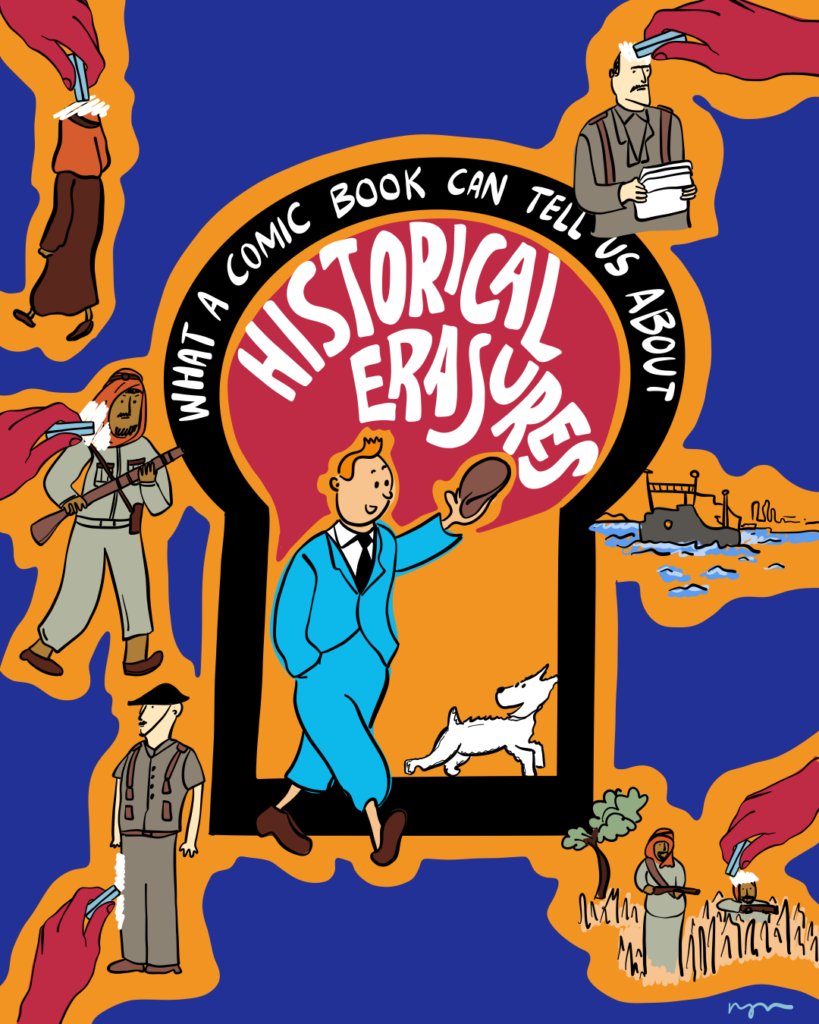 Illustration by @npl_illustration who says: “The illustration shows Tintin and Snowy in the foreground, Tintin dressed in a brown suit waving his brown coloured hat with Snowy trotting along beside him. Surrounding them are characters from ‘The Land of Black Gold’ issue. The bottom left shows a British soldier dressed in army uniform with part of his leg being erased. Above him is an Arab soldier also dressed in military uniform and with part of his head being erased. In the top left is a Palestinian citizen with his back facing the viewer with his headscarf being erased. On the right is another British Army Officer with part of his head being rubbed out. Underneath is a ship at sea and beneath that is a scene where Arab soldiers are hiding in a field with parts of their body being rubbed out.”