
If anything has become clear to me as an Iranian in the American diaspora in recent weeks, it is the mainstream Western media’s persistent knowledge gap in understanding Iran’s political history, ideological values, and internal social dynamics.
As Donald Trump presses deeper into his joint US-Israeli invasion of Iran, those of us in the Iranian diaspora find ourselves at a familiar crossroads, with many leftists simultaneously demanding an end to Western intervention and expressing disagreement with the Iranian government.
For decades, Iranians have expressed their thorough commitment to civil society protest through street marches, protest, and for some, even imprisonment. However, for those committed to Iranian civilian safety and anti-imperialism, even their most flagrant disagreement with the government would never justify an American or Israeli invasion. In fact, since the 1979 Revolution, Iranians have developed a political consciousness which rejects imperialism as a founding ideology, regardless of partisanship, which has endured throughout the leftist Iranian diaspora.
Anti-imperialism in diaspora
Iranian-American author Alborz Ghandehari recently wrote the article Neither Khamenei, Trump, nor Shah, emphasising solidarity with the Iranian people against state brutality and foreign intervention and for civil society political participation, in solidarity with intersectional feminist demands of the 2022 Iranian Women, Life, Freedom movement.
Iranian-American researcher Ciara Moezidis found in her 2023 study that “those who identify as ‘leftists’ within the Iranian-American context often espouse anti-imperialist views, while simultaneously maintaining a criticism of the Iranian government with caveats,” often aligning with Palestinian liberation.
As an Iranian-American researcher writing from the New York diaspora, my community has grieved in witnessing rising death tolls, communication blackouts, and growing fear as talks of intervention have quietly inundated newsrooms. However, dissatisfaction with the Iranian government cannot be conflated with a desire for American, Zionist or Western intervention.
To explore this further, I asked fellow women in the Iranian-American diaspora about their perspectives of Western mainstream news coverage of Iranian protests amidst threats of intervention.
Iranian political history: sovereignty first
While the US policy of foreign intervention has become increasingly normalised in recent weeks, even before the 28th February invasion – as emphasised by Trump’s coup in Venezuela and threats of a land grab in Greenland – these CIA-backed coups have roots in Iran in 1953. That year, the President of Iran was ousted by Western foreign powers to control Iran’s oil resources, catalysing an era of Iranian political ideology centring anti-intervention and sovereignty of natural resources, particularly emphasising anti-US intervention.
This node of Iranian political history continues to shape Iranian diasporic political consciousness, with communities left traumatised. And considering the US has led genocides and occupations in nearby states such as Palestine and Iraq in recent years, the Iranian diaspora is correct to be wary of foreign intervention for either democratic goodwill or economic growth.
Orientalism in diaspora
State education in America, particularly in the post-9/11 era, has sought to repress Iranian political perspectives and emphasise bleak characterisations of “terrorism,” seeking to establish a temporal break between the “modernity” of the West and the “backwardness” of the Islamic World, or “Orient.”
“It’s this very slim idea that before the regime changed powers, everything was perfect,” one Iranian student at Barnard College tells me. “But the reality is that the reason this regime is here is because people didn’t want the monarchy. And I think that is important to remember.”
Western depictions of Iran seek to flatten Iranian humanity and depth, and instead project American fears and desires onto the region. Against such characterisations, Iranians in diaspora – particularly Iranian-Americans with family in Iran – simply seek to maintain safe and continuous contact with their relatives and communities, with internet blackouts across anti-regime protests met with severe police brutality and killings.
“American news overlays the backdrop of images of the 1979 Revolution – blindfolded hostages being marched in front of crowds cheering ‘Death to America’ and burning American flags in the streets – which codify Iranians in the street as inherently radical, violent, enemies of democracy,” an LA-based Iranian-American woman tells me. “These images are now side by side with images of women burning their hijabs and flipping off the Supreme Leader, and most recently, blurry videos of blood stained sidewalks and warehouses of body bags.”
No diaspora nor state is a monolith, and perspectives vary widely depending on personal and family experience. However, an increasingly visible faction of the leftist Iranian diaspora have sought to re-negotiate this public narrative in favour of a more humanistic and less monolithic perspective of Iranians.
Another Iranian-American peer of mine remarks, “Some headlines couldn’t be more insensitive, in my opinion. NYT headlines, like ‘How Iran Crushed a Citizen Uprising With Lethal Force’ or ‘How Iran Crushed an Uprising,’ read more like a Cosmopolitan article than breaking news.”
She continues: “The people in Iran deserve so much better than how their own government treats them and how Western media portrays what they are going through.”
Like other ethnic minorities whose home countries have an unfavourable history with the US, many Iranians in diaspora hold a precarious balance of witnessing both Western media-propelled ideology and their community’s lived experience with US occupation or intervention.
As an Iranian-American growing up in the early 2000s, I was forced to reckon with the dissonance between the post-9/11 “terror” talk and my own familial traditions, culture, and identity. Similarly, today, Mexican-, Venezuelan-, and Somali-Americans, to name a few, are singled out in Presidential “terror talk,” leading many to defend their basic humanity against such characterisations.
Similarly, another LA-based Iranian-American emphasises the resilience of the Iranian people demanding sovereignty and democracy in the face of police brutality and murder. “Decades of propaganda and dehumanisation have stripped the Iranian people from their own story, allowing whichever political party seeks to profit from their suffering, poised to take the driver’s seat,” they say. “Still, the Iranian people’s unrelenting fight for a future on their terms shouts back: they cannot die in vain.”
Expressing solidarity with Iranians
While the Iranian diaspora in America contains a multitude of perspectives based on experience, family history, connection to Iran, and education, the leftist Iranian-American diaspora – maintaining support for Iranian civil society protest while rejecting imperial intervention – has undoubtedly become more mainstream in recent weeks.
Join our mailing list
Sign up for shado's picks of the week! Dropping in your inbox every Friday, we share news from inside shado + out, plus job listings, event recommendations and actions ✊
Sign up for shado's picks of the week! Dropping in your inbox every Friday, we share news from inside shado + out, plus job listings, event recommendations and actions ✊
As both the United States and Iran face increasing police brutality against domestic anti-government protests, the narrative around political change in Iran must change to reflect the Iranian people’s goal of political sovereignty.
Supporting Iranians’ struggle for democratic participation cannot be conflated with endorsement of imperial intervention, and allies of Iran ought not to be convinced that Iranian liberation can be bought by American or Israeli influence, as some suggest.
Empire is a two-sided coin, and standing with Iranians against foreign intervention is the same anti-imperial fight which seeks to limit ICE detention and fascism at home. To leverage empire abroad is to bolster its strength at home, and the people, united, refuse to be complicit in such imperial conquest.
Instead of seeking the downfall of regimes abroad, we must start at home, recognising and rectifying the violence of our own regime.
What can you do?
Read:
Iranian political perspectives beyond Western sources:
- Good Muslim, Bad Muslim by Mahmood Mamdani
- Orientalism by Edward Said
- Islam in Liberalism by Joseph Massad
- This Flame Within by Manijeh Moradian
- Iran’s Protest Culture by Tim Brinkhof
Listen:
- NPR Throughline episode on Iranian political history
Act:
- Challenge media narratives that frame intervention as liberation
- Oppose collective punishment for imperial goals
Do:
- Centre Iranian voices and civil society demands
- Build transnational alliances that identify common experiences amongst diaspora communities
- Read more articles by Maia
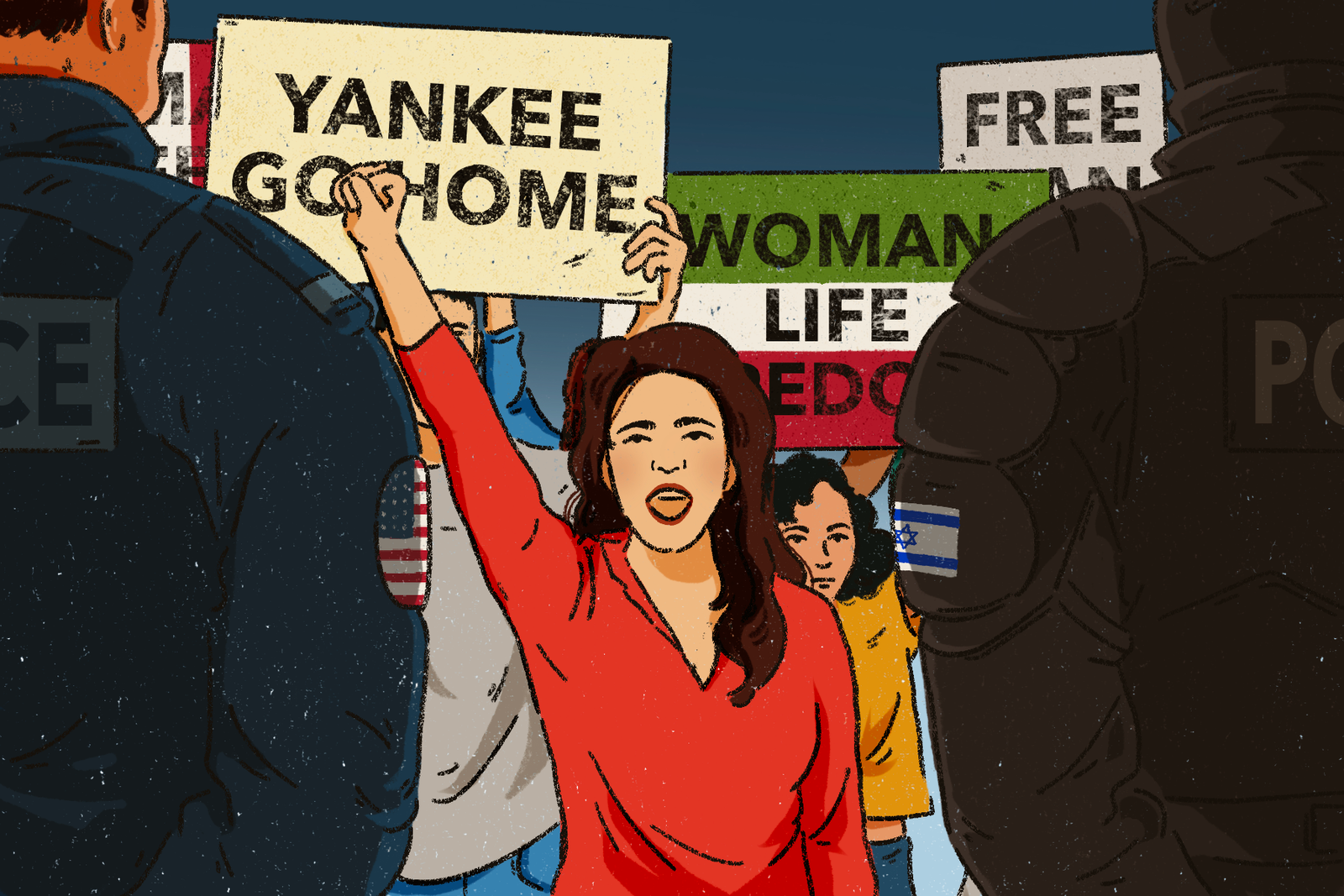
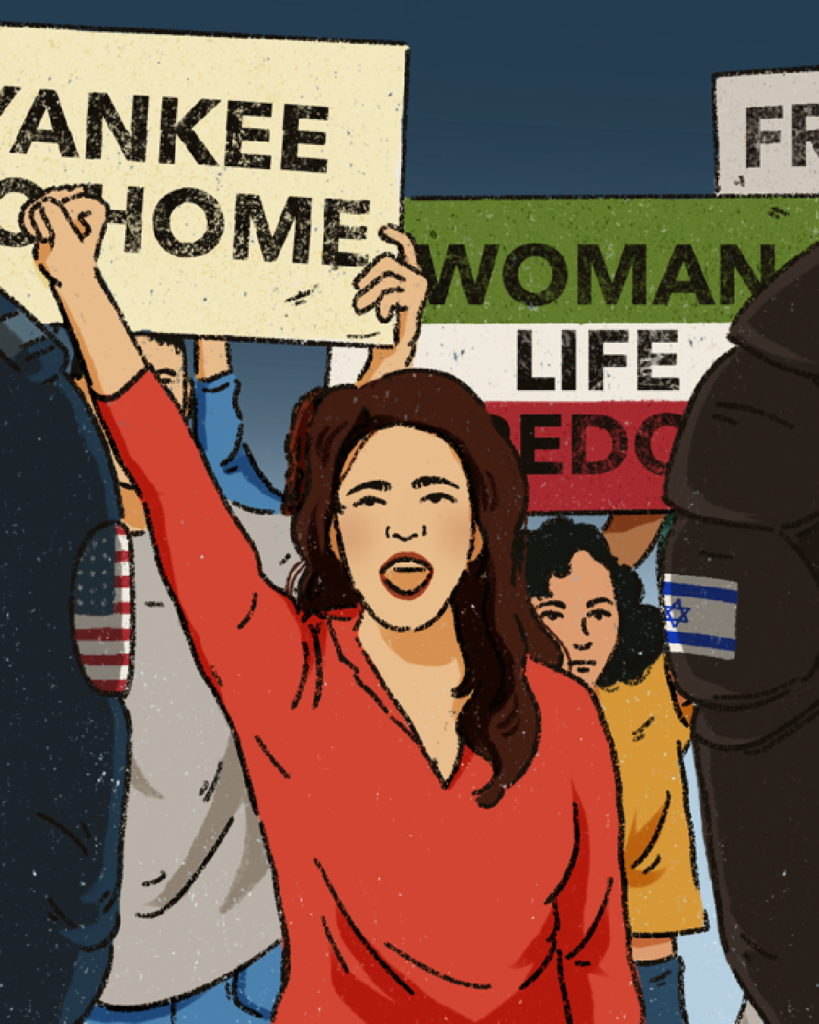 Illustration by @heedayahlockman who says: “This illustration captures the ‘Woman, Life, Freedom’ movement’s struggle for autonomy. It frames defiant protesters between the looming silhouettes of U.S. and Israeli authority, visualising a fight for a future free from domestic oppression and foreign interference. It’s a testament to a people demanding a path written by their own voices, not by outside agendas.”