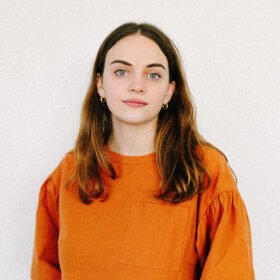
I moved to Barcelona in late September 2023, just a few weeks before the genocide in Gaza began. I walked many streets of the city for the first time during marches, and some of the first Catalan words I learned were through chants and placards. I forged friendships during actions, encampments, talks, and fundraisers. For me, moving to this city and activism for Palestine have been intertwined.
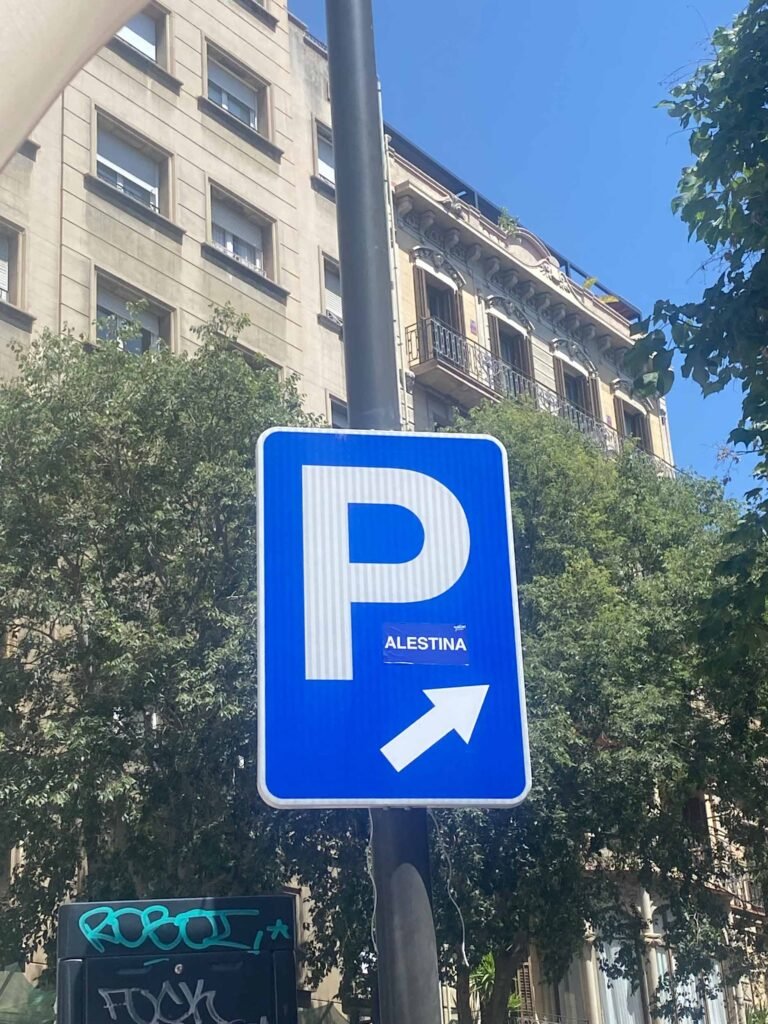
As I navigated new streets, symbols of Palestinian solidarity appeared wherever I looked. I found myself taking photos of them: my phone filling up with flags on balconies, graffiti scrawled on walls, stickers layered on lampposts. I was drawn to these everyday, creative ways people were sewing solidarity into the urban fabric.
I had moved to Barcelona to begin a Master’s in Political Ecology, Degrowth & Environmental Justice, after nearly a decade of working in the creative industry. Like many of us, I was wrestling with questions of what meaningful solidarity with Palestine looks like – and when it came time to start a final research project, I became curious about the role these visual expressions of solidarity play within the broader ecosystem of resistance.
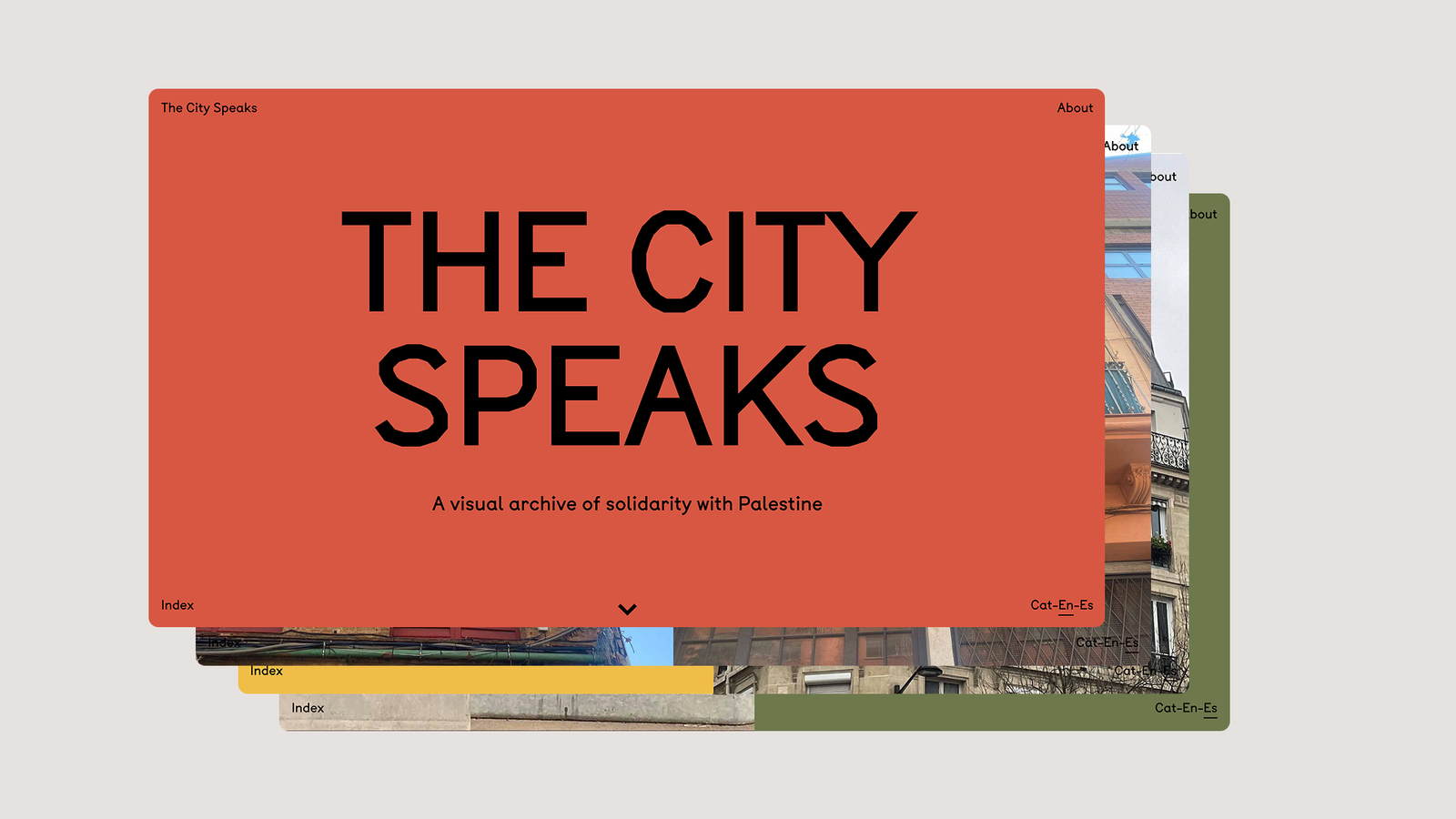
This curiosity led to the creation of The City Speaks, a growing digital archive of images of Palestinian solidarity in Barcelona that I designed and launched in March 2025 with the help of developer Rifke Sadleir. Scrolling through, viewers explore images side-by-side, giving a feel for Barcelona’s layered urban landscape and evoking the experience of wandering its streets. Building the archive has been a way to engage with the city as a newcomer – a collective process with local contributors whose voices are throughout the archive, helping explore how visual solidarity shapes both the places we live and our collective resistance.
The complexity of symbols and resistance
Wearing a pin or hanging a flag is an accessible, everyday way to show support for Palestine. Visual solidarity has long been central to movement-building, and in the case of Palestine, symbols are heightened as sites of conflict. The keffiyeh, the flag, the map, the watermelon, the key, the poppies – these hold generations of meaning and have resisted steadfastly in the face of erasure, policing and bans. But the power of visual acts of solidarity is contested.
Writing for Dazed in April 2025, Salma Mousa questioned whether symbols of Palestinian solidarity are merely “soothing guilt, barely changing nothing,” asserting that the keffiyeh has been commercialised, desensitised, and depoliticised. This isn’t a new concern. Back in 1981, cultural theorist Stuart Hall warned that “this year’s radical symbol or slogan will be neutralised into next year’s fashion.”
The City Speaks was formed in a rapidly changing context. In some ways, a cultural shift has been taking place – complicit businesses have had to close their doors, major cultural figures have spoken out, and the tide of public opinion appears to be turning. Yet even with the latest ceasefire, justice is far off: Gaza lies in ruins, the death toll exceeds 64,000, and settler attacks continue daily across the occupied West Bank.
In the face of genocide and decades of occupation, symbolic gestures can feel painfully inadequate. But as patience for empty gestures wears thin, the machinery of state power doubles down on repression of even symbolic actions. This is no better exemplified than by the UK’s decision to proscribe Palestine Action as a terror organisation, with hundreds of people arrested for simply holding signs reading “I oppose genocide, I support Palestine Action.”
Given this, instead of dismissing acts of visual solidarity as mere performance or embracing them uncritically, perhaps we can understand them as part of a web of solidarity practices – as a connector, a reminder, a disruptor and more.
So what does visual solidarity actually do?
To find this out, I used the solidarity networks I’d become part of in Barcelona, sending a call-out inviting people to join me in building the archive. The idea was simple: people would contribute photos they took in their daily lives, and then we’d sit down to have a conversation about what those images meant to them. I was moved by the response – people from all kinds of backgrounds reached out, each connected to the cause in their own way: marches, direct action, boycotts, fundraisers, encampments, murals, and more.
One of those people was Mona, a Palestinian woman who has lived in Spain for the last five years. We meet up in a bookshop cafe, and over coffee she shared how seeing these symbols helps her overcome the disconnection of living far from Palestine. “You might be having a shitty day,“ she says. “You just saw the news, saw something horrible again – and you take a walk to get some fresh air. And you see stuff like this, and you feel more connected.” She was not the only person to mention that seeing symbols in the city made them feel less alone; like they’re not the only one, that they’re part of something bigger.
In a hostile climate, symbols can take on the role of care. I meet Ana, who lives in Raval with their family, through attending some of the same Palestine-related events. Living on the second floor makes their balcony visible from the street, so they put up a flag with the help of their two-year-old nephew. Showing me the picture of it, they explain that a new Palestinian neighbour introduced herself after seeing it, demonstrating how a flag can foster safety and solidarity for those in our local communities.
Others spoke about how these images do more than comfort, they keep momentum alive when the international solidarity movement fluctuates. “It is a constant reminder that something has happened, it serves as a reminder to keep doing things,” Mona says.
After some kind of fresh horror, there is a news surge and the protests grow. Other times, it feels energy is waning, that the genocide becomes a backdrop to people’s everyday lives. In the face of this, we must hold onto the things that power our steadfastness, and many described how seeing a symbol of Palestinian solidarity, even briefly, catches your attention and brings you back to the cause.
Zara, a recent newcomer to Barcelona who moved to study the same course as me and was active in Palestinian organising back home, describes it beautifully as “a promise” – by wearing or displaying a symbol, you hold yourself accountable to do more: to boycott, to organise, to protest.
José is a local artist who paints pro-Palestine murals across the city, and we were introduced by a mutual friend I’d met when wheatpasting posters promoting a demonstration. “The city doesn’t have an algorithm,” he tells me over a call, explaining that his motivation to put things into the streets is to reach beyond his bubble. A few collaborators noted that while social media has been helpful for sharing information and organising, there is a surreal disconnect to consuming deeply distressing content in between adverts and social updates. And as Zara notes: “social media is always so fleeting, right? Something awful happens and there’s this quick flurry of reactions. But in the city, you’re establishing this is who we are, as a neighbourhood, as a street.”
This disruption of public space has a powerful effect on the city. Barcelona was described to me as a place with a different standard, somewhere that wears its political hearts on its sleeve. However, the city is under pressure from forces of capitalism, overtourism and gentrification – forces that are reshaping urban spaces all around the world. Rene Boer calls this the ‘Smooth City’ – spaces that are increasingly stripped of local identity in favour of a uniform, commercial aesthetic.
Symbols of solidarity push back against this, with Zara noting that through looking out for them she could see “what is a hotel and what is where people are living.” Meanwhile, Ana points out that older parts of the city have more signs of life on balconies, “whereas in newer buildings it all just feels a lot more sanitised.” By expressing themselves on streets and balconies, people help resist the depoliticisation of urban spaces, a process that makes cities more commercially palatable.
In 2014, Ali Abunimah wrote that “the battle for justice in Palestine is and has always been, first and foremost, a battle of ideas.” This was echoed in all my conversations, each peppered with terms like ‘propaganda battle’, ‘cultural fight’ or ‘discursive fight’. Israel has a well-funded narrative that dominates media and political discourse, dehumanising the Palestinian people and portraying Israel as a victim entitled to the land at any cost. By putting Palestinian symbols into the city, we create small cracks in this narrative – reminding us of the mass movement of people who do know Palestine must be free.
Join our mailing list
Sign up for shado's picks of the week! Dropping in your inbox every Friday, we share news from inside shado + out, plus job listings, event recommendations and actions ✊
Sign up for shado's picks of the week! Dropping in your inbox every Friday, we share news from inside shado + out, plus job listings, event recommendations and actions ✊
There is an added resonance in placing symbols of Palestinian solidarity across cities in the Global North. Lea, who grew up in London in a Jamaican family and has lived in Barcelona for the past decade, voiced her anger at the governments propping up and funding the genocide. “It’s the same countries letting it happen who are the ones who colonised the rest of the world,” she tells me despairingly over a coffee near her home in Poble Sec. In this way, such symbols become reminders of interconnectedness, reflecting the ties between the struggle for Palestinian liberation and movements against colonialism and imperialism worldwide.
The power of an archive
Historically, archives have been tools of control, determining whose stories get preserved and whose get erased. This project follows in a history of radical archiving practices, which help subversive counter-narratives to be remembered. I was particularly inspired by projects that broadened my understanding of what an archive could be, such as Queering The Map, a community-generated counter-map of LGBTQIA+ memories. Projects like these demonstrate how archives can take different forms beyond the stereotypical image of dusty rooms of cabinets – as creative, layered and participatory forms of alternative documentation.
As The City Speaks grew with the contributions of those involved in the project, I was struck by all the creative ways people were taking the city into their own hands. As you’d expect there are many flags hung on balconies, from street level to the highest floors. Messages vary from quickly scrawled words to a detailed mural that has taken hours. Calls for freedom are echoed in Catalan, Spanish, Arabic, English. They show up on windows, balconies, walls, lamp posts, bins, traffic signs, pavement slabs, trees.
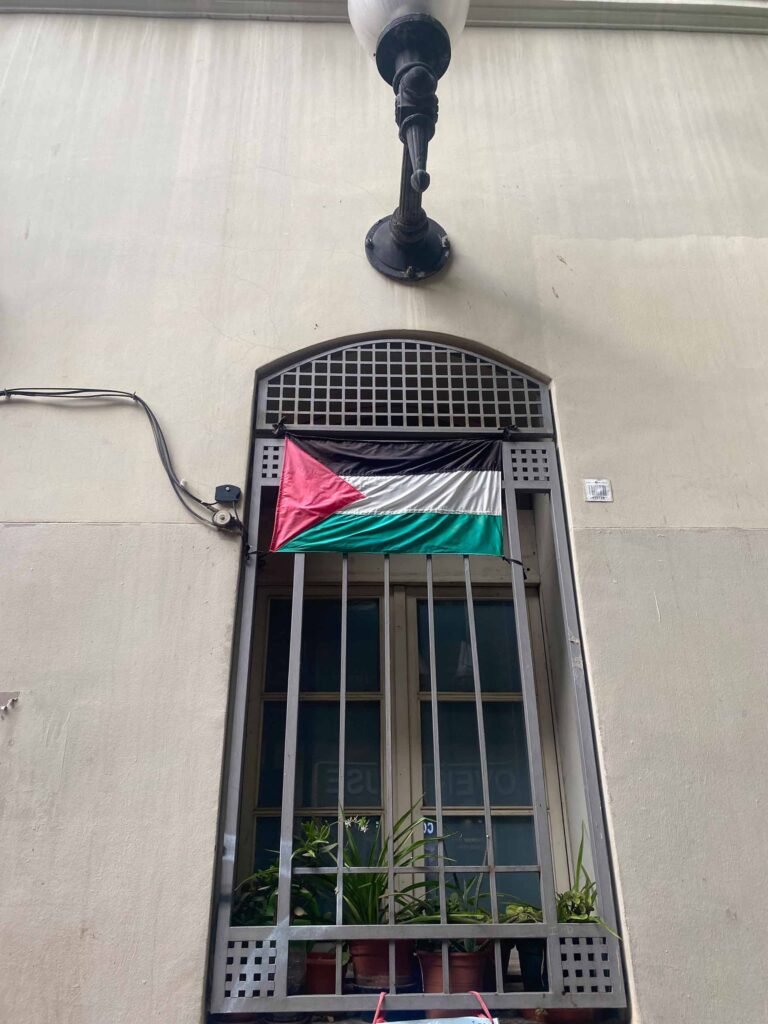
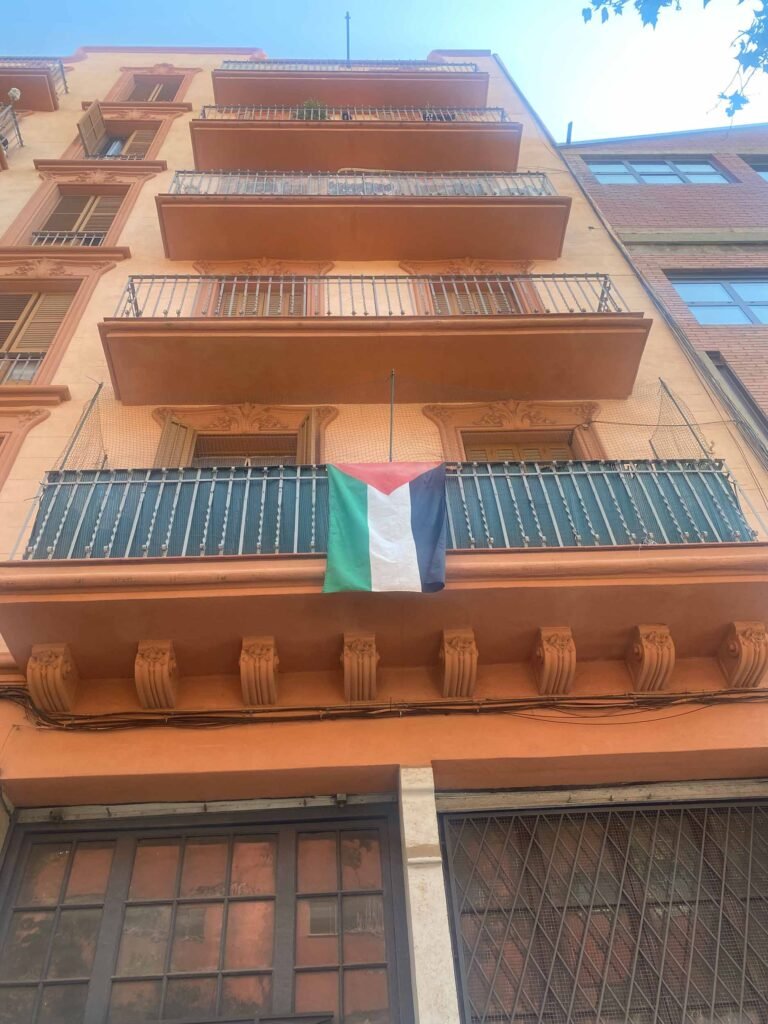
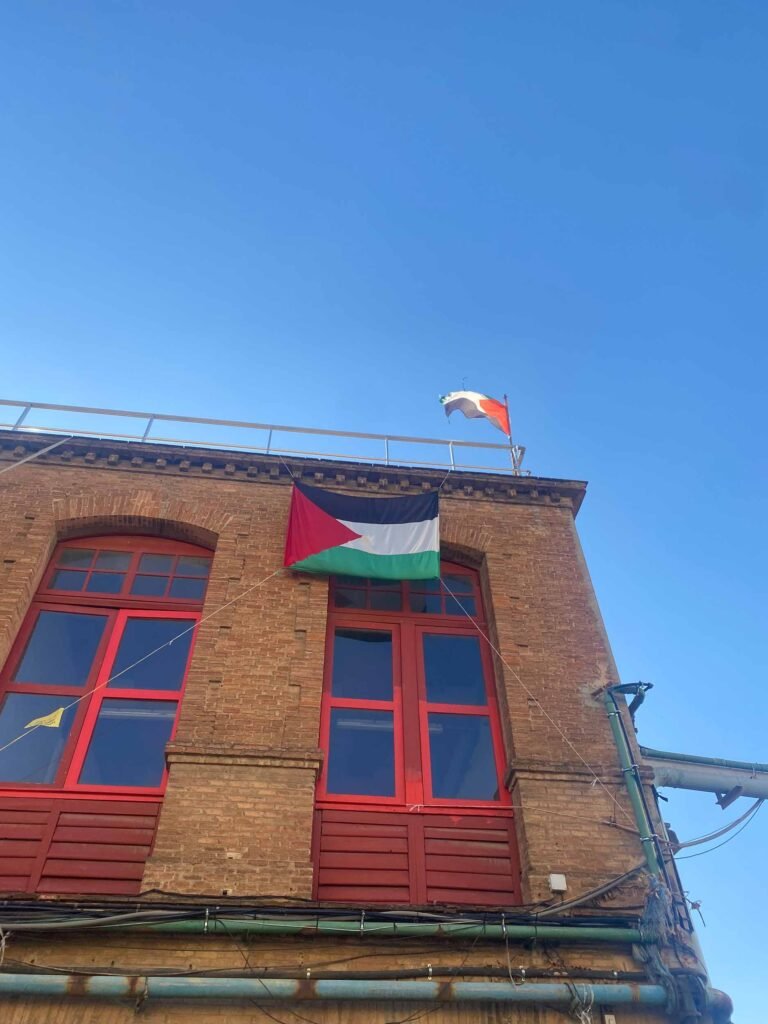
These expressions often disappear – worn away by time, weather, street cleaners or people moving house – and this temporal nature invites archiving. Every time I saw that a flag I had taken a photo of was no longer there, the importance of the project strengthened for me.
But why does having evidence of these matter? Because we see time and time again how history is rewritten. When justice is won and Palestine is free, records like this can be evidence that it happened not because of benevolent leaders but because of collective pressure – ordinary people who organised, marched, striked, got arrested, broke relationships, and refused to stay silent. Archiving is a way of saying: this mattered.
Solidarity is the start
So while symbols of solidarity clearly hold power, the tension still remains that they can lose meaning through overuse, depoliticisation, or co-option. Many collaborators shared this discomfort, struggling to define the line between performative and meaningful action. But people kept coming back to the idea that maybe with Palestine, it’s different. “When you say I’m going to wear a keffiyeh or I’m going to put up a flag, you’re setting yourself up for potential judgement,” says Nico, a fellow student I met during the nights spent at the encampments in Barcelona universities in June 2024. Even if someone adorns symbols for performative reasons, he argued they would be inevitably politicised through having to confront any criticisms that come their way.
Ultimately, to resist performativity, we must return to the idea of these acts as promises. They are not enough alone, concrete action must follow – protesting, boycotting, organising, campaigning. As Sara Greavu writes: “solidarity is the start of something, not the product.”
While no sticker or flag will stop the bombs falling on Gaza, my conversations have shown me what power these expressions do have in keeping the cause visible in the everyday fabric of our cities. In Barcelona and beyond, the city speaks. The question we’re left with is if we listen, and more importantly, if we act on what it’s telling us.
I now experience the city differently: I look up and look closer at all the ways people reclaim public space. As Mona says: “Sometimes I see the combination of the colours of the flag somewhere, but then it’s not. It’s a girl wearing black pants, a red bag, and a green scarf.” That started happening to me too. I see Palestine everywhere – a constant reminder of the cause, and of my commitment to it.
People’s names have been changed to protect privacy.
What can you do?
If you live in Barcelona:
- Submit an image to the-city-speaks.com
- Join a local action group such as the Boicot Carrefour campaign
Wherever you live:
- Explore the Palestine Poster Project for visual inspiration of Palestinian resistance throughout history
- Read some of the books and articles that inspired this project:
- Think about how you can take the city into your hands in solidarity with Palestine, whether through displaying something in your home or wheatpasting posters – and then don’t stop there!
- Read more shado articles on Palestine