After an evening of excellent Nigerian cinema, a friend and I finally found a pub in Brixton quiet enough to hear ourselves think. We order a pint each and eagerly start my favourite pub pastime: analysing media. Our conversation drifts, as it often does, until there is a small pause, when my friend asks, “so hey, what does Afrofuturism actually mean?”
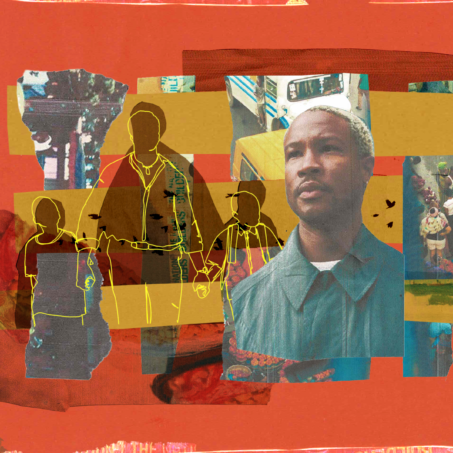
It’s a fair question, because earlier that evening, at the advance screening of In My Father’s Shadow hosted by We Are Parable, I had raised my hand and asked, very excitedly: since the film has an all Black cast, and plays in the imagination and memory sandpit, would this count as Afrofuturism? I remember the filmmaker, Akinola Davies Jr, smiling and saying it was a very good question, which is both reassuring and deeply unhelpful when you later have to explain yourself in a pub after two beers and a joint.
I explain that Afrofuturism is a cultural and artistic framework that uses speculative fiction, fantasy, sci-fi, and alternative histories to explore Black futures, Black pasts, and Black possibility.
Afrofuturism expresses notions of Black identity, agency and freedom through art, creative works and activism that envision liberated futures for Black life. They still look confused, so I try to search for examples they would know. I can’t remember the name, but through my stoned memory I am able to describe enough of the insane plot (telemarketing, labour, capitalism, and literal horse people) for them to ask, with an eyebrow raised, “wait, are you talking about Sorry to Bother You?”
The predictable pushback against inclusive media
Historical inaccuracy has long been manna to nitpickers in fantasy. Online kingdoms are constant battles of heckling the writers, the costume designers, and sometimes even the actors themselves. Racists, in particular, love to be upset about a minority playing a main historical character, as though we only spawned into existence in the 1990s.
Horrible Histories recently had a Victorian-era sketch featuring a Black policeman, much to the chagrin of racists who for some reason are still watching a children’s show. Wiki links about John Kent, Britain’s first Black police officer (who joined in 1835 in Carlisle), or Robert Branford are ironically met with, “wow, you found ONE black policeman, that doesn’t prove anything!” This is why I’m increasingly of the opinion that no fruitful or good-faith conversation can be found online, and especially not on X. Save yourself and never engage.
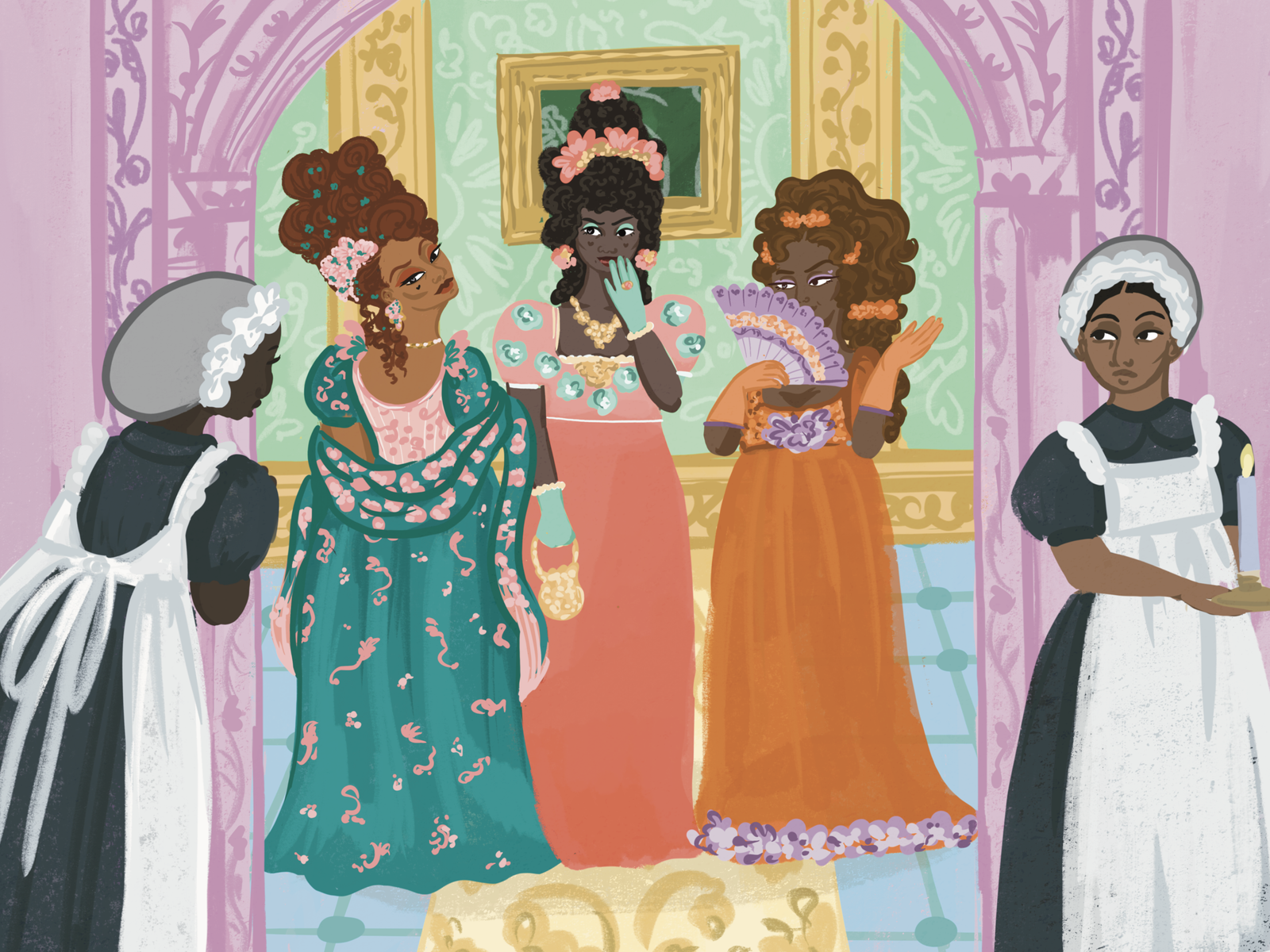
This sort of discourse is never-ending for Bridgerton, now on its fourth season, with detractors resurfacing every year to complain about how deeply “unrealistic” it would be to have nobles of colour freely mixing with the white aristocracy.
But Bridgerton does acknowledge the race issue, kind of. Effectively we can understand that Bridgerton exists in an alternate historical reality in which a large swathe of Black upper class were ‘accepted’ into the very white aristocracy that takes place in Julia Quinn’s universe, later expanded by Shonda Rhimes. It is not “colour blind” per se, but more so colour conscious. In the spin-off Queen Charlotte, we see that racism isn’t non-existent. The world we meet in Bridgerton is an alternate history, similar to our own world, and the acceptance of Black nobility is tied to Queen Charlotte’s marriage. And it was conditional for a full generation and still depended on class being inheritable.
The limits of mainstream Black imagination on screen
The issue with this is all the times we touch the limits of Shonda’s universe. The most recent first half of the fourth season (streaming schedules are getting crazy and we need to discuss that) reveals this conflict with Eloise. A feminist of her time, who doesn’t want to marry but she will because it’s expected for women of her class and status in society. She has no trade or money of her own, and is completely reliant on her (okay benevolent) older brother who is head of the household, even over her own mother.
Because the basic plot of the show is the upper class daughters and sons in the Bridgerton family needing to find “suitable” marriages, the fact that they all find a ‘love match’ is the twist we all see coming. Inevitably, Eloise will marry, though the plot hasn’t got there yet. The story relies on a society where women don’t generally have their own wealth and where maintaining your social class is of paramount importance.
By contrast, race has no real role in the mechanics of the plot, with each season bar one resulting in a wealthy and upper class interracial couple.
Fans are, and maybe rightly, asking if we can imagine a better world in some ways, why can’t we do it for all the ways? Why must we settle for pittance? And therein lies the problem with an inconsistent ideology. But we always knew this of the Shondaverse – she wrote Scandal for heaven’s sake where Kerry Washington has a nearly decades long affair with the Republican president!
Then is this much analytical thinking for a historical romance somewhat silly? I get it, but complex thought experiments are interesting. Grow some curiosity. Or at the very least don’t begrudge the rest of us who want to interrogate what we are watching. Questioning the media we consume will always be a net positive to society. So stay with me.
Unpicking the politics of regency fan-fiction
Bridgerton firmly seats itself in the romance genre but most importantly it’s fantasy. Fantasy’s very nature is about imagining new worlds. Which has always raised the question for me on why white audiences can imagine dragons and orcs but a Black elf is treated like mutiny to J. R. R. Tolkien’s memory. There is an argument to be made that fantasy, especially romantic fantasy with imaginary historical Black characters, is playing into the Afrofuturist genre..
Nearly three decades have passed since the cultural critic Mark Dery coined the term “Afrofuturism,” asking the question: “Can a community whose past has been deliberately rubbed out, and whose energies have subsequently been consumed by the search for legible traces of its history, imagine possible futures?” Speculative fiction is a powerful force for re-imagining society and I can’t help but think about Black Panther.
Because of Afrofuturism’s wide influences in fashion, music, the visual arts, technology, and science fiction, it has perhaps been most recognisably mainstreamed through Ryan Coogler’s 2018 blockbuster, starring the late Chadwick Boseman as T’Challa in the first Marvel film to host a mostly Black cast.
Wakanda, as a concept, is Afrofuturist: an uncolonised African nation, technologically advanced, culturally rich, and politically complex. It asks the question: what if African nations had developed without extraction, invasion, and imposed underdevelopment? What if tradition and innovation were not framed as opposites, but as collaborators?
Despite this categorisation, I’m still resistant to call Bridgerton an Afrofuturist story. Maybe it’s just alternate history, and that’s okay. By contrast, Boots Riley and even Spike Lee, for all my own criticisms, consistently situate Black characters in tension with power rather than comfortably inside it. Their films often ask who benefits from a system, who is marginalised by it, and what resistance looks like within that structure. There is an insistence on confrontation, on friction, on political stakes.
But even there, there are limits. I’m not always convinced Spike Lee writes fully rounded Black women characters with the same depth afforded to his male protagonists, which complicates the idea that oppositional storytelling (or counter-storytelling, a narrative method used by marginalised groups to challenge, subvert, and dismantle dominant, mainstream, or “majoritarian” stories) is inherently complete storytelling. Challenging power in one dimension does not automatically mean escaping its blind spots in another.
If we understand sci-fi to be speculative worldbuilding, then the TV show is bending reality to ask what if. It is an alternate timeline dressed as Regency romance and for those reasons alone, we can say Bridgerton is speculative fiction. Race, and thus racism, is acknowledged in Bridgerton, but class, marriage, lineage, and inheritance – and therefore power – remain the true plot engines of the story. The show imagines racial integration at the very top of society while preserving the same patriarchal and class constraints that shaped the real Regency era.
Join our mailing list
Sign up for shado's picks of the week! Dropping in your inbox every Friday, we share news from inside shado + out, plus job listings, event recommendations and actions ✊
Sign up for shado's picks of the week! Dropping in your inbox every Friday, we share news from inside shado + out, plus job listings, event recommendations and actions ✊
I’m sorry, but revolution does not begin with a light-skinned Black queen. But hey, I do love the Regency-inspired Afro wigs. They’re designed by the show’s hair and makeup team led by Nic Collins, whose work deliberately blends period styling with Afro-textured hair to signal that this is, unmistakably, a fantasy world rather than a strict historical reconstruction.
The real Afrofuturist question: is it that deep?
It is important to note that Bridgerton does not take itself seriously. It gleefully plays in the absurd with the Cinderella plotline this season. Benedict is looking for the Silver Lady, aka Sophie Baek played by the beautiful Yerin Ha who is very obviously Asian. However, we still see Benedict search through a truly diverse cast of ladies to try and find her. Hey, he’s a true colour blind ally!
There is something rather romantic, and almost maybe radical, when you realise that the true love story within the story playing out in Bridgerton is actually between the Queen and Lady Danbury. Two Black women of status stuck together at the top of the hierarchy by social convention, tied to one another in a more real marriage than each had to their own husbands. Could we argue that this is Afrofuturism? Perhaps, that is, if you understand Afrofuturism in its loosest, most emotional sense.
I don’t know, for me Afrofuturism is not just about inserting Black faces into existing power structures. It should be about challenging those structures entirely. Interrogating time, power, memory, and possibility. Bridgerton, by contrast, reimagines who gets to exist within aristocracy, but not whether aristocracy itself should exist.
I spoke to Alex, a long-time Bridgerton fan, who rightly says, “the nobles of all shades and backgrounds can either pay their fair share in taxes or get the guillotine!” I laughed and heartily agreed. She went on to add, “to me it’s a kind of fantasy, turn-your-brain-off series… at least the diversity and hyper-colourful textiles and decadence remind me that it’s all just for fun […] in a reality that never really happened. It’s just a fantasy and we’re all invited.”
Khadijia, another fan, offered a more pointed critique. “It’s a shame,” they noted, “because the show has the opportunity to explore where these African nobles come from and it never really does. There are very few elements of African culture in the show. The moment these Black characters interact with white nobles, they are effectively required to assimilate into a white society and culture.”
Is it actually progressive to reimagine society, but simply with more of us positioned on the other side of it? As Alex put it, “the idea that it’s [Afro]futuristic to have a diverse wealthy class while there is a diverse working/slave class is not progressive at all. I do not care if the elites are queer, women, or transcend borders; it is just rebranding inequality.”
Every imaginative framework has its constraints. Alternate history, Afrofuturism, political cinema, romantic fantasy – each opens certain doors while quietly closing others. The question is less whether a text fits neatly into a label, and more what kind of world it is willing to imagine, and for whom.
So is Bridgerton Afrofuturist fantasy? Is [pop star] a feminist? Is MasterCard a queer ally? Is this TV show my friend? No, dearest gentle reader, in my humble opinion I don’t think Brigerton is Afrofuturist. It is however escapism of the highest order with very beautiful gowns.
What can you do?
Read:
- Parable of the Sower (Octavia E. Butler): The definitive afrofuturism and dystopian story following a young woman navigating a climate-ravaged, crumbling America. For more fiction book recs see this list!
- Check out Filmmaker Boots Riley’s catalogue and read this chapter from the The Routledge Handbook of CoFuturisms that frames Sorry to Bother You as an Afrofuturist vision of Black, disabled revolt against capitalism.
Watch:
- Robots of Brixton (2011): A short film by Kibwe Tavares portraying a dystopian future with robot riots.
- Black to Techno (2019): Jenn Nkiru’s short film exploring the Afrofuturist roots of Detroit techno music.
- Dark Matter: A History of the Afrofuture (2021): BBC series investigating Afrofuturism in music, from jazz to UK jungle. (Last broadcast in 2022: currently hard to locate online, but not impossible to find with a little digging)
- Read more articles by Fopé HERE
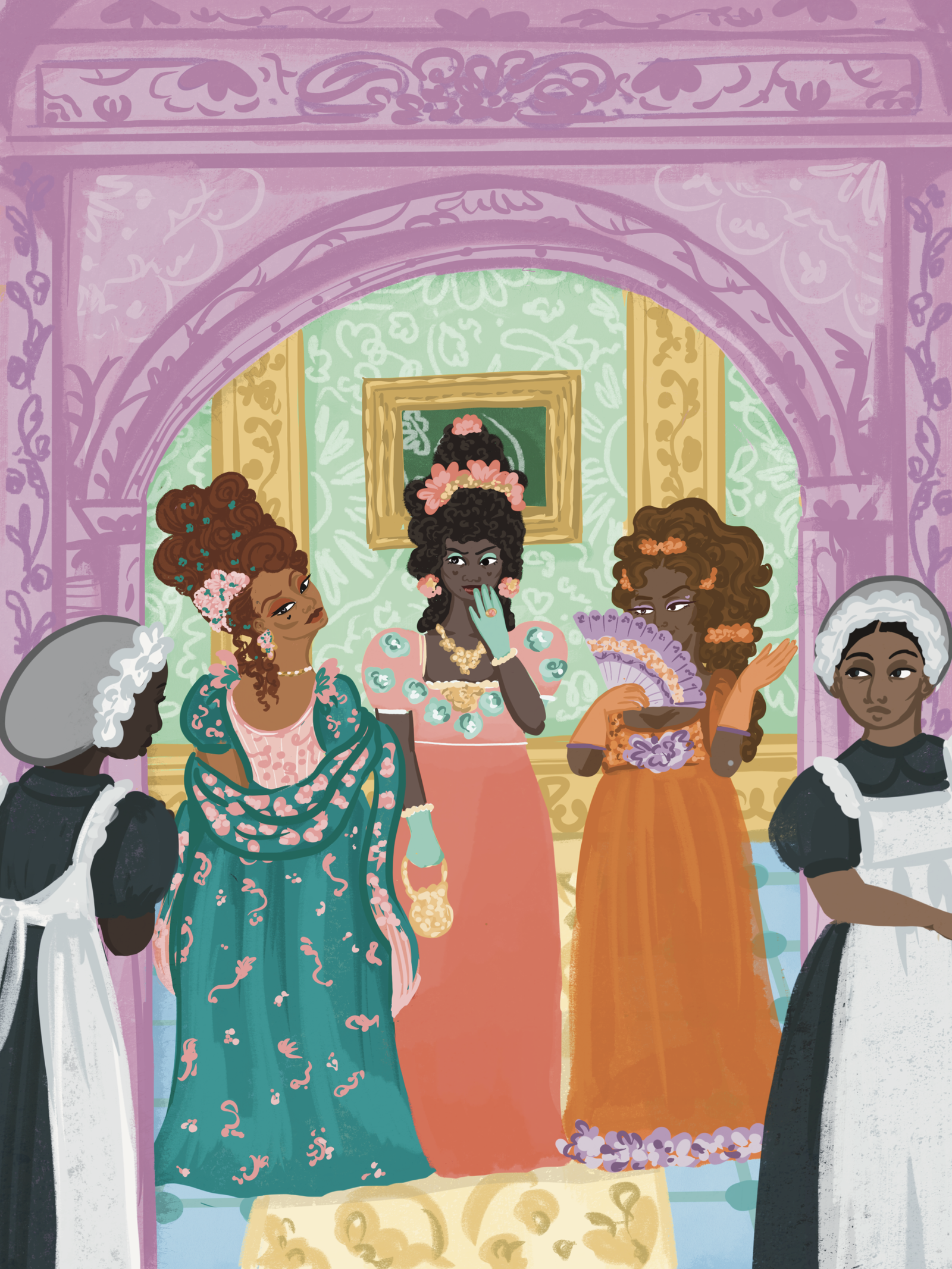 Illustration by Tinuke Fagborun @tinuke.Illustration