
At some point during the editing process of this article, I was asked to introduce myself to the reader – who may not be aware I am shado’s new Contributing Culture Editor (!) – before getting into the nitty-gritty of gender-critical ‘feminism’. It’s easy to feel, as a trans writer, that you have to be constantly reflecting on the prejudice you face. After diving deep into the murky legal waters of two very significant cases, it was nice to be reminded that I am a person with many different things to say. In fact, if you compiled a list of all my writing, you’d see I have a wide range of interests, including subjects such as fame and femininity, the evolving landscape of Berlin’s club scene, race and identity in fiction, and antisemitism in politics. Through my work at shado, I plan on writing more essays on pop culture, too.
Still, I consider writing to be a seamless craft for a trans person. To become skilled at writing is to show the world in a different light, to utter your truth until the world listens. I often can’t help but feel that even when I am not explicitly writing about transness, it’s somehow there – a quiet force that hums on the page.
Each word I have already written, and all the words I plan to write, are in some way shaped, therefore, by the conditions that prevent trans women from being able to speak their truth. The essay below describes two key events that offer, in my mind, two of the clearest examples of this political suppression: how transphobia is about challenging the legitimacy of our perspectives and, ultimately, our presence.
Writing is in itself a political act. I’m so excited to have the opportunity to share mine with you.
One.
It might sound like an obvious thing to say, but gender-critical campaigning has shifted our approach to the word ‘trans.’ We have the case of Sandie Peggie, for instance, a nurse who objected to using the same changing room as her trans colleague, Dr Beth Upton. Last month, after the Judgment of the Tribunal received its second amendment, the BBC described it as the ‘trans doctor row’. Similarly, three years ago, a second dispute emerged between nurses and a trans employee at a hospital in Darlington, cynically summarised in a recent article by The Guardian as the ‘trans complaint’.
Two.
Both headlines make clear that a trans person had some part in a social, and eventually legal, conflict; however, the judgments of both tribunals make clear that this was a consequence of them merely existing, of using the spaces they were legally permitted at the time. Less discernible in the newspapers’ headlines is the specific actions of the trans women that caused the nurses to complain, as well as who, or what, their complaints were primarily directed at.
Three.
In each headline, ‘trans’ is meant as a crude label: an adjective for describing a particular moment in which a familiar wrongdoing, conflict, or injustice occurred, and could occur again. ‘Trans’ no longer solely denotes an identity; it hasn’t perhaps since our culture shifted from the optimism of the ‘transgender tipping point’ to our politicisation as a result of ‘the trans issue’. ‘Trans’ now denotes an act of transgression. But who, in these instances, is often making the transgression according to law? And who is the aggressor?
Four.
When Sandy Peggie took her employer, the NHS Fife Health Board, to a tribunal, she claimed that both Upton and the organisation she worked for at the time harassed her. The tribunal ruled that her claim regarding the behaviour of the Board was indeed founded: the claimant was, according to the law, harassed by her employer. One of the reasons for the decision was that they “[failed] to revoke the grant of permission” to Upton to use the female staff changing room while Peggie was on site.
As for the claim that the nurse was harassed by her trans colleague, this was dismissed “on one rather simple basis” – she had, whether or not it was legal, been “given permission” to use the facility. This outcome bears similarity to the judgment regarding the Darlington nurses’ case: the tribunal ruled that their employer, County Durham and Darlington NHS Foundation Trust, should be held accountable for harassment as a result of their Transition in the Workplace Policy, which allowed trans employees to use the changing rooms designated for their chosen genders. Apparently, the policy created for the nurses “a hostile and intimidating environment”. However, the claim that the trans practitioner involved in the case – Rose Henderson – engaged in misconduct was also dismissed.
Five.
Both rulings have been widely reported as either a win or a “partial win” for the nurses, focusing on their potential significance for employers. The nurse’s failure to accuse trans people of illegal behaviour in the workplace seems like less of an important note. Perhaps, then, the vagueness of something like a “trans complaint” or “row” serves as an invitation for the reader to assume the aggression of a trans individual, even if they do go on to learn, somewhere in the tail-end of the article, that no trans person had been found by a tribunal to have acted illegally; the nurses at Darlington Memorial Hospital claimed that Henderson stared at them in the changing room. This claim could not be proven. Sandie Peggie claimed that Upton sexually harassed her. This claim could not be proven. It is hypocritical of both tribunals to assert that an employer can be found guilty of misconduct for failing to protect its staff from a situation in which no misconduct between employees took place.
Six.
I find it stranger than fiction to live in a time when a judicial body can rule that an employer’s policy on gender – how it manages its spaces to facilitate an entire workforce – should be informed by a case in which no trans woman was found to have acted illegally. There is an obvious flaw to this logic, which is that, whether or not you believe the trans employees involved in the cases should be able to use female changing rooms, the point is that they did, and nothing happened. No one was hurt. Yet still, they are incorrectly presented as dangerous examples of what can happen if institutions fail women.
Seven.
But then, gender-critical complaint is not an appeal to rational thought. It is first and foremost about anxiety. And this begs the question, what is the use of reason in countering gender-critical ideology when the purpose of its cause is – it is becoming increasingly clear – to supersede logic, and replace it with a politics of fear and obsession?
In Black Skin, White Masks, political philosopher Franz Fanon reflects on the psychology of anti-Black racism, on Blackness as a phobic object: “For the object, naturally, need not be there, it is enough that somewhere it exists … [It is] is [already] endowed with evil intentions.”
What both the cases introduced by Peggie and the nurses at Darlington Memorial Hospital have confirmed is that it is legitimate by law to have a phobia of trans women: their presence alone is enough to make someone feel as if they have been exposed to someone they shouldn’t see, someone in the wrong place. And while the encounter itself might be benign, it can be understood as a form of latent harm that must be prevented before it is enacted.
Eight.
No trans employee in either case was found to have harassed anyone, but Peggie was. Peggie held a viewpoint – that trans women are men – that was protected by law. How she expressed that view, however, was not lawful. The nurse compared Upton to a male “rapist” and questioned her about the nature of her chromosomes, language that made Upton feel, understandably, “distressed”. The judge described Peggie’s cruel words as an “impermissible manifestation” of her belief.
Perhaps this speaks to the conundrum which gender-critical campaigners find themselves in: they might be legally entitled to their views; however, the more a view is based on anxiety, on feeling over fact, the harder it is to express that view respectably. Often, in cases where employees face repercussions for their gender-critical narratives, this distinction becomes murky, including in how it is reported by the media.
Take the case of Enoch Burke, for instance, an Irish school teacher who was dismissed after he refused to refer to a trans student by their new pronouns. Burke claimed he was being denied his religious rights. He was eventually arrested, in his words, as a result of “refusing to affirm transgender ideology”, a statement echoed in a viral article posting on X. In truth, Burke was imprisoned for trespassing and leading a “fanatical campaign” against the school. As a matter of fact, the teacher was free, stated the judge, “to proclaim his objections to transgenderism from the rooftops” – just as Peggie was permitted at her place of work.
Nine.
Complaint has – and justifiably so – become synonymous with feminist practice. It has been at the heart of feminist organising, from trade unions in the UK campaigning to make sexual harassment a form of workplace discrimination (and succeeding in 1986), to the role of whistleblowers in mainstream movements such as #MeToo. It is perhaps why some people are so eager to celebrate the so-called ‘victory’ of the nurses: they are women taking on their employers, forcing management to “listen” to them, to (cis) women in general.
The problem with this blanket association of complaint and feminism is that not all women yield the same power. There is often an imbalance of power between women, too, in the workforce, not just between women and patriarchy. Is it possible for there to be, as Sara Ahmed describes in her new book on the subject, a “hegemony of complaint”? Can we simply assume that the complaint of a female employee, purely on the basis of her being female, is motivated by a desire to disrupt power, rather than the urge to protect it? Was Peggie surprised to learn that she is not legally permitted to express her views in any manner she wants? Did she assume that her communication simply did not matter, that power would in the end be on her side?
Ten.
Wokeness, writes Ahmed, is something which is reacted to with “counter-complaint (a complaint about those minorities who complain)”. In their speech, it is certainly illuminating how close the nurses at Darlington Memorial Hospital tread to this line. The judgment of the case describes how, initially, Miss Hooper, one of the claimants, felt uneasy about raising her concerns about a trans woman using a female changing room because she was worried “she may be seen as bigoted or transphobic”, a feeling shared among some of the other nurses. After the staff did raise their concerns, they were asked to “broaden their views” – a comment which contributed to them being made to feel, shared one nurse, like “terrible” people.

Join our mailing list
Sign up for shado's picks of the week! Dropping in your inbox every Friday, we share news from inside shado + out, plus job listings, event recommendations and actions ✊
Sign up for shado's picks of the week! Dropping in your inbox every Friday, we share news from inside shado + out, plus job listings, event recommendations and actions ✊
You could say that the nurses felt cancelled, before and after they spoke, as a result of being asked to consider the role of equality and inclusion in the workplace. This is hardly a framework developed by the most powerless in society. What it does suggest is a frame of mind toward minority presence: a reactionary impulse to treat those who are fighting for a seat at the table as taking up space they do not deserve.
They’re coming for us all
The question of how to counteract gender-critical narratives in the workplace is becoming increasingly important. Anti-trans campaigners won’t stop at the legalisation of trans people’s exclusion; they are actively trying to make it illegal for organisations to be trans-inclusive. Last year, the UK Supreme Court ruled in favour, a gender-critical group, For Women Scotland, that “sex” in the Equality Act (2010) should refer to “biological sex” as opposed to someone’s gender identity. Since then, gender-critical campaigners have attempted to take organisations to court for allowing trans people to remain inclusive. In other words, transphobes aren’t just coming for trans people, they’re threatening their allies, too.
Still, you are anything but powerless, especially if you’re a cisgender woman. The intention of gender-critical complaint is to hurt trans people. They can’t do this, however, without disempowering all women. Criminalising trans-inclusion would remove the democratic right of cisgender women to choose to be in the company of trans people. There are organisations that are standing against this.
I have been moved by the women across at least 12 Women’s Institutes groups who decided that they would rather close than carry on running under transphobic rules. As more pressure mounts on organisations to exclude trans people, there are going to be moments when solidarity means sacrifice.
What can you do?
- Read: For trans women like me, the courts kickstarting a trans witch hunt in the workplace is a troubling sign of the times – a shameless plug, me for Glamour magazine.
- Read: ‘The Transgender Issue’ by Shon Faye
- Check out Out and Wild – a trans inclusive festival
- Follow and support:
-
- Trans Kids Deserve Better
- Not In Our Name (NION), a UK-based grassroots collective of cisgender women standing in solidarity with the trans community, refuse the notion that gender-critical beliefs represent the politics of all women. You can sign their petition here and help them reach their goal of 100,000 signatories.
- TransLucent is another brilliant organisation run by both trans people and our allies. Their mission is to advocate for the social acceptance and legal recognition of trans people. TransLucent has numerous experts in their fields who can help with the trans cause in specialist ways. You can donate here.
-
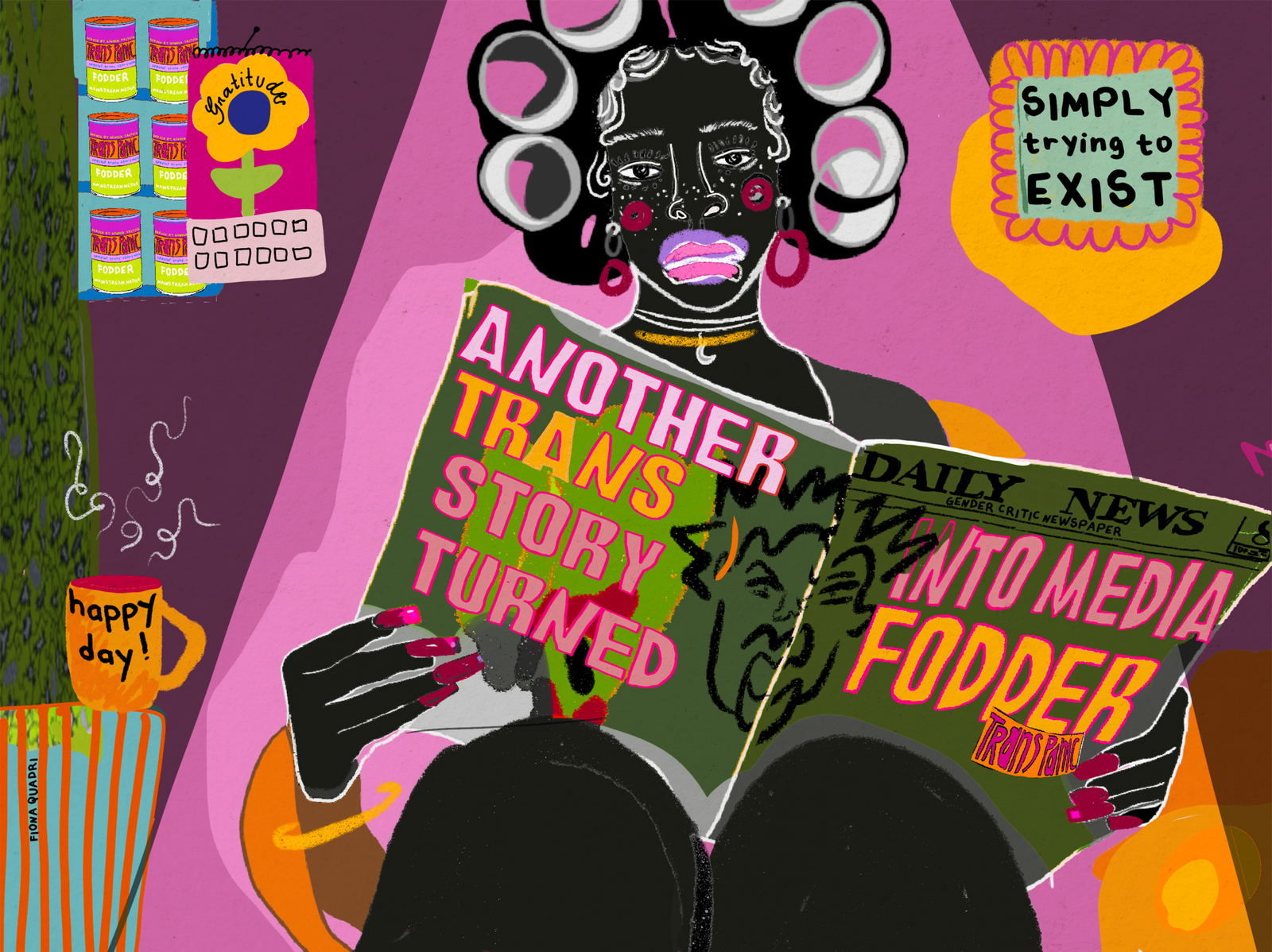
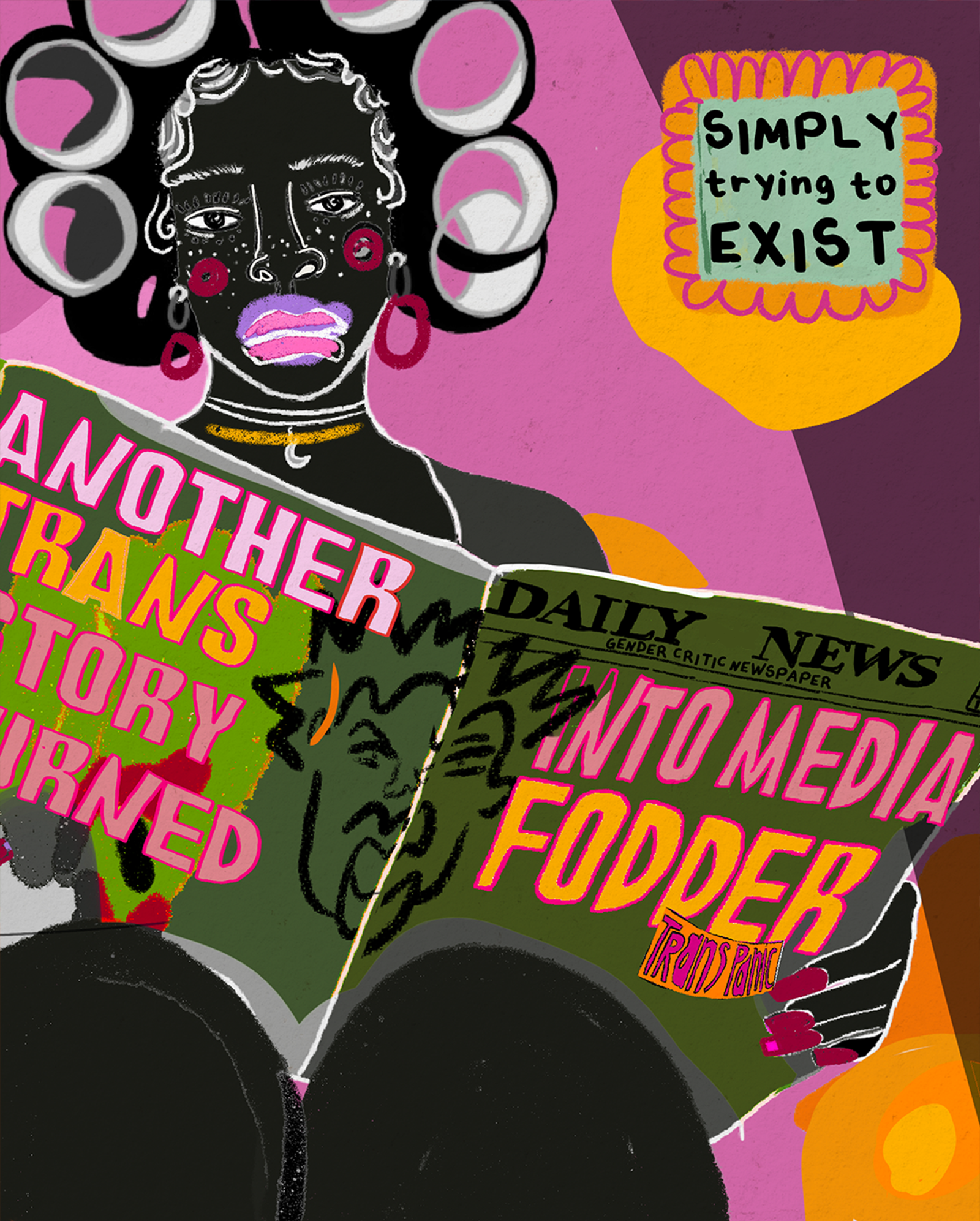 Illustration by @fioandfio who says: “This artwork responds to the way media narratives often frame trans people through panic and sensationalism. I depict a quiet domestic interior, presenting the home as a place of safety where someone can simply exist without being turned into a headline or public debate. Positive affirmations fill the room, hinting at the small acts of care and resilience that happen in private. In contrast, a newspaper enters the space with the headline “another trans story turned into media fodder,” symbolising how trans lives are simplified, sensationalised, and circulated for public consumption. A small tin labelled “trans panic; fodder” sits in the corner, reinforcing how these narratives are repeatedly packaged and reused by the media.”