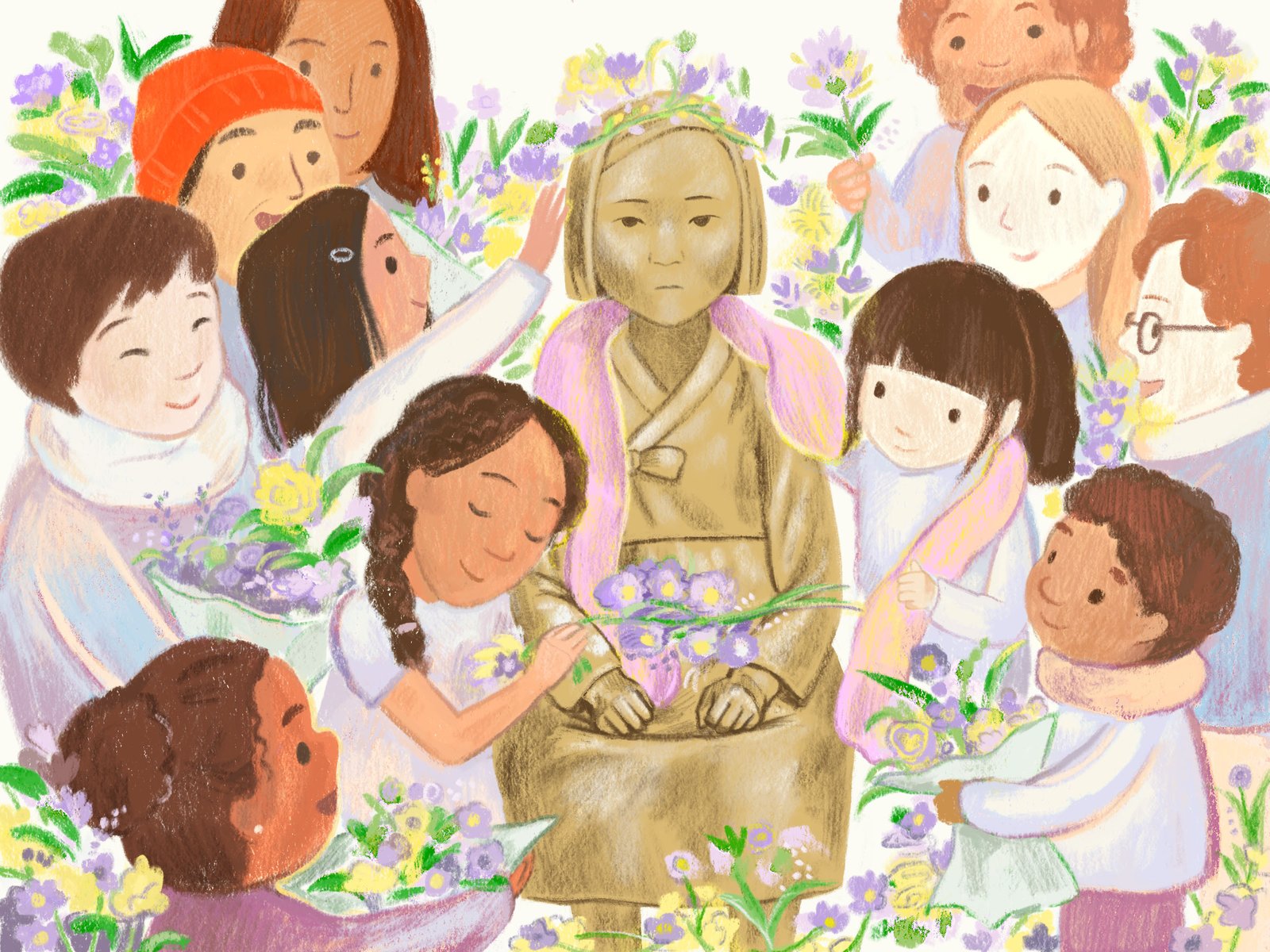
In late January of this year, Berlin-based migrants’ rights organisation Korea Verband posted a series of photographs on Instagram, which quickly went viral. As I flicked through them, one image particularly caught my eye: a typical, European, cobbled park, already dark and visibly freezing, yet filled with people queuing up to offer flowers to a bronze statue of a young girl in traditional Korean attire.
With her hair roughly cut and both her fists clenched tightly on her knees, the statue sits still beside an empty chair, gazing straight ahead, a look of determination carved into her face.
The statue is called the Statue of Peace, locally known as Ari (which means ‘courage’ in Armenian). She commemorates the victims and survivors of Imperial Japan’s sexual slavery, often referred to as the ‘comfort women’ system.
During the Asia-Pacific War, the Imperial Japanese military systematically abducted and raped women and underage girls from Japanese colonies and occupied territories. It is estimated around 200,000 people were forced into the ‘comfort women’ system. To date, the Japanese government has neglected to acknowledge its responsibility for the war crime or to offer official apologies and victim-centred reparation plans.
In 1991, Kim Hak-sun halmoni (halmoni means ‘grandmother’ in Korean) was one of the first women to publicly come out as a survivor of the ‘comfort women’ system, following Bae Bong-gi halmoni, who gave testimony in the 1970s. This inspired other survivors and their supporters to join her in the transnational anti-colonial feminist movements demanding justice for the victims.
As part of such efforts, the original statue was erected in 2011 in front of the Japanese embassy in Seoul. This movement quickly went beyond Korean borders, with more than a hundred subsequent memorials from Glendale to Berlin commemorating the ‘comfort women’ being built.
Ari was one such statue, unveiled in Berlin in 2020, but last October, she was forcibly evicted by order of the Mitte District Office. On 22nd January 2026, the statue finally found a new home, in a semi-public park near its original location, as the photograph captures.
Statue building as a method of community organising
When I saw the photograph on my feed, my heart leaped for joy. It was long-awaited news for many local grassroots organisers and international supporters alike. As a London-based community organiser from so-called ‘Japan’, the Berlin organisers’ continued and steadfast efforts to protect Ari was something I had always drawn inspiration from in my own organising.
A few weeks prior to the inauguration ceremony unveiling Ari’s new location, I visited Berlin to speak with local organisers. Through our conversations, I wanted to think through the potential of memorial-centred activism with them in a world where Indigenous groups and their histories are violently erased and forgotten in the present tense.
I chatted with Nataly at her office inside the Korea Verband’s Museum of Comfort Women. Serving as chair of Korea Verband, Nataly played a central role in installing the Statue of Peace in Berlin. She told me about the time when her team decided to display the replicated, plastic version of the statue at their museum in 2019. Although she was well aware of the iconographic importance of the statue, what Nataly wasn’t expecting was the volume of positive feedback she received from museum visitors. To her surprise, many of them were children.
“Our first visitors were kids from the neighbourhood, and they loved the statue so much!” she smiles. “They asked me what the statue was about, why the girl’s fists were clenched. And when I explained, they appreciated our work and found the topic of sexual violence very important. That encouraged me to build a bronze one.”
With the support of public funding and donations, Korea Verband launched various cultural and educational projects around the Statue of Peace, collaborating with and attended by local school students, artists, and activists.
‘Sit Next to Me!’ is one such programme, offering children with migrant backgrounds a chance to learn about the weaponisation of sexual violence both in the past and present, inviting them to create artworks inspired by the Statue of Peace. By offering migrant children art as a vocabulary, it allows the narration of their personal and ancestral stories, the statue serving as a conduit of empowerment.
What struck me was how Nataly’s team so intentionally centred the community in their statue building project from the very beginning: for them, the statue building was never an end in itself but always a means of community organising.
Politics of (in)visibility and migrants homemaking
The next day, I met up with my organiser friends who are all based in Berlin and have been working closely with Nataly to protect the statue. I first asked Bogy, a Zainichi-Korean organiser who moved to the city in the late 2010s, what the statue means to her. Without hesitation, she pointed to its visual representation. “In Germany, most statues and memorials are white,” she says. “So, for Asian women communities in Berlin, having a statue that looks like us in a public space carries great significance.”
A Korean migrant organiser herself, my other friend Nam agrees with Bogy, telling me that the statue helps her community gain visibility and political agency in a society where Asian women are often reduced to an invisible care labour role.
Their stories resonated with me as a racialised migrant in the UK. I have lived in London for the past three years, which was long enough to understand the political stake of representation in public spaces; the London streets still so shamelessly celebrate the white men who both materialised and profited off of British colonialism, while the histories of people of colour, who have long been an integral part of the British society and culture, are confined to the museums enshrining the stolen artifacts.
From a meeting point to a symbol of transnational feminist solidarity
Ari has also attracted a broader group of people who would otherwise find little place in the racist memorial culture of Germany. The year 2020 saw a surge in anti-immigrant hate in Germany, following COVID-19 and a racially-motivated shooting incident in the western German city of Hanau.
As one of the very few statues representing non-white bodies in the city, the Statue of Peace was selected as a meeting point for anti-racism rallies.
My friend Nori, also a migrant activist from the so-called ‘Japan’, tells me about the annual gatherings that have been organised next to the statue for several years now, on the International Day for the Elimination of Sexual Violence in Conflict in June. The rallies have been attended by local migrant women’s groups from Sudan, Ethiopia, Yazidi, Afghanistan, and the Philippines, to name a few. Activists share and learn from each other’s struggles, forming and practising solidarity.
Join our mailing list
Sign up for shado's picks of the week! Dropping in your inbox every Friday, we share news from inside shado + out, plus job listings, event recommendations and actions ✊
Sign up for shado's picks of the week! Dropping in your inbox every Friday, we share news from inside shado + out, plus job listings, event recommendations and actions ✊
Whenever you pay a visit, Ari is always garnished with flowers, letters, or hand-knitted hats and blankets offered by local communities. She has become an embodied symbol of a transnational anti-colonial feminist solidarity.
Although memorial-centred activism concerns historical events and trauma, it’s never solely about the past. It is rather about what kind of future we want to live in today. Statues don’t only visualise connections already made, but they also inspire new ones – becoming a means of practicing radical imaginaries.
Against imperialist memory erasure
Since the first installation in Seoul, however, the Statue of Peace has been subject to censorship, the Japanese government repeatedly putting diplomatic pressure on various states to remove the statue, framing it an ‘anti-Japanese’ symbol. Immediately after the installation of Ari, the Japanese government made complaints to the German Foreign Office, the Berlin Senate, and the Mitte District Office. Within the next week, Korea Verband received a first district order to remove the statue, citing “current difficulties interfering with German-Japanese relations.”
The order was later withdrawn thanks to the local grassroots organisers’ successful campaigns. However, the situation worsened when Berlin elected Kai Wegner of the conservative Christian Democratic Union (CDU) party as the new mayor. In May 2024, just after his official visit to Tokyo, Wegner published a press release announcing his intention to remove Ari, describing her as a “one-sided representation.” A few days later, the media reported on a financial corporation agreement signed between Berlin City and a Japanese corporation, Mitsubishi Electric Corporation. What might be read as a coincidence can also point to Berlin making a promise to remove Ari in exchange for lucrative business deals.
In September of the same year, the Mitte District Office issued an official removal order again. Despite the petitions and solidarity rallies organised by local communities, Ari was finally evicted in October.
Ari’s eviction was deeply felt. With Nam’s lead, Korea Verband organised a vigil in the evening of Ari’s eviction, to which about 100 people joined, including local residents and passers-by. “The mood was really like a funeral. Everyone was very sad, a sense of loss was in the air,” says Bogy. “But it was so nice. I think we should share our feelings of grief.”
One thing I noticed through our conversation is how the organisers talk about Ari as their friend, or someone they can share emotional connections with. This makes a space for grief within their organising space. And we all know that grief can be a powerful driving force for radical imaginaries if shared in communities.
Building a just future with Ari
After paying a fine to get Ari back from the Mitte District, she now stands on the grounds of the semi-public institution, ZK/U Centre for Art and Urbanistics, located just a block away from her original location.
However, Ari can only stay in this new location for one year, after which Korea Verband will have to find another place to reinstall Ari. “I think she’s like us, a migrant,” says Nataly. “We don’t know her future yet. Like her, one can move to another country and try to connect to new people, but you don’t know how long you can stay there.”
I think this analogy perfectly captures the parallel between Ari’s eviction and Germany’s racist border control policies. Since the conservative-led coalition government formed last year, Germany is now implementing new and stricter immigration policies to criminalise certain routes of migration, and the same government gave a silent nod to Berlin City’s decision to criminalise Ari.
“What happened to Ari symbolises the situation both in Germany and globally,” Nori says. “Historical revisionists are everywhere, and their power is only getting stronger. I think it’s really important to rebuild the movement again. The statue is not just a symbol. What we build around Ari is what’s also important.”
Statues are powerful because they translate our imaginaries into something physical. My conversations with the Berlin-based organisers taught me that, if we were to build a better world, perhaps we should start with a radical reimagining of who gets memorialised on our streets.
What can you do?
-
- Read, watch, and learn about the history of the Japanese military sexual slavery system on: the Fight for Justice’s website (available in English, Korean, simplified Chinese, and Japanese)
- “List of Resources on Japanese Military Sexual Slavery (“Comfort Women”) Issue” (available in English, Korean, and Japanese) by The Korean Council for Justice and Remembrance for the Issues of Military Sexual Slavery by Japan
- Follow Berlin-based grassroots organisations such as Korea Verband, Ostasien Antikolonial, and Decolonize Berlin on Instagram. If you’re in Berlin, join their future events and demonstrations.
- Watch an interview clip featuring Berlin-based grassroots organisers on Youtube to learn about their organising history.
- Visit and support the Korea Verband’s Museum of Comfort Women in Berlin.
- In 2024, the funding application for the Korea Verband’s youth education programme “Sit Next to Me!” was rejected by the local authority, against which Korea Verband filed a lawsuit in the following year. Read about their ongoing struggle on their website.
- Follow a London-based feminist group, Empty Chair Collective, on Instagram to learn about their past solidarity actions with the Berlin activists, and think of potential actions you can take with your community.
- Read other shado articles: How the Korean film ‘Broker’ makes room for the reality of black market baby adoptions, family-making and intergenerational justice
- Read, watch, and learn about the history of the Japanese military sexual slavery system on: the Fight for Justice’s website (available in English, Korean, simplified Chinese, and Japanese)
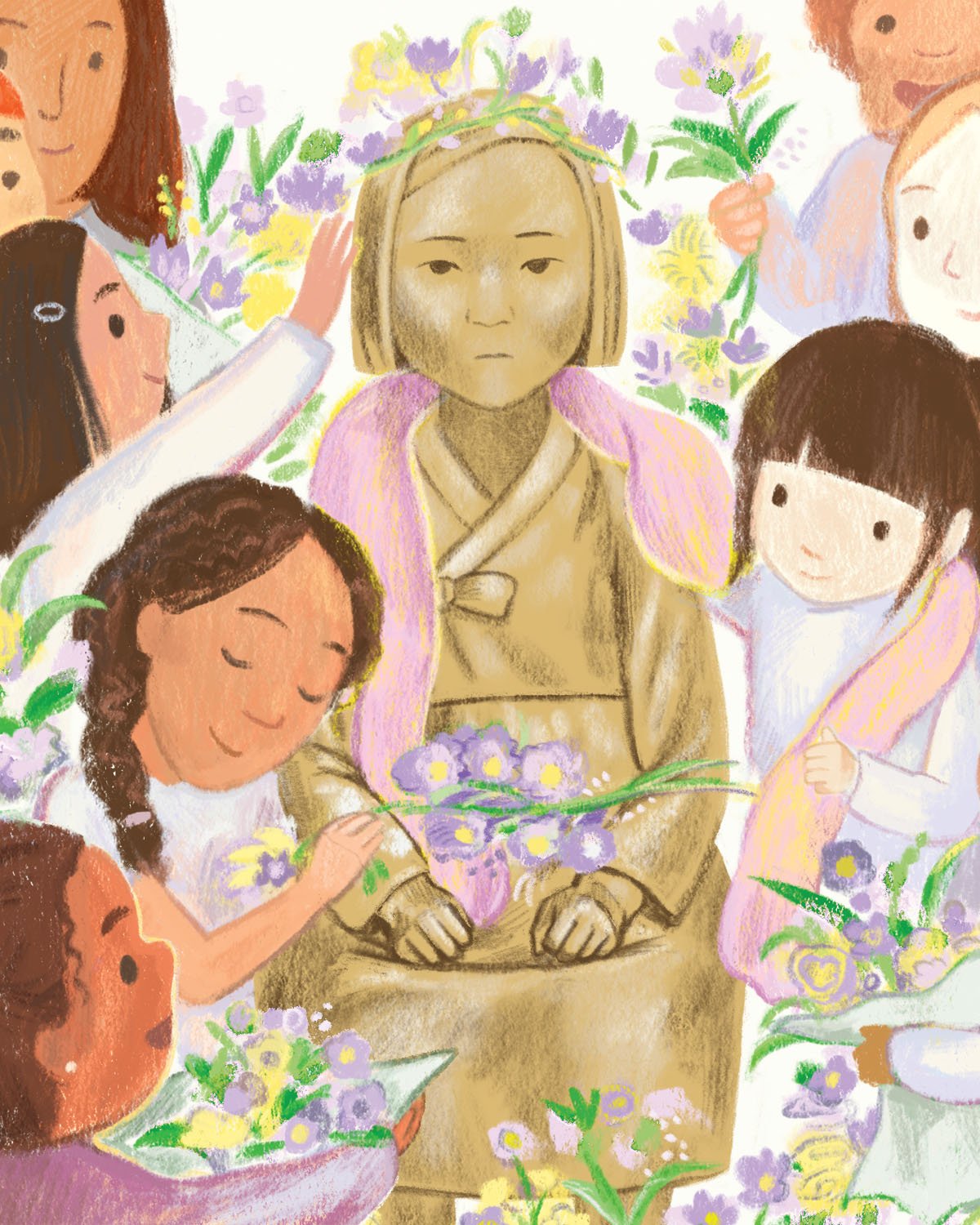 Illustration by Cindy Kang @cindysykang who says, “Many victims of the comfort women system were children. This illustration shows children approaching Ari with compassion, seeing her as another child like themselves. Surrounded by vibrant flowers and local communities that support her presence and significance, Ari remains strong and resilient at the centre.”