“What kind of sly language is this?” (Que língua safa é essa?) I ask Lucas Santtana, a Brazilian singer, composer, and producer. I’m half-joking, half in awe as we chat in what we could call ‘Brasiliano’, a language that sounds like Portuguese, but isn’t quite. I’m sitting at home in Rio while he is in São Paulo performing a series of concerts.
Portuguese became the official language of Brazil in 1758, imposed to consolidate power in an act that sought to silence Indigenous peoples and enslaved Africans. But, despite this top-down enforcement, history shows us that language in Brazil is sly. It bends and improvises, stretches and reinvents itself in the streets. Lucas asks me, “Everyone agrees that Brazilians were formed by Portuguese, Indigenous and African peoples. So, why is the language called only Portuguese?”
Sunny rhythms, deeper meanings
I remember first hearing Lucas’s music as a young university student, when I started getting more into popular Brazilian music. And while the rhythms were infectious, it was how he told stories that caught my attention. ‘Meu Primeiro Amor’ was one of the gateway songs introducing me to Lucas’s catalogue. At first presenting as a love song, encouraging couples to dance cheek to cheek, the lyrics actually reflect the socio-political environment when Lula da Silva, a leftist president, was in power for the first time. As a poet myself, language has a central place in my thinking, so when I learnt that Lucas was telling the story of Brazil’s sly language in a new album, Brasiliano, I was curious.
“The album is quite sunny,” Lucas muses about its blend of upbeat, bright rhythms. But, just as with his first song that captured my attention, the rhythms belie the deeper meaning of the album: one of emancipation. Here, language is presented as the foundation of a community pushing back against colonial legacies. A tongue that could be called ‘Brazilian’ – or ‘Brasiliano’.
Lucas tells me that this central idea was born from a conversation he had with his son about the beauty of the term ‘Romance languages’. However, it wasn’t until he found Latin in Powder, a book by linguist Caetano Galindo which traces the origins of Portuguese and how it was transformed in Brazil, that he realised that the story of these languages was one of colonisation and resilience, one tied to his own country’s history. I’ve recently started reading myself, and it felt like I was encountering the Brazilian language for the first time, a language I could finally call my own. It helped me realise that I speak something intensely alive, intensely Brazilian, a tongue shaped by history and connections.
The album’s many tongues
These connections also define the album, as it features artists from across the world (Karyna Gomes, María Lado), each collaboration widening the Indigenous language reclamation discussion. The album is sung in eight languages: Tupi-Guarani, Occitan, French, Italian, Spanish, Galician, Guinea-Bissau Creole and Brasiliano itself. This globality links the recognition of ‘Brasiliano’ with a broader movement unfolding across other formerly colonised nations. Burkina Faso, Mali and Niger have all recently removed French from official status, replacing it with local tongues. The call for linguistic recognition that Brasiliano is asking for is being heard elsewhere.
The call is perfectly encapsulated by Brasiliano’s opening track, ‘A História da Nossa Língua’ (The Story of Our Language). In it, language becomes a female figure travelling from the vulgar Latin spoken in early Europe, picking up influences like Occitan and Galician along the road, until it becomes the Portuguese that crosses the seas and finds Indigenous and African ways of describing the world. And who better to help tell this story than Gilberto Gil? Chosen as the featured artist on the track, he lends his voice to this journey, a composer who has handled the Brazilian language with mastery, playfulness, and political intent for decades. Gilberto was one of the Tropicalistas, a late-1960s group which blended psychedelic rock, traditional Brazilian rhythms and avant-garde experimentation while challenging cultural purism and the military dictatorship. He is now a member of the Brazilian Academy of Letters, the country’s leading cultural and literary institution.
The story of Brasiliano continues in ‘Cuendo mi lengua’, a percussive and hypnotic track, connecting language to the profane, associating it with symbols of Indigenous cosmology, like the serpent. Galician poet María Lado brings her voice to the song, chosen because troubadours who migrated to Galicia shaped a lot of Portuguese culture. That same lineage pulses through ‘Liga’ with Occitan duo Cocanha, a track built on traditional Occitan sounds like body percussion and vocal polyphony, whose refrain pleads: ‘Listen to your language, recognise your people, so that our history is not erased again.’
Then there’s Tainara Takua, whose voice opens ‘Línguas Gerais’ in Tupi-Guarani, a moment of gathering force, a return to the languages spoken in Brazil for centuries. In ‘Ver meu povo se abraçar’, a collaboration with Chico César, they incorporate baião, a traditional rhythm from Brazil’s Northeast, accompanied by a classic accordion and synthesiser. Each voice adds a vital layer to the universe Lucas creates.
Listen to mother tongue
Despite its connection to a global movement, Brazil’s situation is not without its own particularities. More than 200 Indigenous languages are still spoken today, surviving centuries of colonisation. But in a country of continental scale, what has become strikingly predominant is our reshaped form of Portuguese, influenced by Indigenous and African languages. There is no single tongue for us to return to, but rather a new one, forged through conflict and adaptation, to be embraced. Here, the mother tongue’s memory is marked by violent encounters but also by survival.
There is also tension between the spoken language and the standardised written form, which closely mirrors European Portuguese. As Lucas points out, this gap is often the main argument used against recognising a distinct Brazilian language. Yet, this standard was never truly spoken and has historically functioned as a tool of exclusion, deepening social inequalities. But even that “original” Portuguese is not as fixed as it appears. Linguist Fernando Venâncio argues in Assim Nasce uma Língua that what we now call Portuguese was once indistinguishable from Galician, reshaped during Portugal’s political consolidation. Language, after all, has always been political.
These complexities, often dismissed by policymakers, become untangled and approachable through artistic projects like Lucas’s. For him, this is where the work lives. Even as capitalism tries to turn music into empty sound, artists like him still insist on other possibilities. “Art has precisely that power, to touch people’s hearts,” he says.
Making the language dance
Some say that Brazilians speak a ‘singing’ form of Portuguese; unlike European Portuguese, which is more direct, the Brazilian language features more melodic inflections in its intonation. I think that in Brasiliano, Lucas makes the language not only sing, but dance. It is a festive album, capturing the energy of street parties across the Global South.
“It’s as if it were born on the street, because languages are born on the street,” Lucas says. “They aren’t created by a bunch of clever people in a room saying, ‘Right, let’s go and invent some words now.’ Languages are born between two people trying to communicate. So, I wanted it to have that sense of vibrancy.”
Lucas had a very broad musical upbringing, with experiences ranging from classical music to Afro groups and sound systems of Salvador, Bahia, where he was born. It became part of his identity as a musician and producer. “I’m always looking for these alchemies,” he explains. “I mix things from different musical worlds that somehow glue together, you know? And that has so much to do with language. A language is, at minimum, multiple bilingualisms in a region over a period of human history, slowly frictioning until a new language emerges. It’s so beautiful because no one really knows exactly how a language was born.”
Together, we came to the inconclusive conclusion that languages can be as fluid as musical genres; it’s like a dance, and there is a great deal of poetry in that.
“Eu vou sentir saudade” (I am going to miss you)
Toward the end of our conversation, we swap book recommendations. Lucas tells me he’s finishing Brave New World: A History of Human Occupation in the Americas by Bernardo Esteves, which brings Indigenous knowledge into the telling of pre-colonial history and the languages that existed before the Portuguese arrived. He’s also been reading plenty of Brazilian fiction, like Prayer to Disappear by Socorro Acioli and Where Do They Come From by Jeferson Tenório. “Whenever I visit Brazil, I buy loads of books,” he says. Literature is another way of listening to the many voices that shaped the language he sings in.
Lucas has been living in France for four years now, and thinking about how much Brasiliano speaks of our roots, I ask if he feels saudade. “Saudade” is a word that has no perfect translation in almost any other language and appears a few times throughout the album’s lyrics. It’s how I ask if he misses Brazil. His answer:
“Look, in these four years, I’ve come back to Brazil at least once, sometimes twice a year, to play. And I’ve never actually had time to feel saudade for Brazil. What I feel saudade for is my friends. I miss that warmth we have, that thing of lowering our guard, being exaggerated. That, I miss terribly.”
Well, it’s time for the album to finally hit the road with its vivid, unique language. The Brasiliano tour continues in Europe; Lucas told me he was excited, and here in Rio de Janeiro, I can’t wait either. That sly language is finding new ways for you to listen. Let it take to the streets; find it through the crossings. Have a listen to Brasiliano and see how it can move you.

Join our mailing list
Sign up for shado's picks of the week! Dropping in your inbox every Friday, we share news from inside shado + out, plus job listings, event recommendations and actions ✊
Sign up for shado's picks of the week! Dropping in your inbox every Friday, we share news from inside shado + out, plus job listings, event recommendations and actions ✊
What can you do?
-
- Listen to Brasiliano by Lucas Santtana
- Watch this documentary about the Tropicália movement on YouTube
- Listen to Fio da Meada podcast with Caetano Galindo (turn on auto-dubbed audio)
- Read Linguistic Imperialism by Robert Phillipson
- Read The head of the saint by Socorro Acioli
- Listen Língua by caetano veloso
- Read more shado articles on Music
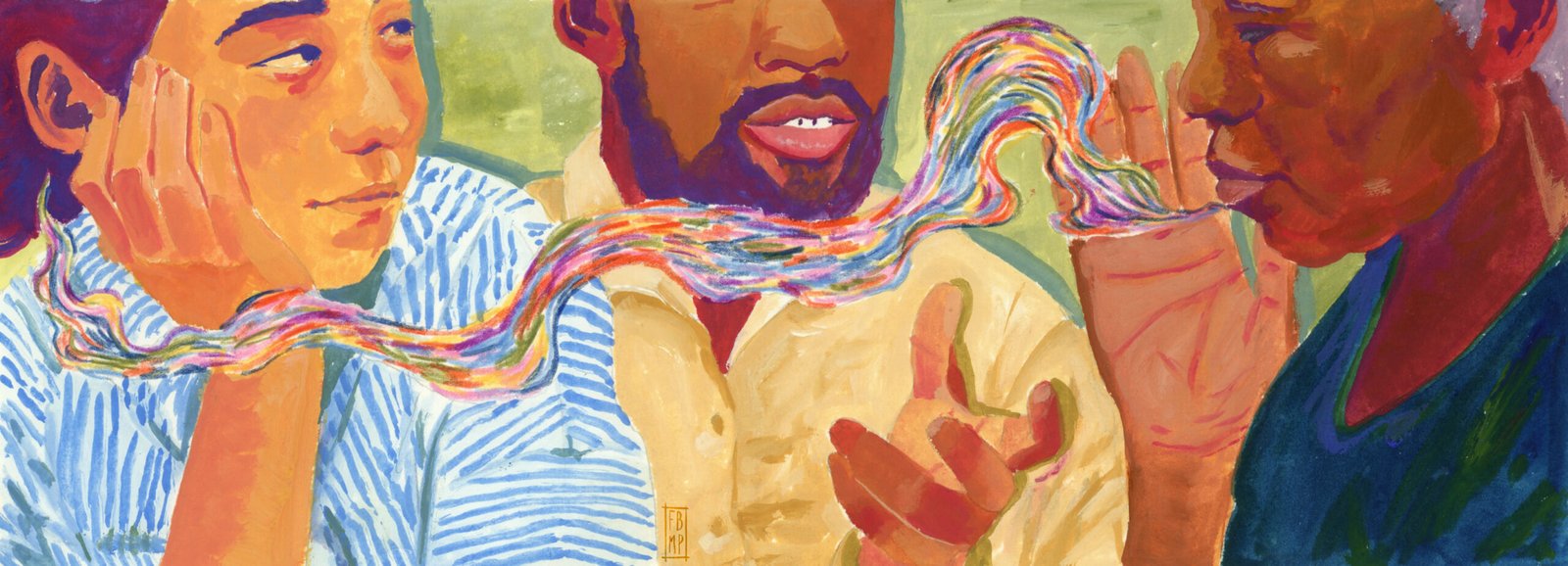
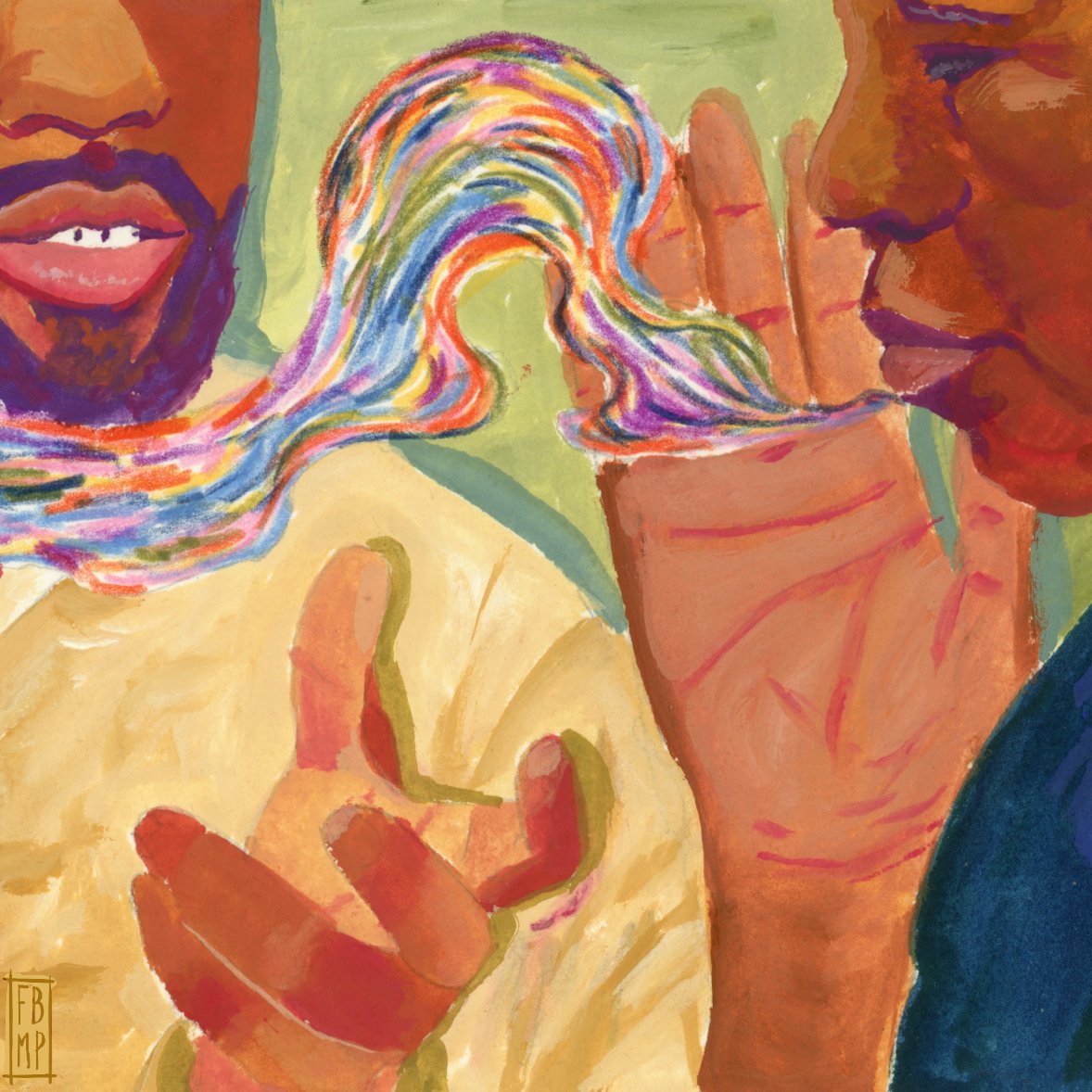 Illustration by Fernanda Peralta @fernandaperalta_fbmp who says, “I’ve decided to interpret it as a conversation happening between different people, symbolizing how language depends on its users to travel and morph into something new. It’s amazing how, despite its continental size, you can travel Brazil from north to south and almost everyone will understand you, because we all speak Brazilian Portuguese (or Brasiliano, as the text suggests). I tried to convey this playful game of talking and listening and exchanging experiences among the people I’ve painted. I couldn’t omit the representation of an older black woman as one of the speakers, given this quote from Lara’s text: “They were the ones who passed the word forward, transforming the way we speak”