
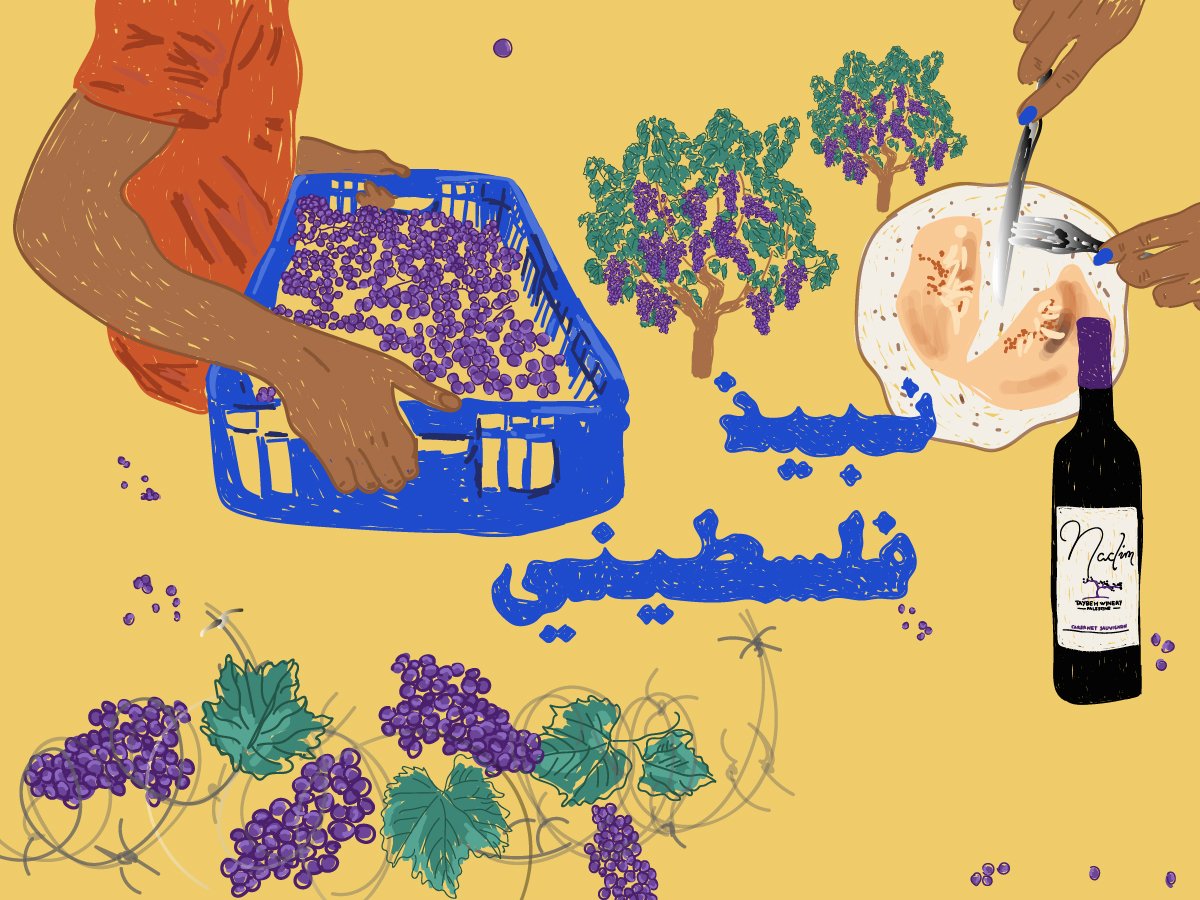

If someone were to ask you where you thought the oldest vine-growing and winemaking region in the world was, what would your answer be – France, Greece or maybe Romania? In fact, the first grapes to be planted by humans were in Jericho, in the West Bank, around 9500 BC.
Fadi Kattan, co-founder of Palestinian restaurant Akub in Notting Hill, created Nabeeth Wines with sommelier Anna Patrowicz to distribute and import wine to various establishments around the UK and, in doing so, platforming Palestinian terroirs in the West.
It was Fadi who first told me about Nabeeth Wines. And after delving into the rich context and culture of Palestinian terroirs, I felt compelled to share my newfound knowledge on the topic, which is, of course, particularly prevalent in the political reality in Palestine today.
I had the pleasure of speaking to both him and Anna about the work they do at Nabeeth Wines, the history of Palestinian grapes and navigating the agricultural effects of the ongoing genocide in Gaza.
Introducing Nabeeth Wines
We cannot begin this discussion without acknowledging the intentional destruction of Palestinian farmland and vineyards by the Israeli occupation. Grapes are the second largest crop in Palestine but production is rapidly decreasing due to such demolition. Despite being the oldest in the world, Palestinian terroirs are underrepresented and often unknown – so Nabeeth’s mission is to try and change this.
Fadi and Anna’s partnership started after a catch up at an Akub solidarity dinner for Palestine, in which they expressed a mutual desire to hone the restaurant’s wine list. After seeing the popularity of the Palestinian wines at Akub, they decided to expand and go further, introducing more Palestinian producers to the UK market.
Anna began to taste the wine and choose a specific selection, leading to a collaboration with four producers in Palestine. As Nabeeth began to take flight, the important question of ‘What is Palestinian terroir?’ was raised. Anna and Fadi tell me that Nabeeth’s mission is to not only to authentically answer this question, but to raise awareness of the complexities of the terroir.
Too often, the consumer’s mind lumps Levantine wines under the singular banner of ‘Lebanese wines’. However, their winemaking industry and native grape varieties are completely different to those in Palestine, Jordan and the rest of the Levantine region.
Anna clarifies: “In Palestine, you have both Galilee – which is much greener, close to the Mediterranean sea – and the Jordan Valley in the West Bank, which has more elevation and is drier and hotter during the summer.” The combinations of soils, the elevation, and micro-climate, she tells me, all make a difference. Thus, these elements give winemakers a lot to play with, allowing them to create different blends and honour this diversity.
It isn’t widely known that Palestine is the oldest winemaking region in the world, despite there being numerous mentions in ancient Abrahamic literature – the Bible, Qu’ran, and Torah. With the West fixated on European wines, not many people think of Palestine as a winemaking country at all.
As Indigenous people, land is of upmost important to Palestinians – and this cultural pride is infectious, extending into the team behind Nabeeth. “My job is amazing!” Anna says, not masking her excitement. “The history behind each winery goes back generations, and my role is to bring these stories to others – all while letting them taste the incredible range of wines.”
Winemaking under occupation
Of course, we must address the reality that is on the ground today – of Palestinian farmers living in an apartheid system that punishes their very existence through the destruction of their land. The genocide doesn’t only impact their daily lives, but their economic activities and livelihoods. Their land is regularly threatened and confiscated, systemically removing access to their vineyards and the production of wine.
“The lack of security makes the industry incredibly fragile, so we don’t know how to talk about the future,” Anna explains. “Agriculture is based on planning years ahead – it’s not an activity that you do ad hoc. This creates another layer of complexity.” Therefore, the Nabeeth team see it as their duty to spotlight not only the wine but the people who make it, spotlighting their resourcefulness and courage.
This is evocative of just one of the many ways Palestinians show themselves to be some of the most resilient people worldwide. Through decades of occupation, constant confiscation of farmland and an attempted erasure of their cuisine – they still persevere. Despite enduring such testing circumstances, they still desire to platform their craft, displaying their innate relationship with the land.
In buying Palestinian wine, consumers are also contributing to stewardship of the land and giving the farmers, winemakers and wineries the means to keep going. Something that may seem insignificant to consumers as just buying a glass of wine, goes directly back to Palestinian farmers and preserves their craft.
Self determination over charity
On the other hand, Fadi emphasises that maintaining a balance of wanting people to respect the history of Palestinian wine versus successfully integrating it into the Western palette is a difficult thing to do. “We don’t want people to buy the wines because it’s a sob story or because they think it’s for charity,” he says. “They are exceptional wines and should be recognised for what they are.” Keeping an undercurrent of recognition for the farmers’ resilience, stewardship and community remains as important as ever, but ultimately there is more to the craft than solely the political struggles they are forced to endure.
One of the wineries Nabeeth works with is Cremisan Valley, the oldest winery still in existence in Palestine, founded by the Salesian brothers in 1890. They plant their own grapes, but they also buy grapes from farmers in their local community. Additionally, they run a bakery in Bethlehem where they donate bread to families. I feel that Cremisan Valley is indicative of the wider ecosystem: everybody is involved to a point, as it’s all centred on a symbolic return to the land.
Even during times of economic struggle, Palestinians uplift and provide for their neighbours. This is innate in our Arab culture – it isn’t seen as a sacrifice or something that must be rewarded or reciprocated. And the preservation and protection of Palestinian crafts such as winemaking do not just benefit the artist but the community that surrounds them. It holds up the very fabric of their society and life as they know it.
Nabeeth’s aim is to bring Palestinian wine into the mainstream, both as an ancient plant and agricultural basin, but also as a connection spot between East and West.
Fadi tells me that Anna has been working to get their wines into UK restaurants, and you can now find them across varied menus in the London restaurant scene. “Seeing who chooses to include them on the menu is fascinating,” he says. “It means people are slowly taking their defences down.”

Join our mailing list
Sign up for shado's picks of the week! Dropping in your inbox every Friday, we share news from inside shado + out, plus job listings, event recommendations and actions ✊
Sign up for shado's picks of the week! Dropping in your inbox every Friday, we share news from inside shado + out, plus job listings, event recommendations and actions ✊
Fadi and Anna tell me they feel a responsibility in carrying these stories and this heritage, but mostly as a role to fully normalise Palestinian wine. “This is where we need to get to,” Fadi asserts. “To not only buy Palestinian wine at a solidarity dinner, but at any dinner, without fear that they’re going to polarise guests.”
At the end of the day, Palestinian wines must be treated as what they are – a high quality agricultural product that is worth tasting.
The art and heart behind the trade
The role of a sommelier is multi-faceted, laced with emotion as well as an intrinsic knowledge of the wines they work with. In a singular bottle, wine can encapsulate our existence through the lens of social perspectives and history, giving us this link with the past. The small percentage of wines that have the capacity to age are thus somewhat of a time capsule.

As our conversation came to a close we addressed the question of why we so often go back to these revered aged, vintage wines. It’s exactly that connection with the past that we humans crave. We’re able to access something that’s been there for a long time, and that contact with the liquid is where the magic happens. Wine reminds us to slow down. With one sip, we are whisked away, encouraged to bask in the memory of taste.
“This is where our horizons are opened,” Anna smiles. She tells me that’s what she does as a sommelier – when creating a wine list, she wants to give her customers a perspective that reaches what was.
Ultimately, this link to the past is most evident through an innate responsibility towards a heritage that’s disappearing due to the reality on the ground. Nabeeth Wines have a sense of urgency that’s prompted by something deeper than just commercial drive – they want people to drink and buy Palestinian wines because that allows Palestine itself to keep existing.
What can you do?
Watch:
Listen:
- Sabah Al Yasmine – Ramblings of a Chef by Fadi Kattan
- Matbakh by afikra
Read:
- What is Food Sovereignty?
- Bethlehem by Fadi Kattan
- Palestine on a Plate by Joudie Kalla
- Stone and Seed by Mira Mattar for Vittles
- Zaitoun by Yasmin Khan
- The Palestinian Table by Reem Kassis
Follow:
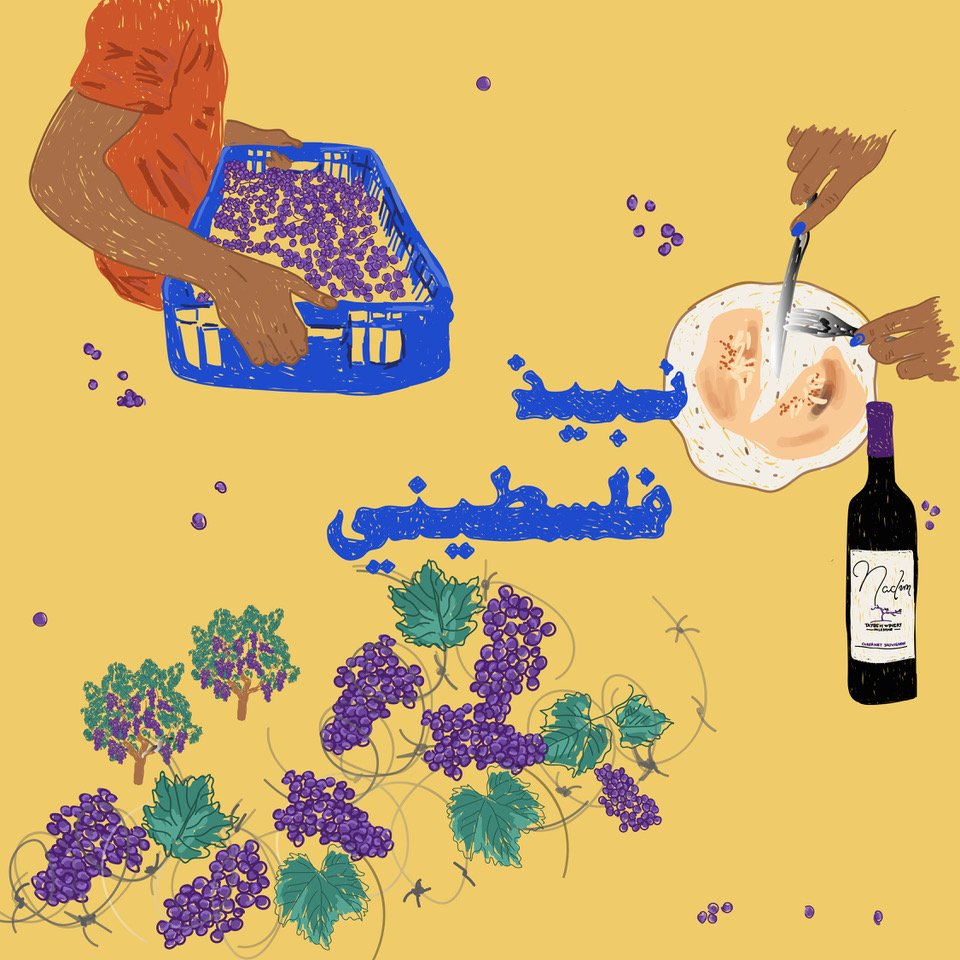 Illustration by @hayfaachalabi who says: “The illustration refuses to limit the narrative about Palestinian wine to the struggle alone, however, acknowledges the resilience wine farmers experience under the Israeli occupation that insists on destroying land. The illustration shines light on the importance of seeing Palestinian wine as part of a fine dining experience and celebrates its unique identity without confusing it with other wines in the region.”