
At the start of 2025 I reflected on a milestone that felt monumental: 10 years of being vegan. A decade spent exploring ethics, care, and the ways in which food shapes our relationships with ourselves, each other, and the world around us. Veganism taught me how to think ethically about food. It also taught me the limits of turning ethics into an identity. But after a decade, I am no longer willing to call myself “vegan” – not because I have abandoned its principles, but because the label has come to obscure more than it reveals.
Over the past decade, I have watched the mainstream vegan movement become increasingly commodified and trend-driven. What was once rooted in ethical reflection has often been reduced to something shallow and one-dimensional: a lifestyle signifier, a marketable moral identity, or a form of social signalling. From luxury vegan sneakers to packaged “ethical” convenience foods, it often replicates the same cycles of consumption, exclusion, and environmental harm that I sought to step away from in the first place.
In 2022, I wrote an article for The Guardian entitled “I used to be that weirdo vegan, but now it’s totally normal.” It was a reflection on how what was once marginal had entered the mainstream; celebrated in magazines, supermarket aisles, and social media feeds.
Looking back now, this normalisation has had a double-edged effect: while it has made plant-based eating more accessible, it has also accelerated the commodification and trend-driven tendencies of market-led consumption. The ethics have often been overshadowed by lifestyle branding, marketing, and virtue signalling, revealing what the wider food industry tends to prize most: profit over care, visibility over depth, and trendiness over critical engagement.
Before the word “vegan”
It is important to clarify that my critique is not of the ethical principles that underlie veganism. The core ideas – reducing harm, resisting exploitation, and cultivating care – pre-exist the word itself. Practices of plant-based eating and mindful consumption can be found in Ital diets within Rastafari traditions and across Indigenous and ancestral food systems across the world. These traditions emphasise reciprocal, sustainable relationships between humans, non-humans, and the land, guiding practices that minimise harm and waste, support ecological balance, and sustain life.
By contrast, the word vegan was coined in 1944 by Donald Watson and his co-founders of The Vegan Society in Britain, a group of white, middle class men and women defining a non-dairy vegetarian diet and lifestyle. That historical and cultural context still matters: it shaped the movement’s early framing, reach and worldview. It also created structural and cultural norms that continue to influence the mainstream vegan movement today.
The experiences of Eshe Kiama Zuri, who, during their time in leadership, challenged the Society around systemic racism and exclusion, illustrate how these dynamics are not merely historical. Eshe, who is Black, queer and disabled, faced racialised hostility and erasure within the organisation, highlighting how institutional structures within mainstream veganism often fail to reflect the ethical breadth and cultural diversity inherent in plant-centred eating. This distinction is crucial: there is a difference between the ethical philosophy of plant based eating and the mainstream, institutionalised movement that carries the vegan label. My decision to quit the label is about critiquing the latter, while remaining aligned with values of care, sustainability, reduced harm and relational ethics.
Confronting the shadow of the mainstream vegan movement
Part of what led me to step away from the label is recognising the shadow of the vegan movement; the unacknowledged, often uncomfortable aspects of collective identity that remain repressed but exert immense influence. In practice, this shadow manifests as patterns of moralism, exclusion, and performativity across the movement.
Within large sections of the vegan community, I have observed moral superiority, classism, and racism, alongside a refusal to integrate intersectional analysis. My undergraduate political philosophy professor, Dr David Walker, once reflected that many self-help or spirituality-oriented thinkers are “politically apolitical”, rooted in “an abstract individualism that neglects, or even denies, the extent to which social, political, and economic policies shape our lives and wellbeing.”
Sadly, I have found many vegans to also embrace this position. The result is a movement that champions personal morality over systemic critique, individual lifestyle over collective responsibility, and ethical performativity over relational care. This shadow is not just theoretical. I have witnessed, for example, vegans critiquing Palestinians for the food they eat under conditions of siege and occupation, judging choices made in survival contexts as if moral purity could be abstracted from political reality.
Moments like this lay bare the moralistic, apolitical posture my professor describes. Such critiques reveal how sections of the movement can reproduce classism, racism, and even colonial attitudes, positioning moral superiority above empathy, history, or context. These are the patterns that made me question whether the label “vegan” could ever fully encompass the relational, intersectional ethics I care about, ethics that extend beyond animals to the full spectrum of care, justice, and human connection.
These dynamics show up not only in personal attitudes, but in the marketplace. Products are often marketed as ethical simply for being plant-based, such as plastic’s rebrand to “vegan leather”, while more sustainable, historically grounded, or relationally conscious alternatives are overlooked. This performativity, privileging visibility and moral signalling over substantive engagement, reinforces the very hierarchies and exclusions the movement purports to challenge.
Veganism in transition
While my decision to step away from the vegan label is not motivated by trends, it is worth acknowledging that mainstream veganism has seen a noticeable shift in recent years. Many former vegans are returning to eating meat, alongside high-profile restaurants such as Eleven Madison Park reintroducing animal proteins to their menus. London’s Holy Carrot has now followed suit, announcing that its new menu will include eggs and dairy. The move reflects changing consumer demand as well as the limitations of a strictly plant-based approach in mainstream dining.
Many ex-vegans frame their return to omnivory around health, illustrating the limited, oversimplified way veganism has been framed as a universal solution rather than an ethical and nutritional practice. In reality, it requires nuance, preparation, and critical engagement, yet many neglect these, treating veganism as a single-issue commitment to animal welfare and downplaying nutrition, ecology, and relational responsibility. What emerges is a version of veganism that is easier to adopt, but harder to sustain thoughtfully.
For some, returning to meat is not a deliberate political statement, but a way of stepping away from the ethical and cultural debates that veganism has come to embody. Yet this retreat into apparent neutrality is not politically neutral. It reflects a discomfort with the complexity that ethical eating demands and a preference for disengagement over sustained critical reflection. In this sense, the move away from mainstream veganism does not resolve the tensions it raises, it simply sidesteps them, often reinforcing the status quo in the process and echoing the broader right wing narrative that politics should be kept out of everyday life while traditional hierarchies of power remain intact.
The cultural return of meat
If the vegan label has become a site of moral signalling and identity, then the recentering of meat reveals the other side of the same dynamic. While veganism’s popularity seemingly declines, meat has been repositioned as a political, cultural, and even sexual symbol. Campaigns such as Make America Healthy Again elevate animal-based diets as markers of strength, tradition, and national identity, while implicitly casting plant-based eating as unpatriotic, elitist, or morally suspect. Globally, the rise of right-wing politics has coincided with renewed celebration of meat and “traditional” diets, often as tools to assert national, cultural, or gendered identity.
The sexual politics of meat are also central: within the manosphere and related online spaces, meat consumption is coded as a sign of virility, dominance, and traditional masculinity, while veganism is mocked as feminised or weak – ‘soy boy’ being their insult of choice. With the resurgence of “tradwife” aesthetics, the ideal wife is pictured serving steak rather than salad, using meat as a marker of proper domestic care and nourishment for her family. In this context, food becomes a shorthand for broader ideological commitments about masculinity, heritage and social order. These cultural performances reveal that returning to meat is not just about personal taste, but is deeply entangled with gendered, nationalist and political signalling.
What has emerged is not simply a rejection of veganism, but a mirror of it. Where veganism can become a performance of moral purity, meat is recast as a performance of strength, heritage, and cultural authority. Both reduce complex ethical questions into simplified identities, flattening food into a symbol rather than as relationships shaped by history, ecology, and care.
The same patterns I observed within the mainstream vegan movement – moralism, performativity, and a failure to engage with structural realities – reappear here in inverted form. The issue is not that food has become political, but how narrowly that politics is often expressed.
Beyond the vegan label
As I continue to develop and refine a framework for my own work, which I call Intentional Nourishment, I remain conscious of the limitations and unintended consequences that accompany any ethical system once it is formalised. The shortcomings that have emerged around institutional and mainstream veganism, including those left unanticipated by organisations such as the Vegan Society, serve as a cautionary tale. Intentional Nourishment, like any evolving philosophy, will inevitably encounter its own blind spots and tensions over time.
Join our mailing list
Sign up for shado's picks of the week! Dropping in your inbox every Friday, we share news from inside shado + out, plus job listings, event recommendations and actions ✊
Sign up for shado's picks of the week! Dropping in your inbox every Friday, we share news from inside shado + out, plus job listings, event recommendations and actions ✊
I do not propose that “vegan” be replaced by this framework, but rather suggest the need for more grounded, relational, and context-sensitive ways of thinking about food ethics. My approach sits alongside, and is informed by, a wider constellation of food philosophies and practices (see the ‘what can you do?’ section.)
Rather than offering a new label to adopt, I hope it encourages a deeper process of inquiry; one that invites people to research, question, and engage with the histories, cultures, and systems that shape what we eat, and to develop their own ethical frameworks in response. From Bronx-based collective Ghetto Gastro to Chef Rishim Sachdeva’s “mostly vegan” Tendril, contemporary plant-forward hospitality gestures toward a future where relational care, creativity, and inclusivity matter more than rigid labels or moral signalling. Rather than offering a definitive solution, these approaches collectively invite further inquiry into how food might better serve justice, pleasure, and community.
Quitting veganism as a label, then, is both personal and political. It is an acknowledgment that ethical living cannot be reduced to a word, a dietary checklist, or a marketable lifestyle. My ethics, practices, and interests do not always fit neatly into a category. The word “vegan” has begun to feel like a fence around my work and my thinking; it signals certainty where I feel complexity, judgment where I want curiosity, and division where I want dialogue. I remain committed to plant-based eating, but my choices are no longer organised around the boundaries of a single label. Instead, they are shaped by an ongoing, relational process – one that considers not only animals, but also people, cultures, ecologies, and the material realities of how food is produced and shared. This is slower, less easily defined work. It resists purity and embraces nuance.
What I am leaving behind is not an ethic of care, but the illusion that such an ethic can be fully captured by a fixed identity. If veganism once offered a language for thinking differently about food, then stepping beyond it is, for me, a continuation of that same inquiry. It is an attempt to hold onto the questions rather than settle into the answers.
Ultimately, I hope for a broader shift away from rigid labels and towards more thoughtful, context-sensitive ways of engaging with food that make space for complexity, accountability, and care. Food is never just sustenance, but a window into the systems, relationships, and choices that sustain us all.
What can you do?
- Explore ethical eating in ways that reflect your values, not trends, by first deeply understanding yourself and what you care about
- Support local, ethical and culturally rooted food systems
- Consider the social and political impacts of your food choices, including labour, environmental and cultural justice
- Engage with community projects or organisations that centre justice and sustainability alongside plant based ethics
If you’re inspired to explore more about ethical eating and the cultural, social and political dimensions of food, here are some resources to get started:
Books/Publications:
- Vittles
- Chicken and Bread Zine
- Sitopia: How Food Can Save the World by Carolyn Steel
- Vibration Cooking by Vertamae Smart Grosvenor
- All Consuming: Why We Eat the Way We Eat Now by Ruby Tandoh
- No Meat Required: The Cultural History and Culinary Future of Plant-Based Eating By Alicia Kennedy
- The Omnivore’s Dilemma: A Natural History of Four Meals by Michael Pollan
- Eating Animals by Jonathan Safran Foer
- Veganism of Color: Decentering Whiteness in Human and Nonhuman Liberation ed by Julia Feliz Brueck
- Food Power Politics: The Food Story of the Mississippi Civil Rights Movement by Bobby J. Smith II
- Aphro-Ism by Aph and Syl Ko
- Black Food edited by Bryant Terry
- African American Environmental Thought by Kimberly K Smith
- Black Feminist Ecological Thought: A Manifesto by Dr. Chelsea Mikael Frazier
- Braiding Sweetgrass: Indigenous Wisdom, Scientific Knowledge, and the Teachings of Plants
Writers/Thinkers:
- Ruby Tandoh
- Alicia Kennedy
- Sierra Nicole Reece
- Krystal C Mack
- Eating The Other
- Bryant Terry
- Jocelyn Jackson
- Rocio Carvajal
Podcasts:
- The Intentional Nourishment Podcast
- The Racist Sandwich
- From the Desk of Alicia Kennedy
- The Black Kitchen Series
- Edible Activist
- Whetstone Audio Dispatch
- Sonder and Salt
Collectives:
Organisations/Initiatives:
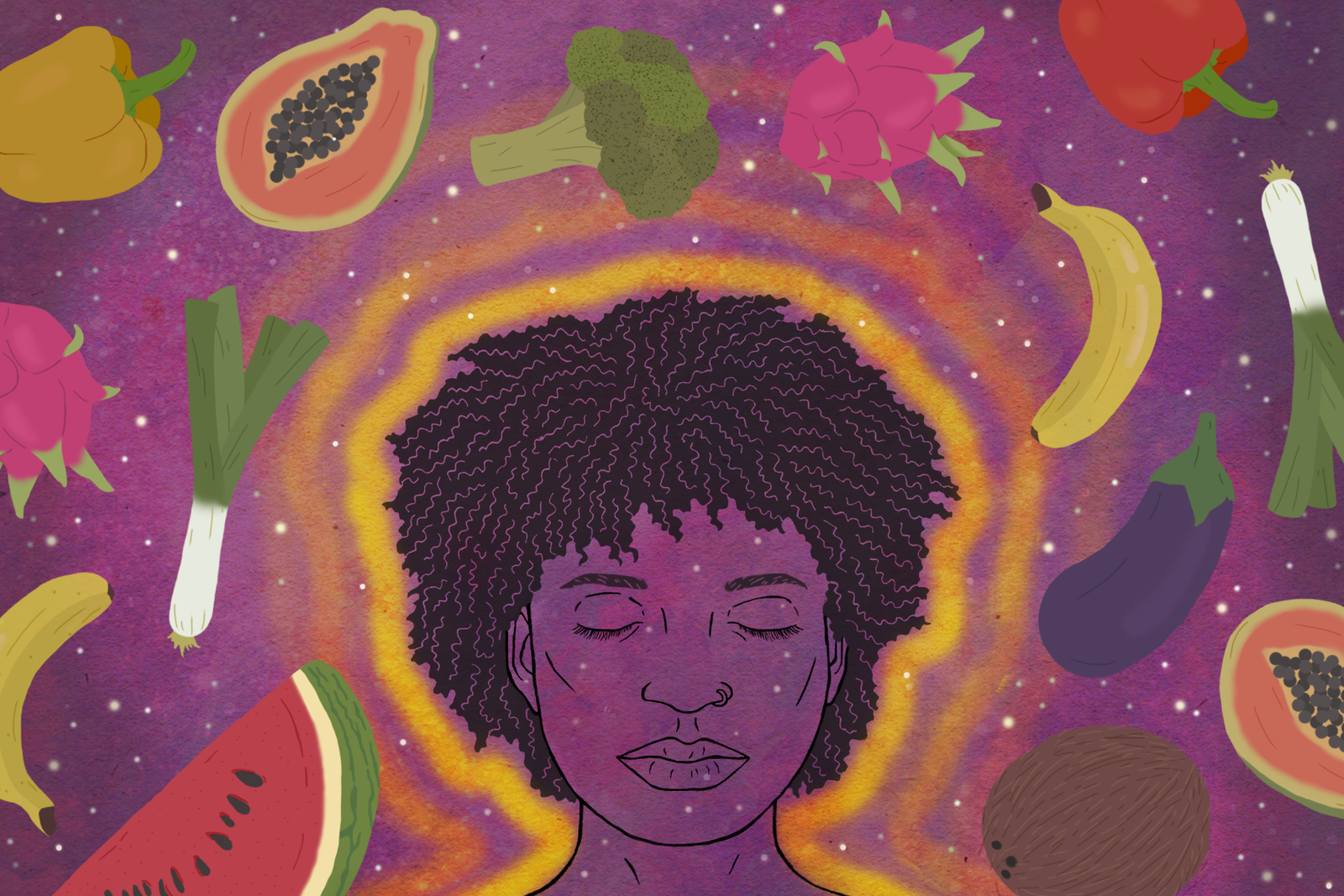
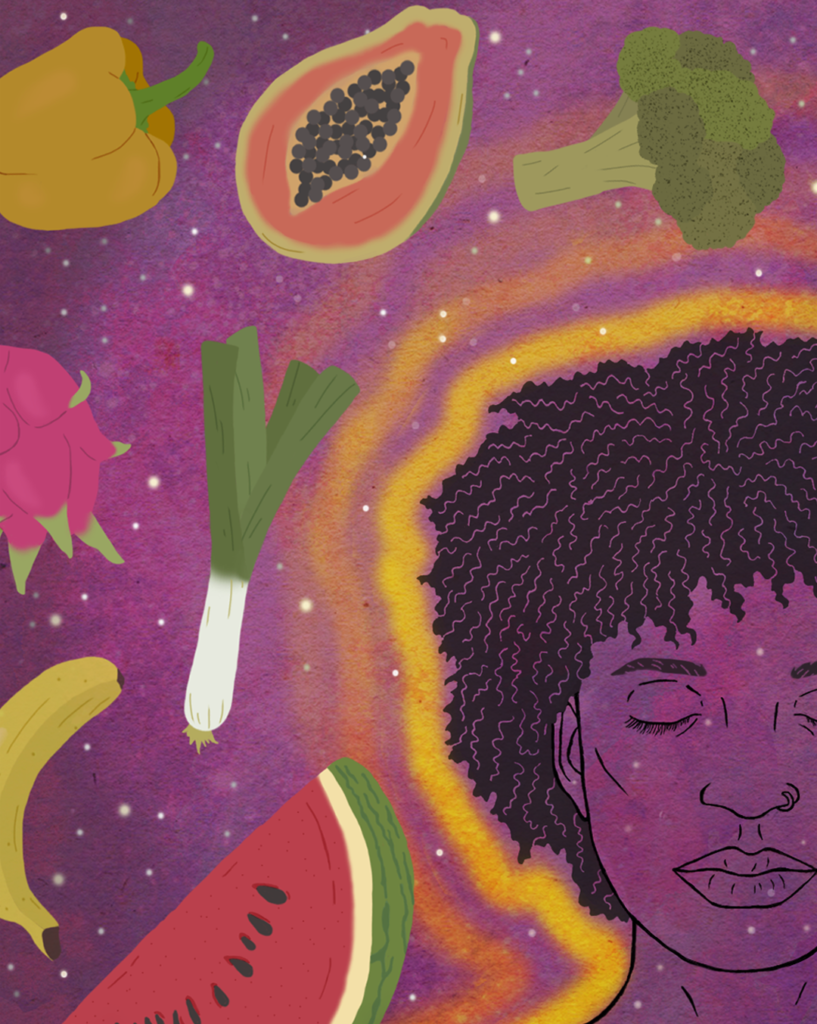 Illustration by @sayeeda.bacchus who says: “Mindful eating and self care – Holistic health aura around a woman’s mindfulness with floating vegetables and fruits.”