
“Only the strong go crazy. The weak just go along.”
– Assata Shakur
As both an emergency medical technician and a mental health patient, I find it impossible to situate my own mental health, and that of my patients, without the political context of our times.
In a world where the Zionist entity has attempted to make genocide a sociocultural norm; where the United States regularly kidnaps or kills heads of states and violates their sovereignty; and where ICE abducts our neighbours with impunity – how can we begin to speak of mental health for ourselves or for our patients while the world around us is alight?
During these extreme political times of heightened contradictions, I found myself working in the emergency room, giving up my mental health to care for my patients who danced along the thin line between life and death. Until slowly, I began to experience flare-ups of old mental health symptoms I long thought I had dealt with and shelved. As my symptoms came to a head, I found the dawn of the first day of Ramadan on the horizon.
Sequels of oppression
Searching for renewed explanations for my own symptoms, I decided to take a step back from both my organising and healthcare work while I cracked open texts that I hadn’t explored in a while.
In The Wretched of the Earth, Franz Fanon makes the direct link between oppression and mental illness. Speaking to his context of the Algerian war of liberation against the French, he writes: “When colonization remains unchallenged by armed resistance, when the sum of harmful stimulants exceeds a certain threshold, the colonized’s defenses collapse, and many of them end up in psychiatric institutions. In the calm of this period of triumphant colonization, a constant and considerable stream of mental symptoms are direct sequels of this oppression.”
Experiencing debilitating mental health symptoms is a logical consequence of the conditions of our times – the state knows this, and is depending on it. Too many beautiful revolutionaries have ended up in prison, in exile, dead, or completely debilitated – and I have personally seen the majority of my comrades experience depression, anxiety, psychosis, OCD, and the range of mental health conditions and symptoms.
If we are to continue the work of service to our communities, we must emphasise life and health – we don’t just want the continuation of the revolution we are already in. We want a revolution where we see ourselves on the other side free, alive and healthy.
For us Muslims, Islam gives us the roadmap to do just that. And Ramadan comes as a time of both renewed political and spiritual commitment.
Deed over word and Jihad al-Nafs
The greatest struggle in Islam is Jihad al-Nafs: the struggle against ego and self.
Through Surah Al-Balad (The Chapter of the City) in the Quran, we learn that Prophet Muhammad, peace be upon him, faced intense repression in his own hometown. It is written that “Indeed we have created humankind in constant struggle” – and I have come to understand this in conjunction with histories of resistance. Humanity has inherited a historical lineage of struggle, and during Ramadan, this struggle includes resisting the overconsumption so normalised in our daily lives.
In Islam, there is an emphasis on deed over word. We are asked: “And what will make you realize what attempting the challenging path is? It is to free a slave or to give food in times of famine to an orphaned relative or to a poor person in distress, and – above all – to be one of those who have faith and urge each other to perseverance and urge each other to compassion.” This demonstrates the need to subvert the systems of oppression that cause the downstream mental health effects we see in our comrades.
Building trust between medics and mental health patients
There are significant challenges on this road to revolution. Among them is the lack of trusted medical practitioners.
It shouldn’t be altogether surprising that many folks with mental illness do not trust medical practitioners. In a western medical practice that experimented on enslaved Black women to “pioneer” medical techniques, where emergency medical services collaborate closely with police officers to criminalise mental health, and where pharmaceutical companies prioritise profit at the expense of harming patients, how can we begin to trust any part of healthcare? And for those of us who are healthcare workers, how can we resist the empire of healthcare while remaining entangled with it?
In his book A Dying Colonialism, which analyses the Algerian resistance to French colonialism, Franz Fanon wrote a chapter called ‘Medicine and Colonialism.’ In this chapter, he writes: “In the colonial situation, going to see the doctor, the administrator, the constable or the mayor are identical moves.”
However, he also describes the transformation of medicine from a colonial tool to a technology of liberation in colonial Algeria, providing a strategy for how a people living under oppression can transform their healthcare workers from state agents to accomplices of revolution. Healthcare workers aligned with their patients’ political struggle, rather than merely acting as technicians who treated physical symptoms.
Fanon put it simply: we must release the golden handcuffs of prestige that the medical establishment promises. We must adapt to the times, which means not only adopting the latest scientific techniques, but also embracing the political demands of our people on the front lines. In the context of Turtle Island, some of these demands include Land Back for Indigenous folks, abolition of the police, and self-determination of Black and brown people.
It is through coherent and co-conspiratorial struggle – like the Young Lord’s establishment of the Lincoln Detox center – that medics can begin to build trust with mental health patients.
Ramadan teaches us to resist repression
Historically, when the government wants to attack a movement, they attack the purpose of the people first. They try to lure some away through money, others through state-sanctioned methods of resistance such as non-profits, others through fear and psychic battle. We need only look towards governmental projects such as COINTELPRO to confirm this, in which the FBI systematically tore down organisations struggling for liberation such as the Black Panthers.
Join our mailing list
Sign up for shado's picks of the week! Dropping in your inbox every Friday, we share news from inside shado + out, plus job listings, event recommendations and actions ✊
Sign up for shado's picks of the week! Dropping in your inbox every Friday, we share news from inside shado + out, plus job listings, event recommendations and actions ✊
It is by design that the surveillance state we live in seeks to deteriorate our mental health. For Muslims living in a post-9/11 world, we are particularly targeted.
From history we know that it takes discipline and powerful community bonds to resist repression. Islam builds that discipline and those community bonds.
Black Liberation Army member Safiya Bukhari, who dealt with a life-threatening reproductive health condition while in maximum security confinement, wrote in The War Before: “The discipline of making salat [prayer] five times a day and having Allah constantly in your remembrance is a wonderful thing, because it enables you to deal with the madness around you.”
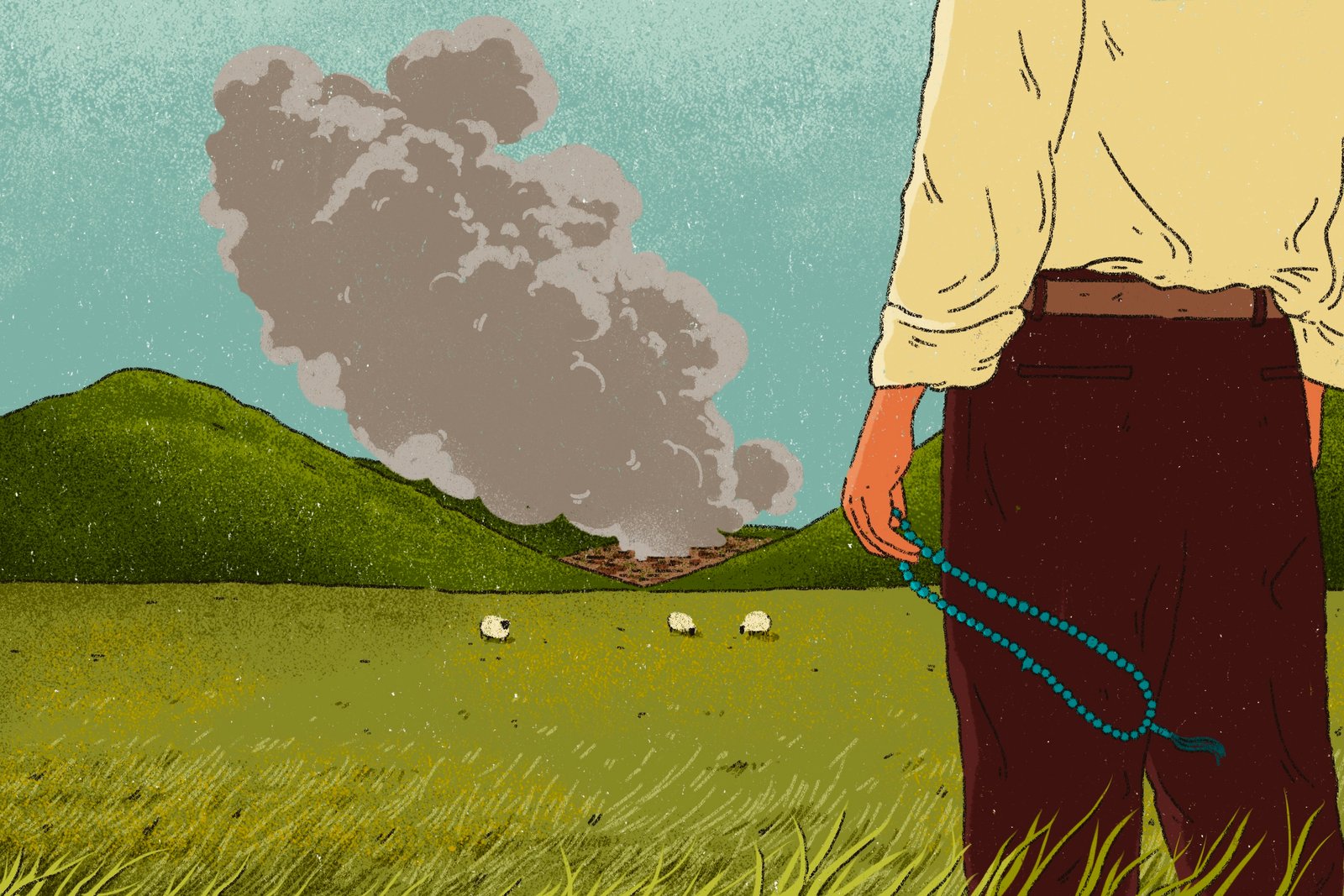
This remembrance is a protection. Throughout Ramadan and into the rest of the year, Muslims are encouraged to engage in Dhikr – remembrance of Allah. We are encouraged to use prayer beads or even the lines upon the digits of our hands to count out repetitions of the names of Allah, prayers, or phrases of power such as Allahu Akbar.
If Jihad al-Nafs tells Muslims that the first arena of struggle is within ourselves, then the first place that our oppressors will try to colonise is our minds and hearts. Indeed, the struggles in Iran, Palestine, Sudan, the Congo, and Tigray (where Muslims continue to fast in man-made famine conditions), ask that we elevate our consciousness to meet the moment, and Ramadan asks us to fortify our souls and minds through spiritual struggle.
It becomes imperative, then, to resolve spiritual and intellectual conflicts and work through the repression in our minds and hearts so that we are not susceptible to this internal colonisation. And as a community, we must work through our internal contradictions so that justice may prevail for all.
Amanah and Ibadah, trust and worship
When Muslims fast during Ramadan, we do so as an Amanah and an Ibadah. Amanah means trust – the body is a sacred trust between the Lord of all Worlds and the Self. Our responsibilities and blessings, of which our bodies are part and parcel, are given as a trust from God. Without Amanah, we cannot develop the trust through which it becomes necessary to conduct resistance in this Dunya, or world.
That is why we have Ibadah – worship. To worship in this world is to be of service to all of Allah’s creation. One way I have come to be of service is by co-founding a jail support network – I came to this work by identifying a gap in the needs of my community.
While doing jail support once, a freshly released prisoner told my comrades and me that “we were put on this world for three purposes: to praise Allah, to protect and love women and children, and to protect and love animals and Nature.” Resistance is our Ibadah. Purpose is the direction we take towards fulfilling this Ibadah.
Lead with your heart
Health – particularly mental health – in Ramadan is bound up with fasting from those cravings which do us no good. Fasting does not just mean abstaining from food and water – in fact, many people may be physically unable to do this. Fasting means abstaining from bad habits or anything that harms us, too. For me, mental and spiritual health go hand in hand, and fasting is a practice which cures spiritual ills and disciplines our minds.
I have taken this Ramadan as the antidote to the venom of this world which debilitates me – it is the antidote to consumer capitalism, to distraction from injustice, and ultimately to denial of the signs which prove the existence of the oneness of the Lord.
We also need not limit ourselves to viewing mental health through medicine. We must take into account the trauma our ancestors went through, especially our women ancestors who carried generations upon their backs, the struggles they waged against colonialism and patriarchy, and the endurance they fostered in giving life to their progeny. This is something I have practiced this Ramadan. I have recognised that mental health is a primary site of spiritual struggle, and I ceased seeking individual solutions for systemic problems.
In Islam, we learn that the organ of perception is the heart. And so when we take care of our mental health we must lead with our hearts.
So for my siblings who navigated difficult choices regarding their mental health this Ramadan, for my accomplices in resistance who stare down the barrel of repression without fear, and for my political prisoners who struggle in both patience and in haste, I would urge you to lead with your heart and know that that no one, in any situation, can take away your freedom. Self-determination is ours, has always been ours, and will always be ours. InshaAllah.
What can you do?
-
- Islamic public health organisation HEART has developed a framework around Amanah so that we may develop more just relationships with our bodies and with others, particularly with regards to reproductive justice.
- Read Safiya Bukhari’s autobiography The War Before, in particular her chapter ‘Islam and Revolution’ is Not a Contradiction.
- Organise locally – identify the gaps in your community and build a network of support around that gap
- Open up your wallets for zakat or mutual aid towards the personal gofundmes of Palestinians in Gaza.
- For healthcare workers: engage in political education and infuse your practice with political teeth. We are not merely technicians, but humanistic practitioners of healing, and we need to be able to understand the lived realities of our patients if we are to guide them towards healing.
- Muslim or not, engage the Quran to understand Islam better and support your Muslim siblings every Ramadan.
- Read: Do I really need paper plates that say “Ramadan Mubarak”?
- Read: What is Abolition?
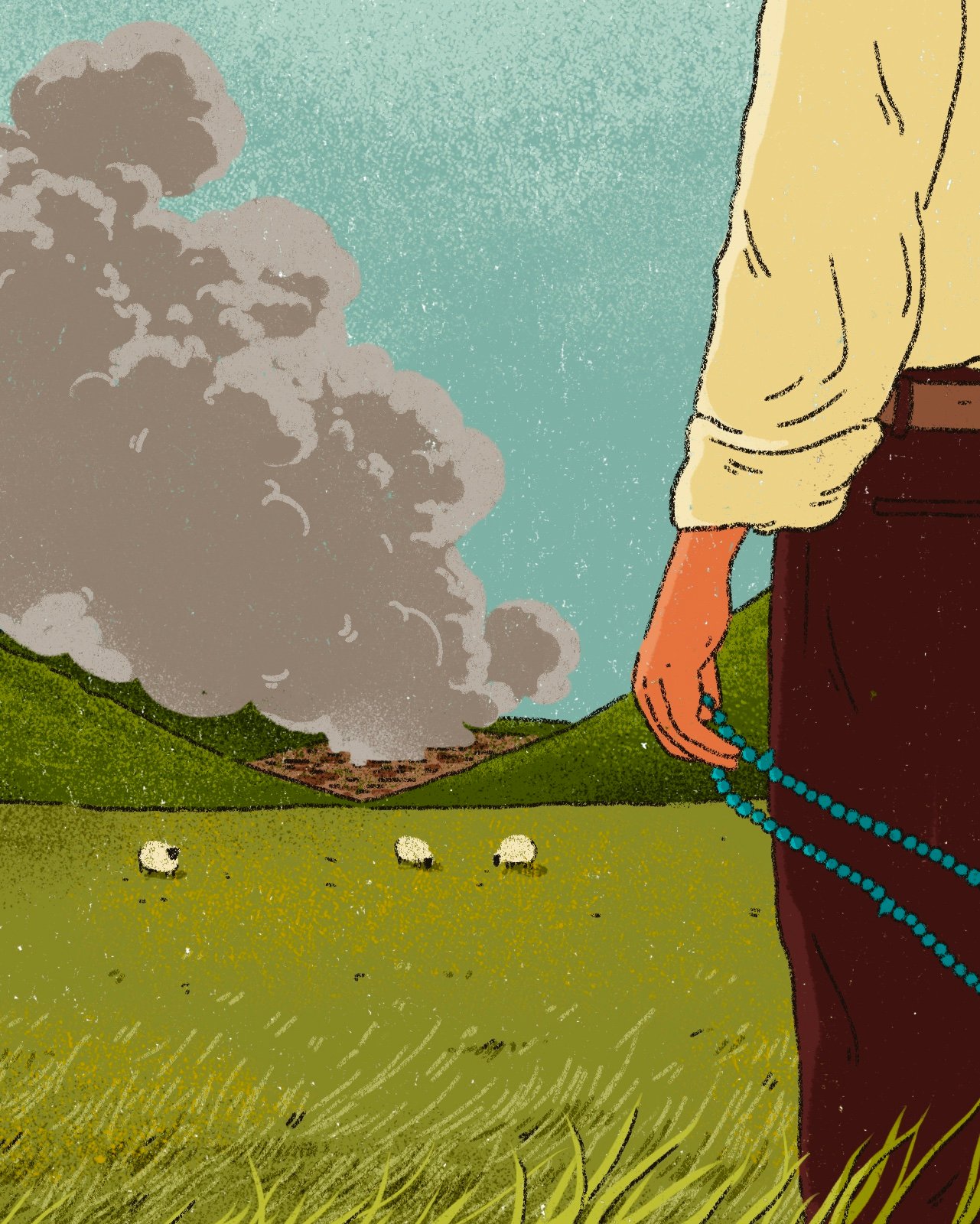 Illustration by @heedayahlockman who says: “This illustration depicts a figure holding prayer beads — a symbol of dhikr and internal spiritual struggle — while gazing toward a landscape where smoke rises on the horizon, representing the external spiritual exigencies of global oppression. In the background, a few sheep are scattered, deliberately apart from the herd, serving as a quiet symbol of resistance.”