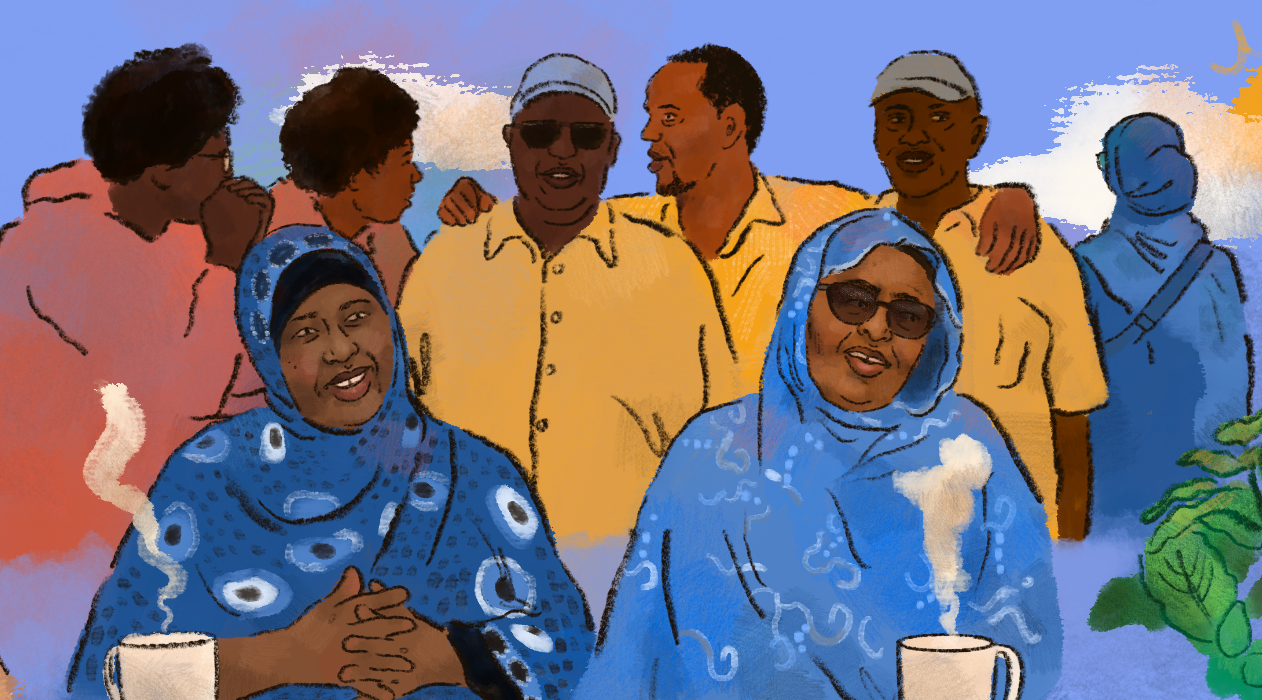

It was a crisp winter’s day when I met with Francesca, the Systems and Governance Lead at Coffee Afrik. I opened the door to a warm room of Somali aunties celebrating, clapping and basking in a good final quarter at Coffee Afrik’s women’s hub in Dalston.
They had just finished a workshop with Sistren Legal Collective, who are supporting these same women to set up as an independent legal organisation. As I stepped in, I was immediately welcomed with the smell of shaah (Somali chai), digaag duban (Somali baked chicken in lemon and spices), and warm hugs from all of the aunties. I spotted Francesca and we embraced before heading outside to chat with our shaah.
Francesca tells me she feels nourished. “It’s been quite a transformative year for Coffee Afrik,” she says. “Devolving this hub back to the community is special because I think power belongs with the community.” This offering provides the essence of what Coffee Afrik is all about.
From Pembury Estate to the world
Coffee Afrik started in 2018 in Pembury Estate in Hackney, by sibling duo Abdirahim and Simeera. They were running a crisis cafe, providing food and drinks for the community in need to come in, and get first response support.
“From that,” Francesca tells me, “the need for physical spaces as means for building community, power, healing and liberation became more apparent.” And access to physical spaces has changed so much over the years, with community spaces gutted and redeveloped through the process of gentrification.
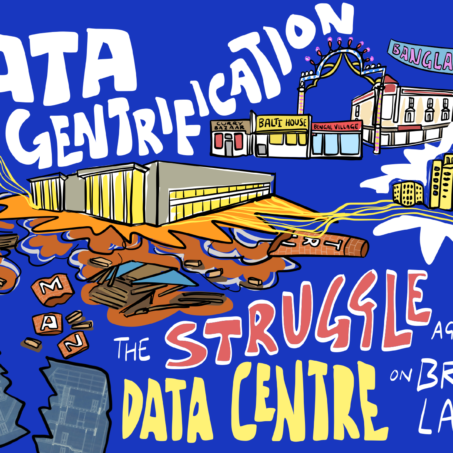
Despite how violent gentrification has been throughout Hackney in East London, Coffee Afrik has been able to build. Between 2018-2025, Coffee Afrik has built eight hubs across East London. “These are spaces for people – particularly women and young people from Black and Global Majority backgrounds – to convene, support each other, build, organise and heal,” explains Francesca.
Francesca describes their women’s hubs as “healing hubs,” places where women who have survived war, domestic violence, racism, and the disorientation of migration can come together and rebuild a sense of self and belonging. Many of them have been in the UK for years, yet still face new forms of oppression here. These hubs provided a lifeline of community and healing to these women.
Decision-making done differently
I learned through our chat that Coffee Afrik’s purpose is about empowering people through knowledge, skills and a deep sense of collective vision to become the leaders of their own communities.
Giving power back to the community is something that deeply resonated with Francesca. She tells me about growing up mixed‑race, half Filipino, half white, and seeing global inequality play out within her own family. She moved to the UK when she was six and talks about migration not as a romantic journey but as a loss of choice. “Most people didn’t want to leave,” she says. “It wasn’t their first choice. So how do we recreate that sense of choice and belonging that everyone is meant to have?” Her commitment to building spaces where people can reclaim autonomy, voice, and direction comes from this deep understanding of what it means to have choice taken away.
Within her role, she thinks about new ways we can do governance creatively and collectively, building systems that facilitate that. “In traditional NGO spaces, especially women’s spaces, there can be a lot of paternalism – but we want to change that. We want to provide a space for women to determine what decision-making looks like, because they know best and they can deliver it themselves.”
What struck me was how different and refreshing Coffee Afrik’s understanding of governance is. For the aunties, governance isn’t a board meeting or a policy document – it’s relational. It’s about holding each other, laughing together, resolving conflict, cooking, creating, and making decisions as a collective.
It’s an alternative vision of what governance can be. These hubs are what Francesca calls “liberated spaces,” places where people can practice the future they want, regardless of whether the state recognises it. “Whether the government recognises that or not, I don’t know if we care,” she laughs. “We’re building up the muscles for self‑determination.”
It’s something I personally think about a lot as an organiser. When does empowerment end and distrust for people being able to lead themselves start? Shouldn’t we be reaching a stage where our groups can lead themselves and we as capacity builders become somewhat obsolete in their journeys?
The women in the hubs know what community building and governance is, and it’s less about dictating what they should be doing, but rather it’s about building up those skills to a place where they feel like they can take control. This is something Coffee Afrik facilitates beautifully, with the long-term vision for the hubs to be devolved, intergenerational and community‑run.
A mission shaped from the ground up
When I ask Francesca why Coffee Afrik focuses on such a wide range of issues – from the women’s hubs to youth organising, to harm‑reduction to housing justice and community‑led research – she smiles and says: “These issues aren’t abstract, they’re happening right in front of us.”
Their mission emerged from listening to and observing what people were experiencing in Hackney and Tower Hamlets: housing precarity, displacement, health inequalities and public services that were well‑funded on paper but failing the very people they were meant to serve.
Something I deeply admire about Coffee Afrik is their two-pronged approach to tackling community issues, targeting both immediate needs and long-term structural change. They follow in the organising traditions of civil rights movements and Black liberation movements, with the Black Panther Party being a huge inspiration for the community hub model. Meeting people’s basic needs around food, warmth, community and care leave more room for dreaming and evolving.
Safe spaces provide a launch pad for thinking about how we make sure everyone’s needs in the community are met. This is summed up beautifully by Francesca: “I think if you’re dreaming of liberation and life affirming structures, I don’t think you can do that, without having the basic needs met of food, housing, community. For me, collective care goes hand-in-hand with organising for the long-term.”
The young always inherit the revolution
The world the young people are inheriting is unfortunately bleak: rising rents, fewer opportunities, less state funded programmes, police violence, and mass displacement from the areas they’ve known and loved. SImply put, young people are being shut out of opportunities in the places they grow up in.
“Displacement is a big problem,” Francesca agrees. Many of the young people Coffee Afrik works with were born and raised in East London, yet they don’t see themselves reflected in the opportunities around them.
Join our mailing list
Sign up for shado's picks of the week! Dropping in your inbox every Friday, we share news from inside shado + out, plus job listings, event recommendations and actions ✊
Sign up for shado's picks of the week! Dropping in your inbox every Friday, we share news from inside shado + out, plus job listings, event recommendations and actions ✊
Francesca tells me about a piece of research Coffee Afrik conducted earlier this year with 200 Black and brown young people in Tower Hamlets. “Around 90% felt that better opportunities existed outside the borough,” she says. “Which is wild, considering Canary Wharf is right there, people flock here for opportunity.” She pauses. “That feeling of living parallel lives in your own home, that’s structural violence.”
When you think about how many promises of opportunity were made to East London – everything from the Olympics, regeneration schemes and investment – it’s almost criminal how little of that has translated into real opportunity for the communities who were meant to benefit. Instead, the gap has widened.
This is where Coffee Afrik’s youth work becomes so vital. Led by Khaleel, the Youth Hub is a site of political education, economic imagination, and community wealth building. “We talk a lot about solidarity economics,” Francesca explains. “How can we create opportunities that actually bring wealth into the community, instead of extracting it?” She describes the constant churn of businesses and corporations setting up in Tower Hamlets, taking money out of the borough and into international companies or investors who have no relationship to the people who live here.
In response, Coffee Afrik has been running workshops with Nourishing Economics on decolonising economics, regenerative business models, and community wealth building. The young people have been developing their own sustainable business ideas, ideas rooted in the needs and dreams of their own neighbourhoods. They’ve been piloting them, refining them, and receiving mentorship from local thinkers and organisers. “It’s been one of our proudest moments,” Francesca says. “Watching young people imagine futures where they are not excluded, but central.”
If you teach the people how to build community, you feed them for a lifetime
Coffee Afrik’s approach to community building is one I really admire. “It’s about creating space for self‑determination,” explains Francesca. “It’s intergenerational healing, building community power, and even thinking about land, about stewardship.” It’s a reminder that community building isn’t just about programmes or services; it’s about creating the material and emotional conditions for people to shape their own futures.
Through Coffee Afrik’s collaboration with illustrator and artist Javie Huxley, the aunties have learned skills like weaving an arpillera, a Chilean form of textile protest during the Chilean dictatorship. The women at the hub are currently collectively weaving an arpillera to detail the futures they want to build. They’ve been learning bench-making, co-designing and physically making a bench for a new community space in Tower Hamlets. “As they were drilling, many of the women were saying, Oh, I don’t need to wait for a man to do this anymore – proving we all have the power to actually make things and just we’ve got those skills within us.”
Coffee Afrik have been doing this work for nine years, and have set out their 10-year strategy, not only based on numerical targets, but also long-term relationships, funding and strategy. “It takes a long time to build infrastructure and trust,” Francesca says. “Everyone has a say in it – the aunties, the young people. We convene together.” It’s slow, deliberate work, but it’s also what makes it sustainable.
Self-resilience as organising practice
I love this approach, because it makes people decision-makers rather than participants. It’s a huge part of what keeps people committed to the long term work: when you help shape something, you feel responsible for it and you want to see it through.
In my own organising, this approach has proven true also. Communities didn’t stay involved because I arrived with a vision and tried to convince them of it. What brought people in – and kept them in – was creating space for them to name the futures they wanted, what they needed, what was standing in their way, and more importantly, how they wanted to work together to get there. Bringing people into the process early meant they shaped the work from the beginning. That built a sense of personal and collective responsibility: not just to the goal, but to each other.
And honestly, nobody organises like an auntie. If you need a room filled, give an auntie a WhatsApp broadcast list and watch magic happen. Deeper than this, it shows how women are the keepers of community, the holders of culture, memory, and relationships. It is more endearing to see how Coffee Afrik honours and nurtures that truth.
Many of us are trying to build self resilience in our communities and we can look to Coffee Afrik as an example of this working well. I ask Francesca to name a moment when she realised this approach worked. She lights up and says “The first hub being devolved to the community has been transformative. At the first session, the women were nervous. Curious, but unsure.” But over time, they stepped into their power. They named themselves the Hackney Sisters Hub, designed their governance structure and decided how they wanted to make decisions. “Seeing that progression has been incredible,” she says. “They realised they can lead, and now they’re excited to.”
The youth hub offers another blueprint. A young person who came up through the hub is now the youth lead, supported by youth interns who are also gaining qualifications. They run the space, support other young people, and many of them want to do this work for life.
She speaks with particular tenderness about the youth spaces. “They can be whatever they want to be there,” she says. “No harm from school, no police, no judgement. Just space to imagine.” In a moment where youth workers and youth centres have been decimated, these spaces feel even more vital.
Here to stay
Listening to Francesca makes me realise that what Coffee Afrik is building, is being built to stay. Their approach to community and power building ensures the people are at the helm of the future they’re trying to build. Francesca and I were coming to the end of our conversation, and I felt so invigorated and inspired by everything we spoke about.
The topic of longevity came up a lot in our conversation and what it means to stand the test of time in a transient city like London. “Another challenge that we face, particularly in East London, is around the precarity of space,” says Francesca. “We need permanency. That means land ownership, land stewardship – places where people can physically go.”
She questions how capitalism warps our sense of value. “Why is this land more important to be sold off to developers than being kept in the community where it’s been the community centre for 30 years?” she questions. When monetary value is prioritised above the cultural, political, social value of community, gentrification becomes inevitable in this city, and with it comes the slow disappearance of the very people that make this city and areas like ours what they are.
But land isn’t the only part of the vision. Francesca sees Coffee Afrik’s practice of community wealth deepen, creating structures that bring money back into the community. She sees regenerative businesses, community-owned assets and economic models that circulate wealth rather than extract it. The work of systems change is equally important. “We want to keep rallying the community, to keep campaigning, to keep challenging and to redistribute the authorship of our lives,” explains Francesca.
I end by asking what legacy she hopes Coffee Afrik will leave. “I hope these spaces are still here,” Francesca responds. “Or whatever form they take, whether it’s one big hub that’s owned, or hubs that the community takes forward themselves.” The hope is that these hubs will continue to grow, evolve, and eventually be fully held by the people who built them. “Giving back power, assets, resources,” she says. “That’s the journey.”
What can you do?
Support for Coffee Afrik:
- If you’re a young person in East London, come to the to the Youth Hubs
- Donate to the community bank account
- Get in touch with Coffee Afrik through their website
- Follow Coffee Afrik on Instagram and Twitter
Resources recommended by Coffee Afrik:
- Read My Grandmother’s Hands by Resmaa Menakem
- Read Coffee Afrik’s report on systemic violence in Tower Hamlets which they co-authored with 200 Black and Brown children from the borough here
- Check out books by Adrienne Marie Brown and Audre Lorde
Other articles by Simmone:
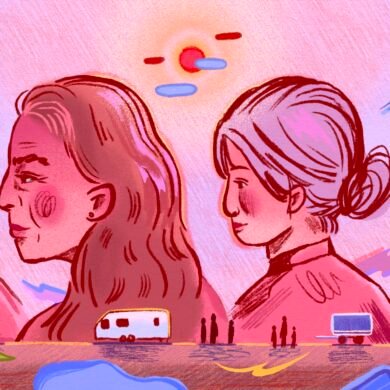
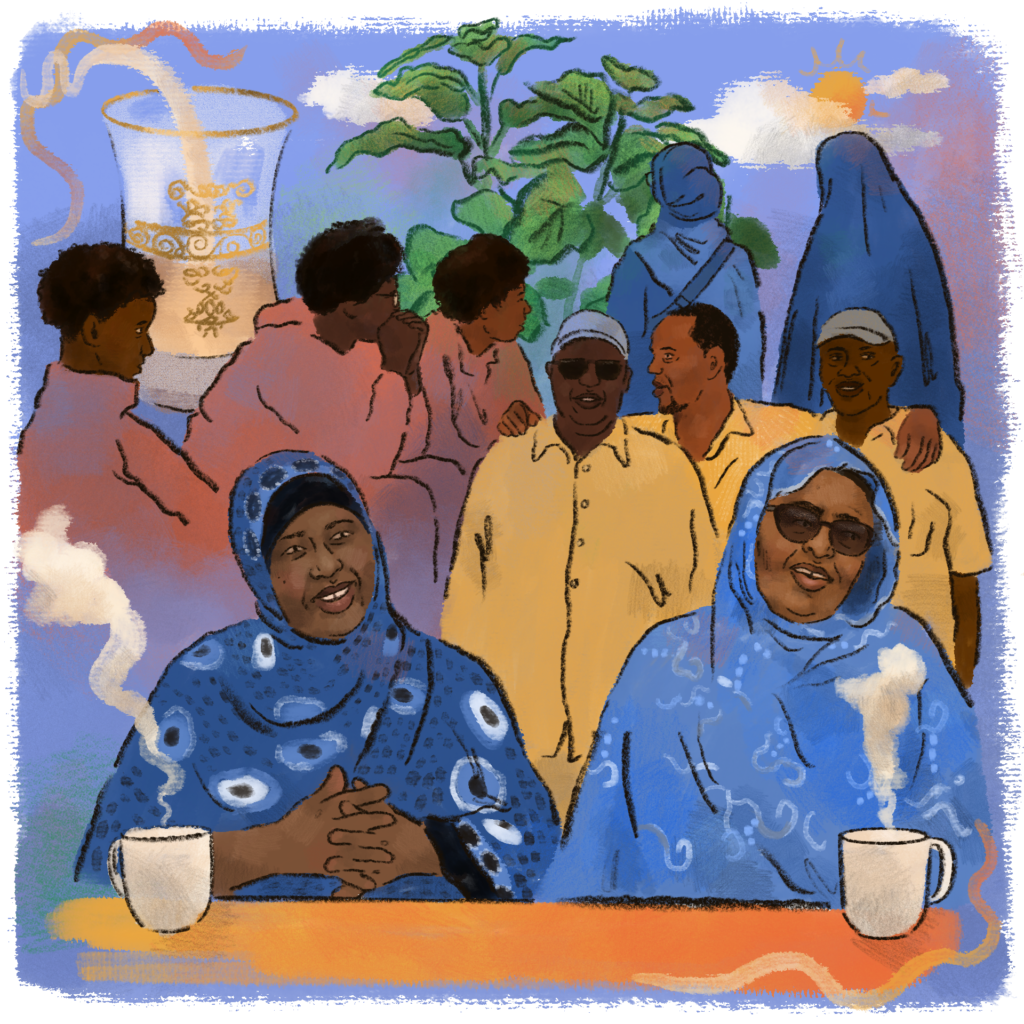 Illustration by @javhux who says: “The artwork is a glimmer of life at the community-led hubs at Coffee Afrik. The women’s hubs, youth hubs and health justice hub. The plant in the background is a nod to the gardens tended to at the spaces and the steaming drinks represent the shaah (Somali tea) you’re often warmly greeted with, which Simmone writes about in the piece. I wanted the artwork to give a sense of the love, care and nourishment at the hubs. With the iconic Somali aunties laughing in the forefront.”