
Microsoft, Cisco, Google, Amazon – you name the tech company, they are investing heavily in Israel. But could this co-dependence on the tech sector be a chink in Israel’s nanotech armour?
In September 2025, headlines broke that Google signed a $45 million contract with Netenyahu’s office to spread Israeli propaganda – describing Google as a ‘key entity’ supporting the Prime Minister’s messaging. X reportedly received another $3 million.
The latest in a two-year cascade of investigations exposing Big Tech’s direct investment in Israel’s genocidal project, evidencing the billionaire funded propaganda machine. The scale of this machine is gargantuan and nebulous: manifesting as a dull ache of hypocrisy and fear as I boycott coke but happily write this article on Google Docs.
“Tech is the foundation of Israel’s apartheid economy – or as it’s branded, ‘start-up nation’.” says Bella, coordinator of the Boycott, Divestment and Sanctions (BDS) tech campaigns, tells me over Zoom in first of several conversations with organisers working in the tech-resistance space. “Silicon Valley and other hubs pour billions into Israel. The apartheid economy couldn’t function without the tech sector.”
In 2024, high-tech made up 17% of Israel’s GDP. Intel alone accounted for 1.75%. This is an unusually, dangerously high figure: Israel is dependent on Big Tech to legitimise, finance and maintain its regime. Breaking those ties, making the Israeli investments unprofitable, could fracture the genocidal project at its core – and this work has already begun.
Let’s start with the workers
In 2024, an anonymous letter from Google and Amazon employees exposed Project Nimbus, a $1.2 billion joint contract to provide cloud, AI, and other tech infrastructure to the Israeli government and military.
Horrified at how their labour was being weaponised, workers launched No Tech for Apartheid, staging sit-ins and public protests that forced Google into damage control, ultimately firing 28 employees. (If you happen to be a Google or Amazon worker, you probably have already heard of this, but if you haven’t, sign up here.)
In May, Microsoft admitted supplying AI services to Israel’s military: denying its tech would be used to harm civilians even as it fired the employee who spoke up against this very thing. We’re seeing the perfect storm of worker repression, propaganda, and secret contracts which have been rehearsed over the past decade to evade accountability.
“Tech workers want to know how their labour is used,” she explains, detailing how the outrage in response to Project Nimbus led workers across Amazon, Apple, Cisco, Google, Intel, Microsoft, Oracle and Salesforce to form the Tech Divestment Network. This worker-led coalition supports organisers through shared resources, coordinated campaigns, and strategy tools.
Each company presents specific challenges requiring different modes of organising “Google workers are arguing that using their labour for genocide is a workplace health issue, appealing to existing labour laws to legally protect those who refuse participation.” notes Bella.
It is important for us, as tech users, to listen to the workers to understand how we can utilise our position to support. No Tech For Apartheid are currently calling for social media users to mass report Israeli propaganda ads seen on Google and YouTube. Under Article 25 of the Rome Statute, these could be considered public incitement of genocide, a blatant violation of international law. To support mobilising workers, we can flood Google’s internal reporting systems and pressure Google to remove all of these ads and make these partnerships less profitable and appealing to Google. Poland has already demanded that Google remove these ads, but Google refused – we can build on this momentum.
“This is a workers’ issue,” says Bella. “Wherever employees stand up for Palestine, they’re fired or silenced. We have reports of companies where you can’t even say Palestine.”
We know tech workers are not alone in experiencing this repression, but the design of the tech sector makes it extremely difficult to mobilise within. The tech sector’s heavy use of on sub-contracting and gig-contracting fragments the workforce, alongside heavy surveillance and the lack of worker protections making most jobs extremely precarious. Further, most tech unions are in Europe, but with the concentration of tech workers in the US, Asia and the Pacific, where unionising is extremely difficult.
All this to say, the workers speaking out and creating these coalitions are extremely brave and precarious – collectivisation, public support and international solidarity are extremely useful for these burgeoning tech justice movements. The overwhelm and turning away only benefits our tech overlords.
And it’s not just tech workers
You don’t have to be a tech worker to stand up against tech companies. With comparatively stronger unions and more worker protections here in Europe, we can all consider how as workers we mobilise against the encroachment of tech within our various industries.
In the UK, Health Workers for a Free Palestine (HW4FP), alongside a coalition of health workers’ and health justice groups, are fighting the creeping influence of Palantir, an American software company, in the NHS.
“Med-tech is central to Israel’s economy,” says an organiser from HW4FP. “It’s where they repackage surveillance and military tech for new markets. The health system is a key site of expansion.”
In 2023, Palantir secured a major contract to manage the NHS’s federated data platform, potentially creating the largest health database in the world. “It didn’t happen overnight,” says the organiser. “It followed years of lobbying and quiet negotiations.”
Then, in October 2023, Palantir ran a full-page New York Times ad declaring: ‘Palantir stands with Israel.’ Three months later, it was supplying AI weaponry for use in Gaza.
Palantir is not a health company. It specialises in supporting government agencies to use surveillance and big data technology to identify and target people in conflict zones, at our borders, or for policing. “We know that they are working with ICE and running the logistics for the mass deportations in the US,” the organiser continues. “The NHS is just its latest frontier.”

Join our mailing list
Sign up for shado's picks of the week! Dropping in your inbox every Friday, we share news from inside shado + out, plus job listings, event recommendations and actions ✊
Sign up for shado's picks of the week! Dropping in your inbox every Friday, we share news from inside shado + out, plus job listings, event recommendations and actions ✊
The contract between NHS England and Palantir was heavily redacted when published: 417 of 586 pages blanked out in initial release. This low public trust, plus unreliability of the software and pressure from health workers has found only 15% of NHS trusts are actively using the software.
Instead of seeing big tech’s influence as overwhelming and unstoppable, we can reframe it as an opportunity to politicise our workplaces and ask deeper questions. HW4FP have used the fight against Palentir to radicalise new organisers and expand the radical potential of health justice, connecting the dots between Palentir and the expansion of surveillance, border policing, and privatisation into the National Health Service.
But unions cannot do it alone
In other workplaces, this could look like: what software and tools are we using? Where are there more ethical sites and tools that we could employ?
The BDS movement focuses on tactics such as contract exclusion campaigns to collectivise this effort, and working to ensure pressure is coming from the outside as well as inside.
One key BDS target is Cisco, a US telecoms giant whose systems underpin Israel’s surveillance and security infrastructure in the occupied territories. “We have workers organising inside Cisco,” Bella says, “and BDS is coordinating contract-exclusion campaigns with local councils from the outside.” These campaigns urge institutions to drop Cisco products like WebEx, which is also used by the Israeli Defence Forces.
“We’ve seen real wins with lobbying for contract exclusions,” Bella adds. In 2016, a farmers union with over a million people signed onto the HP boycott pledge and later in 2018, India’s largest student federation passed a motion to boycott all HP products.
From unions, to BDS, to local activists, the broader ecosystem of activism emerges and we can all locate ourselves within it. As a worker, even if you don’t work in tech, you can organise internally around software contracts and ethical procurement policies with software run by BDS targets.
What can we do as consumers?
Boycotting tech is hard. “These companies are monopolies, practically public infrastructure,” Bella says. “It’s much easier to buy a different pair of shoes to, say, our other target, Reebok…”
But the same reach that makes tech powerful also makes it vulnerable. Microsoft, now a top BDS target, is deeply implicated. Investigations by The Guardian, AP, and +972 Magazine found Microsoft embedded in all major Israeli military infrastructures, its Azure cloud hosting “sensitive” and “classified” operations, its tech driving “combat and intelligence activities.”
“We’re prioritising Microsoft like never before,” Bella explains. “Its profits come mainly from institutional contracts (governments, universities) so we’re pushing divestment campaigns.”
That pressure works: BDS sent over 200,000 letters to Microsoft executives and gathered 2,100 worker signatures demanding an end to AI-powered complicity. In 2020, under this pressure, Microsoft divested $74 million from AnyVision, an Israeli facial-recognition company powering apartheid checkpoints.
More recently, BDS organisers and Microsoft workers have mapped the company’s third-largest revenue stream: gaming. In August, the Arkane Studios game workers union (STJV) published an open letter urging Microsoft to end contracts with Israel and conduct a public human-rights audit of all tech and partnerships. Again, workers and consumers can align with specific targets for serious impact.
“It’s easier for us as consumers to boycott games than enterprise software,” Bella says. “Avoid Xbox, Minecraft, Call of Duty, Candy Crush and support the workers from the outside.”
Simultaneously, a month after the investigations published by the Guardian, +972 Magazine and Local Call, Microsoft cut off the Israeli military’s access and launched an external probe into Unit 8200, Israel’s elite spy agency, citing “violations of terms of service.” These are wins we don’t often hear about, they are not snappy but complex, where pressure comes from all sides.
There are cracks!
These tech companies are in the business of war and apartheid: it is and always has been profitable for them. The clearest example is IBM, the American multinational technology company. Since its establishment in 1911, it has provided technology to Nazi Germany in WWII, supplied computers for the racist population registry of the apartheid regime in South Africa, and developed racist surveillance technology for the US police force. Today, it designed and operates the Eitan System of the Israeli Population, Immigration and Border Authority which collects data on the occupied Palestinian and Syrian people. Apartheid is literally their business model.
Palestinians have been saying for the longest time: tech is invested in oppression, these technologies are developed to oppress and exploit all of us.
But these grassroots movements demonstrate that, while it may not feel like it, pressure works – we just need more of it and from all sides. Pay attention to the wins and replicate them at mass scale.
“We may not all be gamers, but we are tax payers, we are workers, we are students. We belong to these different communities and organisations. Think about the collective power we have.”
Big Tech feels untouchable because it wants us to not pay attention, they control the algorithms that control how we perceive the crisis. Read independent media, boycott Microsoft games, organise in your workplace and local government and pay attention to the wins. The precedent has been set.
What can you do?
-
- Check out BDS’ call to action
- Spend 30 mins supporting mass reporting of Israeli Propaganda, for No Tech for Apartheid.
- If you are a tech worker in the UK, check out UTAWs work organising for Palestine
- Follow: Health Workers for a Free Palestine (UK) (@hw4fp.uk) • Instagram photos and videos
- Read:NHS FDP Rollout information
- Read: No Palantir in the NHS! Campaign Toolkit – Medact
- Take action against Palantir here
- Read more pieces by Zoe here
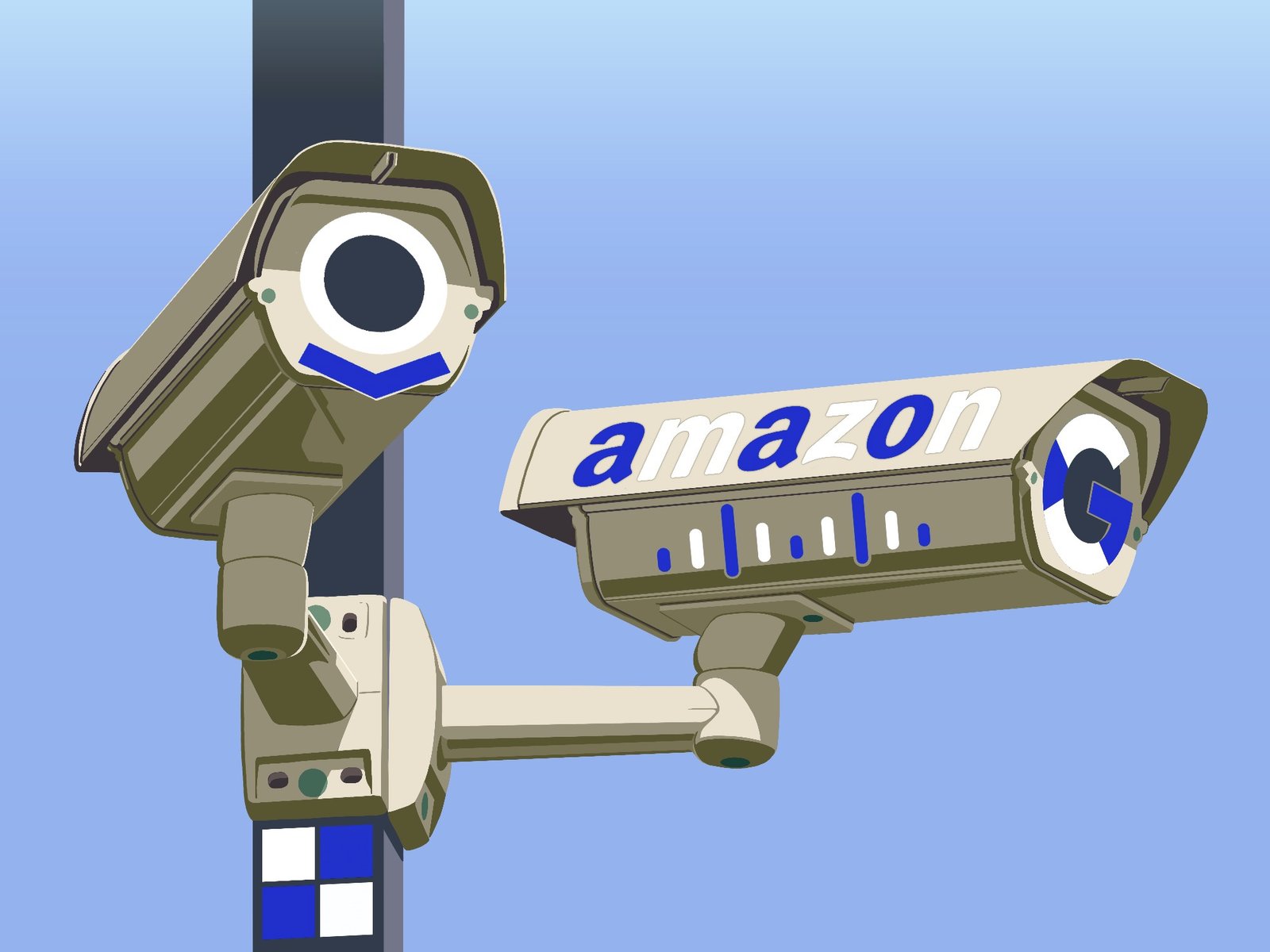
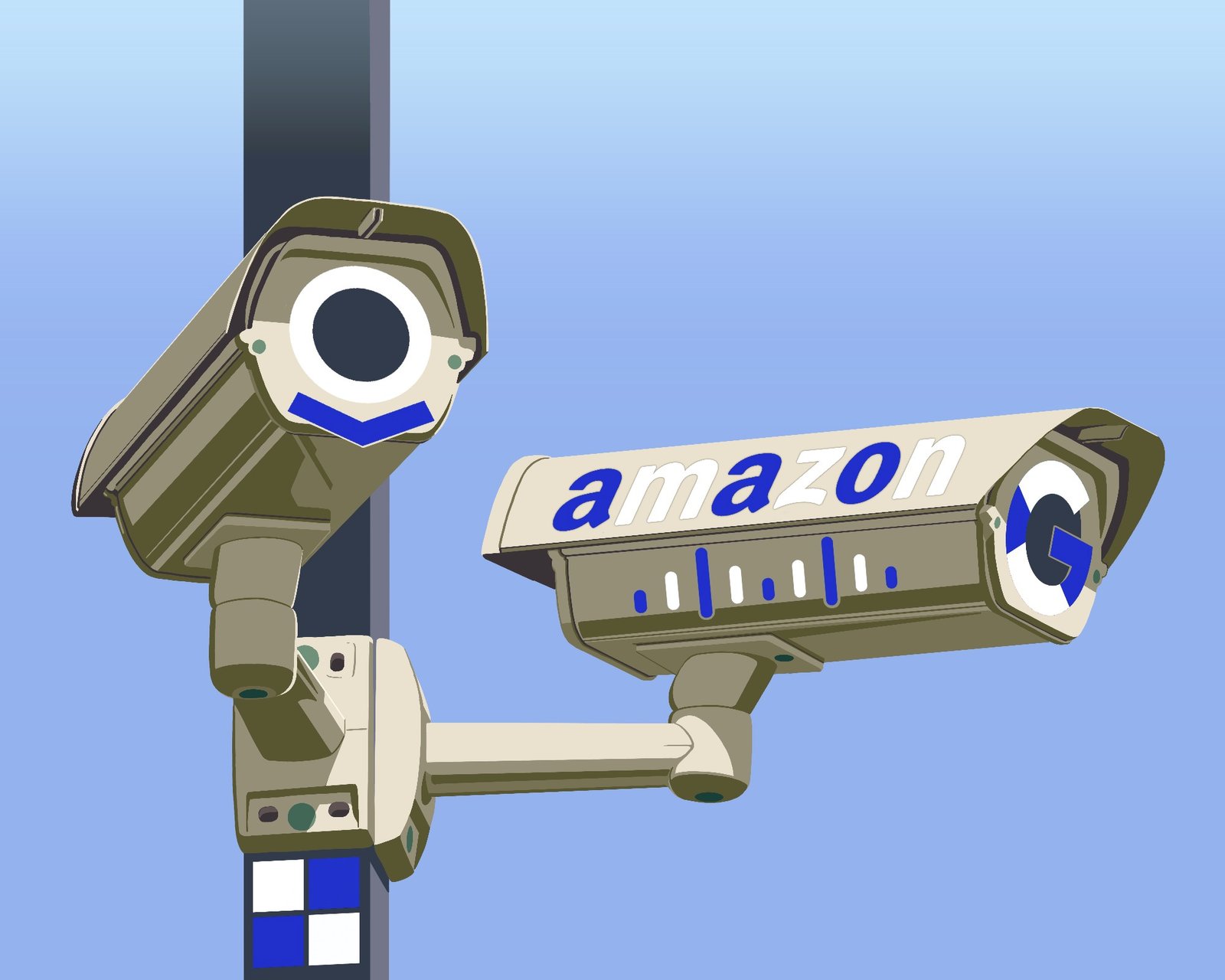 Illustration by Walker Gawande who says, “I chose to depict this article using classic cctv cameras, given that they are a well-known symbol of surveillance. I superimposed onto these cameras some of the logos of the tech companies which have collaborated with the Israeli government to evoke their partnership.”