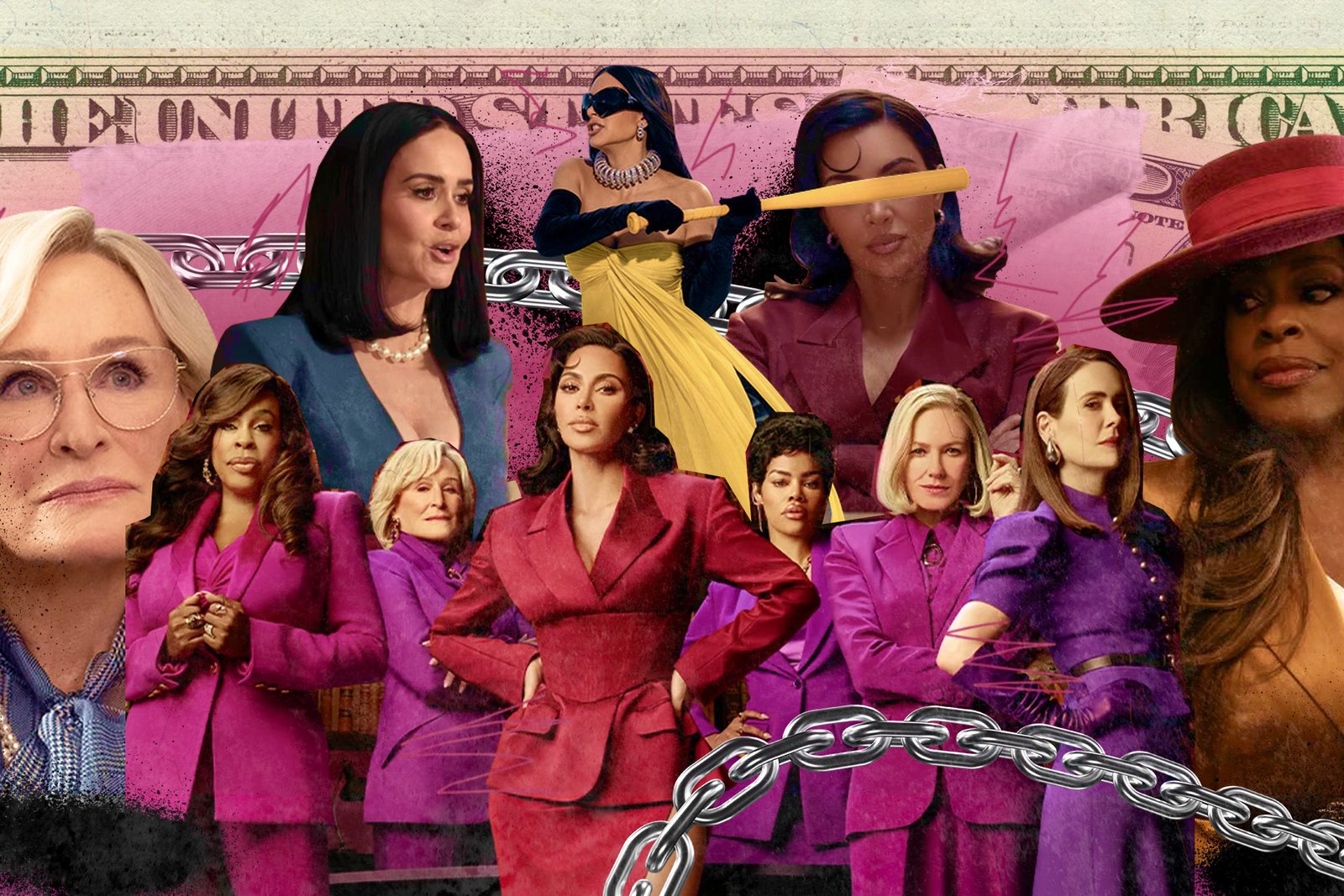

Since the severely protracted announcement of its coming, Ryan Murphy’s All’s Fair created a sparkling buzz of anticipation. The official premise: a women-owned divorce law firm exclusively representing women held up by the feminist principles of solidarity, or as the scriptwriters put it, “women helping women.”
The adversaries in this battlefield are wealthy, abusive, greedy, controlling, corrupt men trying to cheat their ex-wives out of the wealth they invested in them. Disempowered and controlled through money but empowered through reclaiming it, these women are positioned as the heroes in the fight against patriarchy.
The show’s promotion successfully baited audiences with grand displays of wealth and excess in the form of exorbitant luxury cars, private planes, “dream homes” and an endless runway of beautiful fashion. Of course, the strategy of rebranding wealth and excess as legitimately commendable when women control it, is one of the most popular flavours of Kool-Aid being served up today.
Admittedly, I enjoyed the show’s sparkly optics and ate up the (mostly) elegant fashion, but what lies behind that is not a thoughtful story of women resisting patriarchy. Instead, it’s a promise of seeing yet another version of the very opulent public life of its lead cast member. All’s Fair makes a promise and offers a premise that is one and the same: Kim Kardashian – the least feminist, most capitalist person you know.
Great casting as a cover-up for bad writing
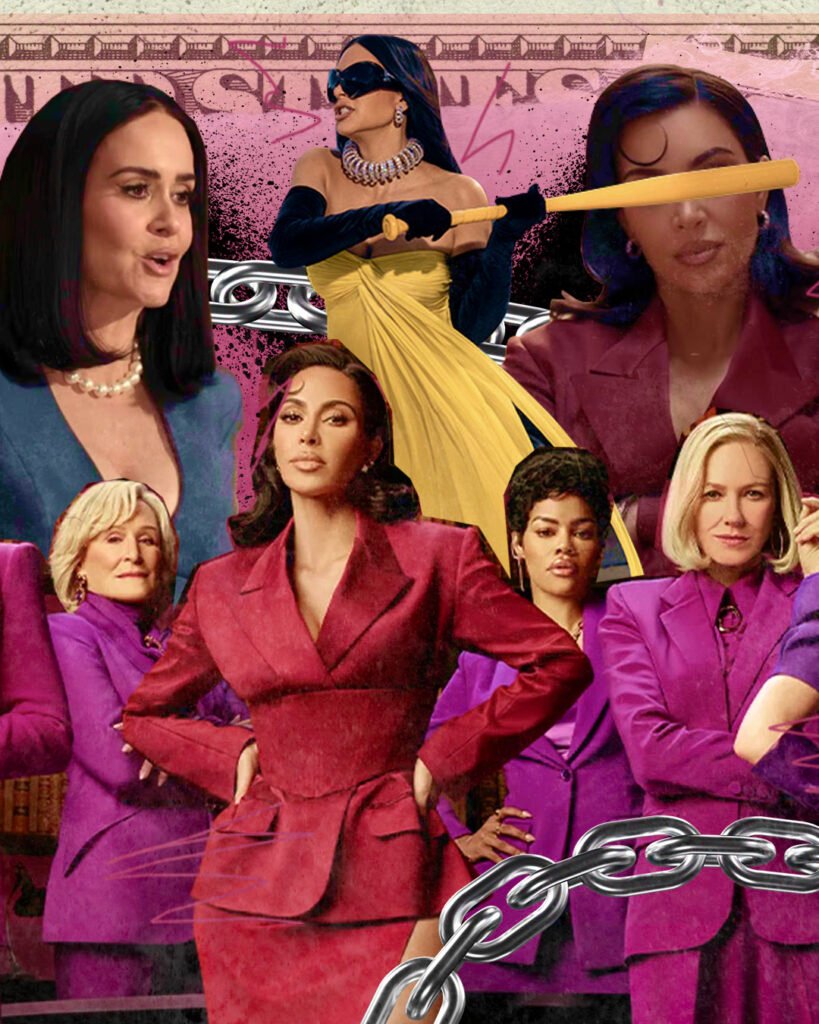
The law firm is run by the divorce law world’s Avengers: Allura Grant (Kim Kardashian), Liberty Ronson (Naomi Watts), and Emerald Greene (Niecy Nash-Betts), with the mentorship of senior Avenger Dina Standish (Glenn Close), the paralegal support of Milan No-Surname (Teyana Taylor), and rivalled by the sociopathic once-ugly-duckling-turned-glamour terrorist Carrington “Carr” Lane (Sarah Paulson).
The reviews for the show, despite its high viewership, are extremely poor by general consensus, and it’s been criticised for many reasons, including Kim’s acting, a G-string-baring power suit and ridiculous, unbelievable plot points. But personally, I am struck by the writing.
Throughout my first watch, I simply gawked and sometimes chuckled incredulously at what these iconic actors were being made to say. There was no way that Sarah Paulson was happy to perform that “My Pussy” monologue.
But, upon watching it a second time, I realised that the script was a compilation of rage-bait topics battled out over social media in the last decade. Piping a mishmash of trendy and controversial talking points into the script left us with a himbo sex-addict husband almost toppling Allura’s law dynasty, a trans ex-sex worker who wants heteronormative currency, a slew of strategic blackmail presentations leveraging participation in queer sexual practices as career-ending, and a Diddy “freak-off” joke – to name a few. However, instead of being picked up and thoughtfully ruminated on, these topics were dealt with flatly. It felt as though the writers had no experience of what the characters were talking about, because themes were addressed in such elementary, uncomplicated ways, leading us back to the show’s feel-good, but empty slogan: “women helping women.”
This is offered to audiences to appease a trend in current filmmaking that allows viewers to feel that their views, thoughts and experiences are represented without challenging any of the harmful normative assumptions and statements they make.
Capitalism is not the antidote to patriarchy
The pursuit of disproportionate wealth is inherently a capitalist endeavour, inextricably linked to the patriarchal need for domination. We do not want any more people, of any gender, with excessive money and power to dominate the world. Capitalist women have never been an acceptable alternative to capitalist men.
Furthermore, these capitalist girlbosses become mired in a multitude of ethical concerns in their pursuit of victory. When recalling some of their favourite cases over the years, Liberty, the British character, takes great ‘feminist’ joy in having saved an English rose from the cruelty of an Arab sheikh who threatened to behead her. Invoking the discourse of delicate white femininity having to be saved from the savagery of Arab and other racialised men already positioned as “swarming” Europe and the USA through immigration is too neat to be coincidental in our current political circumstance.
Liberty also takes on the case of a New York socialite who, wealthy by proxy of her powerful husband and known for her eye-bulging jewellery collection, is kicked out after publicly humiliating him by cheating. A direct violation of their marriage contract, she would leave with nothing. Liberty to the rescue again, with a plan to walk her out with her jewellery (considered gifts under California law where they married and exempt from this stipulation) and sell it at auction for a potential $40 million. All of them fawn over the jewellery and plan to acquire some as a great display of feminist solidarity to save her wealthy life. Solidarity with a rich woman’s jewellery collection at a time when the USA is looking to loot the world for minerals is certainly a choice.
How the show treats Black characters
The show’s main premise of money being the answer to the world’s problems falls down when dealing with its Black characters.
There is a visceral, visible, harrowing quality to the challenges experienced by the Black women in this show. Despite having money (or access to it), Black women are still very much in the struggle – a struggle that does not leave them alone, even when warded off by the protection of a 24k solid gold Chanel belt buckle.
Emerald, the third partner in the firm, spent most of her time focusing on career and her children. She’s finally open to enjoying her social life now that her youngest is going off to college, and of all the things her feminist friends could encourage her to do with her time, they encourage her to get back to dating. After she reluctantly agrees, on the first night out at a single’s party, she is drugged and violently assaulted by a handsome suitor she picked out of the crowd. We see her with a bloody knee and ripped clothing the next morning.
Emerald is also a former cop, which is what makes her the invaluable lead investigator on cases, dredging up blackmail material when needed (and it is needed quite often). These traits are nothing but egregious copaganda, and yet we are also supposed to believe an ex-cop and lead investigator who reads danger for a living completely dropped her guard at the sight of a handsome stranger.
Then there’s Milan who, after getting pregnant by Allura’s sex-addict husband Chase, is fired (and later helped thanks to Allura’s magnanimous feminist conscience) and staying down on her luck for most of the show, where she is constantly in some form of financial or emotional turmoil. She admits that her motives are driven by wanting to be Allura, as all women supposedly do. Yes, she did it because she wants to be a rich white woman.
While white characters are afforded glimmers of fullness and nuance, the Black characters, although obviously coded as Black through mannerisms, speech and humour, offer very little in the form of cultural context.
The only parts of their lives that endure into the show are their struggles – though at no point is it suggested that these struggles have anything to do with being Black women. While their Blackness is not hidden, tempered, or covered up in their character expressions, it is certainly absent in the main feminist message of the series, which is where it matters most.
Giving nuance an even, flat trim lowers real life expectations
For those saying I simply expected too much from this show, I counter: what should we be expecting from the most powerful storytellers in the world when they are mincing women’s lived experiences into a diamond-encased “all women’s struggles are the same under patriarchy” sausage?
Join our mailing list
Sign up for shado's picks of the week! Dropping in your inbox every Friday, we share news from inside shado + out, plus job listings, event recommendations and actions ✊
Sign up for shado's picks of the week! Dropping in your inbox every Friday, we share news from inside shado + out, plus job listings, event recommendations and actions ✊
My main concern with this series is something so brazenly clear that it seems patronising to state it. In a time when the US and many of its Western counterparts are dismantling women’s rights and queer rights, we are being fed tepid, one-size-fits-all feminist messaging couched in a yearning for billionaire-ism.
When it is revealed to us over and over that rich people are running this world without a shred of ethics, we must become highly sceptical of the stories they tell us and the optics they fund. When so much of art is funded by ruthless, rabid rich people whose first and only loyalty is to money, we must ask what they get out of it, and how we get out of it. It also raises a question, which is: how do we respond to bad art? Do we ignore or do we watch?
We might not all have to watch, but we must know what these people are saying and how it affects the climate surrounding the conversations we are having about our collective liberation – these things are not unrelated. We must respond with critique, not because we think they care or will listen, but because the influence of this American entertainment machine on the world’s social consciousness is deeply devastating when directed by people who have a vested interest in the world staying exactly the same.
Toothless feminist discourse is not harmless in the hands of Hollywood
All’s Fair is a fashion show dotted with themes of millionaire girlboss feminism and mental illness, which at times seem to be the same thing. Is she a feminist or just a mad woman? The script does not deliver enough on this idea, which could be done in an interesting way, if critical. It results instead in a weak point of view that leaves us with “feminists are mad women” in very stereotypical ways. Feminism is a thin veneer scattered along the edges of a script ripped from social media “gender war” discourse. Stripped down to its bare bones, this show is nothing but pointless billionaire propaganda for the Hollywood glory of it all, from a time when the US was successfully selling itself as a paradise through film.
In this particular historical moment, with the distortion of so many liberatory ideologies, like feminism, being collapsed under “wokeism” to justify anti-human rights backlash, we can ill afford to let powerful capitalists sell our lived experiences back to us.
While the US and Europe are teaming up to start a new cycle of colonial expansion, we must maintain an intolerance for the sociocultural narratives they feed us across the globe. As the entertainment wing of a war-mongering military power, Hollywood is as much our collective enemy as the politicians that set their mandate to sell the state’s cultural wares. This distraction, which bores the tentacles of American exceptionalism into us, must not be allowed to slip from view, lest we hand the world on a platter to enduring US influence, yet again.
What can you do?
Read:
- Bad Feminist by Roxanne Gay
- Lethal Intersections: Race, Gender and Violence by Patricia Hill-Collins
- Today’s Feminism: Too Much Marketing, Not Enough Reality by Amy Alexander
- Other articles by Jamil
Watch:
 Design by @alexefrancis