For two years, during the genocide in Gaza, I wrote almost every day. Articles, analysis, social media posts – sometimes several in a single afternoon. I was productive, but that word never fit perfectly. Writing wasn’t a way to be productive – it was a way for me to keep functioning.
My body lived in a continuous state of alert: tense muscles, difficulty resting, and the constant expectation of the next message, the next name, the next news headline. Writing also became a form of grounding. It helped me process events that were otherwise too heavy to hold. And it felt necessary – not only for myself, but in relation to Western audiences whose narrative about Palestine was shaped by distance, misinformation and political agendas.
Documenting and contextualising what was happening was a responsibility. Not because I believed I could change the Western orientalist mentality, but because silence during erasure is impossible for us.
Editorial racism
But, finding space for my writing in the media field was far from simple. In the early months of the genocide I was regularly dismissed by editors as “too angry” – labels often attached to Palestinians who refuse to dilute their analysis.
I looked to an independent media outlet to publish my work, but the editor initially refused to let me write about Gaza. She said it was “too risky” to assign such a topic to someone “emotionally involved”, as if proximity to my own people’s experience cancelled out my geopolitical knowledge, and as if professionalism required emotional distance from a genocide.
She assigned the piece to a non-Palestinian journalist. When that person dropped out, the article came back to me – but with an entirely different level of scrutiny. Five editors were suddenly assigned to review my work, when normally only two would have been involved. None of them had expertise on Palestine, yet they insisted on edits that revealed discomfort rather than editorial necessity: at one point they asked me to add references to anti-Netanyahu protests in Israel “to balance” the piece, even though this had nothing to do with the topic I was writing about, as if Palestinian analysis required an Israeli counterpoint to be considered valid.
I had already published with them before 7th October, so this wasn’t about my writing. It was about the persistent distrust toward Palestinian voices and the belief – common across much of Western journalism – that being involved and politically active undermines credibility, while detachment equals objectivity.
It was also a form of violence to have my anger and my reaction to the trauma of the genocide treated as proof of unreliability, rather than as a human response to an ongoing catastrophe affecting my own community.
I spoke to Dr. Ramzy Baroud, a Palestinian writer and editor of The Palestine Chronicle to find out how this is impacting the wider community. “In reporting on Gaza, the Palestinian journalist is often valorised for their victimhood rather than the sheer courage and power of their eyewitness reporting,” he says. “It is a grim reality that we typically learn of a Palestinian journalist only once they are killed, not while they are alive and working.”
That distinction felt painfully familiar. What followed was not recognition, but exhaustion — and the quiet expectation that the work would simply continue, uninterrupted.
“The West struggles profoundly with information originating from Palestine and the entire Global South,” Ramzy continues. “Historically, Western power structures – spanning academia and journalism – used information to ‘understand’ their colonised subjects, thereby facilitating their submission. To be taken seriously as a knowledge producer, you must, in their thinking, accommodate their objectives. Your personal feelings, experiences, and collective memory are therefore deemed to be of little professional worth.”
Involvement is expertise
In my case, being involved has allowed me to understand dynamics on the ground more accurately, while many Western journalists report on Palestine with a distance that most of the time results in superficial coverage.
Research by Omar Al-Ghazzi, associate professor in the Department of Media and Communication at LSE, has proved it. His work shows that in contexts of war and political upheaval, the emotional and “embodied” proximity of local journalists is not a limitation but a source of knowledge.
Insisting on Western ideals of detachment ignores how news is actually produced in conflict zones, where those closest to the events take the highest risks. I don’t believe that emotion is the opposite of professionalism; it is part of the ethical and material commitment required to report accurately. This gap – between my lived knowledge, my academic and professional competence, and the editorial suspicion directed at Palestinian voices – is shaping my entire work.
According to a study by Media Bias Meter, that examined 54,449 articles published between 7th October 2023 and August 2025 across eight leading European and US media, reporting on Gaza in Western media follows a structurally biased pattern that centres Israeli perspectives while sidelining Palestinian voices, producing a distorted perception of the genocide that reflects systemic bias.
On several occasions, during public events, I’ve been introduced as both a journalist and an activist. I don’t reject either label, but I’ve noticed that the combination is rarely applied to my non-Palestinian colleagues. And it affects me: it makes me hesitate to call myself a journalist, as if the title were somehow conditional, something I have to earn twice because others often don’t recognise it.
I don’t deny my political engagement. I have been a militant since I was a teenager, and as a Palestinian, being politically engaged is almost unavoidable, regardless of whatever other profession one pursues. But this does not make my journalism less rigorous. If anything, it gives me a deeper sense of responsibility: I care intensely about getting things right, about avoiding simplifications, about being accurate in contexts where accuracy is often sacrificed for convenience. In this sense, I believe the label of ‘activist’ is used to infantilise my writing and expertise, rather than to meaningfully interrogate my work, my sources, or the factual basis of my reporting.
Rebuilding a professional identity
With the ceasefire, many things I had pushed aside for years suddenly became visible. Without the adrenaline of constant breaking news, I’ve started to notice the impact of these dynamics on my work. I’m trying to understand how to rebuild my identity as a journalist – not only as someone who reported on a genocide every day out of urgency, but as someone who belongs to this profession beyond the emergency.
Now, I’m experiencing a kind of block. Not because there’s nothing to say, but because pitching feels more complicated.
It’s hard to write and go on with life as if nothing had happened. Journalism is built around the “hot” news of the moment and then moves on as if everything were over. The stories in Palestine are endless, but after this fragile ceasefire public attention has faded: the streets no longer fill as they once did, and the anger and powerlessness of being unable to change this system are overwhelming.
Join our mailing list
Sign up for shado's picks of the week! Dropping in your inbox every Friday, we share news from inside shado + out, plus job listings, event recommendations and actions ✊
Sign up for shado's picks of the week! Dropping in your inbox every Friday, we share news from inside shado + out, plus job listings, event recommendations and actions ✊
I ask Shadi Al-Tabatibi, a photojournalist and drone photographer from Gaza, about his perspective. “To this day, I am still psychologically affected by everything I witnessed in the Gaza Strip,” he shares. “Even though I am now outside Gaza, I carry this memory with me. When I take part in conferences and share my testimony, it is extremely difficult, because each time I am forced to relive the experience all over again. Silence does not always mean an absence of thoughts; sometimes it reflects the weight of what we carry in our memory.”
Bearing witness is treated as both a duty and a resource, continuously extracted in moments of attention and then discarded when the cycle moves on. The emotional and psychological cost of this repetition is rarely acknowledged, even as Palestinian journalists are expected to remain available, articulate, and composed – regardless of the toll that recounting violence takes on those who have lived it.
Some editors, including outlets that were very responsive when the genocide became a trend, have started declining pitches that months ago would have been accepted immediately. One refusal in particular unsettled me: a feminist newsletter turned down my pitch on the testimonies of sexual violence documented by the Palestinian Centre for Human Rights against Palestinian political prisoners. Before, when an outlet said no, I could quickly redirect the idea elsewhere or shift my focus. Now this kind of rejection hits differently – with a kind of heaviness that makes it harder to find the next angle. It leaves me wondering how to continue speaking about all of this: the violence, the racism, and also the subtle opportunism behind the sudden interest in Palestinian voices when Palestine is trending.
I also speak with Eman Abu Zayed, a Palestinian writer in Gaza, who confirms this feeling. “Before the ceasefire, we were displaced all the time, so we always had new news to share,” she says. “But now we’re all staying where we are, so we keep talking about Israel’s violations of the ceasefire, the hunger, the floods, the rain, and the cold in the tents – but it’s not like before.”
For me, it is almost incomprehensible that floods, destroyed tents, deaths from hypothermia and hunger are not treated as breaking news. These conditions constitute genocide.
“News outlets abroad follow trends,” Eman adds. “Before, they wrote about Palestine because it was trending and there were always ‘special’ stories to tell; now they no longer accept articles by Palestinian writers.”
I’m a young journalist, and precarity is part of the profession, but there is an additional layer for me: navigating the feeling of having been treated as a symbolic presence when it suited the moment, and now recognising – with more clarity than I had during the height of the catastrophe – the cynicism that shaped some of that visibility.
As the urgency fades, I’m also beginning to process forms of racism that I didn’t fully see, or didn’t have the space to acknowledge, while I was focused on reporting. Distance creates room for reflection, but it also exposes what was previously masked by demand. Like many young journalists, I still have to keep proving my competence – but more than others, precisely because I am Palestinian. And that expectation does not disappear when the headlines move on.
What can you do?
- Get Involved with the BDS Movement
- Read Samah Jabr – Radiance in Pain and Resilience
- Listen to The FloodGate Podcast
- Read Rami Abu Jamous – Diary from Gaza on Orient XXI
- Read Ramzy Baroud and Ilan Pappe – Our Vision of Liberation: Engaged Palestinian Leaders & Intellectuals Speak Out
- Read Maya Wind – Towers of ivory and steel
- Read more articles on Palestine
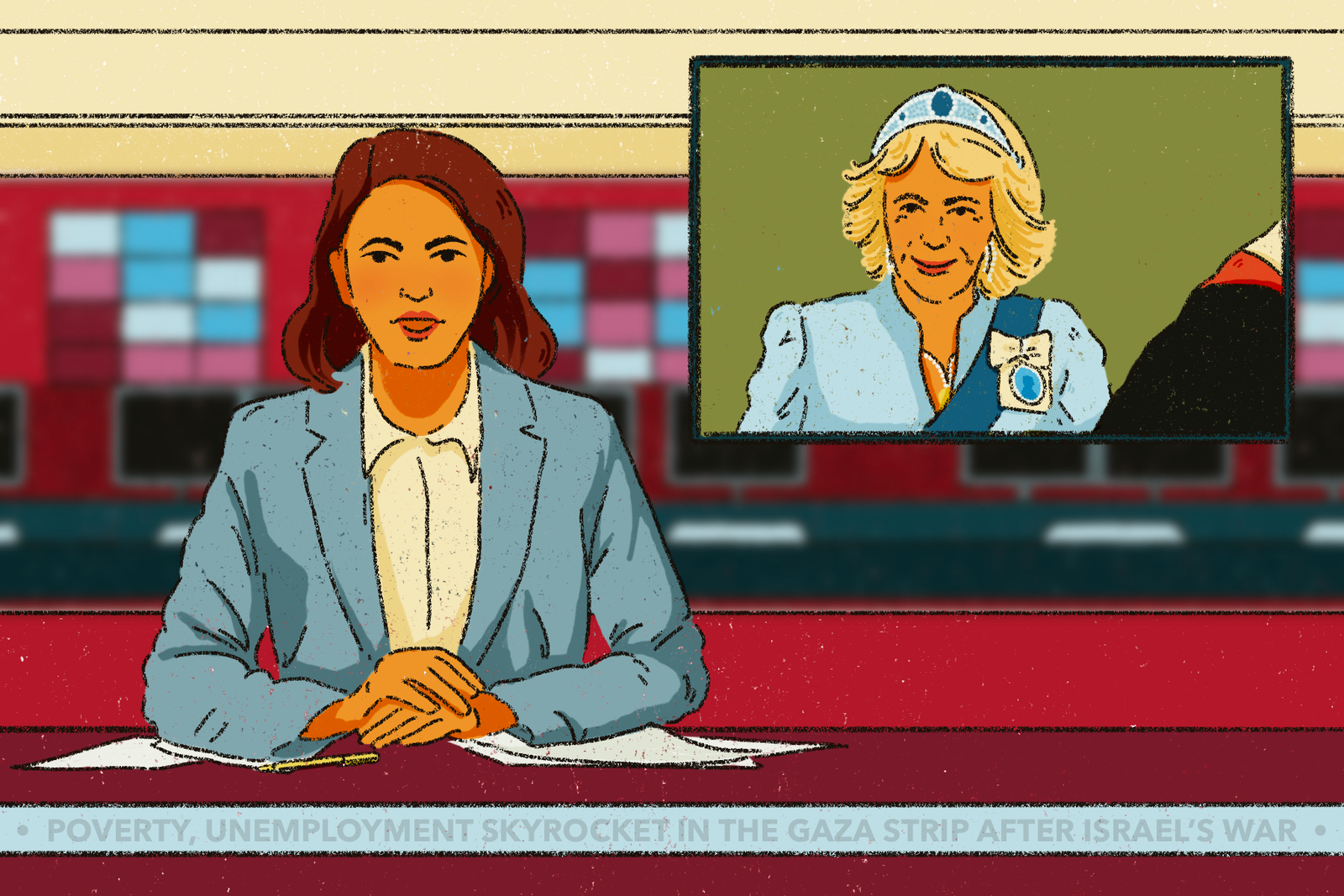
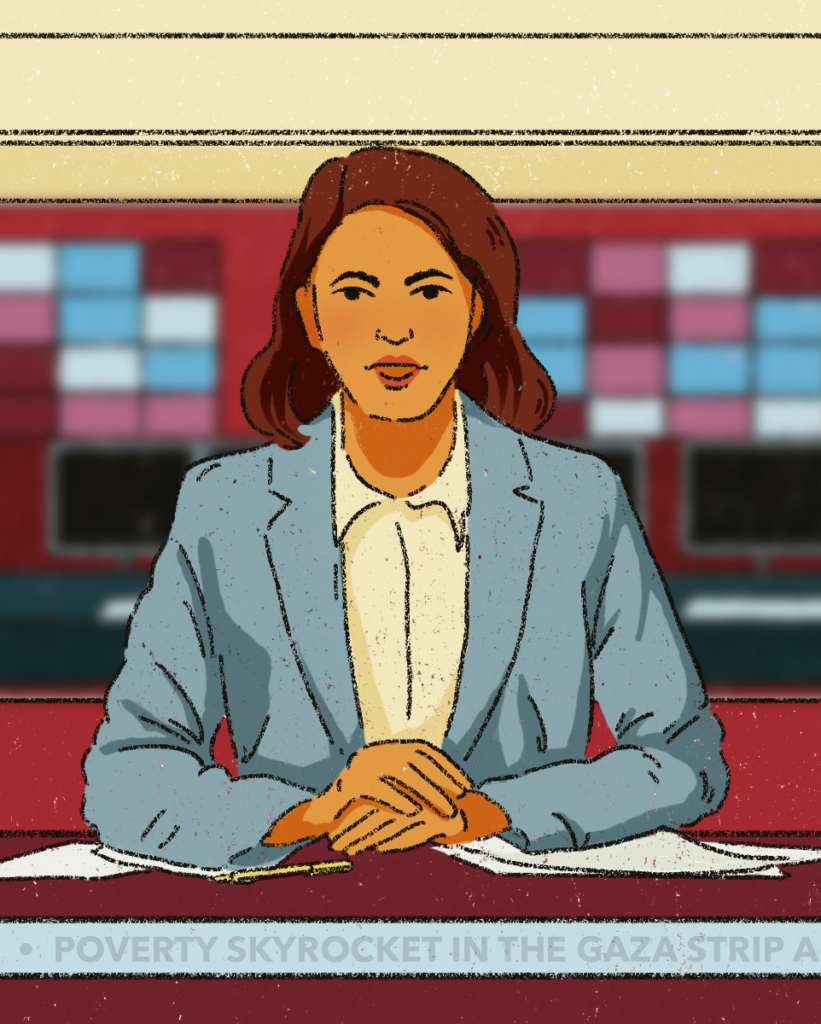 Illustration by @heedayahlockman who says: “A news anchor intently reports on a non-Palestinian story – such as Queen Camilla’s visit – while a news ticker runs beneath the screen. The ticker displays Palestine-related headlines in low-opacity text, rendered almost illegible. This visual contrast highlights how Palestinian news is often pushed to the periphery, present but deliberately muted in mainstream coverage.”