
The visits hall of HMP Bronzefield is a place of dizzying contradictions. Leaflets celebrating neurodiversity sit next to airlock doors. Colourful, kid-friendly posters hang above laminated sheets specifying that prisoners and visitors may hug exactly twice per visit. Face and fingerprint scans must be taken before visitors can buy their oat lattes at the Vita Nova cafe – staffed, naturally, by prisoners, paid under £1 an hour.
These securitised pleasantries disorient me every time I go to visit my friend Amu Gib, who is on Day 25 of a collective prisoners’ hunger strike to demand both justice and freedom for Palestine solidarity protestors and an end to the UK operations of Elbit Systems, Israel’s largest weapons manufacturer.
Whenever I pass through the hall, I think about the words ‘care and custody’, a slick bit of alliteration used in the branding of several British private custodial service providers. Care: warm, tender, intimate. Custody: stern, authoritative, immovable. A neat encapsulation of both the hall’s jangling aesthetics and the bind within which British prisoners find themselves – held by chains of custody, with no one but their jailers to turn to for care.
Over the past 25 days, however, six hunger strikers – Qesser Zuhrah, Heba Muraisi, Jon Cink, T Hoxha and Kamran Ahmed, alongside Amu – all incarcerated for allegedly acting in solidarity with Palestine, have given the lie to those tidy words. There is no ‘care’ in a prison system that allows those locked within it to starve. There is no possibility of ‘custody’ – of containment – for the unruly bodies that, every day, are communicating across walls and borders the irrepressibility of resistance and the utter failure of incarceration as a technology of social death.
The hunger strike does not only indict the UK’s incarceration without trial of 33 pro-Palestine protesters. It indicts the global carceral system that entangles both Britain’s lock-ups and the occupation-administered dungeons of Palestine. In heightening the contradictions and refusing the logics of incarceration, the hunger strike is a form of abolitionist praxis – one which demands both the attention and action of those of us who move freely outside.
The hunger strike against ‘care’
For the prison system to be tenable, it must be made palatable. Of course, some people are more than happy with the idea of prisons as sites of raw punishment where ‘wrongdoers’ are left to rot. For others, however, the carceral system’s rough edges must be softened and smoothed into an image of rehabilitation, where errant souls are coaxed back into line with society’s expectations.
Liberal, ‘charitable’ approaches to prisons and prison reform have been woven into discourses about incarceration in Britain since at least the 19th century. They’re now embedded at the highest levels: as Justice Secretary in 2015-2016, Michael Gove both pushed for massive prison expansion and wrote warmly about rehabilitation’s ‘power’ and the ‘innate worth of every individual’. Shabana Mahmood recently walked a similar tightrope, fretting about prison’s effects on women while promising 14,000 new prison beds by 2031.
Prisons teach. Prisons protect. Prisons – and justice secretaries – care. So goes the liberal, reformist spin. So, too, go the legal frameworks that ascribe to prisons a duty of care for those they cage, including a duty to provide an equivalent standard of healthcare to that available outside prison walls.
Try offering such assurances to anyone who’s spent time inside, or in proximity to, UK prisons. Try telling this to the six people currently starving themselves under the flat, dull gaze of prison guards.
Madeleine Norman, one of the Filton 24, on remand for over a year, recently detailed the ‘mundane’ facts of the ‘campaign of slow death’ to which UK prisoners are subjected. These prisoners – most of them poor, many of them Black or Brown – are regularly locked inside small, spare cells for at least 23 hours a day. Unequal healthcare provision and health outcomes are ubiquitous. Self-harm and mental health crises are rife. At least 411 people died in custody over the past year. Almost a quarter of those deaths were self-inflicted.
Too often, people in prison die quietly – or, rather, under the enforced hush of a prison system that wraps its victims up in deathly silence, assuming that no one ‘outside’ will care enough to kick up a fuss. Too often, this assumption proves correct. In July, at Bronzefield, where Qesser, Amu and Jon are incarcerated, two people, Toni Asik and Tracy Dyke, died in as many days. Almost no major news outlets reported their deaths. They might have slipped away without a trace.
Together behind bars
But their fellow prisoners remember them. Amu remembers them. In a statement in August, Amu imagined a world in which they would be at liberty to ‘lay flowers at the cells of the dead’: ‘I know what we’d do if there were no prisons. We’d be free.’
Palestine solidarity prisoners have consistently named the cruelty and neglect built into the bars that cage them. Fatema Zainab (Ray) Rajwani, imprisoned in August 2024, offered an abolitionist analysis of their own incarceration, presaging the logic of the state’s response to the current hunger strike: ‘the people you are forced to depend on will lock you up even if you are dying’. Aleks Herbich, on remand since November 2024, wrote to decry the ‘endless cycle of violence’ to which the women incarcerated with her are subjected. In August, Qesser described the violent repression she experienced for standing in solidarity with a distressed fellow prisoner. ‘Resistance is our right’, she says: a dictum wide enough to embrace acts of solidarity on both sides of the prison walls, loud enough to ring out clear from here to Palestine.
Palestine solidarity prisoners, like all prisoners, know the only care available in prison is the care they carve out for each other. Now, their hunger strike is dramatising that fact in truly spectacular fashion.
Every day, we read the grim updates: Heba, on Day 19 without food, was dragged to work. Amu, on Day 19, had dropped ten kilos. Kamran, on Day 12, was threatened with force-feeding. Jon, on Day 10, overheard a guard boast about planning to ‘do nothing until he collapses’. T is refusing food for the second time in three months. Qesser, who turned 20 in prison this year, cannot get warm.
Every day that the strikers’ bodies are allowed to waste and wane, we confront the reality of ‘care’ in the prison estate: the British government would rather let six young people cannibalise their bodies’ stores of fat and muscle than engage with their just demands. Just as in 1981, when Thatcher’s government’s intransigence killed ten young Irishmen on hunger strike in Long Kesh, the state’s professed commitment to ‘fostering life‘ has been brought into sharp conflict with the reality of prison as a death-dealing technology. Just as in 1981, the legal fiction and spectre of ‘terrorism’ is being mobilised to render some subjects more disposable than others.
That prison kills – that the state kills, whether within its own borders or in Palestine – is not news. What is distinctive, however, about the hunger strike is the way in which it broadcasts that fact beyond prison walls – and, in doing so, threatens to break them down.
The hunger strike against ‘custody’
Ostensibly, physically, the hunger strike confines. First, the prison administration moves to isolate the strikers: shortly after Qesser and Amu began their strikes, for instance, they were subjected to an implicit non-association order, effectively halving their available visit slots. Next, the strike begins to take its toll on the body. The striker moves less, rests more, conserving precious energy. Light and noise become obtrusive. Four walls hold a shrinking body. Ostensibly, physically, the world narrows.
Ostensibly. But, in fact, the hunger strike is communicable, is communicating, across vast distances. The UK hunger strikers have been joined by solidarity strikers Stecco in Italy and Jakhi McCray in the US. They’ve received solidarity statements from the Lebanese revolutionary Georges Abdallah, freed from his decades-long incarceration in July, from Bernadette McAliskey, veteran of the Irish liberation struggle, and from liberated Palestinian prisoners of the Zionist regime.
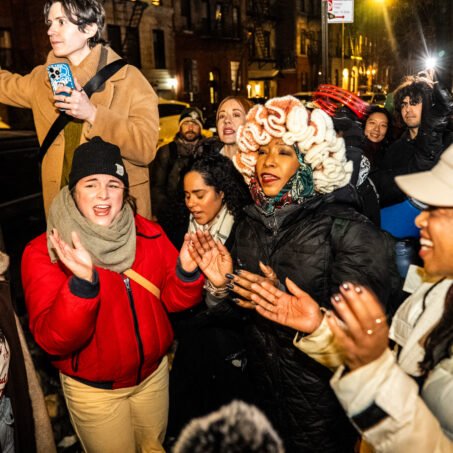
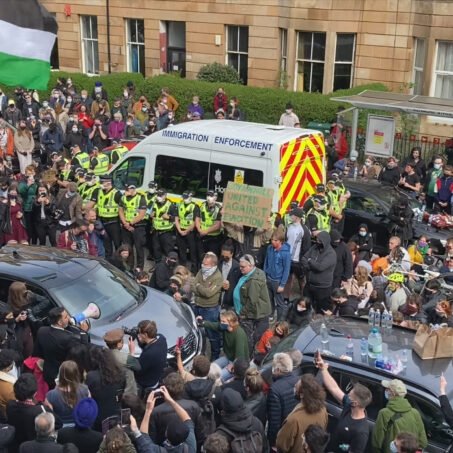
When we in the UK stand outside prisons chanting ‘One body, one fight, we support the hunger strike’, with the strikers inside hearing our voices through the concrete, we mean it, we feel it: the walls dividing us from our friends and comrades are paltry, mean things, shuddering in the face of their commitment and their strength.
Join our mailing list
Sign up for shado's picks of the week! Dropping in your inbox every Friday, we share news from inside shado + out, plus job listings, event recommendations and actions ✊
Sign up for shado's picks of the week! Dropping in your inbox every Friday, we share news from inside shado + out, plus job listings, event recommendations and actions ✊
Incarceration inflicts civil and social death. It sunders people from community and society, and from the right to participate fully in the shaping of both. Or rather, it attempts to. But the courage and imagination of prisoners, and the love and solidarity of their communities outside, can never quite be caged.
From Bronzefield to Asqalan
The people of Palestine, with whom the strikers stand in unfailing solidarity, know this to be true. As of October 2025, there were 9,100 Palestinian detainees in Israeli prisons. One in five Palestinians (and two in five Palestinian men) has been arrested and charged under military orders. The entire millions-strong population of Gaza has been pinned inside an open-air prison, blockaded on all sides, for 18 years.
Thus, the carceral apparatus does not irrupt into Palestinian life unexpectedly, does not upend normality with an officer’s knock on the door. It is the door, the wall, the whole house. As Walid Daqqa wrote from Asqalan Prison in 2010, the life of a Palestinian prisoner is not a state of exception, but rather a ‘parable of the lives of civilians’ throughout the occupied territories.
Detainees’ struggles and strikes reverberate through the captive land. When approximately 2000 Palestinians detainees went on hunger strike in 2012 to end administrative detention, relatives and supporters pitched a camp – the ‘Empty Stomachs’ tent – to amplify their demands. On visiting that camp, the recently liberated Egyptian prisoner Alaa Abd El-Fattah wrote: ‘the prisoners’ hunger strike is leading the struggle of an entire people […] How can we allow ourselves to be overcome with weakness […] when prisoners are achieving victory in their confinement?’
How, indeed? The UK prisoners’ hunger strike poses the same question. It represents resistance incarnate to the carceral state. The strikers’ demands refuse confinement by prison walls: instead, they reach outwards to indict Britain’s ongoing complicity in Israeli occupation, apartheid and genocide. Their bodies refuse regulation by prison guards and nurses: instead, to quote Banu Bargu’s Starve and Immolate, the strike ‘wrench[es] the power of life and death away from’ the state apparatus. And their voices refuse to be stifled, even by the culpable silence of the mainstream media.
They are speaking to us from inside their sharpening hunger. They are calling on us to listen and to act, not only for their freedom, but for a Palestine free from the river to the sea: for a breaking of chains and bars, all over the unfree globe.
Imagining resistance, imagining abolition
It’s often remarked that prison abolition calls us to make an imaginative leap, to unknow the bounds and binds we’ve been trained to accept. As Amu’s August statement notes, it’s a question people ask over and over: what would we do in a world without prisons? What would we do with violence, conflict, trauma? Often, to imaginations impoverished by state cruelty and austerity, such a world seems utterly unthinkable.
But the hunger strike, too, is unthinkable. A body willingly denies itself that which it needs to survive. It lives within the hunger that stands to kill it. Our minds warp around the strike, as we struggle to map the coordinates of starvation onto our own whole flesh. Unimaginable, inconceivable – that is, until someone imagines it.
I don’t know what will happen in the course of this hunger strike. I don’t know what will happen to my friend. But I know that I can choose to imagine and to move with Amu and their comrades towards the horizon they envisaged in August, in the wake of the deaths of two fellow prisoners at the hands of the British state: “We can build a world without prisons. We can kill war machines. All that we have is each other. We should act like it.”
What can you do?
Read:
- Hunger strikers’ statements
- Filton 24 substack
- What is Abolition?
- Free Alaa: The anti-imperial threads of abolition
- Alaa on My Mind (Mohammed El-Kurd, 2022)
- Why We Are on Hunger Strike in Israel’s Prisons (Marwan Barghouti, 2017)
- “You’re Not Defeated as Long as You’re Resisting”: Palestinian Hunger Strikes between the Singular and the Collective
- Freedom Is Coming: Shattering Slavery and Emptying Prisons (Khalida Jarrar, 2024)
- “Taking the idea of prison seriously”: an interview with Orisanmi Burton
- Bobby Sands’ Prison Diary
- Nor Meekly Serve My Time: The H-Block Struggle, 1976-1981
Listen:
- Rebel Matters Podcast #125: Interview with Amu Gib
- The Final Straw Radio: Interview with 2020 Uprising Prisoner Malik Muhammad
- Guthanna ’81 | Voices of ’81 podcast
Watch:
- H Block Hunger Strike (1980)
- The Strike (2024)
- Attica (2021)
- Hunger (2008)
- Lost Time: Palestinian prisoners in Israel (2017)
Do:
- Join Prisoners for Palestine’s weekly open meeting, 7pm every Sunday, on Zoom
- Spread the word! Tell your friends, tell your enemies, tell journalists and politicians and artists and strangers, and share Prisoners for Palestine’s posts online
- Write to the MOJ, MOD, HMPPS and CPS to demand that they respond to the demands
- Sign up to get involved in organising with Prisoners for Palestine
- Write to the hunger strikers, or organise a letter-writing event
- Mobilise! Keep an eye out for protests outside prisons, international days of action, support opportunities for the ongoing Filton 24 trial, and ‘Break the Chains’ blocs at Palestine solidarity demos
- Organise! Coordinate a banner drop. Educate your community. Pressure your local MPs and councillors to advocate for the strikers. Make some noise. Make a spectacle. Shut Elbit down
- Advocate every day, wherever you are, for a free Palestine, and for the liberation of prisoners around the globe
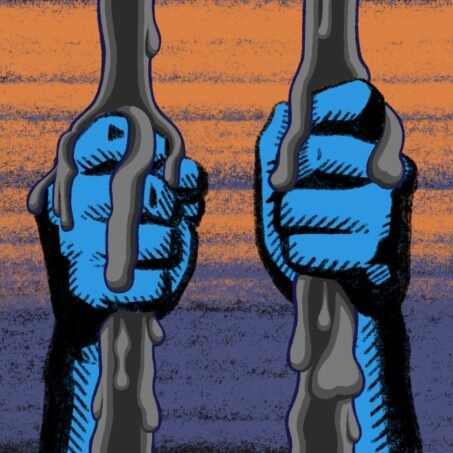
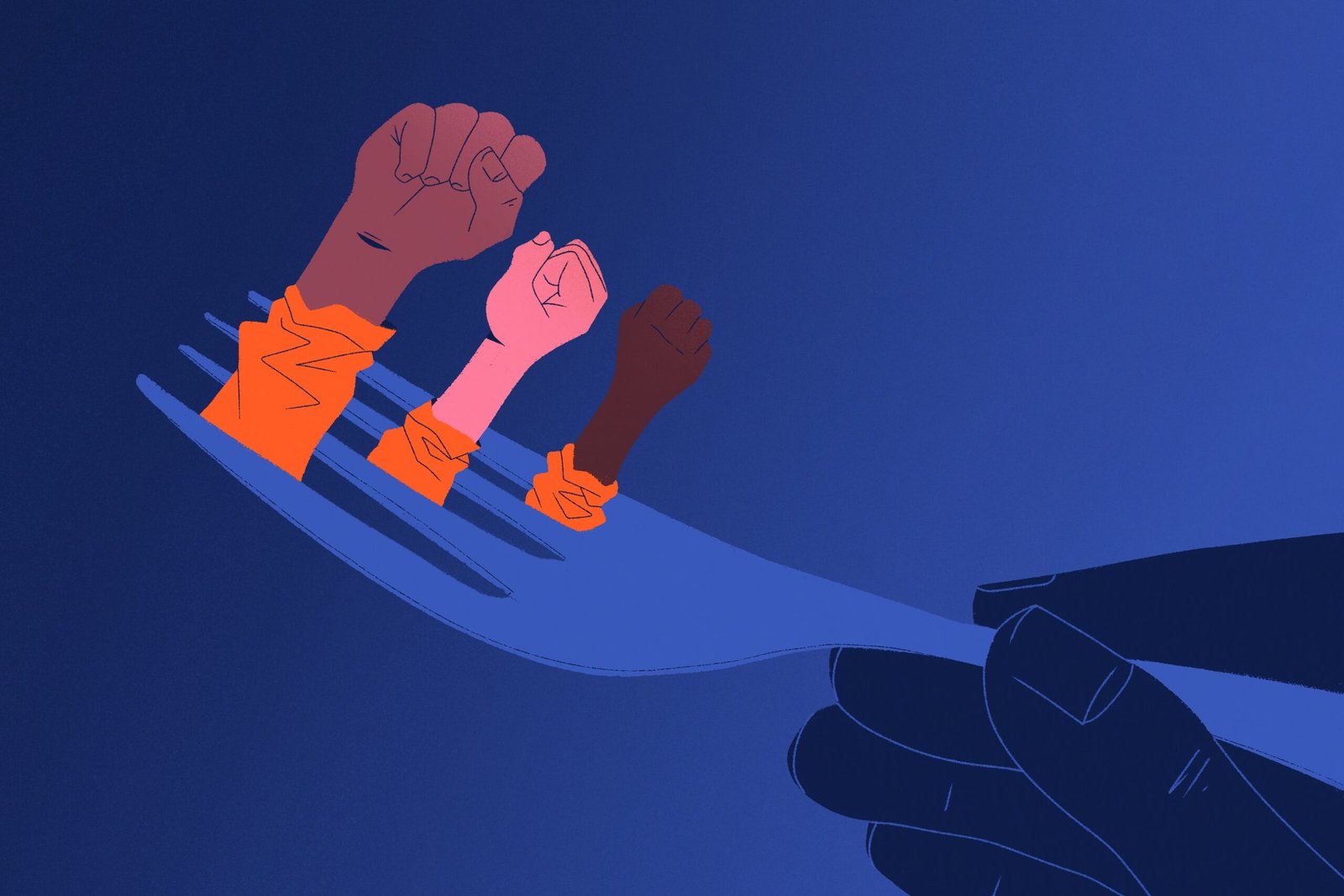
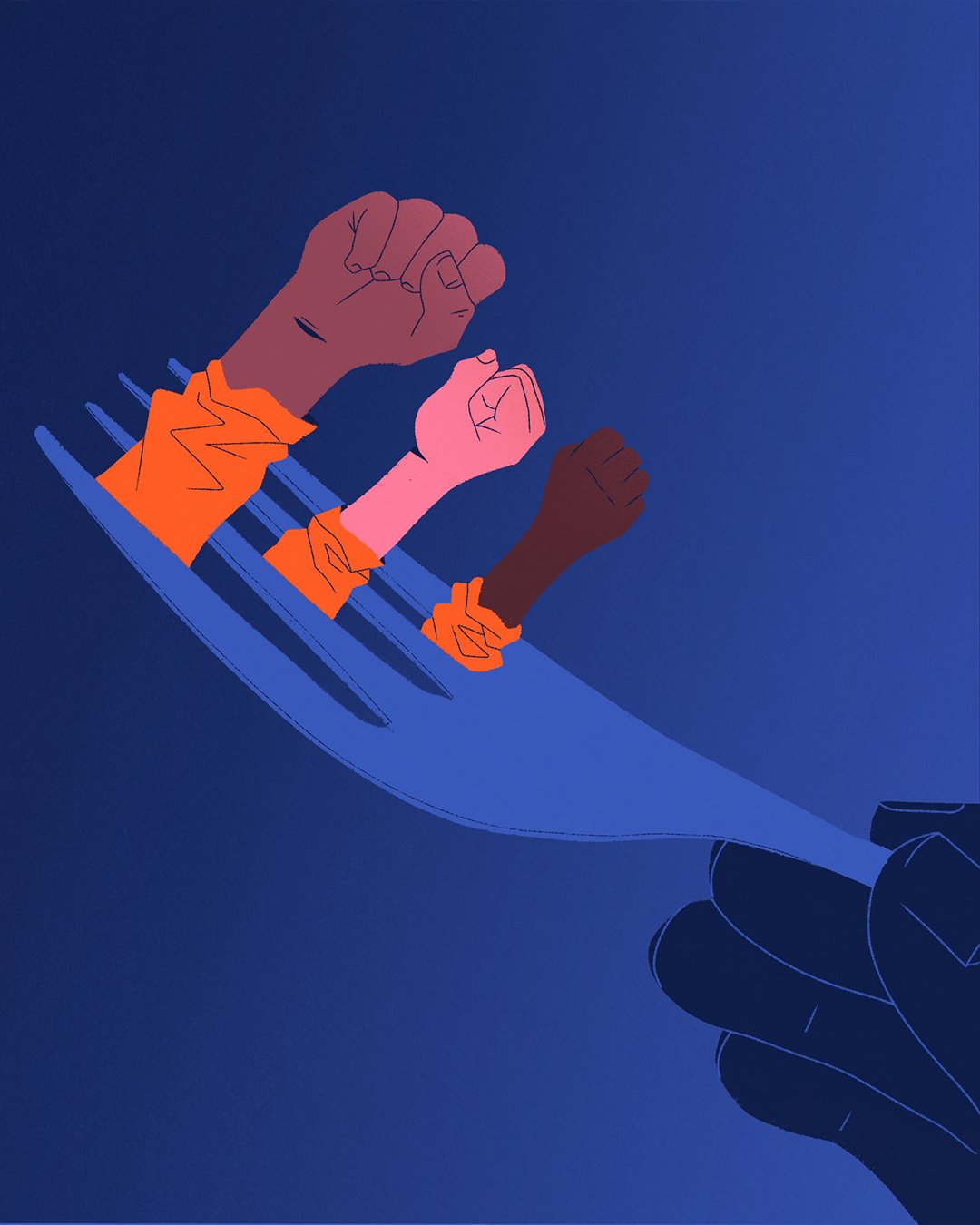 Illustration by @kalakal_klk who says, “Fists of prison inmates are coming out of the dents of a fork, both symbols of hunger and incarceration. Their warm orange tones contrast with the blue background, a reminiscence of a cold carceral system working actively against collective action.”