
Between Bruce Springsteen, U2 and a small festival bill of others, mainstream music has given us a flurry of anthems in tribute to Renée Good and Alex Pretti – two unarmed US citizens executed by ICE earlier this year – marking their solidarity with the state of Minnesota. While these are important songs, Springsteen wasn’t there. Bono wasn’t there. Anna Devine, however, was there the whole time.
The singer-songwriter grew up in the Twin Cities. She was in high school when George Floyd was murdered, and busied herself painting pro-BLM yard signs for neighbours. “It’s safe to say that growing up in this technological age – where we watched the murder of George Floyd, Daunte Wright, Philando Castile, and others on our phone screens – has sparked lots of activism in our age group,” Anna tells me. “And same with Renée Good and Alex Pretti. Seeing clear videographic evidence of this violence heightens our anger toward these injustices. We have no excuse to look away.”
She and her generation looked closer. Anna is one of three local artists-turned-organisers behind a mutual aid benefit album titled Melt ICE. With Ryan Kemp and Jonny Fuller, Anna released the epic compilation – containing 110 songs from 110 Minnesotan musicians – through Bandcamp in February. Priced at $10 or pay-more-if-you-can, it raised $15,000 in its first few weeks, hitting number five on Bandcamp’s best-selling list and first on the alternative charts. All proceeds are for MN Together, a mutual aid effort directing funds to community members in need of food, rent assistance and hygiene supplies.
Music in Minnesota
As a freelance music journalist in the UK, it’s been excruciating to watch powerlessly as this state has been brutally experimented on by Trump and his goons. But it’s easy to forget how much power there is in music – and Minnesota has a lot of both. It’s not just that they’ve produced some of the most groundbreaking, singular artists of the past 60 years – Bob Dylan, Prince, Husker Du, The Replacements, Babes In Toyland, The Hold Steady – I wanted to investigate how the current DIY scene in Minnesota was responding to this invasion. It took mere minutes before I saw the coordinated efforts to oppose ICE, the numerous benefit shows and fundraisers. I also saw the same names cropping up repeatedly, so I reached out to some of them.
“In Minneapolis, we have a wildly diverse music scene spanning every genre and cultural background,” Ryan tells me. “I think the scope of the Minneapolis scene is reflected well in the album.”
Anna, Ryan and Jonny fanned out in order to recruit other artists from across Minnesota’s diverse scene for Melt ICE. Each occupies a different genre space: Ryan helms the fuzzy grunge-pop project Chutes; Anna makes hushed indie-folk, her sighing, solicitous voice front and centre; and Jonny’s ‘Jonny Darko’ alias releases irreverent tracks that bridge lo-fi trap and bedroom pop.
This worked to their advantage as each had a slightly different network of musical allies to call on. Structured alphabetically, the compilation hops from raucous punk to moody trip hop to acoustic protest song and so on.
Though driven by these younger, up-and-coming artists, Melt ICE includes some Minnesota legends whose fanbase range spreads significantly outside of the state. “Some artists we reached out to were famous or bigger than us, so we didn’t expect even a response, and then they were up for it,” says Anna of Bad Bad Hats, Night Moves, She’s Green, and Ber. “That was super cool.”
Wait – what’s been happening in Minnesota?
The Trump administration launched Operation Metro Surge, led by SS-invoking Gregory Bovino, on 4th December 2025. The Department of Homeland Security called it “the largest immigration enforcement operation ever carried out.” 3,000 federal officers – outnumbering local and state officers five to one – moved in on Minnesota.
From the state alone, over 4,000 people have been arrested, around 60 per day. Citizens have been pulled from cars, homes, school and work, and dragged away to detention camps, often hundreds of miles away in Texas. Civilians report squalid, torturous conditions in these camps – insufficient space, poor hygiene, and a lack of clean water. Financially speaking, ICE is among the top 15 largest armed forces in the world, roughly the same size as Canada’s military.
There is a pronounced ICE presence in many US states, but Minnesota seems to have been targeted with shockingly excessive vigour. “Trump and his team are trying to make an example out of us,” Anna thinks. “It’s been a blue state for as long as I’ve been alive” – in fact, since going for Richard Nixon in the 1972 election, and was the only state that didn’t vote for Ronald Reagan’s Republicans in 1984.
“We have a big Somali population and we have a big Latino population,” she continues. “Those groups have faced so much racism and prejudice always, but especially under this administration. We have good social services, we have good welfare. We are a pretty well-functioning blue city and blue state, and in all honesty, I think Trump is angry that we know what we’re doing.”
Minnesota as a case study refutes the idea of ‘sanctuary cities’ – those where municipal laws tend to override federal ones – as lawless free-for-alls, a cornerstone of Republican rhetoric and justification for aggressive military force.
In 2023, Democrats in Minnesota won the white whale known as a ‘governing trifecta’ – a majority in both legislative houses as well as electing a Democratic governor. NBC reported that only a few months in, Democrats “have already tackled protecting abortion rights, legalizing recreational marijuana and restricting gun access. Here is a state fully controlled by Democrats that has offered protections on key Democratic social issues… while maintaining a robust economy and low crime.”
How has the state fought back?
The resistance to ICE has been overwhelmingly inspiring – coordinated, altruistic, tenacious.
You might have seen the photos of locals holding firm in the icy streets while garbed in dressing gowns and fluffy slippers, still wet from the shower, phones poised like shields. People have constructed makeshift roundabouts as a way of sleuthing on ICE patrol cars, slowing them down so they can whistle ahead to warn others. ‘No-sleep’ protests take place outside hotels housing ICE agents, as residents hammer on pots and pans and play instruments through the small hours.
In mid-January, it was student union organisers at the University of Minnesota who coordinated mass walk-outs that swept the country and developed into the official ‘National Days of Action in Solidarity’ – no school, no work, no shopping. Minnesota has not seen this kind of strike action since 1934.
It’s not just the student organisers: across the state, young people have been stepping up, and many are using music as a means of rebellion and fundraising. “Being an artist, I don’t have a lot of money that I can give to certain causes,” Anna says. “But I do have a song.”
She and her cohort are building on the Twin Cities’ lineage of youth-made protest music: from Bob Dylan serenading the Dinkytown folk circuit’s pizza joints after dropping out of university in 1959, to Hüsker Dü’s furious take-downs of gun crime and divide-and-conquer tactics in the ’80s. And onwards – to a DIY community that becomes more solidified with each attack. In 2023, for example, there was the fatal shooting of a Minnesotan named August Golden during a punk show at the Nudieland venue; numerous fundraising efforts followed.
What should I listen to first?
Melt ICE contains a goldmine of inspiring protest songs that, frankly, show up those from Springsteen, Bono, et al. ‘Barnburner’ by a psych-punk outfit called Full Catholic seethes with rusty, junkyard guitars and the collectively cautioned refrain of “this is a barnburner / this is a wild, wild fire.” Recorded in one urgent, live take, it addresses the propaganda that ushered in and sustains fascist hegemony. It “reflects the creeping invasion into the psyches of those that surround us – our aunts, uncles, co-workers, childhood friends,” the band tells me over email. “It is commentary on the indoctrination that empowers this cult of violence to thrive, but also a call to action.”

Join our mailing list
Sign up for shado's picks of the week! Dropping in your inbox every Friday, we share news from inside shado + out, plus job listings, event recommendations and actions ✊
Sign up for shado's picks of the week! Dropping in your inbox every Friday, we share news from inside shado + out, plus job listings, event recommendations and actions ✊
Lily Belle Govrik’s contribution is ‘Toast Your Prayers,’ a slumping groove of droptuned acoustic grunge that cleverly invokes the constitution – “we the people / are we people?” – turning it back on those that distort and weaponise American values. Laamar’s ‘Man Who Makes the Gun,’ a sparse folk fingerpicker reminiscent of Sufjan-Stevens-doing-Bob-Dylan, sings painfully of “every brown baby at rest… turn your eyes away I suggest,” a cello croaking mournfully.
There are dozens more – ‘Told You So,’ ‘American Spirits,’ ‘Rot,’ and ‘MAJOR THREAT’ also stand out – but Anna, Ryan and Jonny also welcomed artists that didn’t have an overtly political song in the bank. They wanted as many contributors as possible, maximum money for MN Together. Anna herself contributes ‘Playing House,’ a gorgeous catch-your-breath parcel “about how you find home in the people that you’re close to – not necessarily the space you live in.” She says even though it’s not directly addressing the federal occupation, it’s about loving each other. In other words, totally relevant.
Resisting ICE through live shows
These kinds of pivots are underway across the music scene: artists repurposing their tools and power, turning them around to fight for their communities.
Ryan tells me about an annual showcase of seven on-the-rise groups from Minnesota hosted by the First Avenue venue. “What is usually a night of celebration quickly shifted gears into a benefit show because this was only ten days after the murder of Renée Good,” he says of the event, which took place in January. “We agreed amongst the artists to donate what we could of our ticket sales to mutual aid and turned the show into an ‘ICE Out’ resource drive.”
“At this moment, it’s more critical than ever to get into rooms with people, experiment, purge, and express within a larger genuine movement,” Full Catholic explains. They’re on the bills of countless benefit shows and their social messaging foregrounds support for strikes and solidarity with immigrant communities. “People are rejecting isolation, definitions, and perfection – we want community, indescribability, and authentic chaos.”
Ryan elaborates: “Bands have cancelled their shows on strike days to stand in solidarity,” he continues. “Whistles handed out at the merch table, ‘ICE OUT’ posters displayed on stage monitors. Artists are doing what they can to help, and that is not slowing down any time soon.”
The next steps
On 26th January 2026, with public pressure mounting over the shootings of Good and Pretti, Trump pulled Greg Bovino off the Minneapolis operation and subbed in Tom Homan, a more by-the-book figure who helmed ICE under Obama (though Homan contributed to Project 2025 and unreservedly backs Trump’s mass deportations strategy, so he’s far from bipartisan).
Trump declared the end of Operation Metro Surge. Homan pulled 700 agents. Many saw this as the denouement; license to look away. However, withdrawing 700 leaves as many as 2,100 in the state. “They are still terrorising the streets, people are still afraid to leave their homes, and life is not ‘returning to normal’, like the federal government wants the general public to believe,” Ryan cautions.
“It’s 100% still relevant. If not more now,” Anna says of resistance efforts. “A lot of people heard the promising news about deescalating the operation, so they think it’s done and they don’t need to care anymore. That sounds harsh, but you see fewer posts on Instagram about it. There’s less media coverage about it,” she says. “They’re trying to make people stop caring about it. To hide the fact that it’s happening.”
Even if ICE does retreat in a meaningful way, the aftermath will require an incomprehensible amount of rebuilding. Families have been separated; friends, neighbours, and coworkers ‘disappeared’. Homes and businesses have been damaged. Trust in institutions and the government obliterated. There are medical and legal bills piling up. Life can never truly return to normal after this, can it? The work seems indefinite.
The Melt ICE team knows this. They’re upping their efforts as the rest of the world looks away from Minnesota, harnessing momentum from the album for other fundraising events. Anna tells me about a live t-shirt printing that is taking place a few days after our call. They’re also planning a benefit show involving as many artists from the compilation as possible – maybe it’ll be karaoke-style, Anna says, each act performing one song. They have loads of ideas of how to bring people together and keep moving forward. They are only just getting started.
People say it takes a village. But maybe it takes an entire state. It’s likely that, sooner or later, every community in the US – and the UK – will face its version of Operation Metro Surge. Reform will emulate the US-style immigration raids if they take power at the next election. Kemi Badenoch’s Conservatives pledged to do the same. We shouldn’t wait until that day comes to learn from the collective action, the sacrifices, and the generosity of this brave lodestar state. We shouldn’t wait to spare 10 bucks for 110 songs doing their bit to make some noise and secure a future for everyone.
What can you do?
- The Melt ICE benefit compilation album is available for purchase on Bandcamp. The minimum cost is $10, or around £7.56, though you can pay more if you are able. All proceeds go to MN Together, which you can donate to directly if you’d prefer.
- Many other charities are working to support immigrant communities impacted by ICE, such as the Immigrant Defense Project and Stand With Minnesota. The former educates immigrants, advocates, and lawyers on the complex intersection of immigration and criminal law to prevent thousands of deportations each year. The latter matches any donation you give to rent funds, and also helps coordinate flights back to Minneapolis for people released from detention centres in Texas.
- You can support DIY artists more generally by buying their music – either direct from their website, at a show, from a record store (including online record stores), or from Bandcamp. Streaming an artist on Spotify not only cuts them out financially, it nurtures ICE and fascism in general. The corporation has run ICE recruitment ads (they only stopped because their contract with the US government expired) and its CEO, Daniel Ek, invests in AI weaponry. Of course, you can also show your support by following an artist on social media and telling your friends about cool, new songs you find.
- Read more about ICE in Minnesota
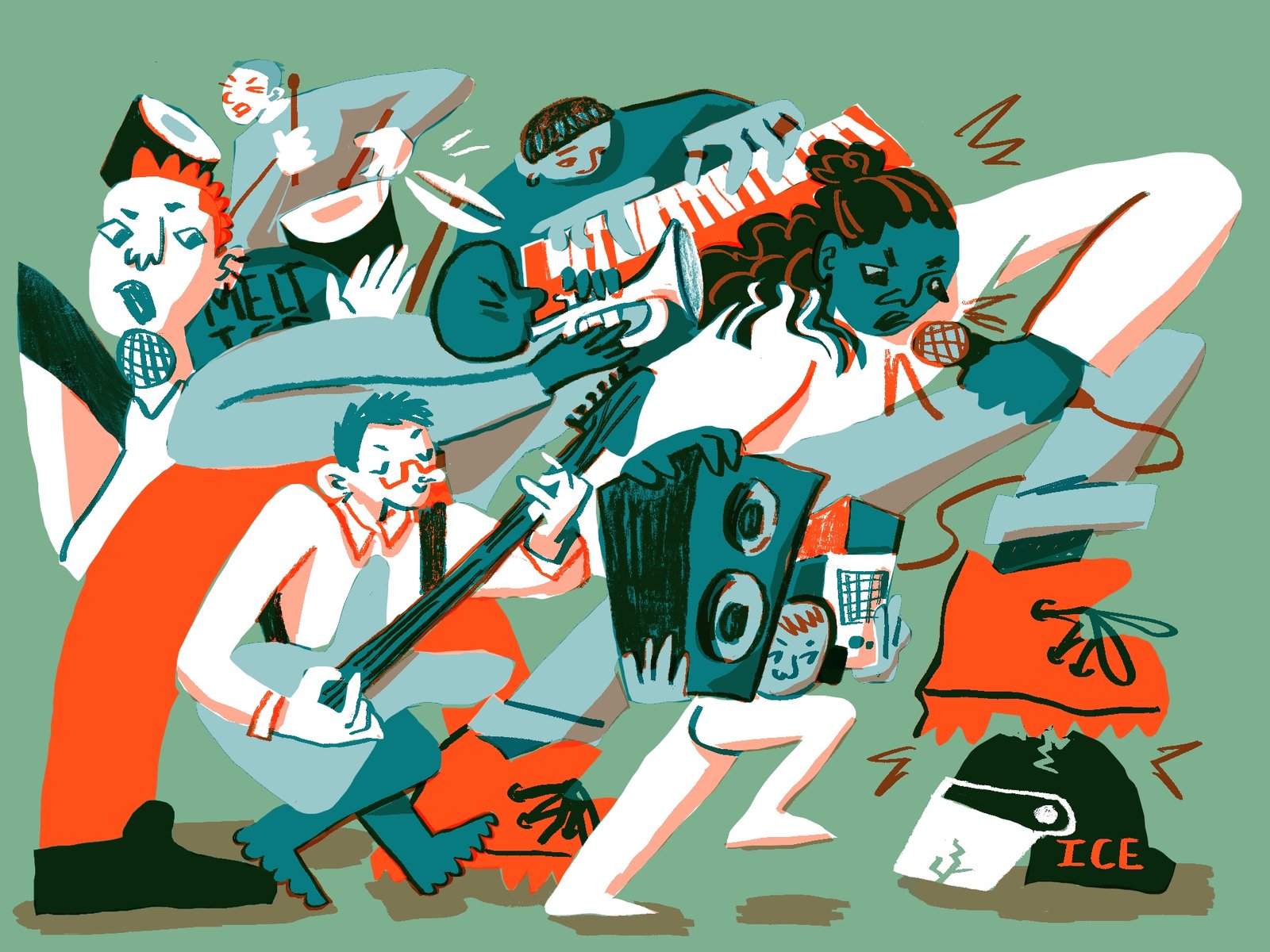
 Illustration by @beck.oh who says: “This illustration shows indie musicians coming together physically and sonically to support their communities, spread hope and make a downright racket against the violent and oppressive force of ICE. The people are the focus, towering, diverse and united, with ICE agents simply represented by a helmet as I wanted to emphasise the humanity and bravery in protest and the lack of it in hiding behind a uniform to enact violence and control.”