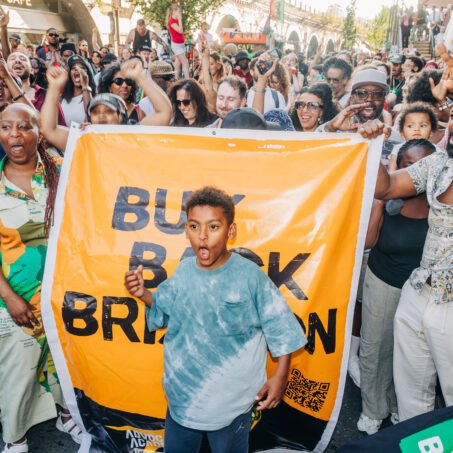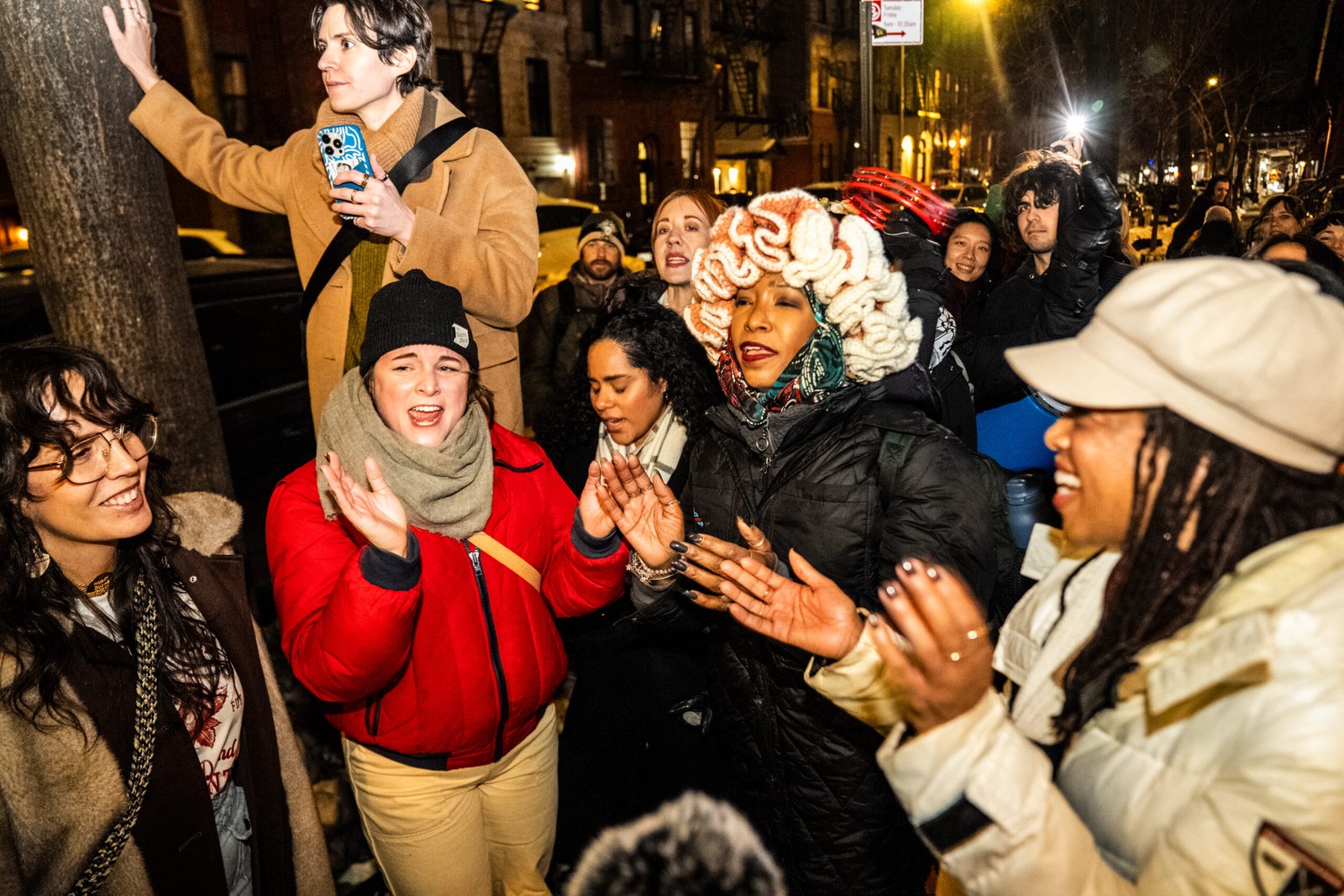

On a blisteringly cold Thursday in the first week of February, the streets of New York City were still covered in snow. The drifts piled up on the curb had formed a hard, icy crust on top of the powder, compacted by days of freezing temperatures.
They made informal risers for a group of people standing outside of Middle Collegiate Church, a gothic facade in-set on a street in the East Village. This was the overflow-beyond-the-overflow for an event hosted by the church and the Interfaith Alliance in conjunction with the Resistance Revival Chorus – a packed Sing-In aimed to teach New Yorkers songs of resistance from history to the present-day.
I came across the event’s flyer while scrolling on Instagram, and brought a friend with me. I’m not a singer myself, and neither is she, but we both agreed that marches needed to switch it up from just standard chants — what better way than incorporating song?
When we arrived, I was shocked to see the church, the balconies and the rec room filled with New Yorkers young and old, settling in for the start of the event. Outside, the brave dozen packing the sidewalk tuned in on a YouTube livestream as the chorus launched into their first lesson of the night.
Ain’t gonna let nobody turn me around, turn me around, turn me around
Ain’t gonna let nobody turn me around, I’mma keep on walking, keep on talking,
Marching up to freedom land.
On the grainy livestream, the chorus director dressed in white twirled a finger in a gesture – signalling to start it from the top! – and called out “Now, ‘ICE agents’!”
In the plush sanctuary of the church, in the balconies, and outside the windows, voices warmed up and soared in song:
Ain’t gonna let ICE Agents turn me around…
Feeding the spirit of the movement
America has always had a history of songs sung in protest, in solidarity, and in community, springing out of the layers of oppression and struggle. From the campfires of the Civil War, to the plantations where enslaved people toiled, to the streets where the Black church and the labour movement marched for civil rights and dignity – song has been a tool to unify people, tell the story of struggle, and carry a message of liberation.
Today, we are experiencing a revival of a revival of a revival – both in the movements for liberation we are fighting and the music we are making. Across the United States, musical groups are taking up the mantle to feed the spirit of music and song in the movement space, and use cultural tools for collective change.
One of them is the Resistance Revival Chorus, hosts of Thursday night’s event. An all-women and gender-expansive chorus, it grew out of the organisers of the 2017 Women’s March, and now performs everywhere from the streets of the city to the stage at Carnegie Hall.
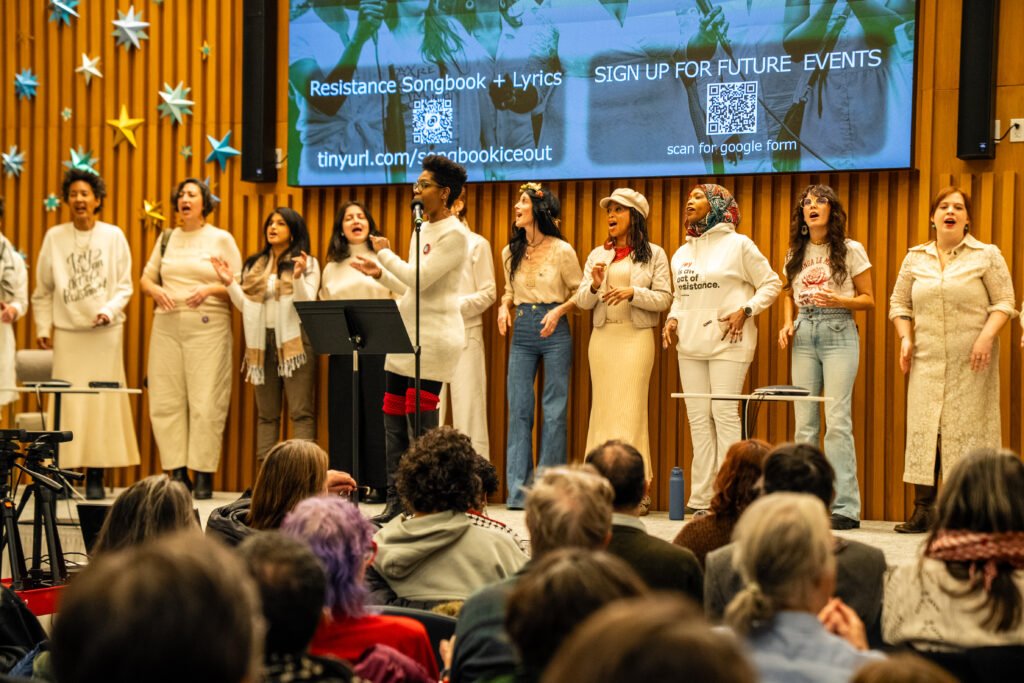 Photography by Ginny Suss
I spoke to a few chorusmembers over the phone to learn more about the organisation.
“Like Harry Belafonte said, many years ago: when the movement is strong, the music is strong,” chorus-co-founder and Women’s March artistic director Paola Mendoza tells me. “We believe that joy is an act of resistance. And we try to use music to bring fortitude to the movement in the current day.”
Zakiyah Ansari, the chorus’ rapid-response director and education activist with Alliance for Quality Education shares, “People often have to tell their stories again and again to be heard – but song does something different, it allows people to hear and see things in a different way. It allows for all senses to be awakened so they can never fall asleep again.”
Inside the church, the aggregate of unpolished voices took shape, revealing a beautiful central melody. In a space surrounded by people singing in one voice, you felt a tremor of faith rippling through everybody in attendance, like one vast hand reaching out and strumming a chord. To me, it is the same faith that people feel in the pews, or at a picket line, feeling like you are transmuted into a single particle of a vibrating whole.
View this post on Instagram
Join our mailing list
Sign up for shado's picks of the week! Dropping in your inbox every Friday, we share news from inside shado + out, plus job listings, event recommendations and actions ✊
Sign up for shado's picks of the week! Dropping in your inbox every Friday, we share news from inside shado + out, plus job listings, event recommendations and actions ✊
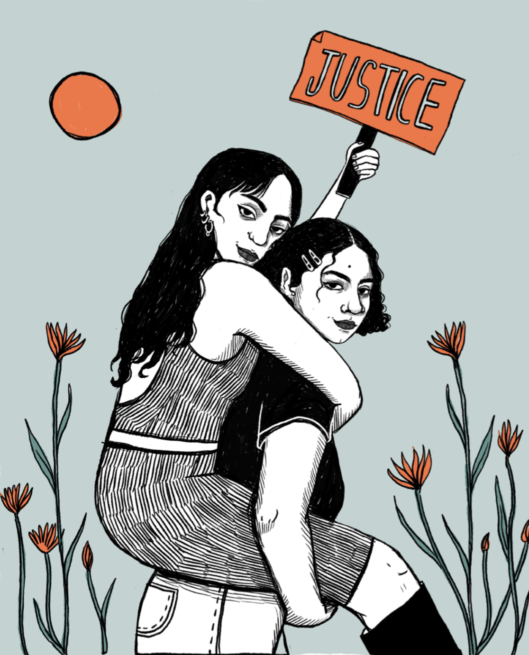
It struck me that the last time I had a memory of singing like this, in unison with others, was primary school, where we learned similar standards like “We Shall Overcome,” “Paz Y Libertad,” or “This Land is Your Land” – songs with their own message of liberation and struggle from the canon of American protest music. Back then, I thought the lyrics were obvious and inevitable. Indeed, this land does belong to you and me. Of course, I believe we shall overcome some day. Yes, we want peace and liberty for all the world.
Years later, in this moment, their lyrics feel radical in their simple declarations. Hearing these promises of victory and justice echoing back at you, the words feel powerful.
As Zakiyah explains: “the more it’s repeated, the more people sing, the more that folks sing these songs and teach them to each other, it reminds us that we’re neighbors, we’re responsible for each other, and it sends the message that, if you can’t sing, we will sing for you.”
Done being on the wrong side of history
On the streets of Minneapolis and Saint Paul, songs have been ringing out against the oppressive backdrop of a horrific and brutal deployment of ICE agents terrorising the streets of the city. At its peak, Operation Metro Surge was the largest immigration enforcement action in American history. The Department of Homeland Security deployed 3000 ICE agents to a combined urban area of under 300 km, kidnapping hundreds, and murdering two civilians, Renée Nicole Good and Alex Pretti.
In sub-zero weather, tens of thousands of Minnesotans turned out as part of an active resistance, tailing ICE cars, marching through the streets, and mobilising to defend their communities. In one viral video, protestors with Singing Resistance, a Twin Cities-based group, gather outside of a hotel housing ICE agents, singing a song imploring them to “change your mind…”
… show us your courage, leave this behind.
You can always change your mind!
And you can join us, join us here anytime.
As the song swells, the crowd seems to magnify as well, voices echoing and mingling to take up the airspace in a deafening message of solidarity.
View this post on Instagram
Some people find it trite. There’s a reason why a common American disparagement is “holding hands and singing Kumbaya” levelled against people who might be too naive and optimistic about reconciliation. It has been leveled against some of these musical efforts. Taking to the streets, the dismissive say, is about seriousness and conviction. We are at war, not at summer camp.
Never mind that these songs come from the struggles of enslaved or oppressed people for generations before.
Never mind as well that, in the specific case of Kumbaya, there is a famous rendition sung by freedom marchers in the 1965 March from Selma to Montgomery – where protestors faced horrific police brutality in one of the critical tipping points of the Civil Rights movement.
I would challenge the dismissive to go to a protest and not chant. To march, and not have a beat. And a chant with a beat is just a melody removed from a song. And isn’t a song powerful in its physicality – feet stomping, hands clapping, hairs raising, vocal chords and eardrums vibrating? In its echo and repetition? In its invitation to sing along?
“Do I think hearing a song is going to have Trump supporters defect in that moment? No!” Paola says. “But it’s about touchpoints – how many ways can you get into people’s hearts and minds with empathy, and have them question a harmful system?”
Singing Resistance writes in the caption of their video, which has been viewed hundreds of thousands of times, that they were inspired by a Serbian civil resistance movement, Otpor!:
“Otpor! members were regularly arrested and beaten by police, after which, they would show up to police stations and officers’ houses chanting: “You may not join us today, but you can join us tomorrow”. In the final hours of their revolution, hundreds of thousands of people from across Serbia marched on Belgrade. Milosevic ordered the police and military to fire on massive crowds of protestors, and they refused. They were done being on the wrong side of history.”
The earworm of a challenge, an invitation, can be a pressure point for taking down fascism, which historically relies on defections. Each person who has this simple chorus stuck in their heads is locked in the battle of hearts and minds. Each person convinced to step away, even if not firmly stepping into the side of resistance, is a weakness in the structure of authoritarianism. It’s one less person committing harm, and one more opportunity for change to flood in.
A sense of real America
Back in New York City, on Superbowl Sunday, the NYC Democratic Socialists of America Choir, Sing in Solidarity, prepared for their first Hootenanny of the year, an event they describe as a “party or get-together where folks sing and play guitar/banjo/mandolin/whatever you’ve got!”
This is a page straight out of the books of the folk revival of the 1950s and 60s. Spanning union halls to big concert stages, hootenannies were sponsored by folk musicians and unabashed leftist activists like Pete Seeger and Woody Guthrie, whose guitar proudly proclaimed to “kill fascists.” They and others in their vein sang songs spanning what they felt was the true soul of America – working-class music like blues, bluegrass, spirituals, organising songs from the 30s, and new standards of blue-collar, anti-war pride – and encouraged an audience to sing along.
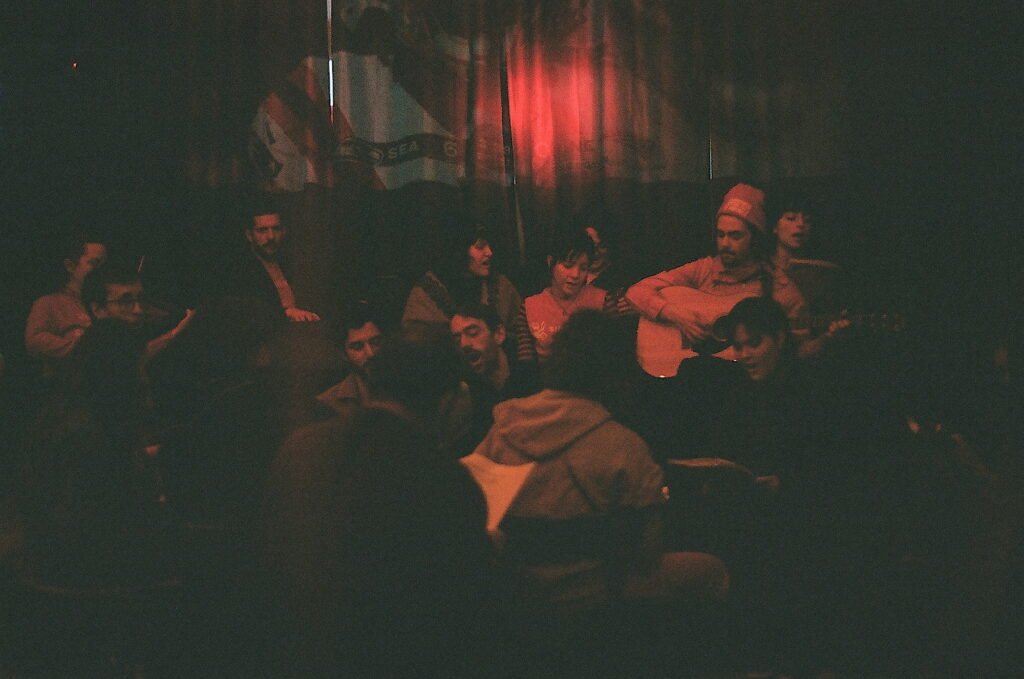 Photo courtesy of NYC Democratic Socialists of America Choir
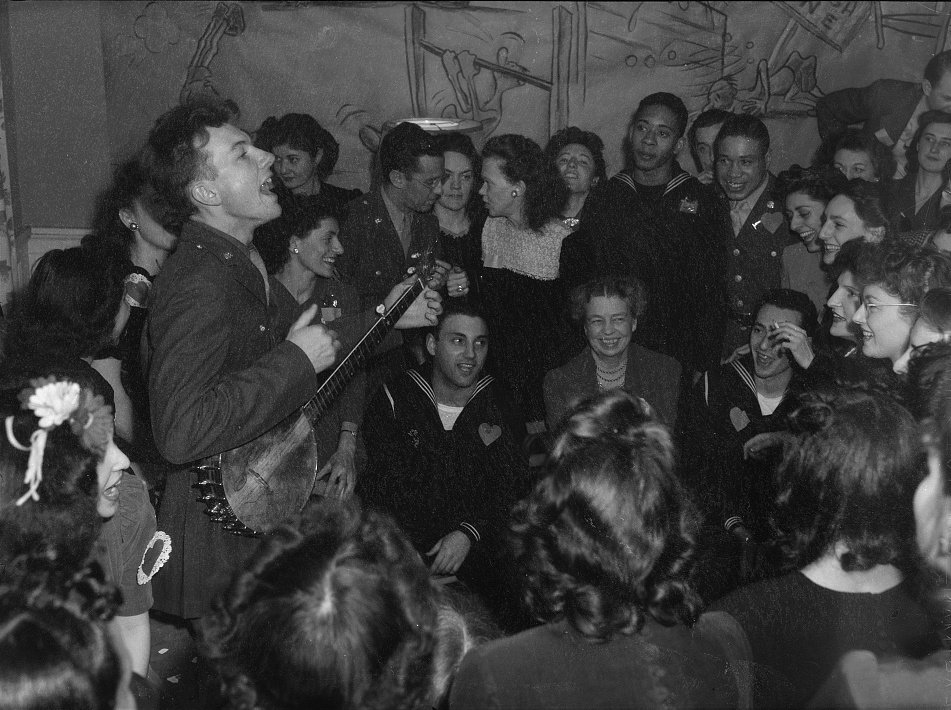 Pete Seeger in 1944 playing at the opening of the Washington labor canteen, sponsored by the United Federal Labor Canteen, sponsored by the Federal Workers of America, Congress of Industrial Organizations (CIO), with first lady Eleanor Roosevelt present. Photo via Wikipedia Commons
“Hootenannies have always served as the basis for musical comments on the events of the world. In general, these comments have reflected a “left-of-liberal” political outlook,” Irwin Silber writes in an introduction booklet accompanying the record Sing Out! Hootenanny with Pete Seeger and the Hooteneers. “The most important quality about Hootenannies has been the fact that its audience is composed predominantly of young people – teenagers and college students – who have found that a Hootenanny communicates music, ideas, and a sense of the real America to them.”
Hosted in a bar in Brooklyn, the new haunt of the youth in 2026, organisers strummed guitars for a crowd that braved the cold and train delays to fill the dim, intimate space with their voices. A video from the night proclaims the new “Golden Age” of socialist folk music.
View this post on Instagram
The young people that make up the audience of a Hootenanny are part of a demographic reshaping city politics. In the aftermath of Zohran Mamdani’s win — NYC’s newest DSA mayor (and first to have sung with the chorus) — I found it interesting to see where that ascendant energy went. What “real America” is speaking to them through the music of the past?
“At a time when collective expression is increasingly rare, it’s special just to see people coming together. But to see these revolutionary songs, some written over 100 years ago, finding a new life, is truly amazing,” Jordan, a Sing in Solidarity member choir member, says. “Music propelled the labour movement in the early 20th century. Those same songs are resonating with younger generations who are struggling under the conditions of capitalism, and are now helping to grow the ascendant socialist movement.”
I love the sentiment of a classic socialist anthem, “Bread and Roses,” which sings about the need to nourish the body and the heart – “hearts starve as well as bodies; give us bread, but give us roses.” It’s something that rang true generations ago when it was written, for the garment workers and the dockhands of old New York — and it’s something that today’s working class is still seeking and singing about.
Building a “muscle” of community resistance
Ultimately, what these groups create in weaving together song and movement is a space for community, creation and imagination. Fascism thrives in isolation, and works to atomise the individual, worming the threat of the state into our relationships and interactions to weaken our bonds with each other. It seems poignant that, despite the literal and figurative icy weather that has been sweeping America, people have been making a concerted effort to be in community, slogging through the slush in our streets, standing on the snowdrifts, to sing with each other.
Gathering together to create “is a small way to build that muscle of resistance,” Paola says.
“We’re not sitting in our apartments, scrolling and feeling helpless. We’re singing, and building community – and then what? We can more readily take action to protect each other.”
I think that’s true. Singing, for many, takes courage — singing in a group is almost like a trust exercise. Where my melody fails, someone else will pick it up and support it. It’s easy to see the connections linger: walking out of Middle Collegiate Church, I saw people handing out whistles, meant to alert neighbors if ICE was present, and attendees striking up conversation and finding common ground. The mood was buoyant and hopeful. Snatches of song carried, fluttering on the wind, picked up from voice to voice:
Hold on, hold on,
My dear ones, here comes the dawn.
What can you do?
- Follow along for future events hosted by the Resistance Revival Chorus (@resistancerevivalchorus), Singing Resistance (@singingresistancecetc), or the NYC DSA Choir (@nycdsachoir)
- Host your own resistance chorus with this guide from Resistance Revival Chorus
- Read more shado coverage about musical traditions of protest and resistance in Algeria, Mexico and Latin America, India, and more.
- Or, more about folk and country’s political tug-of-war in America.
Recommended reading and additional action from organisers:
- Tell Me How it Ends by Valeria Luiselli
- The People’s Project by Maggie Smith and Saeed Jones
- We Will Not Cancel Us by Adrienne Maree Brown