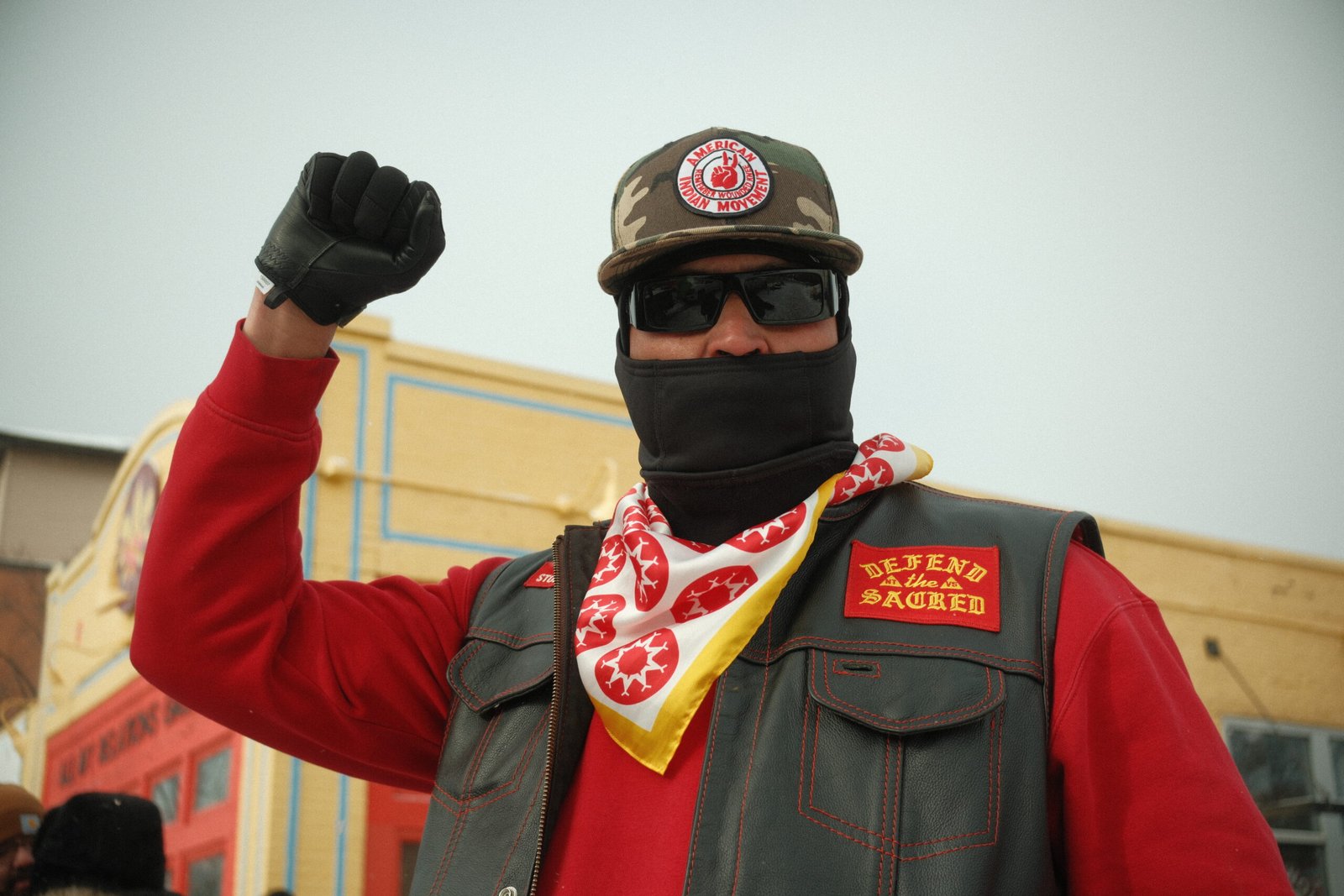

In a sea of white sky and blanketed snow, it’s hard to miss the vibrant colours of Pow Wow Grounds Cafe. In this parking lot, nestled on Franklin Avenue in Minneapolis’s vibrant American Indian Cultural Corridor, the flag that flies proudly and defiantly isn’t the red and white stripes, but one that flies the sacred colours of the Oglala Lakota nation.
Pow Wow Grounds is a Native-owned café – but in recent weeks, it has become much more than a place for coffee and frybread. It has emerged as a central hub of resistance, mutual aid, and community defence during Operation Metro Surge, the largest immigration enforcement operation in American history.
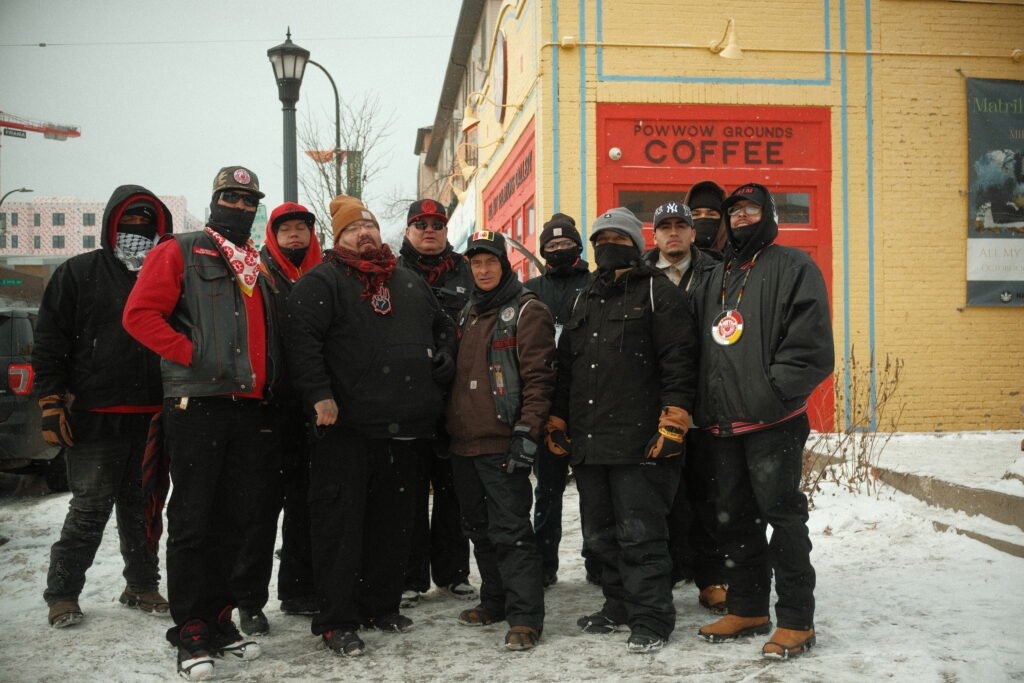 A group of American Indian Movement (AIM) patrollers outside of PowWow Grounds. Photo by @joixlee
Over the last few months, more than 3,000 federal agents descended into the Twin Cities (Minneapolis and St. Paul, Minnesota) with a purported purpose: remove the ‘worst of the worst’. ICE (U.S. Immigration and Customs Enforcement) vehicles flooded neighbourhoods. Helicopters circled overhead. Agents conducted raids and abducted people in broad daylight – including a five year old child and US citizens. Fear rippled through immigrant communities, communities of colour, and Native neighborhoods alike, many of whom have lived under state surveillance and violence for generations.
As a daughter of immigrants and a journalist, I came to Minneapolis to cover what feels like the unravelling of an empire – and to document the growing violations against constitutional rights and our right to free speech.
How Minneapolis became the flashpoint
On 7th January, an ICE agent shot and killed a legal observer, Renee Good. What began as tense encounters between immigration agents and local communities erupted into statewide protests, and calls to abolish ICE echoed through the streets of Minneapolis and St. Paul.
And then, two weeks later on the 24th, they shot and killed another observer, Alex Pretti – an ICU nurse. They killed a man whose job was to save the lives of others.
Minneapolis was already a city pulsing with grief. This pushed them over the edge.
I was on the scene shortly after Alex Pretti was killed, and amidst the haze of the tear gas, the flying of rubber bullets, pepper balls, and other munitions, I saw a city who had not yet time to grieve the loss of a member before facing the violence of another. A city that felt like it had no choice but to band together to protect its neighbours, and to protect itself against what they see as an occupying force and state violence.
Despite demands for their removal, ICE has maintained a heavy presence in the Twin Cities. And so, the communities organised – with little trust in local authorities, they decided to turn to each other. As I heard constantly throughout the streets, “Who keeps us safe? We keep us safe.”
Places like Pow Wow Grounds became critical infrastructure – sites of refuge, coordination, and care.
When I arrived to Minneapolis, I began searching for mutual aid hubs and places where different communities were coming together to meet this crisis. I was immediately pointed towards Pow Wow Grounds, known not only for its community space for Native Americans, but for the larger southside Minneapolis.
I met with the owner, Bob Rice.
“We’re cooking food and serving coffee, free of charge for our community and frontliners,” he says. “But beyond that, we’re providing water, food, essential supplies, masks, gloves. We’re ground zero.”
At any given moment, people move steadily in and out of the café’s front doors, some carrying boxes of donated food and medical supplies, others hauling bags out to distribute across the city. The back room is packed wall-to-wall with cases of water, canned food, first-aid kits, winter gear, and personal protective equipment. By the end of the day, it is often emptied completely. By morning, the process begins again.
While aid is offered to anyone in need, Pow Wow Grounds is intentionally rooted as a safe space for the Native community, who, despite being Indigenous to the land, have not escaped the attention of federal immigration authorities.
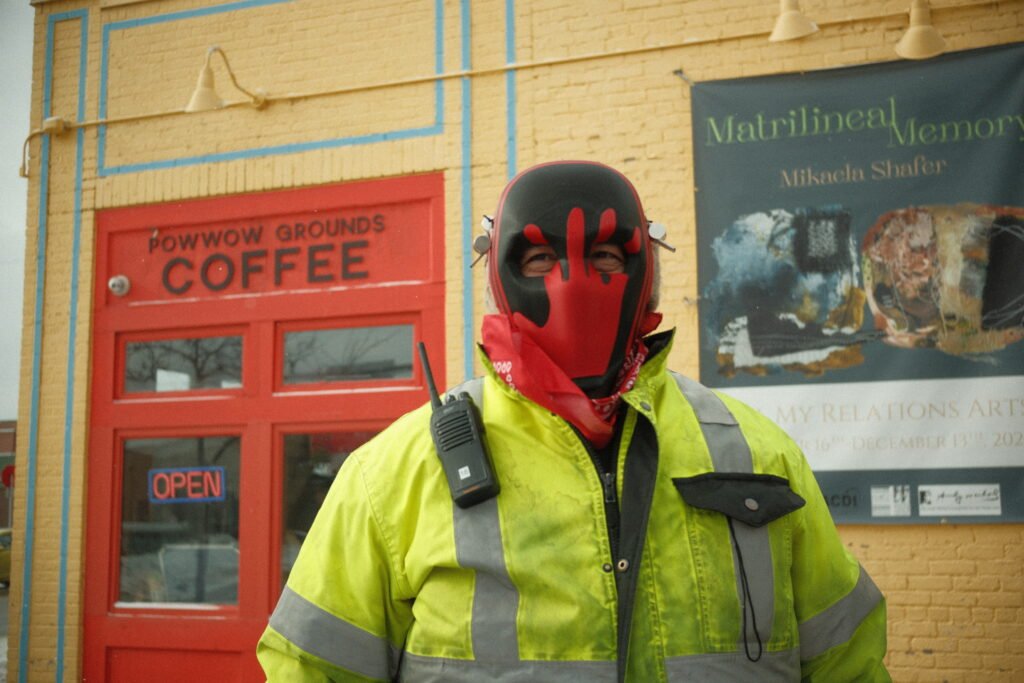 Outside Pow Wow Grounds. Photography by @joixlee
“We are the ‘Original’ Americans”
Amid reports that four enrolled members of the Oglala Sioux Tribe were detained by ICE, Native attorney Chase Iron Eyes traveled to Minneapolis from Pine Ridge Reservation to support the community.
“We look Mexican. We look brown. We are cousins,” Iron Eyes says. “We’re Indigenous peoples of the Western Hemisphere. ICE is targeting and profiling all of us together. We see that. We see that we’re all in this together.”
He looked at me and said, “That includes you.”
Despite the loose guise of cracking down on the ‘worst of the worst,’ Operation Metro Surge has revealed what Native people have long understood. That the question of who is illegal on this land has always been a racist one; and if you’re a person of colour, you’re suspect.
Minneapolis is a city that was built on the sacred land of the Dakota people – who believe that the meeting point of Mississippi and Minnesota Rivers is part of their creation story.
Join our mailing list
Sign up for shado's picks of the week! Dropping in your inbox every Friday, we share news from inside shado + out, plus job listings, event recommendations and actions ✊
Sign up for shado's picks of the week! Dropping in your inbox every Friday, we share news from inside shado + out, plus job listings, event recommendations and actions ✊
The Native community, who have been here long before the formation of the United States, understand that what is happening today is not really about a crackdown on illegal immigration. Rather, what was loosely disguised as a crackdown on the ‘worst of the worst,’ Operation Metro Surge in Minneapolis instead reveals that today’s immigration policies are simply a continuation of a long history of racialised violence by the state.
Like many community members, Iron Eyes often uses Pow Wow Grounds as an informal office, meeting with families, victims and other legal counsel. While he brings legal expertise, others bring different skills – many rooted in longstanding traditions of community protection.
“There are a lot of warriors here,” says Lincoln, a patroller with Many Shields. The group is one of several Native-led organisations in Minneapolis that conduct neighbourhood patrols, particularly around the American Indian corridor. While some patrol systems were strengthened in response to the current ICE crackdown, Native communities in Minneapolis have relied on these methods of protection for decades.
“People of Many Shields, of American Indian Movement, Indigenous Protector Movement, coming together to protect the community,” Lincoln says. “Protecting people from ICE – who are doing unlawful things. We are the first peoples of this land. We have absolutely no business being detained or deported.”
He pauses.
“We are on the frontlines right now in Minneapolis. And it is hard. But the spirits stand with us, and the people stand with us.”
For Native communities in Minnesota, this moment is not an anomaly – it is part of a long continuum.
“We have a history of resistance here as Native Americans,” says Tufawon, a Native artist based in Minneapolis. “Seeing the federal government crack down on civil liberties is something we’ve seen before.”
This was a thread that I saw again and again. On paper, Native Americans should be one of the most protected groups against ICE activities: they are neither immigrants, nor are they illegal.
But history has left them with little faith in those distinctions. Their status, they know, has never reliably shielded them.

To be a good neighbour
From broken treaties to forced removals, boarding schools to over-policing, Native people have lived under the yoke of systemic and racialised state violence for centuries. That reality sharpened during the uprisings following the murder of George Floyd in 2020 – another moment when Minneapolis became a flashpoint for state violence and grassroots resistance.
“We learned from George Floyd that we have a strong community that takes care of each other,” says Rice. “That’s what carried us through then, and that’s what’s carrying us through now.”
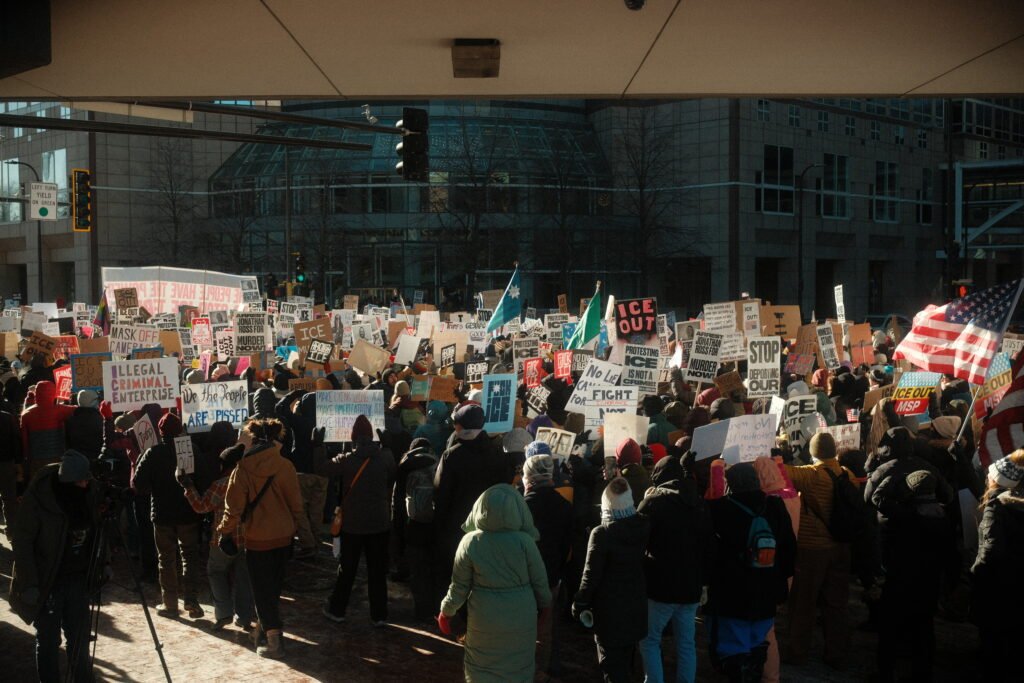
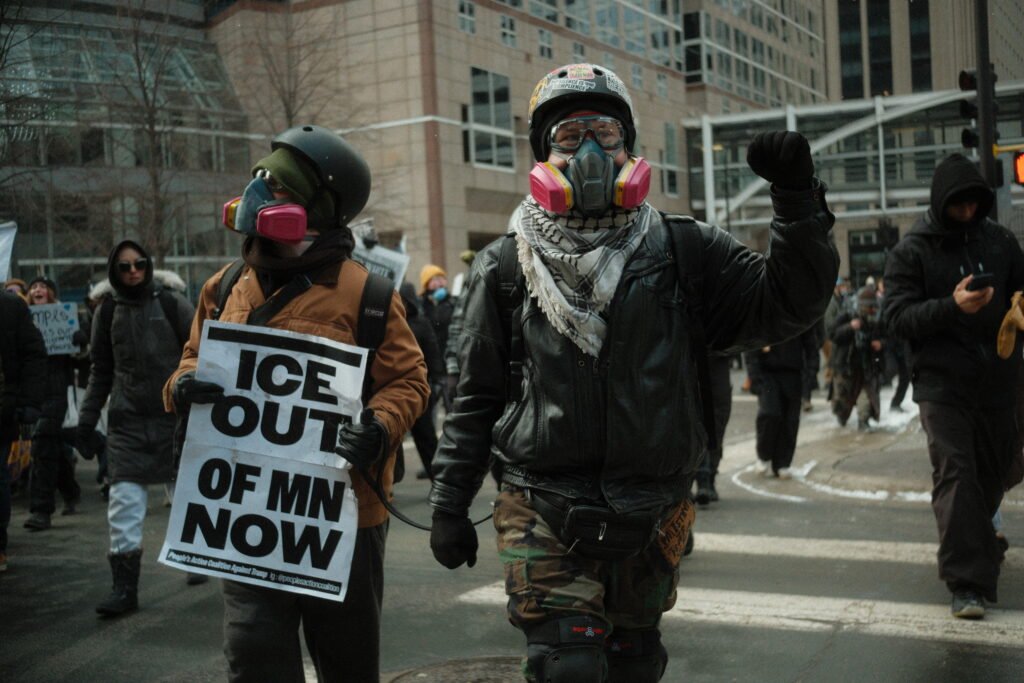 ICE protestors. Photography by @joixlee
For many Native organisers, the lessons of 2020 were practical as much as philosophical: how to distribute supplies, how to de-escalate conflict, how to protect elders and youth, how to move together when institutions fail.
“Minnesota has been under an occupation,” says Julia Green, a Native organiser and community caretaker. “And from a traditional standpoint, as Indigenous people, coming together, this is who we are. I am all my relatives, and all my relatives are me.”
She continues: “Whatever I do affects them. Whatever they do affects me. And we’re always thinking seven generations ahead. What we do now is going to affect our grandchildren’s children.”
For Julia, mutual aid is not charity, it is responsibility. “That’s part of cultivating community,” she explains. “Building that safety net. Getting to know your neighbours. Sharing love with people. Moving in a good way so that our future has good things in it.”
When I moved throughout the different organising spaces of Minneapolis, I could hear the teachings of Native wisdom echoing throughout the city. As people spoke about knowing their neighbours, it became clear that Native Americans aren’t on the margins of this movement, but at its core – offering a blueprint for how to survive, protect one another, and move forward when systems collapse.
Organising for the future
As winter drags on and federal enforcement shows no signs of slowing, Pow Wow Grounds continues to hum with activity. Coffee is poured. Meals are cooked. Patrols check in before heading out. Legal observers charge their phones at crowded tables. Community members donate and distribute supplies.
Outside, ICE vehicles still pass by.
Pow Wow Grounds is not a command centre, nor a symbol crafted for attention. It is something quieter and more powerful: a living expression of Indigenous sovereignty, care, and refusal. A reminder that long before federal agents arrived – and long after they leave – Native people have survived by relying on one another.
And as I see different faces of the Minnesotan community continue bustling in and out of the cafe, I know that those teachings have taken deep root in the city. That neighbours do indeed, protect neighbours. That we do indeed, keep us safe.
As organisers often say here: this isn’t just about the present moment. It’s about the next seven generations. And inside Pow Wow Grounds, those generations are already being protected.
What can you do?
- Follow MN Ice Watch, an autonomous collective documenting and resisting against ICE, police and all colonial militarised regimes
- Support mutual aid efforts
- Read Dawn to dusk in Liberty City
- Read What is Settler Colonialism?
- Volunteer for a local community defence/rapid response network
- GET TO KNOW YOUR NEIGHBOURS.