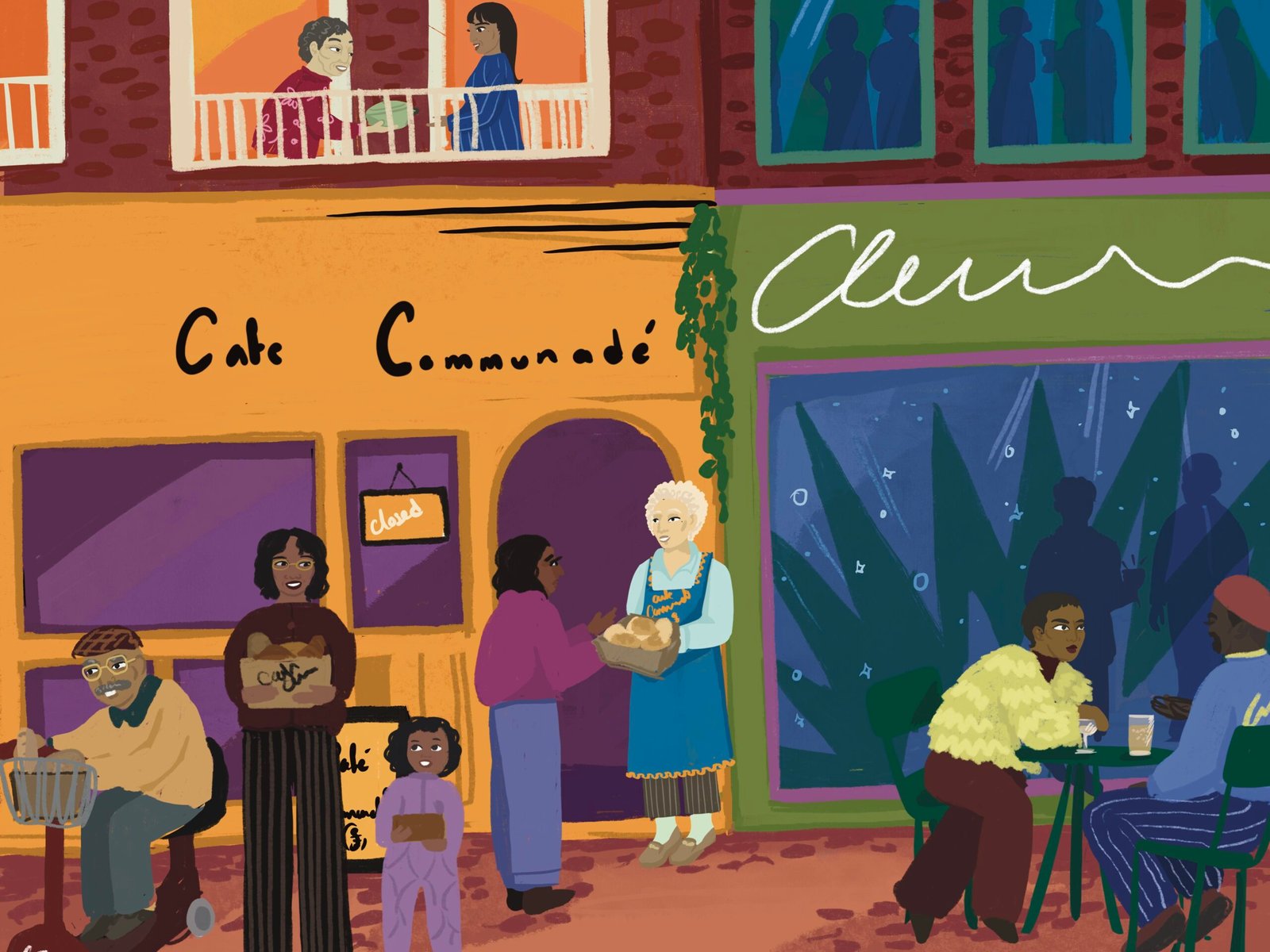

To me, community has always been material, the warmth and comfort of my grandma’s house, the laughter that echoed from my friend’s bedrooms, the knowing smile of a neighbour, local shopkeeper, or family friend. Community is my local sports centre, post office, and school – tangible spaces upon which many of us depend.
Rebellious, subversive, and disruptive cultural spaces like bookshops, nightclubs, and art venues have often served as facilitators of solidarity and mutual aid, and many continue to do so today. A personal favourite is Finsbury Park’s New Beacon Books, a Black-owned bookstore showcasing the work of Black and global majority authors, whilst hosting community-led events that aim to cultivate creative networks for Black Londoners.
However, London’s new wave of culinary and cultural venues seems less concerned with resistance, struggle, and battle, and more concerned with building spaces to reassert their cultural capital, meet similarly intentioned people, and show off a cute fit.
You’re not building community, you’re building a following
The idea of a homogeneous community has always been a misnomer. None of us is singular in our identities; we are reflections of a series of fluid representations.
Taking myself as an example, I am both British and African, of mixed ethnic origin, and yet proudly Black, queer, and a Londoner, and the product of discovered identities and future selfhoods.
I believe it’s truer to say that, rather than ‘belonging’ to singular communities, we are all in a state of flux, existing both within and outside the communities which we hold meaning to.
Increasingly, community is used as a descriptor for a space in which like-minded people are free to explore their likeness, reinforce the characteristics they believe make them likeable, and then feel a bit better about liking themselves so much – all under the guise of raising “solidarity.” Run clubs, a phenomenon that has swept London over the past years, are a particularly noticeable example of this. Admittedly, they’re not without benefit; running clubs can support the physical and mental health of their participants. However, a closer look at their social composition reveals a deeper self-interest.
My personal observation (conducted first-hand in many a park cafe) has solidified a few core beliefs. Firstly, entrance to these clubs seem strictly dependent upon ownership of ON running shorts (prices start at £55) and a pair of Salomons – preferably in black. Secondly, you need to be able to speak “Slope-ese”, the language of those who swear by a tri-annual ski escape to the Alps, and thirdly, you need to have both the time and financial freedom to be available on a random weekday morning – usually Tuesday at 11am. Putting my satirical bitterness to one side, these barriers to entry reflect a genuine elitism and cultural peacocking that intentionally excludes others from sharing in the physical and mental benefits of collective running outlined above.
A key marker of artificial solidarity is the adoption of language typically associated with social justice. Of particular note is the adoption of sustainability aesthetics among the city’s specialty coffee venues. These coffee houses dress themselves in the language of conscious coffee, bean-to-cup production, and democratised farming techniques – all whilst barely paying their staff above the London Living Wage.
By appropriating this language, otherwise elitist cultural venues like supper clubs, run clubs, coffee houses, and nightclubs appeal to a clientele that is both well-intentioned and collectively minded, but fails to fully understand culture as a means of both reputation laundering and, conversely, genuine social change.
To navigate these spaces, it takes a particular class and aesthetic presentation that is only attainable through privilege and wealth. At many specialty coffee shops, a flat white at the lower end will set you back £4.20, with prices at more expensive venues reaching £8 a cup. Having both the ability and the will to meet these prices facilitates entry into a network of equally able people, further facilitating connections, relations, and enterprises that serve the interests of the network’s inhabitants – and insulate their shared socio-cultural and economic interests.
So when we’re told that an equitable community is unreachable – or worse, undesirable – let’s consider the fact that many are already practicing an inward kind of class solidarity. Why shouldn’t we do the same?
This piece is not written to be a critique of this search for identifiable likeness; the search for belonging is a fundamental part of the human condition. Rather, it’s a call for the dissemination of a looser identity: a no-strings-attached community in which bonds of mutual care and layered intersectionality are built on our collective humanity – and not on attachments to the artificial, divisive, and immaterial tribes to which we claim.
Progressive, promiscuous, personal communities
I am not arguing against the value of networks of support, mutual aid, and cooperation. But in an individualist neoliberal world, camaraderie tends to extend itself to those who fail to threaten our economic, social, and cultural standing. In this light, I’m calling for the adoption of a new model of community, built on more elastic ties of no-strings-attached, liberated care.
In many parts, this model is inspired by the work of The Care Collective, a radical group of thinkers who call for the centring of care and true community in domestic, economic, and public life.
In The Care Manifesto, the collective argues for ‘promiscuous care,’ an idea rooted in ideals of unbounded, unconstrained, and liberated care. In this sense, promiscuity does not hold the weight of indifference or nonchalance it does in a sexual context; rather, the term advocates for indiscriminate love. In short, anyone can and should care for anyone.
Relentless fiscal austerity and the erosion of our social fabric have accelerated the normalisation of introverted care; the belief that in a world of scarce resources, care for “our own” should take priority above caring for a stranger. Daring to care, love, and support those who differ from us is inherently a rebellious act, and one that is necessary for the nurturing of permanent, elastic, caring bonds.
Promiscuous care need not be fleeting or impersonal; often, the care of a stranger is of greater impact than that of those known to us. During the pandemic, mutual aid groups rallied to gather and distribute resources to those who were unable to care for themselves.
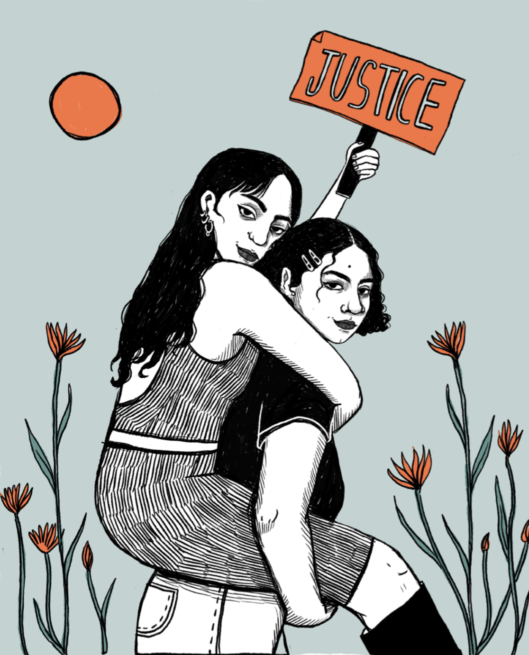
Today, our friends, neighbours, families, and strangers continue to advocate for a permanent end to the ongoing genocide in Gaza, whilst equally renewing calls for a just peace in the Congo, Sudan, and elsewhere. By advocating, fighting, and resisting for those we don’t know and often don’t see, we all engage in the embodiment of promiscuous, expansive care; to do so is a fundamental part of our collective human experience.
In encouraging promiscuous care, we must build promiscuous institutions that run in parallel. This means the cultivation of accessible, open, non-homogeneous communities. If our communities continue to solely reflect ourselves, we continually fail to see the value in care that extends beyond ourselves and our immediate others.
Join our mailing list
Sign up for shado's picks of the week! Dropping in your inbox every Friday, we share news from inside shado + out, plus job listings, event recommendations and actions ✊
Sign up for shado's picks of the week! Dropping in your inbox every Friday, we share news from inside shado + out, plus job listings, event recommendations and actions ✊
Food, fun, and freedom for all
Food For All, a food collective from London that operates globally, is one such community that embodies this spirit for promiscuous caring communities. The collective works on the basis that access to healthy, nutritional food is an inalienable human right. Of course, any commentary on the prevalence and growth of food collectives should be prefaced by the admission that these groups are filling in for the carelessness of states and governments that continually fail to prioritise the eradication of hunger.
I first became aware of Food For All through my partner’s role as a barista at a bakery close to our home. When closing, Lin, a volunteer for Food For All, would visit the bakery on a near-daily basis to collect unsold goods that could then be given out to those in need of food. Doing this on an unpaid, voluntary basis, and at great physical cost to herself, her service was the embodiment of unrestricted care, and underlines my belief that care for the stranger is care for all. “To me, food is love,” Lin tells me. “And we aim to spread love with every meal distributed.”
This mode of care is not limited to organised charity. A year ago, I completed a research project that explored the capacity of queer hedonistic spaces to serve as pools of solidarity. Set against the backdrop of a crumbling social fabric, decimated by a decade of economic austerity, and a political landscape in which marginalised identities have become political currency, I was heartened by the care, affection, and kindness shown by familiar strangers.
My research took me to club bathrooms, smoking areas, and some LONG, long queues. Time and time again, I found a commonality in these spaces. The clubs provided a space in which their participants were free to dance, love, and exist without the perceptions and preconditions of a hostile outside world. Untethered from these restrictions, clubbers were able to care without the fear of misconception; they were free to love equally – free to love promiscuously.
In collating my findings, I conducted interviews with friends and fellow club participants. “It’s all about the space,” one friend tells me. “Once you’re in, you’re in, and once you’re out, you’re out, so you’re kind of forced to share adventures, to share connections.”
They continue: “Just sharing a lighter, complimenting a look, can lead to conversations, conversations can lead to connections, and connections can lead to relationships.”
In clubs, they met friends who provided them with employment, financial support, temporary accommodation, and a network of emotional resilience. Their story illustrated the arguments made by The Care Collective in a way that made the theory of promiscuous care feel both imaginable and tangible, and reaffirmed my belief in the power of true community.
In planning this article, I reconnected with an interviewee who had participated in my research. Matt Horwood is the co-founder of Loose Change, a charitable collective that hosts cause-centred, non-profit club events. “I personally, and we as a collective, believe that we are stronger when our community is stronger together,” Matt tells me. “Many of our organisers and participants work in social justice, and we’re eager to embed that spirit in everything we do. We see part of our role as empowering people to go out and make real change. This could give participants the power to confront a problematic family member or colleague, or attend a protest for the very first time.”
Loose Change employees are both majority queer and PoC; event staff are encouraged to interact with partygoers in a way that eliminates the stereotypical customer-server dynamic present in most hospitality spaces. Equally, the events are charged at “pay as you can” rates, allowing for the widest possible participation. By removing these barriers, the collective cultivates authentic, complex connections and a community that feels intentional in its solidarity and acceptance of all – even those with only a little “loose change.”
Like any community, these spaces have their imperfections. Queer clubs are reflections of the wider society in which we all live. Despite the best intentions, power dynamics involving race, class, and gender are always played out on the dancefloor (if you’re struggling to imagine this, just picture a group of shirtless men pushing past you in the club).
The politics of space – and who owns that space – are always present, even in arenas we create for ourselves. This is not an argument against intentionally queer spaces, far from it; instead, our spaces should be overt and proud in their activism and the role they play in shaping our values, politics, and behaviours. That way, we might get a little more hugging and (maybe) a little less shoving next time we feel like going out.
Towards true community
Our communities will never be perfect. Above all, they are a reflection of us; at times, they reflect our love, our kindness, and our selflessness, and at others, they show us at our worst, our most tribalistic and inward. Structurally, the road toward greater community is a rocky one. But if we reorient ourselves in a more caring direction, we can remember that community need not be prescriptive, binary, or a way of expressing our cultural class positions.
In a time of rising nationalism, a reversal of social and political progress, and thecommodification of hate, choosing to love widely is an intentionally political act. None of us can know the shape that sincere, robust, compassionate communities will take, but this need not be a source of fear. Organisations like Loose Change and Food For All prove that we are not without alternatives; we just need to look a bit harder. We know one thing: these communities will reflect us, all of us, in our humanity, our insecurity, our confidence, and our spirit – this is at least one thing we have in common.
What can you do?
- Support the work of New Beacon Books
- Volunteer and donate to Food for All
- Support the work of The Sutton Trust
- Support the work of The Loose Change Collective
- Read The Care Manifesto to rethink our ideas and imaginations of community
- Read What is Gentrification?
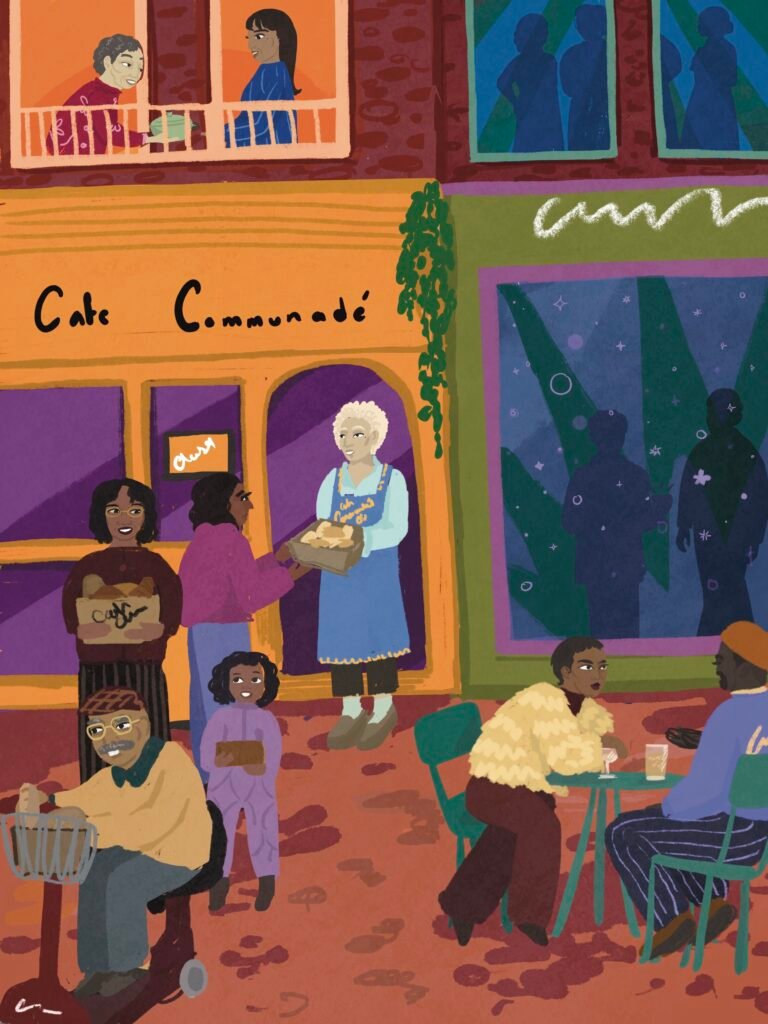 Illustration by @tinuke.illustration