

reflections
The environmental cost of Western greed in Palestine and the Democratic Republic of Congo by Svetlana Onye
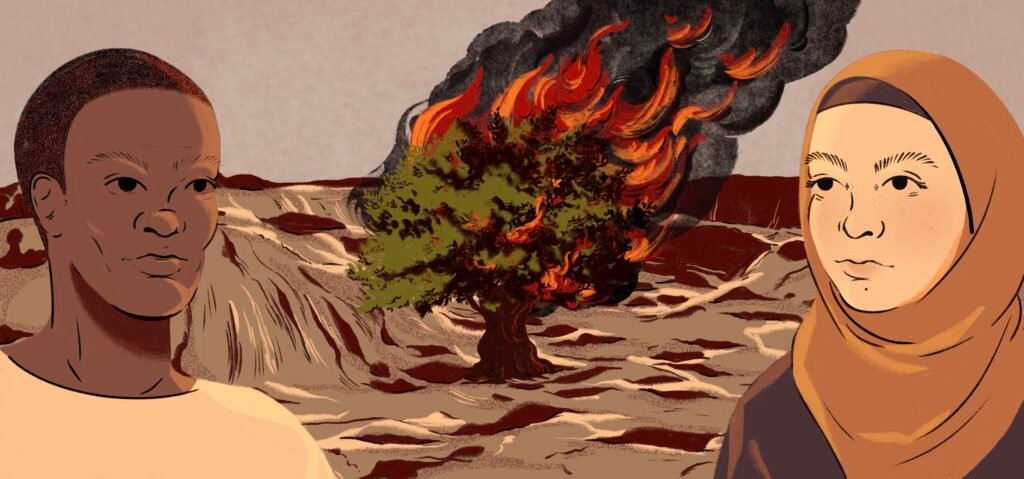 Illustration by @heedayahlockman
This week, I read an article from January 2024 which is, sadly, evergreen. Svetlana Onye writes about how Western greed and resource dominance is a core part of why states go to war.
When states extract materials from occupied land, or create global demand which fuels the mining of minerals in other countries, it harms both the native people and also the environment, as seen in both Palestine and the Democratic Republic of Congo (DRC).
These parallels go deeper than you may think.
collaborators
This piece made me think about how colonisers are actually the greatest collaborators of all. Trade requires willing partners and a shared interest – raw materials – to reap profit. That’s why multinationals exist, and those heavily invested in the extractive industries are particularly exploitative.
It’s interesting how localised or seemingly ‘contained’ conflicts in the Global South, such as civil wars, actually mask international influence. Svetlana gives the great example of the DRC – which has been embroiled in a complex armed struggle for decades. A key part of the turmoil in the central African country is armed groups like the M23 rebels competing over natural resources to control the external trade of them. As Svetlana writes: “Armed groups weaponise mines and areas rich with natural resources because these resources have international value.”
The need to sustain our expensive lifestyles has driven supposedly internal conflicts in Global South countries, which perpetuates the imbalance between the world’s rich and poor. The vast majority of people in the DRC, the most mineral/resource-rich county in Africa, reap none of the rewards of their own land. Instead they are subject to violence and environmental damage to uphold this order.
cobalt from the gate
The rechargeable lithium-ion batteries in our phones and laptops require the chemical element cobalt. Nearly 75% of the world’s cobalt is mined in the DRC, often under horrendous, dangerous conditions for ridiculously low pay, and much of the time by literal children.
As Svetlana points out, this adds another element to the Global North’s ‘green transition’ targets, as we are achieving these goals while still wholly reliant on an exploitative model of extraction from poorer countries. Indeed, the demand for cobalt has only increased as electric vehicles have exploded in popularity, since their production also requires it.
It’s not climate justice if it sustains the current structure and disparity of the system.
predatory energy
The same issue applies to Palestine – their occupied lands sit on veritable oil and gas reserves. As Svetlana describes, Israel not only controls every aspect of Palestinian life, but its waterways and land too, so it can extract and reap, extract and reap – with the help of large multinationals. Palestinians can’t exert control over their own materials. Energy Embargo for Palestine has done great work in tracking oil giant BP’s role in aiding and abetting the destruction of Gaza for the opportunity to build a pipeline on stolen land.
Bombs dropped on Palestine do untold ecological damage, as well as displacing people tied intrinsically to their own land which removes the care and sustaining of it, instead giving way to predatory resource pillaging à la the DRC.
As we in the West watch, and enable, a genocide in Gaza, the harvesting of natural resources by larger powers lives on. It is a core part of a colonial lineage. From Palestine to the DRC, natural and human devastation in the name of multinational corporations is a grim fixture. Time to fucking end it.
~ Tommy
smirk of the week 😏
 maybe doom?
offbeat optics
Japan bans ‘flashy’ baby names with new rules
“Parents in Japan will no longer have free rein over the names they give their children, after the introduction this week of new rules on the pronunciation of kanji characters,” writes The Guardian. Kanji characters are Japanese language symbols that represent an idea or thing rather than just a sound, so can be pronounced multiple ways depending on context.
Apparently, this change is meant to stop the usage of kirakira (‘shiny’ or ‘glittery’) names that have become popular with Japanese parents wanting to give their kid an edgy, non-traditional moniker. These names combine kanji characters in an unconventional way to give it this edgy aesthetic. But the Japanese authorities are having none of that.
The name police have logged on 😡. So what kind of names are they trying to stop anyway?
“Parents have been criticised for naming their children after famous characters or brands: Pikachu, of Pokémon fame, Naiki (Nike), Daiya (Diamond), Pū (as in Winnie-the-Pooh) and Kitty, after the fictional feline Kitty Chan. Others have made headlines for their supposed impudence – Ōjisama (Prince) and Akuma (Devil).”
Oh…yeah, fair. Maybe this is just future anti-bullying legislation.
…. Subscribe HERE for full free post.