
Off to the right of a main coastal road in Pembrokeshire in South West Wales is a small lane, often laden with blackberries in late summer. It is home to about 12 houses of various sizes. One of those houses belongs to my grandparents, who have lived there for over 25 years.
My grandparents’ seaside village used to have plenty of full-time residents. There were some holiday homes, but there were also familiar faces and a small community. Gradually, as residents died or moved away, many of the properties have become short-term holiday lets. Until recently, my grandparents had one next-door neighbour – a single woman in her 90s whom they helped care for. Her recent death marks another home that will very likely be turned into a holiday home.
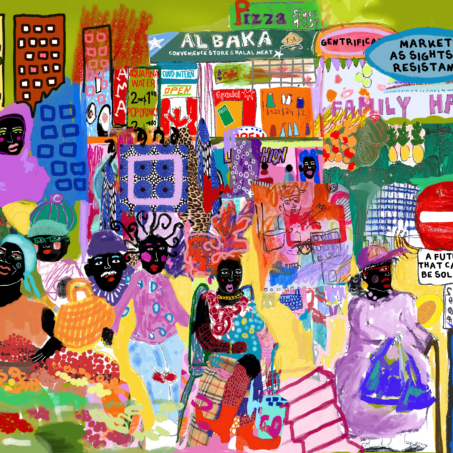
But, this is not just an issue affecting my grandparents’ village or the area where I grew up. In perhaps the most high-profile case of resistance to over-tourism, in Barcelona, residents have been protesting the rise of Airbnb and short-term lets that has exacerbated an existing housing crisis in their city and forced local people out of their homes.
Their most famous tactic has been to water gun tourists, which has brought attention to the issue. However, it’s important to note that over-tourism and the domination of companies like Airbnb on rental markets is not exclusive to urban populations and is currently having a devastating effect on communities across the world: from the Occupied West Bank to San Francisco to my hometown in Wales.
Isolating communities
When I last visited Pembrokeshire this summer, out of curiosity I looked up the area on Airbnb and found that out of the 12 properties in their village, nine were available to rent on Airbnb. That’s almost the entire village, which also includes at least one second home which is lived in for about half of the year. The house next-door to my grandparents was available to rent for £2,200 per week. If that cost was used for a residential renter, who could afford £8,800 per month?!
It breaks my heart to see the village so empty and detached. It means that in the off-season winter months (excepting the Christmas period), the village is desolate, with my grandparents largely isolated from the local community. I’m glad they are both able to drive and have access to a car, as the local bus service is limited and the ability to drive for 15-20 minutes means they have access to friends, church, and community. But when truly local support is needed, there is now very little available. I worry about the impact of the isolation, and of what will happen to the village once my grandparents and the other permanent households are no longer able to live there.
Your Airbnb used to be my home
The phrase used on Barcelonian placards is “El teu Airbnb era la meva casa” – Your Airbnb used to be my home – quite literally the case for Herbie Haggar, my former schoolmate. Herbie is from Tenby, a harbour town in South Pembrokeshire which is a popular tourist destination. I spoke to Herbie to hear more about what has happened to the housing market in Tenby and how Airbnbs are affecting life for people in Pembrokeshire.
While conducting a research project about second homes and holiday lets in Pembrokeshire, Herbie found his childhood home listed on Airbnb. “It’s a terraced house where you’d expect a young family to live, not somewhere you’d expect to be a holiday let,” he tells me. “It’s upsetting that it’s not going to be someone else’s childhood home.”
My childhood home, about a 20-minute drive away from Tenby, is still a residential property (still owned by the people who bought it from my parents when we moved to England 11 years ago) but with another quick search on Airbnb I found the house directly opposite available to rent. This made me feel a little nauseous, so I can’t imagine what Herbie felt seeing his childhood home on there, gutted out for tourists.
Herbie’s parents moved around the corner and only seven out of the 28 properties on the street they currently live in are occupied all year round – the rest are Airbnbs and second homes. “We used to play on the street as kids,” Herbie reminisces, “but you don’t see that anymore. The streets have become so empty it’s taken away the community of our town.”
Streets becoming empty, or neighbours disappearing, as has already happened to my grandparents, is a sign of society that is failing its people. My neighbours were a big part of my childhood. I lived on a main road, so it wasn’t safe for us as children to play on the street like Herbie, but we knew pretty much everyone by name. Families shared lifts to and from school or childcare and supported each other if needed, adults looked out for an elderly resident who lived alone and developed dementia. It wasn’t perfect by any means but there was a community who supported each other, and those are currently at risk or already destroyed by Airbnb, second homes and other holiday lets.
Tackling over-tourism
Pembrokeshire has always been a prominent holiday destination. A county where three out of its four sides are coast is always going to attract visitors. That’s always been a part of living in Pembrokeshire. Locals avoid places like Tenby in the summer, and in September it’s a haven for adults on walking holidays. Tourism is a key part of the Pembrokeshire economy, and no one is trying to stop that from happening – it’s when tourism starts harming local people that it becomes a problem.
“It’s basically gentrification,” Herbie says. “The necessity of housing has been turned into assets to make already wealthy people wealthier.” He tells me how the prices in the pub he used to work in have at least doubled if not tripled in the six years since he worked there, increasing more than has been happening across the UK: “Most of the pubs have become expensive restaurants; locals can’t afford to eat there anymore and they become empty when the school holidays are over.”
But, the biggest impact of over-tourism in Pembrokeshire is its influence on the housing crisis. As I write this there are about 500 entire-home Tenby properties available on Airbnb, and seven properties I could find to rent residentially, the prices of which made my eyes water.
It’s no wonder people are struggling to find places to live. “The only way many people can live in Tenby now is through inheritance,” Herbie laments. “People who have lived here all their lives are being forced out because they can’t afford it anymore.”
This has a ripple effect on the nearby towns and villages, where, according to Herbie, people have moved from Tenby. Demand for housing increases in Tenby which then leads to higher demand elsewhere in the county in a cruel cycle. As more properties become short-term lets and second homes, people are less likely to have somewhere to live.
“I saw something online that really describes it for me,” Herbie says, “that housing should be like good table manners: nobody gets seconds until everyone has eaten.” This analogy is applicable to much in an unequal society like ours with billionaire CEOs whose workers have to use food banks. To me, those who own multiple properties while others are homeless are the epitome of capitalist greed.
A frequent defence of over-tourism often touted by landlords is that it ‘brings in more money to the local economy’ – which to some extent is true. However, Herbie questions whether that is true when short-term lets dominate the market.
“People coming in and spending a lot of money for one week in hospitality, attractions and retail during the summer months won’t make the same impact as people living in a town all year round spending their money in a range of places such as pet shops, local grocers, electricians, using services like libraries and leisure centres,” he explains. “If you’re on holiday here and you bring your dog, you will just bring what you need with you rather than supporting the local pet shop. A permanent community creates a more stable local economy than a town full of temporary visitors.”
Another tool for cultural erasure
In her diaries, which were collated and published by one of my relatives, Vera Morgan, my great-grandfather’s cousin, who was born and lived in Pembrokeshire throughout her life, discusses how in her lifetime the town’s cargo ships, fishing boats, small local industry (such as woollen mills, flour mills and women gathering seaweed to make into laverbread) and guest houses gradually disappeared and in their place came “summer houses galore, a caravan site and camping sites.”
Join our mailing list
Sign up for shado's picks of the week! Dropping in your inbox every Friday, we share news from inside shado + out, plus job listings, event recommendations and actions ✊
Sign up for shado's picks of the week! Dropping in your inbox every Friday, we share news from inside shado + out, plus job listings, event recommendations and actions ✊
Vera writes about the sadness she felt as more and more houses were being bought by English people who would then Anglicise the properties’ names – a clear case study of cultural erasure coming as part of a long history of cultural repression.
Vera mentions the Llyfrau Gleision, or the Blue Books – an 1847 British government report which concluded that the Welsh language was barbaric and Welsh speakers could be saved through learning English. She also writes about the Welsh Not – a Victorian practice in which school children were beaten for speaking Welsh, which was experienced by her father. To me, there’s no way to disentangle the wealthy urban takeover of rural Welsh properties from this history.
In the same way the Blue Books and Welsh Not worked to divide Welsh working-class communities and their culture, so too does the dominance of Airbnb and over-tourism work to split those very same communities and increase the already significant wealth gap present in Wales. When I first read Vera’s words, written in the late 1990s, I couldn’t help but consider what she would think of the state of the Welsh (particularly coastal) housing market today.
Potential solutions and government action
The issue of short-term lets and second homes is high on the agenda of Welsh policy makers. Over recent years, the Welsh Government has put more policies in place to tackle this issue, but the problem persists.
In April 2023, they increased the maximum council tax premiums for second homes and long-term empty properties increased by 300% with local authorities having access to additional funding from this. At the same time new regulations were put in place that meant that self-catering accommodation (i.e. short-term lets) had to be available to rent for at least 252 days of the year and actually let for at least 182 days to qualify for business rates instead of council tax – an increase from a previous 140 days available and 70 days actually let in the year previously. Changes to these requirements are currently under consultation.
In early October, the Welsh Government announced a draft tourism regulation bill known as a draft ‘Airbnb law’. This new bill would “give ministers a formal duty to balance the promotion of tourism with the social and environmental impacts” – a definitive acknowledgement that people and planet should not be overlooked for the sake of profit.
When potential policy solutions are discussed at government level, there seems to be a focus on individual landlords rather than regulating conglomerates like Airbnb that facilitate so much of this over-tourism. Airbnb portrays itself as an open platform where anyone can be a ‘host’, and thus they remove any responsibility it has to the residents of the area and the social and political consequences of these listings. But sites like Airbnb are not neutral entities.
Despite boycotts and widespread criticism, Airbnb still allows properties in the Occupied West Bank to be listed on their site, therefore actively contributing to the settler colonial Zionist project and the genocide of Palestinians. Airbnb could ban listings of properties in occupied Palestine but refuse and take the profits of apartheid anyway.
Although it may have started out as a way for people to rent out their spare rooms for a night or two to get some extra cash, Airbnb has now become the settler colonial poster child. The dominance of Airbnb in places like the West Bank and in Pembrokeshire are linked – they are both the results of when profit is prioritised over people and when necessities like housing become commodities.
Travelling without Airbnb
We don’t want to stop tourism entirely, but we need more homes available for people who want to live where they grew up. As well as policy change, we also need to change societal attitudes towards tourism and property ownership. Housing shouldn’t be a commodity.
It can be difficult to think of ways that we can make a difference in this area. I used to use Airbnb and am completely aware of my hypocrisy in previously doing so, but since finding out about the companies’ operations in the Occupied West Bank I have boycotted it. I understand the attraction of using an Airbnb and renting an apartment for your holiday, but if you want to go on holiday consider using a locally run hotel, hostel, or holiday cottage. Go camping or hire a local caravan.
Most importantly, be considerate about your holidays. Do your best to become a sustainable traveller. If you’re able to go on holiday outside of the main holiday seasons, please do! You’ll bring in money to the area during a quieter period but probably also get to experience the area in a calmer state.
Travel existed before Airbnb, and will continue after it has gone. It is possible to enjoy the world and how wonderful our land is without harming the communities who live in those places. So, let’s reimagine the tourism industry as one that supports our communities to prosper rather than disappear into history.
What can you do?
- Seized, settled, let: how Airbnb and Booking.com help Israelis make money from stolen Palestinian land by Zeke Hunter-Green, Carmen Aguilar García, Anna Leach, Mark Townsend, Pamela Duncan and Prina Shah
- Second homes ‘destroying’ Welsh-speaking areas, say campaigners by Steven Morris
- Wales has accommodated enough. AirBnBs and second homes are no longer welcome by Stephen Price
- Airbnb faces multi-Jurisdictional legal actions over alleged profiting from rentals in illegal Israeli settlements by AJ Dellinger
- What is Gentrification? by Simmone Ahiaku
- What is Settler Colonialism? by Makan
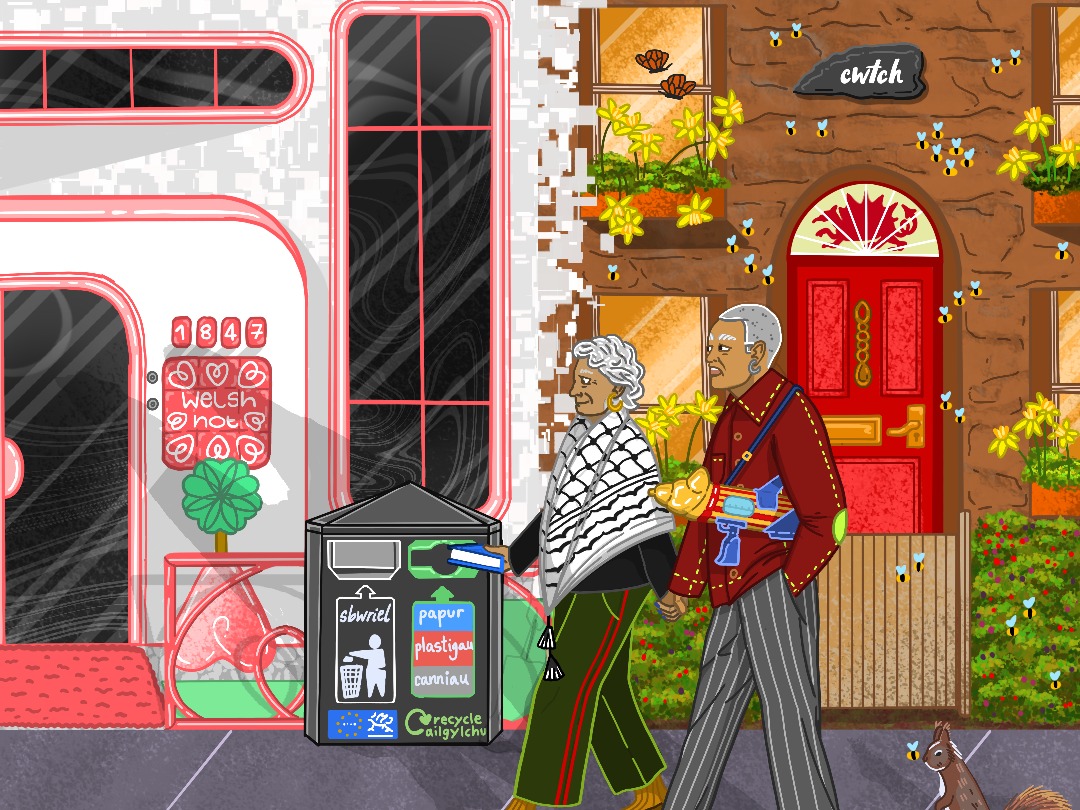
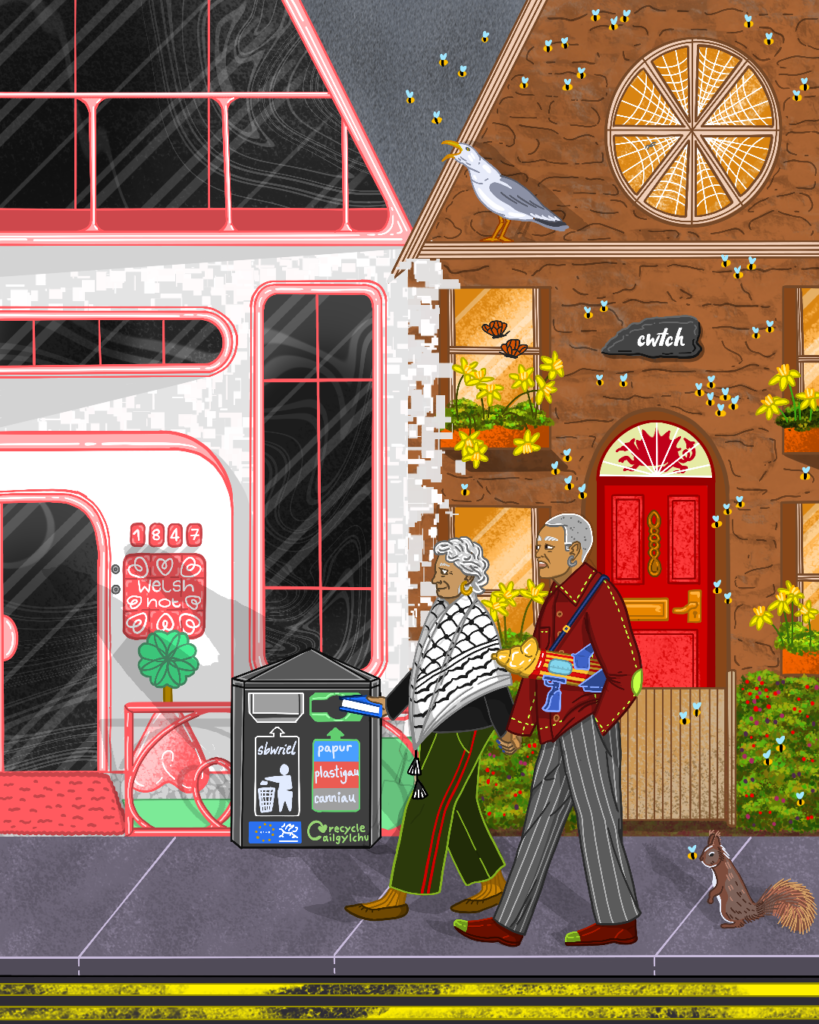 Illustration by @beth__blandford who says: “Two contrasting buildings stand next to each other in a Welsh seaside village, on the left is an Airbnb and on the right is a home. The Airbnb is made of pixels, designed to look like the app/website, with ‘squircle’ windows, brand colours, and decorative variations of the logo making up front-garden railings and plant pot designs. The home is made of stone, the lights are on and wildlife is welcome, the red door has a love spoon door knocker and a dragon stain glass window above it, it’s called Cwtch, the Welsh word for a cuddle. The Airbnb is called Welsh Not, and the house number is 1847 in direct reference to the article, and the Blue Book is being thrown in the swbriel (rubbish) by an elderly couple just outside. The couple are adorned in items referencing other places mentioned in the article: a keffiyeh for Occupied West Bank, a water gun for Barcelona. The dominance of this company is shown by the Airbnb pixelating into the Cwtch home, and the protesting of the wildlife.”