I spent 20 years telling people that I would dance in the streets the day I saw the system in Venezuela fall. But when I woke up to the picture of Nicolás Maduro in a sweatshirt, in an American plane after a military extraction, I didn’t even know what to feel. What I saw was an image stripped of catharsis: a man removed, not a system dismantled; an ending imposed rather than earned.
Part of that paralysis came from the context. On 3rd January, Caracas was bombed after months of tensions and targeted attacks in the Caribbean sea, with aircraft attacks resulting in dozens of killings (although this number is still unclear, as most numbers surrounding Venezuela are).
This was the culmination for a campaign that was difficult to understand and that was widely seen as a push to get oil. The reality and the perception of US presence in the Caribbean is more complex, however, especially for Venezuelans on the ground and in the diaspora. Yet the facts remain that the US military put together a military operation to extract none other than the main leader of Venezuela’s chavista government to face charges for drug trafficking. It was not a clean break but the acceleration of something already fractured.
I have spent more than two decades living, documenting, and annotating Venezuela’s unravelling, first from within, later from the outside. But, distance does not always dilute fear when the reach of the conflict is so large. Families depend on each other across borders; money, worry, and silence circulate constantly.
For many Venezuelans, the country is carried in fragments: in calls that don’t go through, in mind-boggling strategies to send money and medicine, in messages sent carefully, in the knowledge that speaking too clearly can cost someone else dearly.
This should have happened differently. We know, we tried.
While I found it hard to celebrate, it was just as hard to simply repost warnings about the dangerous precedents this operation sets. Not because those precedents aren’t real, but because every sentence seemed to require a disclaimer and leave out way too much. Every reaction had to be exhaustingly padded, clarified, preemptively defended.
This exhaustion is not abstract. It is shaped by years speaking to groups that don’t mind believing propaganda because it’s telling a good story. It is also the experience of living inside an information environment deliberately damaged: communications platforms degraded on purpose, vast deserts of reliable information, the constant awareness that a call, a message, an opinion can carry consequences – prison, torture, or worse. For those of us outside the country, nights are spent with our noses pressed to our phones, waiting for proof of life from family members. Sometimes we don’t fully understand what is happening ourselves. We are asked to explain in real time a reality designed to be opaque.
One of the most persistent violences in these conversations is the assumption of choice. This situation is often presented as if it were the result of a decision we, as Venezuelans, made – or failed to make correctly – as if we had endless options. We haven’t been able to choose who represents us formally, nor have we been able to choose most of our allies. We didn’t choose this US operation either; in fact, friends and family in Caracas tell me it’s sad and shameful that it had to come to this to open the door to regime change. The few democratic choices that were left meant extraordinary danger, and still they were taken.
Last year proved that. Venezuelans have always bet on democracy, even within a broken system. Even under conditions that were neither free nor fair, even knowing the election would be stolen, people still went out to vote. Despite intimidation, disinformation and threats. Seeing people queue for hours under those conditions was massive. It spoke of desperation and also determination. That effort is often erased in favour of abstract debates about sovereignty, as if context were optional, and as if participation under threat did not count as political agency.
There was condemnation but when it came to resolutions, things were different: the Organization of American States, for example, rejected in late July 2024 a resolution calling on Maduro’s government to provide transparency regarding the results of Sunday’s elections, with 17 votes in favour, none against, and 11 abstentions.
What makes this erasure harder to bear is how quickly responsibility has been displaced. Everyone in my circles knows what Donald Trump represents. No one around us believes in fairytales; those scandalised by the operation are right to think of it as a new chapter of imperialism.
In these discussions Venezuelans are often warned about the costs of this, as if we didn’t know, or had not felt the impacts of imperialism before, just not this particular brand. Not to mention the incredible plot twists that keep popping as days go by and that indicate how this intervention was quite probably negotiated by Maduro’s own people. The non aligned, leftist, anti-American government that keeps so many around the world constantly defending their rebellious nature are those shaking hands with CIA agents – and working hand in hand with not just any American government, but Trump’s.
This is what it means to live inside a crisis without end: constant, costly explanation under conditions where listening is fragile and attention rarely lasts long enough to hold complexity. And with every chapter of the crisis, the explaining has to start over, with constant pushbacks based on abstract terms, with victims completely out of the picture.
Facts, precedents, and a country purposefully turned opaque
Any attempt to understand what is happening now collapses if it treats this moment as an isolated rupture caused by one set of actors.
Venezuela was not a space free of foreign influence until this operation. That idea is simply not true, and it starts with Cuban presence among intelligence and repressive groups in exchange of, among other things, oil.
The presence of the Russian military is also well known, and there has been documented presence of the Wagner Group in Venezuela. Venezuela owes Chinese creditors around 20 billion dollars in loans, and Iran provides technological support that has translated in the use of drones during demonstrations in 2024.
These are only a few examples of a far wider net of influence and dependency. Not all interventions or influences look like an army crossing a border. Venezuela constantly challenges analytical templates. This complicates the claim that this crisis suddenly crossed a red line that had never been crossed before in any other way, and that matters, because the language of sovereignty and non-intervention is being deployed as if it were neutral, when in practice it has been selectively activated.
Concerns about foreign interference, colonial logics, and geopolitical abuse are real, and they’re happening. But they are also being weaponised to erase other forms of intervention, other ruptures of legality, and the people who have lived with their consequences for decades.
30 million lives can’t be reduced, again and again, to a footnote.
Inside Venezuela, the damage has never been episodic. It has been cumulative and systemic. Torture is not confined to detention centres, its effects radiate outward. Families reorganise their entire existence around survival. Having a detained loved one means navigating a maze of prisons, denial, and extortion, something that permeates the daily lives of most Venezuelans inside the country, and quite often also the lives of those abroad. One issue opens five others. Like Russian dolls, endlessly nested.
Join our mailing list
Sign up for shado's picks of the week! Dropping in your inbox every Friday, we share news from inside shado + out, plus job listings, event recommendations and actions ✊
Sign up for shado's picks of the week! Dropping in your inbox every Friday, we share news from inside shado + out, plus job listings, event recommendations and actions ✊
This is also a country that has been deliberately converted into a country without data. Independent organisations have been criminalised, forced to exile or work underground under extraordinary risk. They’re documenting patterns of abuse when the curtain of disinformation is thick, intentional and long-standing. Some numbers exist, but they always cast a wider shadow behind them. Even the figure of roughly one thousand political prisoners requires unpacking, not because it exaggerates harm, but because terror itself produces silence.
Journalist and human rights defender Luis Carlos Díaz explains how these people have not been put behind bars and torture centres by just “the government.” The reality and its logic is a lot more complicated. A significant number of actors within the government and its authorities have their own political prisoners. Among detainees and those who have been released, it is common to hear questions like: “Who was your jailer?” “Who were you imprisoned by?” The number of officials who effectively hold licenses to imprison and extort civilians, military personnel, and foreigners would be surprising, Díaz says.
None of this justifies violent interventions. In this case, however, it helps us situate these recent events within a longer history of institutional collapse, abandoned justice, and power vacuums that have already been exploited by multiple actors, across ideological lines.
Ignoring those precedents does not defend international law, it weakens it further. Venezuelan civil society organisation CEPAZ is calling our attention to take this into account when proceeding to what comes next: The international community has one last major opportunity in Venezuela to mitigate the crisis that its own ineffectiveness helped create.
Indignation without acknowledging victims is baseless
What has been most disorienting in the aftermath is not disagreement about international law, but the way indignation is being organised. Once again, Venezuelans find themselves addressed as an abstract case rather than as people, seeing outrage and protests about them, without them. The language of anti-imperialism is invoked with urgency, yet it leaves the victims of a dictatorship outside the frame.
There is a form of imperialism in this too. Not the movement of troops, but the imposition of narratives so rigid that lived experience becomes inconvenient. I have watched writers, journalists, and thinkers I respect, people who have taught me how to read power critically, reduce Venezuela to a punchline, a prop, or a cautionary tale deployed at speed. Being incisive, funny, or fast in response to Trump seems to matter more than accuracy or care. Real numbers matter little, expanding voices well connected to the government seem like a good, objective choice. Opposition figures are mocked for their imperfections, as if bravery under threat were required to be flawless to count.
This is deeply alienating for the people in the front row of the complex humanitarian crisis. We are told there are “no buts” when it comes to invasions or wars — and can’t but I agree. There are no buts. I do wonder why, however, that moral clarity evaporates when the subject turns to this dictatorship. Suddenly, there are many buts. But geopolitics… But sovereignty…
No change in sight
As all of this unfolds, the Venezuelan regime loses one of its five heads and weakens the rest, but not yet enough to see a change in the system. There are charges still open in the International Criminal Court for crimes against humanity. Promises of “releasing” (not freeing) political prisoners have resulted in very little.
At the time of writing, around 100 people (according to Foro Penal, and out of almost 1000, a number that is also unclear due to government’s deliberate opacity) have been released while families continue to wait at the gates of these notorious prisons only to get confusing information, if any. The numbers are always indicative and not exact. Some optimistic analysis point at a start of a transition, which could be not done without the presence of chavismo; and while that certainly makes sense, the reckless and bombastic declarations of Trump and his administration are not suggesting democracy is in their plans. We’re still forced to project and analyse based on reports of actors who are erratic, disconnected and who lie on a daily basis.
The right to complexity matters here. International law is being instrumentalised in this debate as surely as it has been violated. The danger of precedent in terms of military interventions is real, as it is the precedent of having a government dismantle institutions, justice, and legality, protected by the cloak of sovereignty.
It has been naive of many people in high income democracies to fear that an intervention like Venezuela’s could happen to them, but not the dismantling of institutions that preceded it. Those are also dangerous precedents. Authoritarians love to share notes, and they listen to each other, unlike the people they crush. Those precedents have been quietly accumulating for years, along with their victims.
Dialogues collapse at precisely this point. When sovereignty is invoked without acknowledging stolen elections, political prisoners, terrorised communities, years of humanitarian crisis, an exodus of a third of the country spilling around the region and a society hollowed out, the message received is not principled restraint. It is “we care about what may happen to us, not what has happened to you.” What this asymmetry in outrage communicates is simple: we, Venezuelans, do not matter in this.
What can you do?
English speaking resources
- Caracas Chronicles (These analysts are devoted to explain Venezuela and its crises to people abroad)
- Conversation with other researchers and activists (I participated)
- Register for this upcoming conversation with researchers: What is Happening in Venezuela? (with translation)
Follow Venezuelan media (in Spanish. Automatic translation can work well)
- Efecto Cocuyo: Efecto Cocuyo
- Armando info: Armando.info
- Espacio Público: Espacio Público
- Ipys Venezuela: IPYS Venezuela
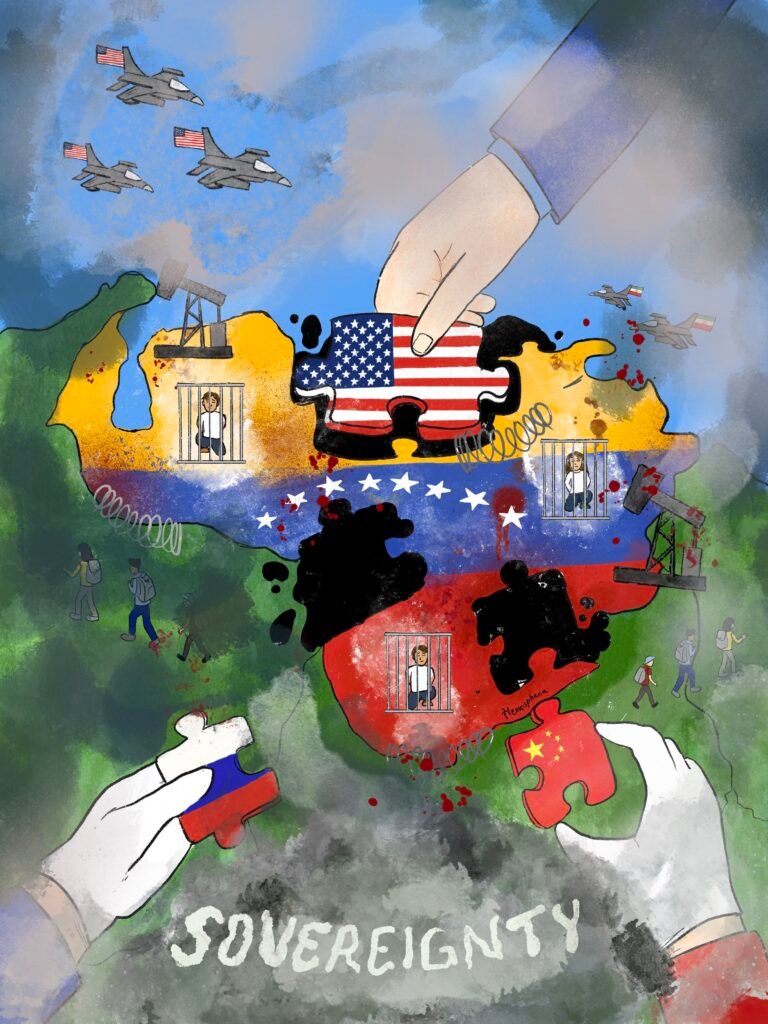 Illustration by @hemispheria._ who says: “This illustration frames Venezuela as a contested territory where sovereignty has long been eroded. The country becomes a geopolitical puzzle, while people’s lives fuel selective outrage rather than sustained attention.”