
Something has shifted in the wake of Heated Rivalry. What began as a niche television adaptation has grown into a cultural touchstone, described by viewers as a moment for recalibration: a desire to show up more gently, to love differently and to let care guide their choices.
This is not simply a fandom, people are orienting themselves around it. Some speak about returning to creative practices, seeking out community or allowing intimacy back into their lives after long periods of withdrawal. For me, it was a confronting pull to live more passionately and freely, and to ask whether I was being as honest in my own life as the show demands of its characters.
The show’s afterlife has also been striking. Instead of staying confined to private viewing or online discourse, it has begun to surface in places where intimacy is rarely afforded room. In Canada, key songs from the series have been played at live ice hockey games, and the Empty Netters Podcast – hosted by straight former ice hockey ‘bros’ – openly unpacked each episode. These small but symbolic moments suggest how narratives of softness can enter environments historically resistant to them. In an era defined by loneliness and emotional austerity this response feels like permission to want something gentler.
Desire on equal ground
Set within the hyper-masculine world of professional ice hockey, Heated Rivalry centres two men, Shane Hollander and Ilya Rozanov, who are equal in status and social positioning.
Part of what makes Shane and Ilya’s relationship so arresting is how evenly matched they are before desire even enters the frame. They arrive in the league as rookies at the same time, rise in parallel and eventually become captains of rival teams (Shane in Montreal, Ilya in Boston). They earn the same money, command the same attention from press and fans, occupy the same tier of visibility and power. Even physically they mirror one another: similar builds, height and fitness.
That symmetry has proven key to the show’s cultural power. No one is positioned to be more accommodating or more careful and no one arrives more expendable. Because they meet on equal ground, desire can move between them without turning into leverage. Without ego or safety to manage, neither man is reduced to an object or a mirror. Beyond the show’s explicit intimacy, its erotic pull is grounded in this balance, and the safety that flows from it.
Shane and Ilya want each other without spectacle. Their desire unfolds over a 10 year span through unembellished dialogue and sustained attention: late-night texts, pre-game innuendos, the ease of conversations that stop and start across seasons of life. Longing builds through the patience of ordinary questions and ordinary answers. There is no audience within the scene and consequently, no sense of being watched or assessed. What builds between them is an intensity defined through trust and a noteworthy clarity of consent – something which, tellingly, still reads as exceptional.
Even the differences between them don’t disturb this balance. Ilya’s Russian background and the pressure exerted by his family register as weight, but not as constraint. Externally, both men move freely through the world, buffered by wealth, status and masculine legitimacy. They are protected, however precariously, from the kinds of vulnerability that might otherwise distort intimacy.
The labour love asks for
Watching Shane and Ilya together, the response I’ve seen from straight and queer women is often described as gender envy. Not envy of men themselves, but of the conditions that allow this kind of intimacy to exist: the freedom to give oneself and be changed without it feeling like loss, to truly inhabit love rather than negotiate its terms. As a queer woman in a heteronormative relationship, I’m interested in how the show’s appeal lies less in queerness as identity alone, than in the rare model of care and power it offers when gender stops deciding who will absorb discomfort so softness can continue.
There is grief beneath that envy. Not a longing to be someone else but a mourning for an even playing field that never arrives. For many women, vulnerability is earned, offered only after demonstrating resilience, patience and an ability to hold more than one’s share of the emotional weight. It lives in the choreography of the everyday: monitoring tone, managing conflict, anticipating reactions and ensuring closeness doesn’t tip into withdrawal.
What Heated Rivalry stages briefly is the absence of that labour. Between Shane and Ilya there is no inherited script asking one to diminish so the other can expand. Strength and tenderness coexist without one being traded for the other. Watching it provides a glimpse of what becomes possible when intimacy isn’t asymmetric.
Even in its most progressive forms, desire is often shaped by misogyny and expectation. Even when women love women, even when men leave the room, power does not simply dissolve. It lingers in language, in habit and in the grammar of who is allowed to remain intact.
Coded intimacy
Importantly, Heated Rivalry does not pretend this balance exists beyond Shane and Ilya’s relationship. Outside of each other, their lives remain shaped by the rigid expectations of professional ice hockey, a culture built on silence, toughness and plausible deniability. Around them, the sport offers small reminders of what is at stake. Slurs tossed casually in locker rooms. A teammate remarks on how “brave” it must be to be gay in Russia. Ilya, who the viewer knows to be bisexual, is publicly cast as a ‘ladies’ man’, afforded cover through masculinity performed loudly. There is pressure shaping how closeness can appear and demanding it be carefully coded.
Hockey already makes room for certain male intimacy. Players tell each other they love one another, share nicknames, physical affection and emotional loyalty. However, this closeness is permitted precisely because it is framed as fraternal. The intimacy that feels so rousing exists against the grain of a public world that will not yet accommodate it. They save each other’s names under aliases and retreat into surnames when first names feel too exposed. None of this is framed as shame so much as vigilance and an instinctive understanding of where the line is drawn as they negotiate constantly between who they are and what their environment will tolerate.
While Shane and Ilya’s relationship is defined by its rare equilibrium, the women of the show do the work of helping hold it together. Characters like Rose, Svetlana and Elena are written as empathetic, intelligent and deeply supportive – allies in the truest sense. They provide the emotional safety that allows the men to explore who they are and what they deserve, holding space for a love they themselves do not get to experience. It’s a familiar dynamic: women positioned as caretakers of intimacy rather than its recipients, facilitators of emotional truth rather than beneficiaries of it.
What becomes visible
Recent conversations online, like Chanté Joseph’s question of whether having a boyfriend is embarrassing now, point to a growing disillusionment with the terms under which heterosexual intimacy is still offered.
What Chanté captures is a fatigue with relationships that increasingly mirror the same hierarchies, compromises and emotional scarcity that shape the wider world. If women no longer need men in the ways they once did, what becomes intolerable is not the intimacy itself, but rather the unequal terms on which it is still offered. What viewers are responding to then, is not an escape from heterosexuality or a fantasy of queerness, but a recognition of what feels missing and perhaps, a growing question of how much love is being asked to carry.
In Love in Exile, Shon Faye offers a political framework for this unease. She argues that under capitalism, love has been increasingly privatised, forced to compensate for the erosion of collective care, welfare and community. As social infrastructure is dismantled, romantic relationships are asked to become everything at once: refuge, emotional anchor, economic buffer, source of meaning and proof of belonging.
This pressure is a result of political choices that task love with absorbing instability that once belonged to wider social structures. Under that weight, love buckles. This is what gives the show its unexpected emotional clarity. Against a world that asks intimacy to function as infrastructure, Heated Rivalry offers a version of love that has not yet been overworked by the demands of a system that has withdrawn care everywhere else.
Rather than romanticising queerness, Heated Rivalry helps diagnose the conditions that make this response so widespread. It shows what becomes briefly possible when hierarchy loosens and how quickly that possibility could collapse when institutional power reasserts itself.
Join our mailing list
Sign up for shado's picks of the week! Dropping in your inbox every Friday, we share news from inside shado + out, plus job listings, event recommendations and actions ✊
Sign up for shado's picks of the week! Dropping in your inbox every Friday, we share news from inside shado + out, plus job listings, event recommendations and actions ✊
The character of Scott Hunter makes this clear. When he comes out publicly the moment reads as romance for the viewer but is referred to as ‘bravery’ within the world of the show – a word that returns again, revealing how exceptional visibility is in traditionally guarded masculine spaces.
Fittingly, despite the show’s cultural impact, the NHL has yet to meaningfully confront its own culture of silence where only one male player (active or retired) has ever come out publicly. The intensity of the response to Heated Rivalry and the narrowness of its institutional uptake expose the gap between symbolic inclusion and structural change.
In a political moment defined by punishment, emotional restraint and the policing of masculinity, it’s telling how many people are responding to a vision of intimacy built on balance. That this vision feels so unreachable is itself an indictment of the systems we’re living under.
What can you do?
Read:
- Love in Exile by Shon Faye: a political and personal exploration of how love has been privatised under capitalism, and what it might mean to imagine care beyond romantic enclosure.
- Manorism by Yomi Sode: an intimate examination of masculinity, desire and the architectures of power that shape how we learn to love.
Watch:
- Heated Rivalry, Femme, and Queen & Slim: stories that explore how intimacy is shaped, constrained and sometimes softened by social conditions rather than personal choice.
Reflect
- If Heated Rivalry resonates, it’s worth sitting with what that response is pointing toward. Notice what’s missing with intimacy in your own life and whether that absence is personal, or political. Look for spaces where care is shared: in friendship, creative collaboration or community. The work of wanting something gentler is something we practice together.
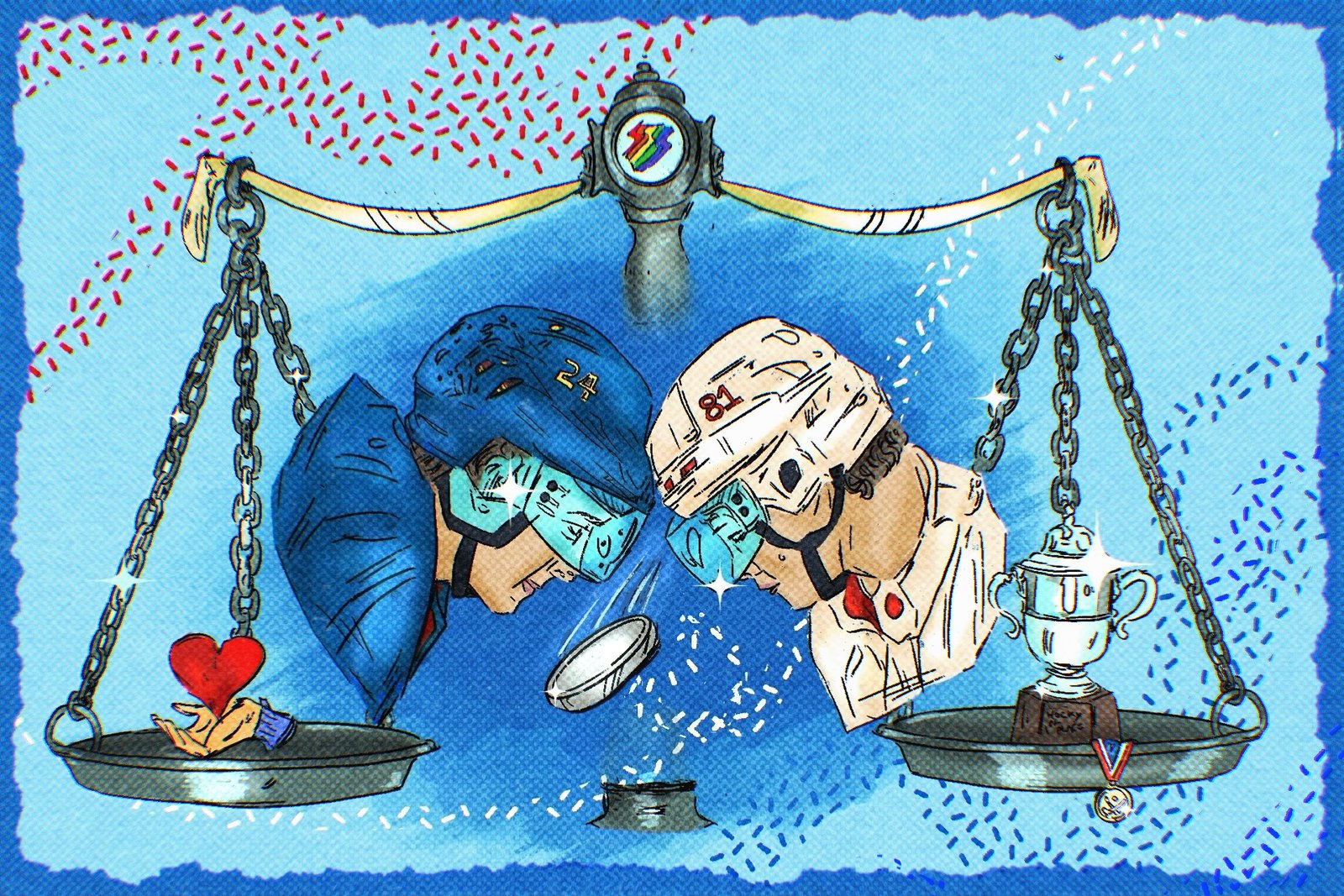
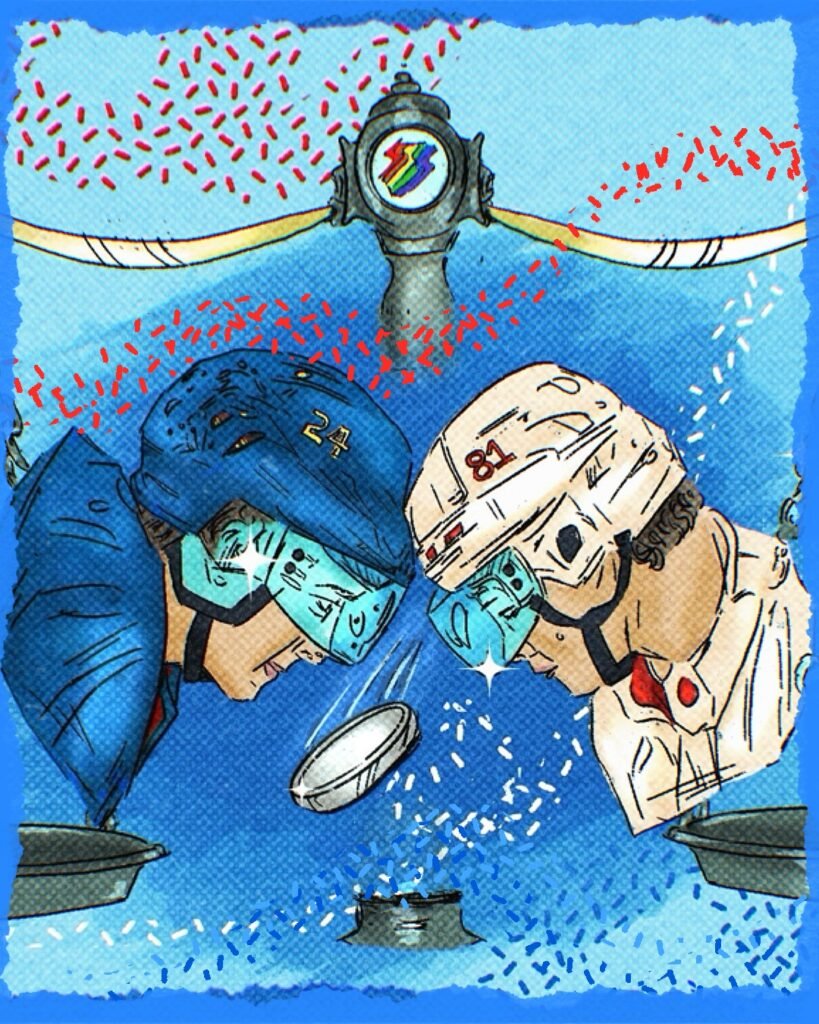 Illustration by @that.zany.martian who says: “The illustration shows how the article centres around the two queer ice hockey players, as they balance their shared vulnerability / romance with patriarchal archetypes of success & achievement.”