
“Smiling is a remedy for the brave,” read one of the pages from the worn notebook Silvana held up to the audience at Vive Latino, Mexico City’s annual music festival. The handwritten quote, from her song ‘Sabré Olvidar’, reminded us why we were there.
As Mexicans, we often forget our past. Normalising tragedy has become a civic habit, leading to the slow erosion of collective memory. From armed violence to organised crime to femicide, long-standing crises have become open wounds that, as Mexicans, we seem unable to heal from.
On Vive Latino’s stage, Silvana gave voice to struggles that had long remained in the minds of many but on the lips of few. Songs like ‘Si Me Matan’, in which she dignifies women’s fight to live free from violence – with lines such as: If they kill me, when they find me, let them always say I was a singer’ – served as acts of remembrance. And perhaps more importantly, as an attempt to confront the greater danger that lies in forgetting.
Rooted in jazz, folk, and Latin rhythms, Silvana has become one of the defining singer-songwriters of her generation. Her ability to blend tradition with the avant-garde, together with her voice, captivating as it is ethereal, infuses her music with a sense of vulnerability that reaches deep into the listener.
For us, two young Mexican writers deeply invested in social movements, Silvana’s music is more than art. It is a call to remember. A call to name Samir Flores, Marisela Escobedo, and all those who have lost their lives speaking out against injustice. In fusing the intimate with the political, Silvana’s confessional songwriting urges us to inhabit the world with honesty.
We were lucky enough to sit down with Silvana just weeks after her performance at Vive Latino. We discussed her new album, how her roots influence her songwriting, and how she aims to confront realities Mexican society often tries to forget.
The preservation of memory
Silvana’s artistry has played a key role in preserving traditional Mexican music. Her journey is a sonic manifestation of her deep connection to the land, as its essence is not merely a metaphor, but the very foundation of her musical identity.
“Roots, to me, are vast and boundless. They know no borders,” says Silvana when we meet on a sunny afternoon in Mexico City. “When I say I make music from the roots, it is because my essence is tied to the land,” she smiles, referring to the Mexican State of Veracruz, the land where she was born and raised.
Silvana’s roots were nurtured by many forces: her childhood in the countryside, the chanting of protest songs, and the folklore of son jarocho – a musical genre born of resistance, community, and the blending of Spanish, Indigenous and African heritage.
By safeguarding the integrity of tradition and passing it down from generation to generation, memories unfold in countless directions – honouring the footsteps of those who came before while carving new paths for those who will come after.
The search for identity
Silvana’s music channels the struggles that have shaped her life and the lives of many.
One of these struggles occurred during her childhood, when she endured “violence beyond comprehension” throughout Mexico’s infamous War on Drugs. Under Felipe Calderón’s presidency, Mexico launched a security strategy that mobilised both military and civilian forces to take down drug cartels. The campaign, aimed at dismantling cartel leadership, left around 35,000 people dead and unleashed a cycle of violence from which the country has yet to recover. Silvana’s rendition of Manu Chao’s ‘Clandestina’, a song protesting the criminalisation of migrants within an institutional framework that has failed to address drug trafficking, serves as a reminder that no solution can ever be lasting when human dignity is at stake.
Another pivotal moment came in adulthood, when her best friend, Jorge Tirado, was murdered in Mexico City – one of more than 30,000 homicides reported nationwide in 2022. The assassination was particularly shocking as it was committed in broad daylight, in his own home, and in one of the busiest neighbourhoods of an apparently “safe city”. Confronted with the impossibility of finding answers to questions that have no meaning, Silvana transformed her pain into something tangible. ‘How fragile must fate be, that we always choose to love?’ She asks in her new song ‘Un Rayo de Luz’. It features on her recently-released album Vendrán Suaves Lluvias, which is a tribute to the life of Jorge and a living testament to love as the only certainty we have.
Silvana has always wanted to tell stories from her roots. Places like La Culpa, where she first played her songs, live on in memory and return years later to remind us that who we are is a reflection of where we come from. Silvana’s artistry is rooted in her parents’ luthier’s cabin in Veracruz, surrounded by mountains, rivers, and endless laughter. Reflecting on the legacy that Veracruz has left on her music, she inevitably recognises nature as one of her greatest teachers. “There is innate well-being in nature, to which you hopefully become addicted,” she says. “It gives back the most basic truths, the ones most easily forgotten.”
Could it be that Silvana, too, doesn’t know the answers to universal truths, yet in seeking them she finds her way back to the simplest ones? Her narrative wraps us in the milestones of the everyday, in the quiet process that follows surviving just long enough to tell the story.
“I didn’t always want to write songs,” Silvana admits, recalling the moment she first felt compelled to compose after the passing of one of her university professors. “I wrote songs because I needed to.” Silvana redefines art as a means of preserving memory, turning loss into something that gives us purpose. Her urge to dissect emotions and turn them into art is what immediately sets her apart.
“Of course I want to connect with people and share my stories,” she says. “But at the heart of it, I just want to have fun. Isn’t that the only way to survive this world?” For many, Silvana’s music is happiness within sorrow, love within loss, presence within absence – and a reminder that, despite the world around us, we can always be brave enough to smile.
Narrative risks
Like most artists who tell stories from their roots – including Natalia Lafourcade, who has achieved global recognition by fusing Latin American folklore with modern sensibility – Silvana’s music resists the industrial trends that have dominated the last 20 years.
Both artists, in addition to being a voice of resistance in Latin American music, have become voices for women inside and outside the industry. Silvana explains that during her performance at Vive Latino, where she advocated for greater female representation in festival line-ups, she wanted to show that “although the road can be hard for us as women, it matters when you see your efforts as paving an easier path for the generations to come”. This statement takes on greater significance given the persistent gender disparities in Mexico’s music scene. Recent studies show that female representation in the lineups of major events rarely exceeds 22.7%.
According to Silvana, modern, commercial art, seduced by quick appeal, drifts away from tradition and compromises its own authenticity. “Music has been profoundly affected by this consumerist logic. Progress, as it is traditionally understood, goes against the very nature of our bodies. Even the audience’s listening process deteriorates,” she explains.
Join our mailing list
Sign up for shado's picks of the week! Dropping in your inbox every Friday, we share news from inside shado + out, plus job listings, event recommendations and actions ✊
Sign up for shado's picks of the week! Dropping in your inbox every Friday, we share news from inside shado + out, plus job listings, event recommendations and actions ✊
Silvana believes that the new synthetic identity, brought about by musical consumerism, is not only more massive, accelerated, harmful, inorganic, and individualistic — it also obliterates the natural cycle of creative processes. The latter has imposed unbearable pressure on artists, demanding immediacy without regard for the organic timelines of artistic conception. “The industrialisation of music has created a demand for creative processes to be hyper-fast and hyper-instantaneous. It overlooks the very essence of who we are as humans,” she adds.
Silvana’s argument is supported by other artists. A recent Chilean study found that 66.5% of musicians believe streaming platforms have altered their content publishing habits. Algorithms favour constant output to maintain visibility and audience engagement, creating a climate of pressure that often sacrifices creativity.
In contrast, Silvana stands as a standard-bearer against the commodification of music, urging us to reflect: are we truly aware of the significance of artists like her, whose music extends from the very fabric of our cultural heritage?
When there is no place left to return to, Silvana’s music becomes a home in itself. It is the home of the migrant, of the feminist, of the land defender, of the dreamer. But—will we be a home for her? To this, she gives a simple: “yes.” And that, perhaps, is the ultimate purpose of art: to create homes vast enough for everyone to belong.
Long live Silvana Estrada and the roads that lead home.
What can you do?
-
-
- Watch Silvana’s Tiny Desk (Home) Concert and experience the nuances of her music, paired with the roots of Mexican folklore.
- Immerse yourself in Silvana Estrada’s latest work Vendrán Suaves Lluvias, and discover how preserving memory through art can turn pain into purpose.
- Listen to Silvana’s song ‘Si Me Matan’, where she raises her voice in protest to Mexico’s escalating femicide crisis.
- Deepen your knowledge of Mexico’s infamous War on Drugs by reading José Luis Pardo’s article “A Decade of Failure in the War on Drugs”.
- Listen to the podcast episode “El Sonido Podcast – Silvana Estrada: La nueva raíz“, that explores how music should embrace rather than divide, reinforcing the idea of art as a space without borders.
- Watch the award-winning documentary What Happened, Miss Simone? and attest how artists in activist communities are pushing for revolution.
- Read more from shado’s HEAR section
-
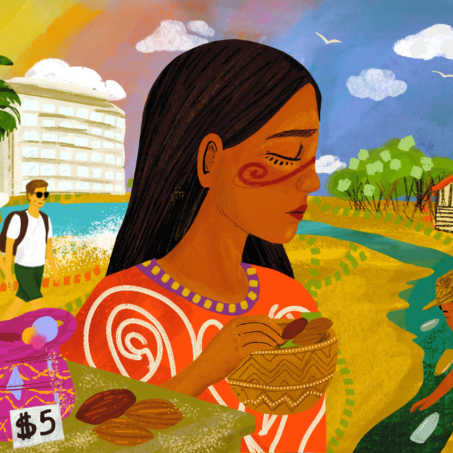
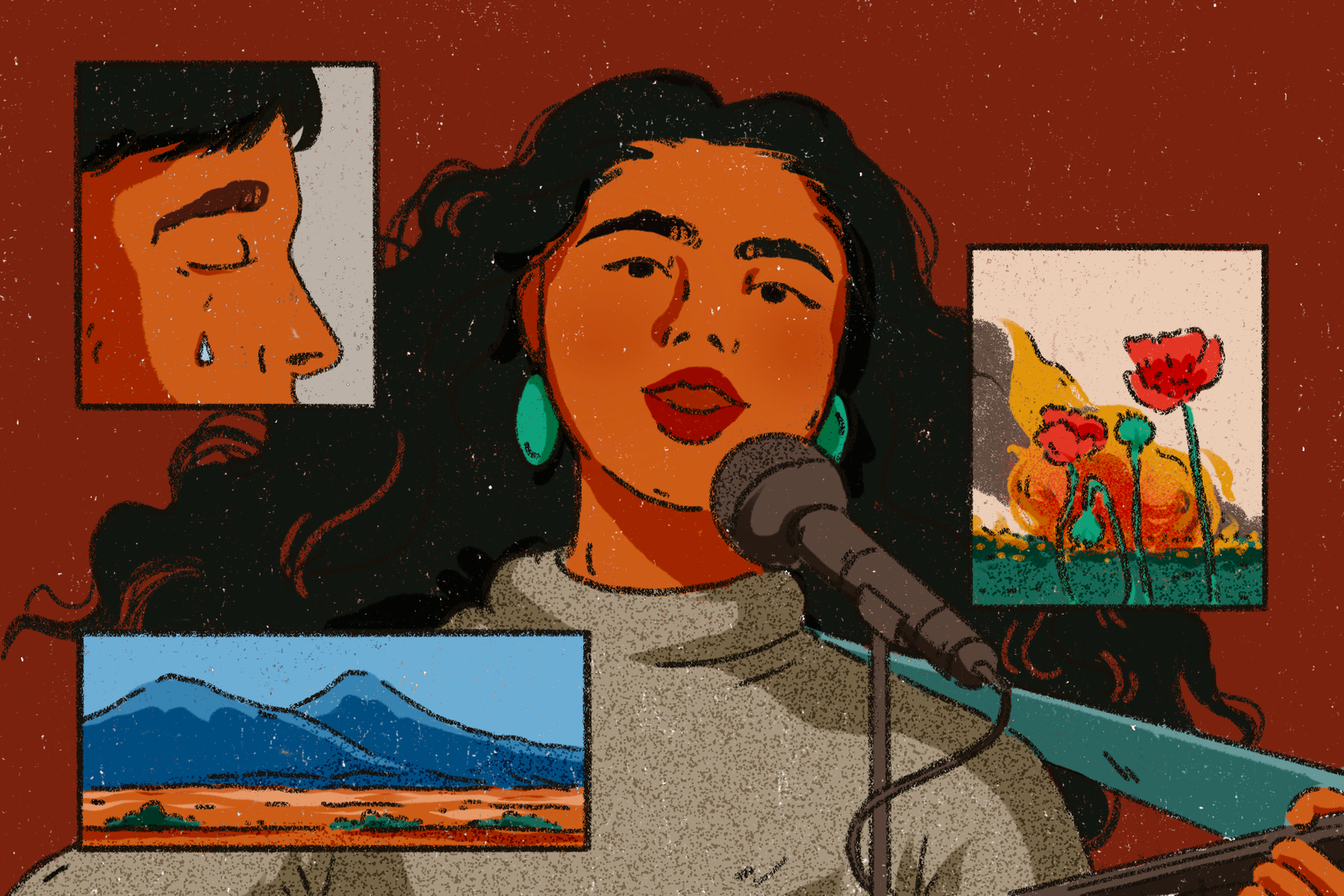
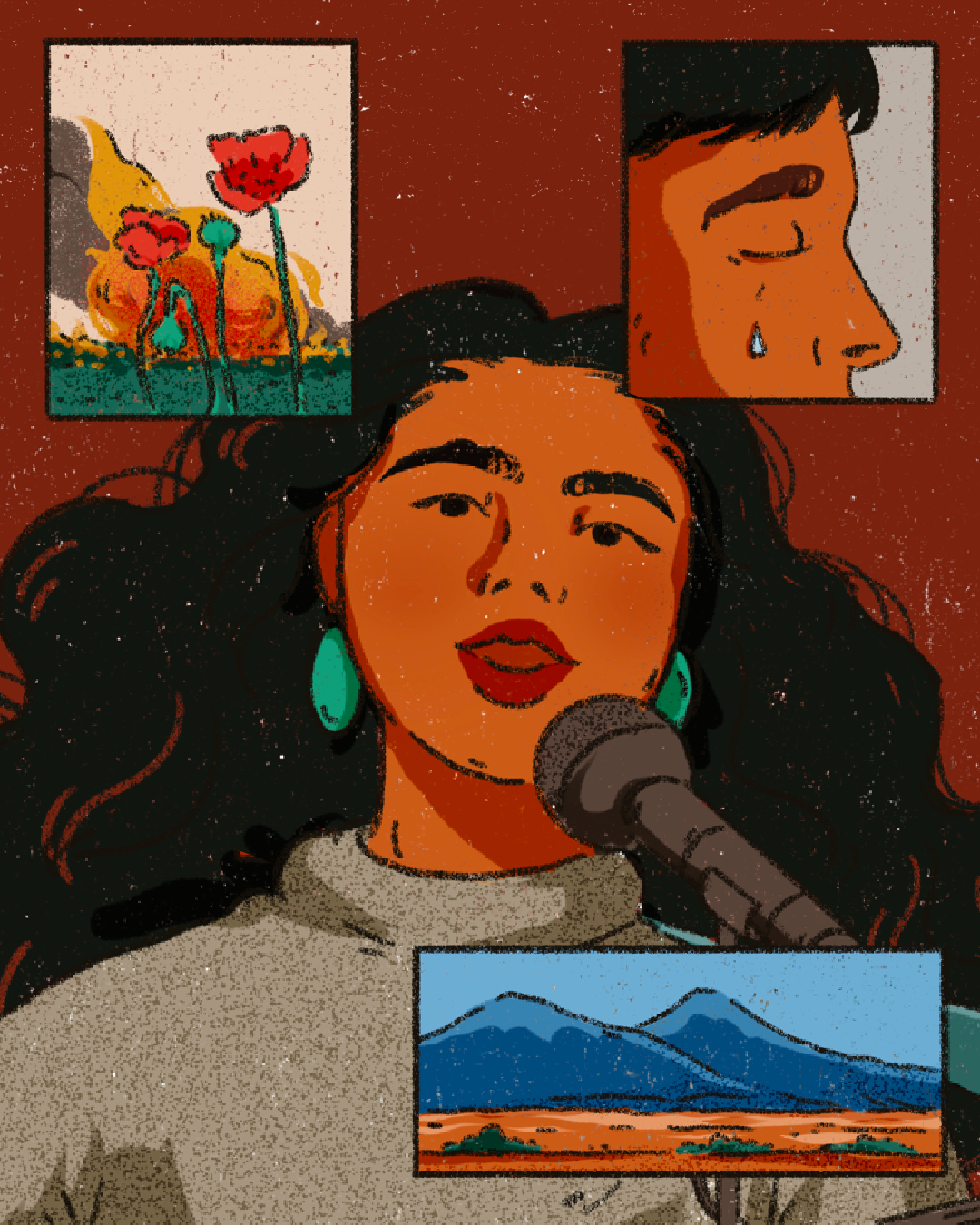 Illustration by Heedayah Lockman who says, “This illustration captures Mexican singer-songwriter Silvana Estrada channelling her powerful music. It surrounds her with panels that reflect her core narratives: the pain of personal loss, the enduring beauty of her Veracruz roots, and the harsh realities of Mexico’s social crises. A voice for her generation, Estrada fuses the intimate with the political, turning loss into purpose and using her art as a fierce call to remember.”